The South Bank Show: Talking Heads

talkingheads.jpg

Like many UK arts documentaries, The South Bank Show seldom repeated its films so you had to watch them when they were broadcast or you might never see them at all. This Talking Heads feature from 1979 is one that I missed, a great portrait of the band shortly after the release of their third album, Fear Of Music. Shots of the group performing songs from the first three albums are intercut with interviews and montages of American TV. You also get to see a very young-looking David Byrne writing (or attempting to write) some lyrics. The most revelatory aspect of the film now is the discussion of the ordinariness of both the band and their lyrics. In 1979 being resolutely mundane had become a radical position.

Weekend links 294

napoleon.jpg

Painting by Alex Tavoularis.

• There are silent films, and then there is Abel Gance’s Napoleon (1927), a five-and-a-half hour historical drama following the emperor’s life from boyhood to the invasion of Italy. The word “epic” is overused but Gance’s film demands the description: in addition to the recreation of huge battles and scenes from the French Revolution, cinema screening required three projectors for sequences which are either multi-screen or three times the width of the Academy ratio. The film was revived in the early 1980s after an extensive restoration by Kevin Brownlow, but Napoleon is still more talked about than seen so news of a forthcoming digital release by the BFI is very welcome indeed. The poster above is from this collection which includes more information about the film and its troubled history. Related: a trailer for a 2012 screening at the San Francisco Silent Film Festival.

• “His films broke with traditional production methods, having virtually no shooting script and capturing the freshness of their genesis.” RIP Jacques Rivette. In 1998 Frédéric Bonnaud talked to Rivette about the director’s cinematic likes and dislikes. Elsewhere, Jonathan Romney speculates that Rivette’s Céline and Julie Go Boating (1974) “might be the only film in which the story is dreamed by a passing cat”.

Strange Flowers‘ selects 16 books for (what’s left of) 2016. Stand-out for me is Aubrey Beardsley: A Catalogue Raisonné by Linda Gertner Zatlin which will be published in May. Two cased volumes, a total of 1104 pages, and a price tag of $300.

It’s a powerful trope, but it also risks trading one stigma for another: ‘‘Phobia’’ is now so embedded in our language that it’s easy to forget that it is a metaphor comparing bigots to the mentally ill. The comparison also has the effect of excusing those Americans—like certain presidential candidates in the 2016 race—who wield prejudices strategically. It’s not your fault if you get sick. But hating people is a choice.

Amanda Hess on how “-phobic” became a weapon in the identity wars

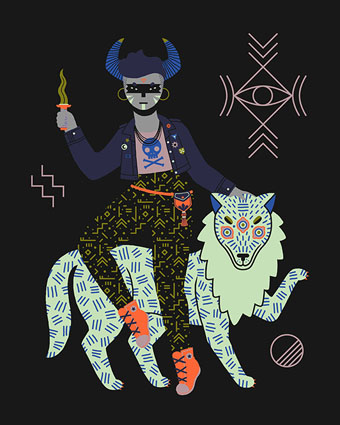
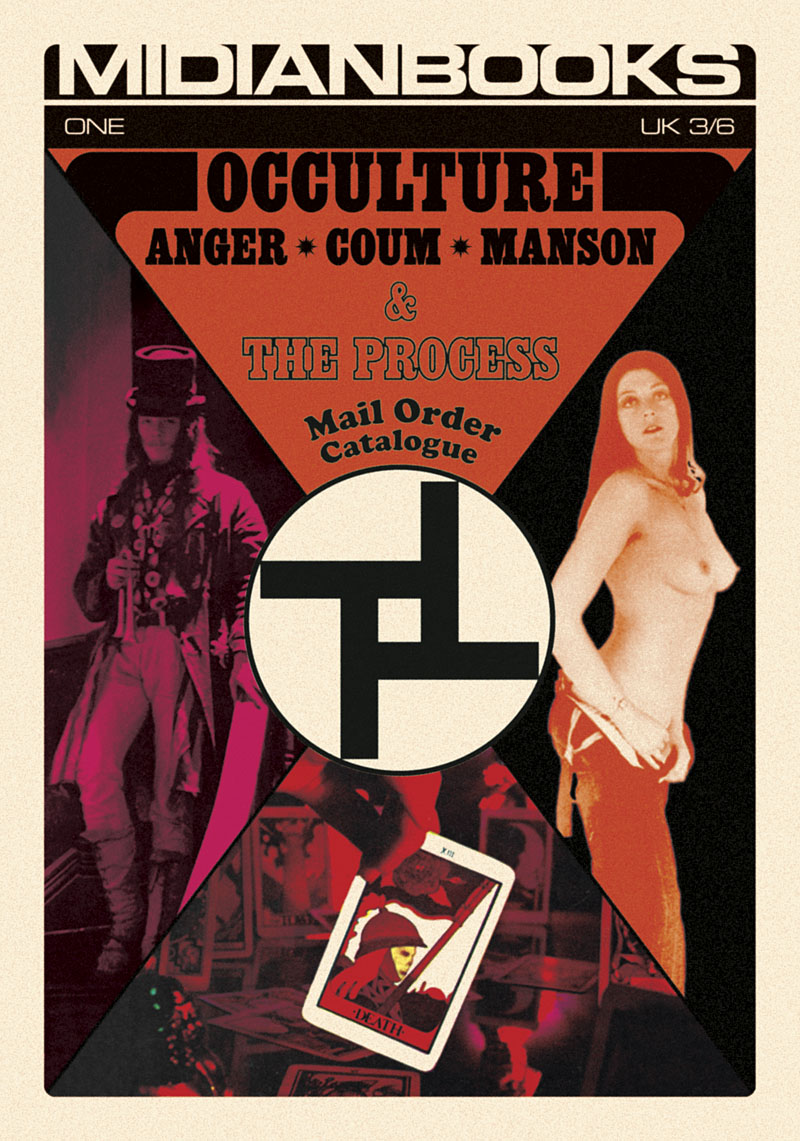
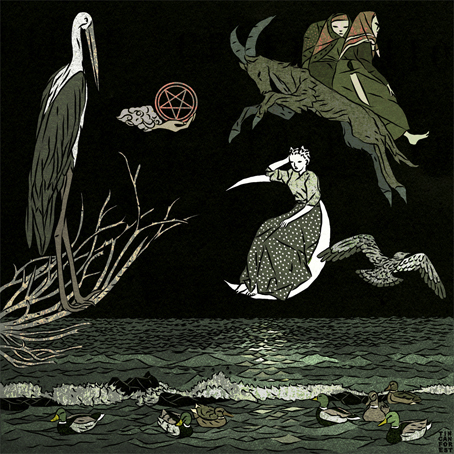
• Delving into the shadowy world of occult art: Priscilla Frank talks to Pam Grossman about her Language of the Birds exhibition. Related: “The occult never quite goes away,” says Kenneth Anger.

• “It was a magic day in our happy, young lives.” A proposal for a monument in Baltimore celebrating the final scene of John Waters’ Pink Flamingos.

• Mixes of the week: Wrap Up Warm Mix by Moon Wiring Club, Secret Thirteen Mix 175 by Inner8, and FACT mix 533 by Roly Porter.

• “He was less an architect than a Busby Berkeley with a penchant for Black Masses.” Jonathan Meades on Albert Speer.

• More film posters: Benjamin Lee on the compromises that have made contemporary posters “drab and uninspiring”.

• The vast and ghostly landscape of “Britain’s only desert”: photographs by Robert Walker.

Wyrd Daze, Lvl2 Issue 5, is free and brimming with the weird.

• The films of Michael Mann in 44 shots.

Laurie Anderson‘s favourite films.

Flamingo (1959) by Henry Mancini | Moon Occults The Sun (2006) by Espers | The Moon Occults Saturn at Dawn (2015) by Steve Moore

Cosmic eggs

1: The Metamorphosis of Narcissus (1937) by Salvador Dalí.

dali1.jpg

dali2.jpg


2: Geopoliticus Child Watching the Birth of the New Man (1943) by Salvador Dalí.

dali3.jpg


3: The Crack in the Cosmic Egg: Challenging Constructs of Mind and Reality (1971) by Joseph Chilton Pearce.

pearce.jpg


4: Karthago (1971) by Karthago.

karthago.jpg

Cover design by JH Löffler.


5: Edge Of Time (1972) by Norma Winstone.

winstone.jpg

Cover art by Terry Eden.


6: Supernature (1973) by Lyall Watson.

watson.jpg

Cover art by Jerry Pinkney.


7: A Cosmic Book (1988) by Itzhak Bentov.

bentov.jpg


8: The Crack in the Cosmic Egg (1996) by Steven Freeman & Alan Freeman.

freeman.jpg


9: Cosmic Egg (2009) by Wolfmother.

wolfmother.jpg

Cover by Invisible Creature.


10: Krautrock: Cosmic Rock and Its Legacy (2012) edited by Nikos Kotsopoulos.

krautrock.jpg

Weekend links 293

meyohas.jpg

Red Petals by Sarah Meyohas.

• “For MMoB, I want it to be like a [Werner] Herzog movie, so at our concerts the people on stage aren’t necessarily people who are named. We’re trying to create an entity that is beyond music and relates visually and sonically with everything in a way that’s different.” Randall Dunn talks to Simona Mantarlian and Daniel Jones about the Master Musicians of Bukkake and his production work for other artists.

• “Is reel-to-reel tape the new vinyl?” asks FACT mag. It’s certainly better than cassette tape (if less convenient) but it was always a niche format for albums, even in the 1970s. Rene Chun made a similar argument for an emerging trend last October. Those expensive machines do look tempting… Early adopters should start collecting here before prices rise.

Airwaves: Songs From The Sirens is a new release of spectral audio transmissions by A Year In The Country: “…a gathering of scattered signals plucked from the ether, cryptograms that wander amongst the airwaves…” Physical versions come with the usual plethora of monochrome artefacts.

A vivid memory to his friends, Litvinoff was one of those people whose performance was their life. His most lasting achievement was the profound influence he had on Performance – the hallucinatory film directed by Nic Roeg and Donald Cammell, and starring Mick Jagger, which captured the London of the late 1960s, merging pop stardom, violent criminality, illegal drugs, gender-blurring, the occult and Jorge Luis Borges.

Jon Savage on David Litvinoff

• Virgin Prunes “are THE #1 most underrated group of the post-punk era” says Richard Metzger. I’d say that honour goes to The Passage but the Virgin Prunes were unique even if they’re too often dismissed as a freak footnote in the U2 story.

Magic, Witches & Devils in the Early Modern World is a free exhibition at the John Rylands Library, Manchester, that will run until August 2016. Related: “John Dee painting originally had circle of human skulls, x-ray imaging reveals.”

• “What I’m seeing now is an awful lot of people just following things. We tried to find our own thing and ask, ‘What else is there?'” Charles Hayward on the past and present of post-punk band This Heat.

• “I’ve never been tempted to write anything that was not essentially nightmarish.” Thomas Ligotti in a comprehensive profile (originally run in 2010) at Dennis Cooper’s blog.

• Mixes of the week: An introduction to Stereolab by Jon Dale, and Silent Radio Transmission Jan 2016 by SilentServant.

• Kicked Toward Saintliness: Max Nelson on the dark erotics of Jean Genet’s Our Lady of the Flowers.

• Reverse Engineering: Danny Hyde on Coil, Backwards and NIN.

Fuck Yeah! Anna von Hausswolff

Harry Flowers (1970) by Jack Nitzsche | Flowers In The Air (1970) by Sally Eaton | Darkness: Flowers Must Die (1972) by Ash Ra Tempel

The Song of the White Horse by David Bedford

bedford.jpg

Many of the old TV documentaries I link to are ones I saw when first broadcast and wanted to see again, but this edition of the BBC’s Omnibus from 1978 is one I missed. The late David Bedford is a familiar name in British music: in the 1970s he was as much known for his orchestral arrangements for Kevin Ayers, Roy Harper, Mike Oldfield, et al as for his own album-length compositions. The Omnibus film concentrates on the composition and performance of a new Bedford piece inspired by the ancient earthwork known as the White Horse of Uffington.

The first half of the film has Bedford visiting the White Horse and nearby Wayland’s Smithy before returning to his studio where he shows the film crew some of his electronic gear. Later we get to see Mike Ratledge of Soft Machine helping create an electronic equivalent of the sound made by the Blowing Stone. The second half of the film has a complete performance of Bedford’s piece which takes its libretto from The Ballad of the White Horse by GK Chesterton. The sound quality doesn’t do the composition any favours at all but Bedford did record the piece in 1983 for Mike Oldfield’s label.

Previously on { feuilleton }
Hill figures