The art of Atelier Heinrichs & Bachmann

handb01.jpg

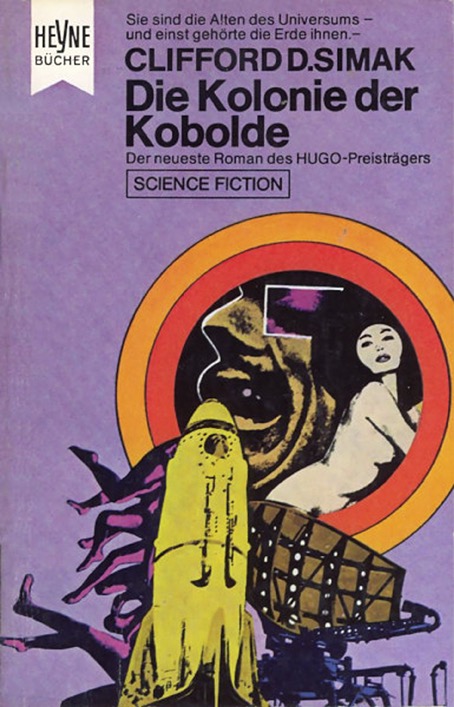
Who were Heinrichs and Bachmann? That’s a good question because neither I nor anyone else who’s written about their book covers can offer any more information beyond their names and the dates when they were active. What we do know is that from the mid-60s to an unspecified point in the 1970s Heinrichs and Bachmann’s studio was credited with many cover designs for books published by Heyne in Germany. By the 1980s the studio was still working for Heyne but with a credit now changed to Atelier Heinrichs & Schutz.

handb06.jpg

The designs featured here date from 1969 to 1971, and are part of a longer run of Heinrichs & Bachmann covers for science fiction titles published from the late 1960s to the early 1970s. I’d run across a few of these in the past but hadn’t gone looking for more until this weekend. I always enjoy seeing unusual approaches to SF illustration, and I especially enjoy anything which adopts this kind of post-psychedelic Pop-collage style. The influence of Heinz Edelmann’s art is evident in places, in particular the Edelmann look as it was filtered through the artists who worked on the Beatles’s Yellow Submarine. The Frank Herbert cover above could easily be added to the Sea of Heads. Also evident are faces that look as though they’ve been lifted from film stills. I’d guess that most of the figures in these collages were clipped from magazine pages then run through a photocopier once or twice to give that posterised effect.

handb03.jpg

handb04.jpg

handb07.jpg

Continue reading “The art of Atelier Heinrichs & Bachmann”

Jan Parker’s witches

parker01.jpg

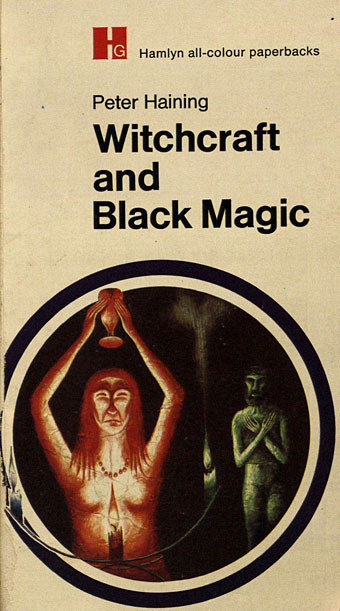
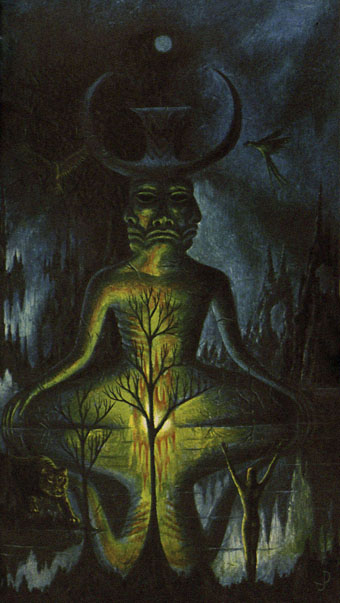
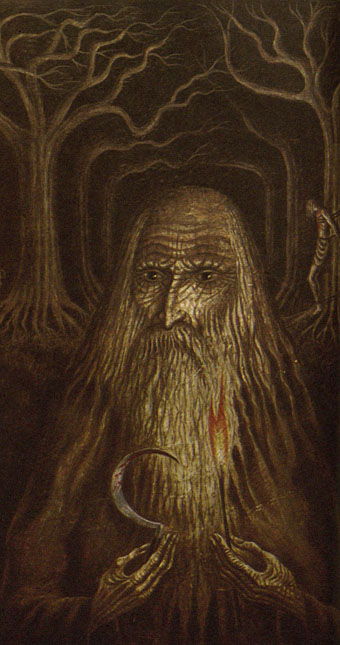
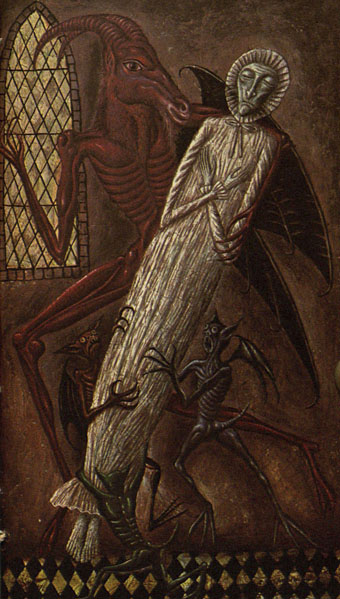
Also witch-finders, demons, magi, and a skeletal Adolf Hitler clutching a glowing crystal ball… Jan Parker is a British artist who was working as an illustrator in the early 1970s, during which time he produced a small number of covers for SF and fantasy titles. One of these, The Worlds of Frank Herbert, is a book I used to see a lot on the secondhand shelves although I never owned a copy. As with Victor Valla’s cover art, the 70s was a decade when idiosyncratic imagery of the type created by Parker and co. was a more common sight on genre covers than it is today. Witchcraft and Black Magic, published by Hamlyn in 1971, brought Parker’s brand of naïve weirdness to a Peter Haining history of the more lurid forms of occultism. This is a book that I did own for a while until someone borrowed it and never returned it, a persistent hazard for the books in my not-very-extensive occult library. Haining’s study is the kind of thing that publishers often call a pocket guide, although this suggests something you’d carry around to be used as an identification tool during chance encounters; you wouldn’t want to encounter most of the people (never mind the creatures) in these paintings.

parker02.jpg

A handful of Parker’s illustrations turned up some years ago at the now-defunct Front Free Endpaper, then were reblogged at Monster Brains and elsewhere. The copies here are from another recent upload at the Internet Archive where the book is part of a sub-archive of titles scanned from Indian libraries. The very tight binding evidently presented difficulties for the scanner, hence the appearance of fingers holding open most of the pages. It’s good to see this one again; I always valued the book more for the artwork than the text which isn’t bad but was simply another commission for the very prolific Haining, a writer who was a better anthologist than a historian. If you want a general history of the occult there are more authoritative options elsewhere.

parker03.jpg

As for the artwork, I wonder now how long it took Parker to paint all these pictures. There are about 80 original illustrations plus a number of others taken from antique books or from artists such as Frans Hals and Goya; that’s a lot of original art for a book of only 160 pages. Many of Parker’s pieces are copies of pre-existing portraits or of familiar illustrations like the perennially popular demons from de Plancy’s Dictionnaire Infernal. This makes me wonder why Hamlyn commissioned copies from Parker rather than simply paying a picture library for the original images as Marshall Cavendish were doing in 1971 with their multi-part encyclopedia, Man, Myth and Magic. Whatever the reason I’m pleased they gave Parker so much free reign. His depictions of historical figures wouldn’t be out of place in the portrait gallery in Dance of the Vampires, while some of his other pieces stray into outright Surrealism; the picture of people being menaced by flying eyeballs was used for the cover art of the US reprint from Bantam.

parker04.jpg

Haining’s book had at least one reprint in the UK before going out of print. The early 1970s saw the peak of the occult revival which had begun in the previous decade, and which made room in publishers’ lists for odd little books like this one. Secondhand copies are still floating around although they’re seldom cheap. If you do find one just be careful who you lend it to.

parker05.jpg

Continue reading “Jan Parker’s witches”

Weekend links 308

trochut.jpg

Frank Herbert’s Dune receives a new cover design by Alex Trochut together with other notable works of science fiction and fantasy for a new series from Penguin.

• “…poet, scholar and biographer Sandeep Parmar…has raised the possibility that a long poem by Hope Mirrlees, titled Paris and published by the Hogarth Press in 1919, was a strong influence on The Waste Land.” Alfred Corn on new TS Eliot scholarship.

• “[Evolution‘s] strain of body horror brings to mind an ethereal HP Lovecraft mixed with David Cronenberg.” Rachel Bowles talks to the film’s director, Lucile Hadžihalilović.

• Library music “is a sonic world of ‘weird beats, odd instrumentations, albums full of dark jazzy interludes or bizarre garage rock.'” Adrian Shaughnessy on innovation in banality.

Italy, which EM Forster called “the beautiful country where they say ‘yes’”, became another resort, especially the island of Capri, where a French poet staged a ceremonial flogging of his teenage Italian lover before the boy departed to do his military service and became the subject of a novel by his compatriot Roger Peyrefitte. In the Egyptian city of Alexandria, Forster observed the Greek poet Constantine Cavafy “standing absolutely motionless at a slight angle to the universe”, and the Australian novelist Patrick White met a local man who became his lifelong companion. For decades, the novelists Paul and Jane Bowles presided in Tangier, which Jack Kerouac was to call a “sinister international hive of queens”. William Burroughs arrived in 1954 with a teenage Spaniard named Kiki who, Woods writes, “was, famously, the boy who would blow smoke into his pubic hair and say ‘Abracadabra’ as his hardening cock emerged from the cloud”. Tangier was to figure in Burroughs’s novel Naked Lunch as a phantasmagoric, rubbery walled sex market called the Interzone.

Caleb Crain reviewing Homintern by Gregory Woods

• Beardsley biographer Matthew Sturgis reviews Aubrey Beardsley: A Catalogue Raisonné, a two-volume collection edited by Linda Gertner Zatlin.

• “He was the Bresson of Birkenhead.” Andrew Collins reviews the forthcoming collection of BBC dramas directed by Alan Clarke.

• “The postwar Hollywood western was more content to let strangeness be strange,” says Michael Newton.

• “Bosch’s work has always caused trouble for interpreters and critics,” says Morgan Meis.

Misplaced New York: a project by Anton Repponen and Jon Earle.

Wyrd Daze, Lvl2 Issue 6, is out, and as before is a free download.

Lessons we can learn from Robert Altman’s 3 Women.

• Mix of the week: FACT Mix 548 by Peder Mannerfelt.

Paris 1971 (1971) by Suzanne Ciani | Paris II (1987) by Jon Hassell | Dreaming Of Paris (2013) by Van Dyke Parks

Weekend links 266

dune.jpg

Spine and cover art by John Schoenherr for the first American edition of Dune, 1965.

• “[Herbert] had also taken peyote and read Jung. In 1960, a sailing buddy introduced him to the Zen thinker Alan Watts, who was living on a houseboat in Sausalito. Long conversations with Watts, the main conduit by which Zen was permeating the west-coast counterculture, helped turn Herbert’s pacy adventure story into an exploration of temporality, the limits of personal identity and the mind’s relationship to the body.” Hari Kunzru on Frank Herbert and Dune, 50 years on. Related: “To save California, read Dune,” says Andrew Leonard. There’s a lot more Dune cover art at ISFDB.

• “Embedded in Adam’s footage were several dark forms, human-ish in outline, unidentifiable but unmistakable, visible within the leaves or the shadows.” Holloway is a short film by Adam Scovell based on the book by Robert Macfarlane, Dan Richards and Stanley Donwood.

The Library of the Lost: In Search of Forgotten Authors by Roger Dobson; edited and with an introduction by Mark Valentine. Roger and Mark were my first publishers in 1988 when their Caermaen Books imprint produced the large-format edition of The Haunter of the Dark.

• “…over the years he created a series of ‘Pharmacies’: rows of glass bottles filled not with medicines to cure the body…but objects to stimulate the mind.” Clare Walters reviews Joseph Cornell: Wanderlust, an exhibition at the Royal Academy, London.

• “The sound machines we build today are invariably one-offs, made from salvaged parts, with all the precariousness of a prototype.” Sarah Angliss on the art of making music machines.

Mission Desire is a new single by Jane Weaver whose video is “set to scenes from Marie Mathématique – the French 1960s mini-series about Barbarella’s younger sister”.

• Ghost signs, ginnels and hidden details: an alternative guide to Manchester by Hayley Flynn aka Skyliner.

• “I want to be despised,” says John Waters who has a new art exhibition at Sprüth Magers, London.

Sonic Praise, an album of “Krautprogbikermetal” by Ecstatic Vision.

• The Evolution of the Great Gay Novel: an overview by Rebecca Brill.

• At Bibliothèque Gay: more homoerotic drawings by Jean Cocteau.

Wyrd Daze Lvl2 Issue 3 is a free download.

Nicolas Winding Refn: vinyl collector.

Art With Naked Guys In It

Caladan (2011) by Roly Porter | Giedi Prime (2011) by Roly Porter | Arrakis (2011) by Roly Porter

Dune designs

dune01.jpg

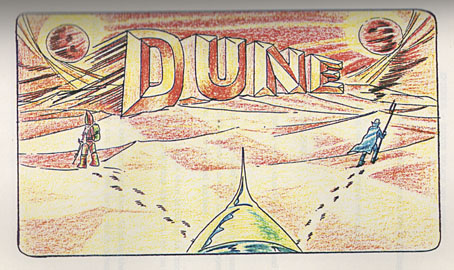
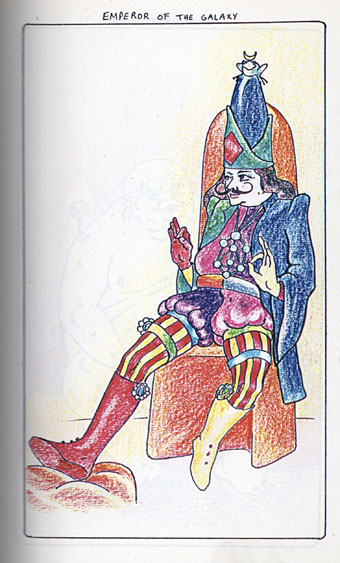
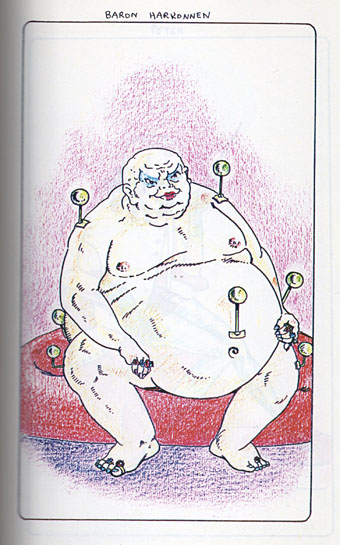
Currently racking up the bids at eBay (again) is an early draft of Alejandro Jodorowsky’s script for his ill-fated film of Dune. Aside from some diverting glimpses of dialogue and plot elaboration, what’s most interesting about the draft is the character and scene sketches, some of which are sampled below. I’ve still not seen the documentary about the unmade film so I can’t say whether any of these have appeared in public before but if they have they’re new to me. No artist is credited but the naive style rules out both Moebius and HR Giger (who arrived late to the project in any case). Best bet is either Jodorowsky himself—in 1967 he was writing and illustrating a comic strip, Fabulas Panicas—or Jodorowsky’s colleague from the Panic Movement days, Roland Topor. In the early 70s Topor was working with René Laloux on the animated SF film Fantastic Planet.

dune02.jpg

Many of the conceptions differ radically from the more graceful designs that Moebius produced later on. Also of note are details such as the anal entrance to the Emperor’s throne room, a Harkonnen orgy and an insemination scene viewed from inside Jessica’s vagina. By the time Giger joined the production team the instruction was not to create anything too erotic or adult since the film needed to reach a large audience.

There’s more from the Dune script (and larger copies of these images) here. (Thanks to Jay for the tip!)

dune03.jpg

Continue reading “Dune designs”