Symphonie Fantastique

fantastique01.jpg

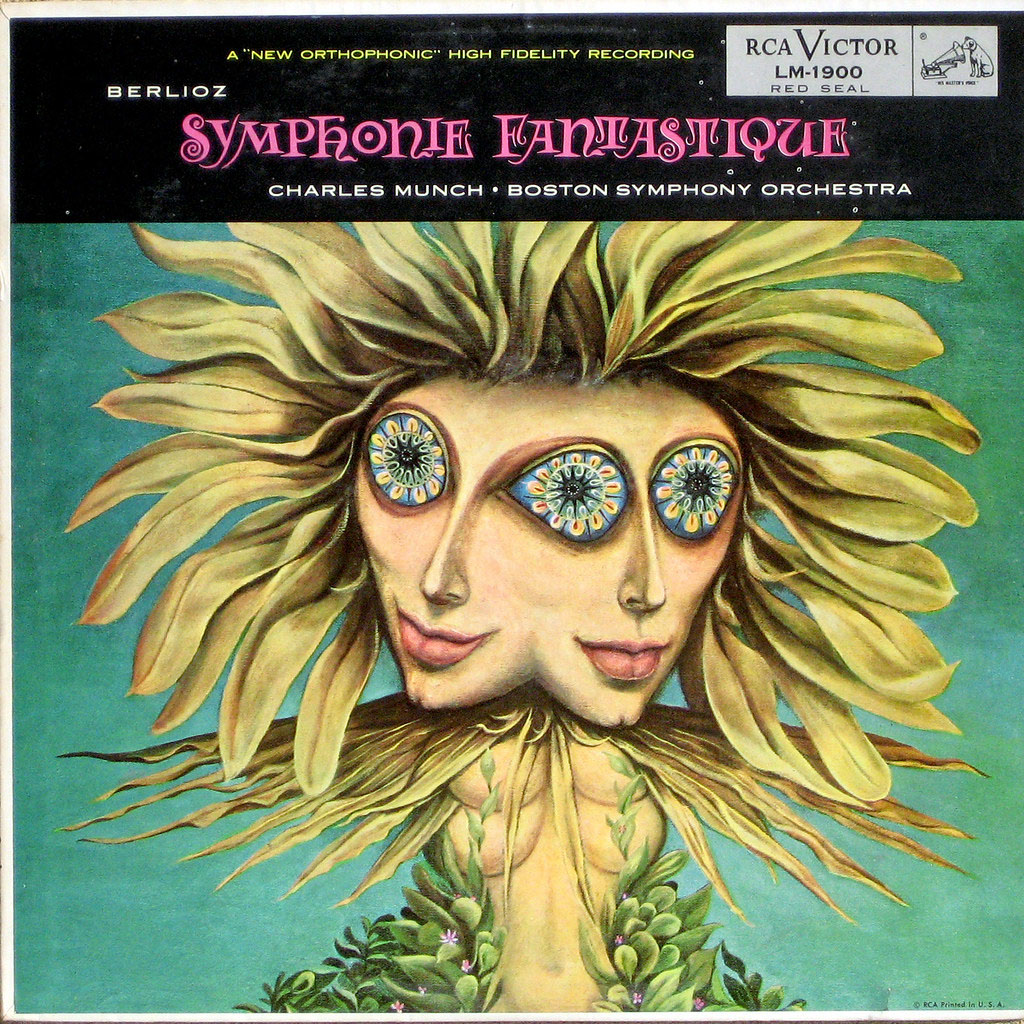
1955. Cover art by Jane Sinnickson Flora.

The programme for the symphony (1845 version) by Hector Berlioz:

Part One: Daydreams, Passions
The author imagines that a young musician, afflicted by the sickness of spirit which a famous writer has called the vagueness of passions (le vague des passions), sees for the first time a woman who unites all the charms of the ideal person his imagination was dreaming of, and falls desperately in love with her. By a strange anomaly, the beloved image never presents itself to the artist’s mind without being associated with a musical idea, in which he recognises a certain quality of passion, but endowed with the nobility and shyness which he credits to the object of his love.

This melodic image and its model keep haunting him ceaselessly like a double idée fixe. This explains the constant recurrence in all the movements of the symphony of the melody which launches the first allegro. The transitions from this state of dreamy melancholy, interrupted by occasional upsurges of aimless joy, to delirious passion, with its outbursts of fury and jealousy, its returns of tenderness, its tears, its religious consolations—all this forms the subject of the first movement.

Part Two: A Ball
The artist finds himself in the most diverse situations in life, in the tumult of a festive party, in the peaceful contemplation of the beautiful sights of nature, yet everywhere, whether in town or in the countryside, the beloved image keeps haunting him and throws his spirit into confusion.

Part Three: Scene in the Countryside
One evening in the countryside he hears two shepherds in the distance dialoguing with their “ranz des vaches” this pastoral duet, the setting, the gentle rustling of the trees in the wind, some causes for hope that he has recently conceived, all conspire to restore to his heart an unaccustomed feeling of calm and to give to his thoughts a happier colouring. He broods on his loneliness, and hopes that soon he will no longer be on his own… But what if she betrayed him!… This mingled hope and fear, these ideas of happiness, disturbed by dark premonitions, form the subject of the adagio. At the end one of the shepherds resumes his “ranz des vaches” the other one no longer answers. Distant sound of thunder… solitude… silence…

Part Four: March to the Scaffold
Convinced that his love is spurned, the artist poisons himself with opium. The dose of narcotic, while too weak to cause his death, plunges him into a heavy sleep accompanied by the strangest of visions. He dreams that he has killed his beloved, that he is condemned, led to the scaffold and is witnessing his own execution. The procession advances to the sound of a march that is sometimes sombre and wild, and sometimes brilliant and solemn, in which a dull sound of heavy footsteps follows without transition the loudest outbursts. At the end of the march, the first four bars of the idée fixe reappear like a final thought of love interrupted by the fatal blow.

Part Five: Dream of a Witches’ Sabbath
He sees himself at a witches’ sabbath, in the midst of a hideous gathering of shades, sorcerers and monsters of every kind who have come together for his funeral. Strange sounds, groans, outbursts of laughter; distant shouts which seem to be answered by more shouts. The beloved melody appears once more, but has now lost its noble and shy character; it is now no more than a vulgar dance tune, trivial and grotesque: it is she who is coming to the sabbath… Roar of delight at her arrival… She joins the diabolical orgy… The funeral knell tolls, burlesque parody of the Dies irae, the dance of the witches. The dance of the witches combined with the Dies irae.

powers10.jpg

1958. Cover art by Richard M. Powers.

The programme for the symphony (1855 version) by Hector Berlioz:

A young musician of morbid sensitivity and ardent imagination poisons himself with opium in a moment of despair caused by frustrated love. The dose of narcotic, while too weak to cause his death, plunges him into a heavy sleep accompanied by the strangest of visions, in which his experiences, feelings and memories are translated in his feverish brain into musical thoughts and images. His beloved becomes for him a melody and like an idée fixe which he meets and hears everywhere.

Part One: Daydreams, Passions
He remembers first the uneasiness of spirit, the indefinable passion, the melancholy, the aimless joys he felt even before seeing his beloved; then the explosive love she suddenly inspired in him, his delirious anguish, his fits of jealous fury, his returns of tenderness, his religious consolations.

Part Two: A Ball
He meets again his beloved in a ball during a glittering fête.

Part Three: Scene in the Countryside
One summer evening in the countryside he hears two shepherds dialoguing with their “ranz des vaches” this pastoral duet, the setting, the gentle rustling of the trees in the light wind, some causes for hope that he has recently conceived, all conspire to restore to his heart an unaccustomed feeling of calm and to give to his thoughts a happier colouring; but she reappears, he feels a pang of anguish, and painful thoughts disturb him: what if she betrayed him… One of the shepherds resumes his simple melody, the other one no longer answers. The sun sets… distant sound of thunder… solitude… silence…

Part Four: March to the Scaffold
He dreams that he has killed his beloved, that he is condemned to death and led to execution. The procession advances to the sound of a march that is sometimes sombre and wild, and sometimes brilliant and solemn, in which a dull sound of heavy footsteps follows without transition the loudest outbursts. At the end, the idée fixe reappears for a moment like a final thought of love interrupted by the fatal blow.

Part Five: Dream of a Witches’ Sabbath
He sees himself at a witches’ sabbath, in the midst of a hideous gathering of shades, sorcerers and monsters of every kind who have come together for his funeral. Strange sounds, groans, outbursts of laughter; distant shouts which seem to be answered by more shouts. The beloved melody appears once more, but has now lost its noble and shy character; it is now no more than a vulgar dance-tune, trivial and grotesque: it is she who is coming to the sabbath… Roars of delight at her arrival… She joins the diabolical orgy… The funeral knell tolls, burlesque parody of the Dies Irae. The dance of the witches. The dance of the witches combined with the Dies Irae.
fantastique02.jpg

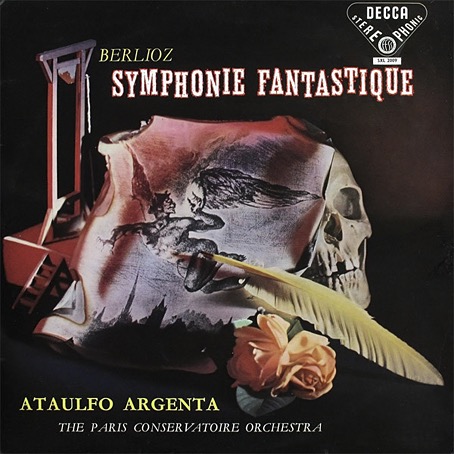
1958. No cover artist credited.

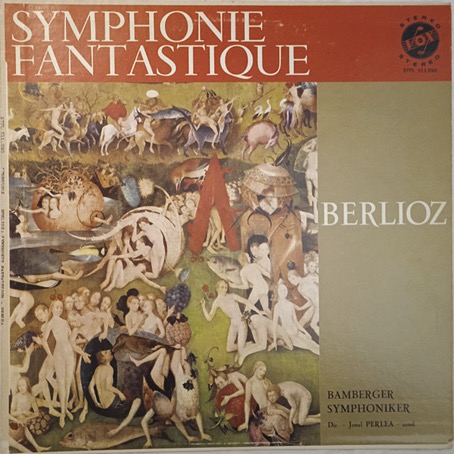
fantastique03.jpg

1959. Cover art by Hieronymus Bosch.

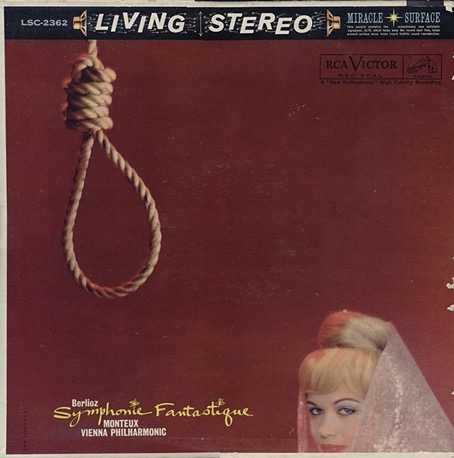
fantastique04.jpg

1960. No cover designer credited.

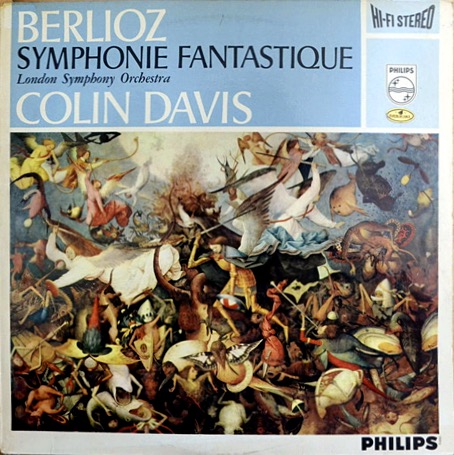
fantastique05.jpg

1964. Cover art by Pieter Bruegel the Elder.
Continue reading “Symphonie Fantastique”

The Midnight Parasites by Yoji Kuri

kuri.jpg

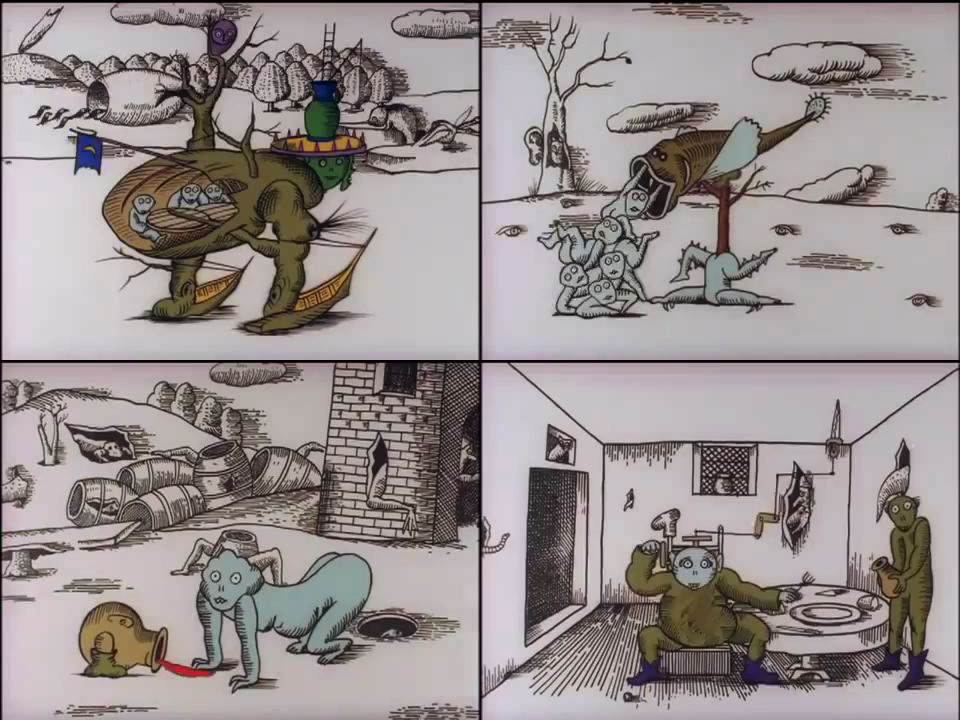
The Midnight Parasites (1972) is a good example of the kind of animation I’m often searching for: strange and grotesque yet with its own internal logic. Yoji Kuri populates a Surrealist landscape with infernal creatures borrowed from Hieronymus Bosch, a succession of humanoids and predatory monsters whose struggles for survival are overlaid with an uncredited electronic score. I can imagine Roland Topor enjoying this one, it belongs in the same solar system as Fantastic Planet. Watch it here.

Elsewhere on { feuilleton }
The Surrealism archive

Previously on { feuilleton }
Bosch details

Goodfellow and Borges

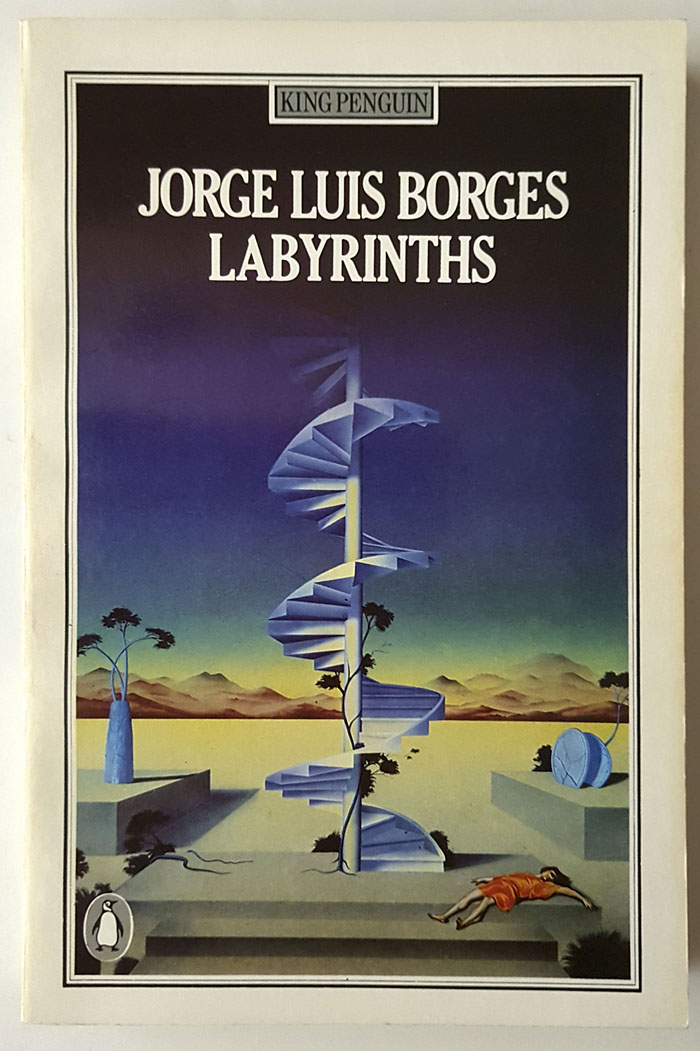
goodfellow1.jpg

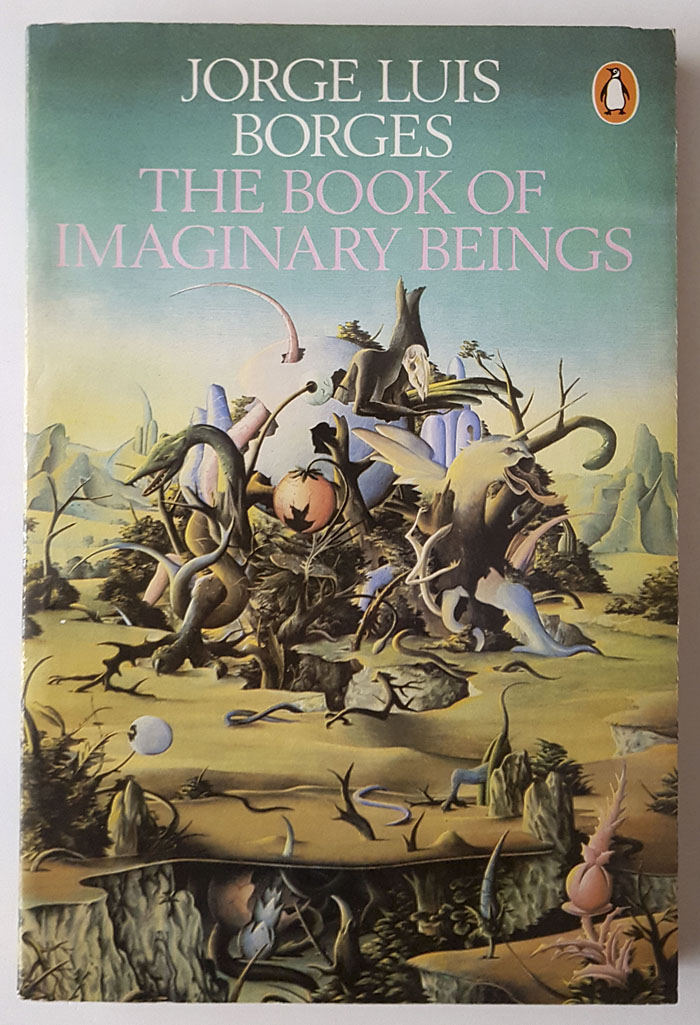
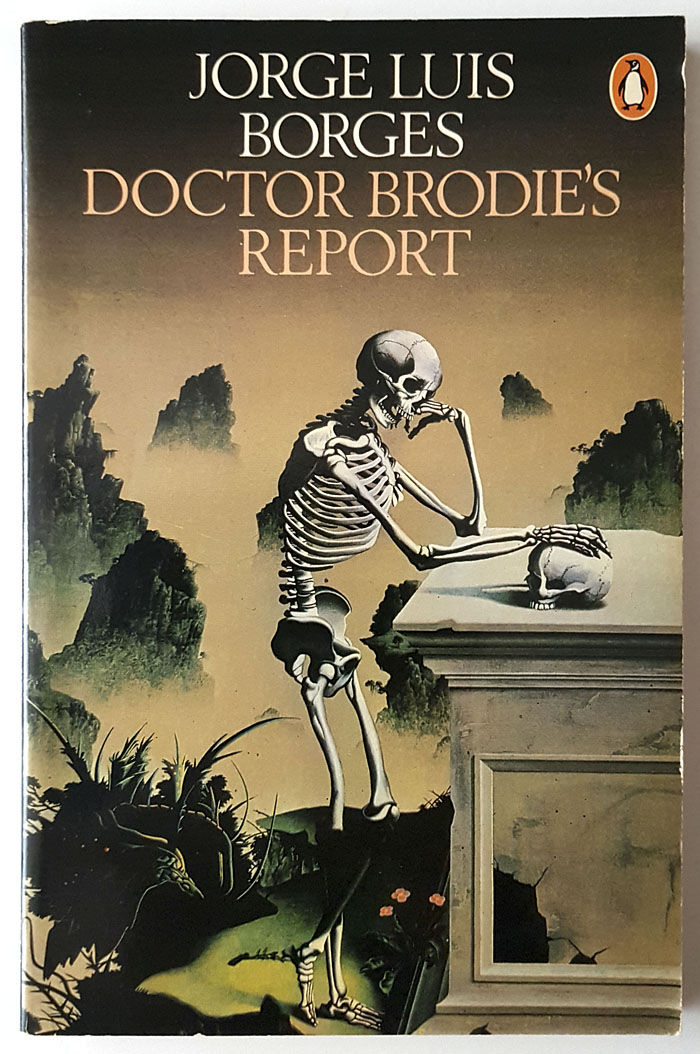
Last week’s story search had me looking through this handful of Penguin volumes again, all of which have cover illustrations by Peter Goodfellow. These were the first Borges books I bought, beginning with the Labyrinths collection in 1985. The Book of Sand is two volumes in one—The Book of Sand and a late poetry collection, The Gold of the Tigers—with cover art suitable for both. I used to think that the covers of the other books were pastiching or quoting well-known artists but now I’m not so sure. Two of them definitely are quotes or pastiches: The Book of Imaginary Beings is a play on the weird growths you find in Hieronymus Bosch, while Doctor Brodie‘s contemplative skeleton is from the famous anatomical engravings in De Humani Corporis Fabrica by Andreas Vesalius, with some Chinese or Japanese landscape details added to the background.

goodfellow2.jpg

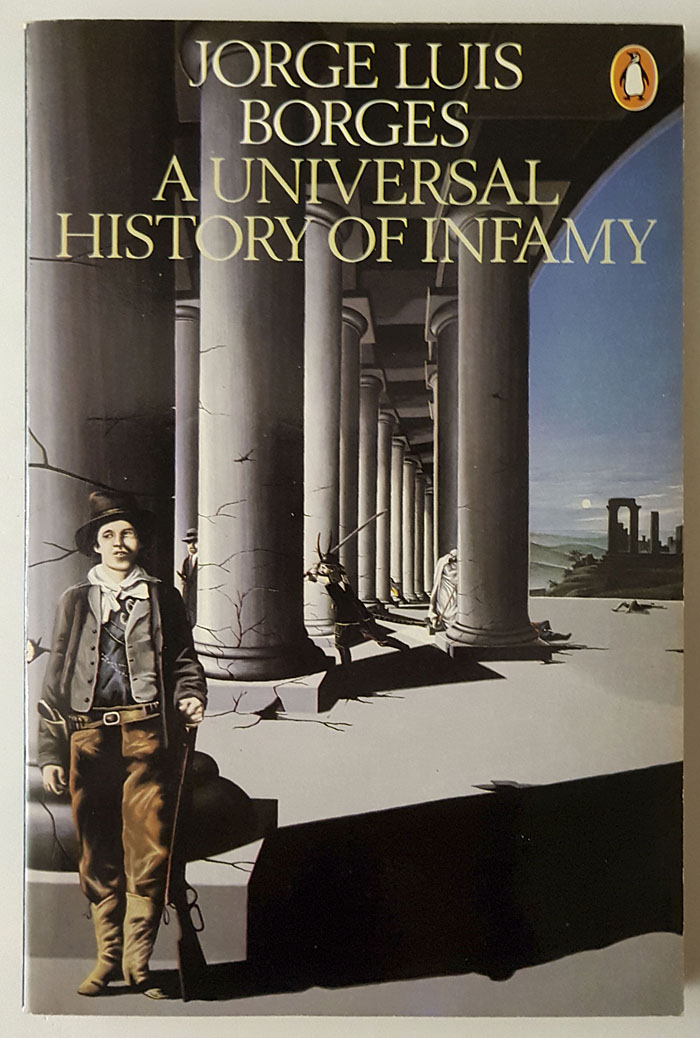
Two positive artistic references suggested that the other covers might follow suit, so I used to take the Labyrinths cover as a vague reference to the anomalies that Salvador Dalí would situate in his desert vistas, while A Universal History of Infamy was de Chirico, perhaps, although this no longer seems certain at all. Those columns look like Bernini’s double colonnade from Saint Peter’s Square in Rome, not a Turin arcade, and the picture lacks the disjunctive perspectives you find in de Chirico’s “Metaphysical” paintings. The pastiche thesis is further diluted when you discover that Goodfellow had been quoting from Bosch as far back as his cover for Ursula Le Guin’s Rocannon’s World in 1972, while he borrowed another skeleton from Vesalius for Structures by JE Gordon. Sometimes you can reach too far for meaningful connections.

goodfellow3.jpg

The Bosch-like cover does seem to have had an enduring influence, however. When Penguin published the Collected Fictions in the UK in 1999 they used a detail from Bosch’s Garden of Earthly Delights for the artwork. Bosch details turned up on a later edition of A Universal History of Infamy, and have subsequently appeared on a series of Turkish Borges editions. Not a bad choice for a writer whose fictions offer universes of possibility.

goodfellow4.jpg

goodfellow5.jpg

Elsewhere on { feuilleton }
The book covers archive
The illustrators archive

Previously on { feuilleton }
The Rejected Sorcerer
The Immortal by Jorge Luis Borges
Borges on Ulysses
Borges in the firing line
La Bibliothèque de Babel
Borges and the cats
Invasion, a film by Hugo Santiago
Spiderweb, a film by Paul Miller
The Library of Babel by Érik Desmazières
Books Borges never wrote
Borges and I
Borges documentary
Borges in Performance

Weekend links 620

varo

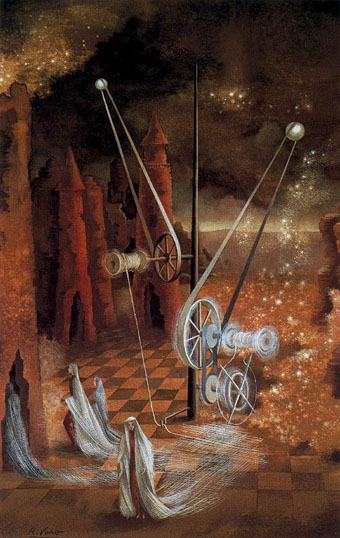
Premonition (1953) by Remedios Varo.

• “Classical mythology, Arcadian idylls, occult speculation, and an interest in cultural curiosities coexisted in the grotto, allowing for the playful exploration of a new tension emerging between Nature and Artifice.” Laura Tradii explores the artificial grottoes of the Renaissance and beyond.

• “Some of the symbols and signs seem like bridges to nowhere, and perhaps Nabokov was lovingly teasing our endless quest to find patterns and generate meaning.” David M. Rubin on writing a response to a Nabokov short story.

• New music: “KMRU & Aho Ssan erupt in post-apocalyptic extremity with Resurgence“. I did the layout for this latest release on the Subtext label but I still haven’t got round to updating my web pages so you’ll have to take my word for it.

• Powell & Pressburger’s Black Narcissus “unleashes a level of eroticism that’s surprising for 1940s British cinema,” says Adam Scovell.

• “Premonitions are impossible, and they come true all the time.” Fiona Sturges reviews The Premonitions Bureau by Sam Knight.

• Between Hell and Paradise: paintings by Hieronymus Bosch and his followers at the Museum of Fine Arts, Budapest.

• At The Collector: Olivia Barrett on the Voodoo Queens of New Orleans.

• Steven Heller’s font of the month is Astronef Super.

• Mix of the week: Isolatedmix 118 by Pan American.

TMP-01 Vintage Synth TV Series from Benge.

• Vale, A Year In The Country.

Premonition (1979) by Simple Minds | Premonition (1980) by Cabaret Voltaire | Premonition (Giant Empty Iron Vessel) (1987) by David Sylvian & Holger Czukay

Max Ernst’s favourites

ernst1.jpg

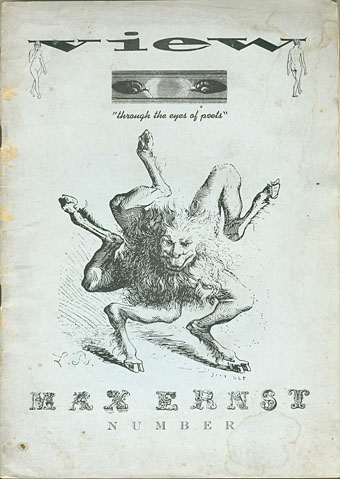
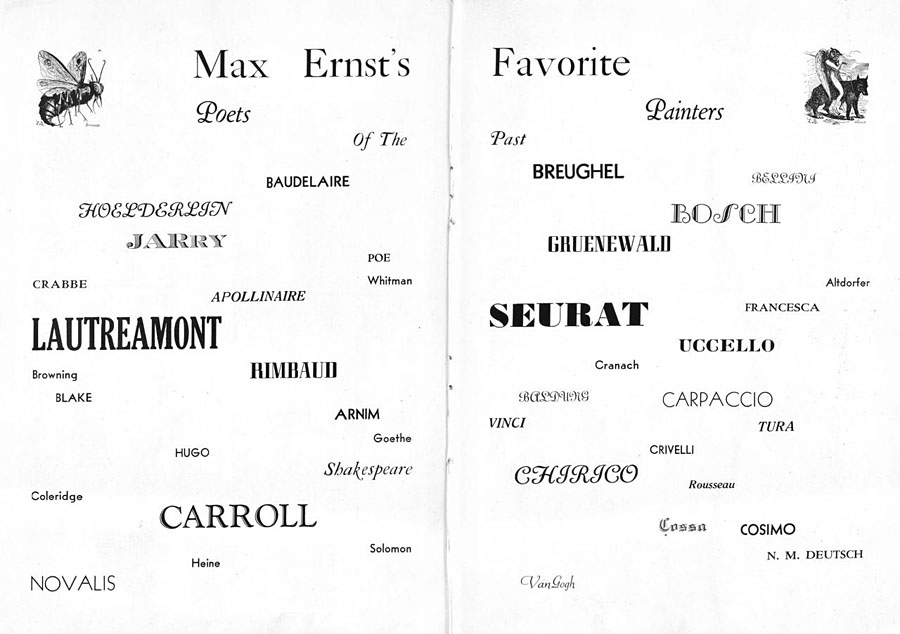
The cover for the Max Ernst number of View magazine (April, 1942) that appears in Charles Henri Ford’s View: Parade of the Avant-Garde was one I didn’t recall seeing before. This was a surprise when I’d spent some time searching for back issues of the magazine. The conjunction of Ernst with Buer, one of the perennially popular demons drawn by Louis Le Breton for De Plancy’s Dictionnaire Infernal, doubles the issue’s cult value in my eyes. I don’t know whether the demon was Ernst’s choice but I’d guess so when many of the De Plancy illustrations resemble the hybrid creatures rampaging through Ernst’s collages. Missing from the Ford book is the spread below which uses more De Plancy demons to decorate lists of the artist’s favourite poets and painters. I’d have preferred a selection of favourite novelists but Ford was a poet himself (he also co-wrote an early gay novel with Parker Tyler, The Young and Evil), and the list is still worth seeing.

ernst2.jpg

Poets: Charles Baudelaire, Friedrich Hölderlin, Alfred Jarry, Edgar Allan Poe, George Crabbe, Guillaume Apollinaire, Walt Whitman, Comte de Lautréamont, Robert Browning, Arthur Rimbaud, William Blake, Achim von Arnim, Victor Hugo, Johann Wolfgang von Goethe, William Shakespeare, Samuel Taylor Coleridge, Lewis Carroll, Novalis, Heinrich Heine, Solomon (presumably the author of the Song of Solomon).

Painters: Pieter Bruegel the Elder, Giovanni Bellini, Hieronymus Bosch, Matthias Grünewald, Albrecht Altdorfer, Georges Seurat, Piero della Francesca, Paolo Uccello, Lucas Cranach the Elder, Hans Baldung, Vittore Carpaccio, Leonardo Da Vinci, Cosimo Tura, Carlo Crivelli, Giorgio de Chirico, Henri Rousseau, Francesco del Cossa, Piero di Cosimo, NM Deutsch (Niklaus Manuel), Vincent van Gogh.

I’ve filled out the names since some of the typography isn’t easy to read. Some of the choices are also uncommon, while one of them—NM Deutsch—is not only a difficult name to search for but the attribution has changed in recent years. The list of poets contains few surprises but it’s good to see that Poe made an impression on Ernst; the choice of painters is less predictable. Bruegel, Bosch and Rousseau are to be expected, and the same goes for the German artists—Grünewald, Baldung—whose work is frequently grotesque or erotic. But I wouldn’t have expected so many names from the Italian Renaissance, and Seurat is a genuine surprise. As for Ernst’s only living contemporary, Giorgio de Chirico, this isn’t a surprise at all but it reinforces de Chirico’s importance. If you removed Picasso from art history de Chirico might be the most influential painter of the 20th century; his Metaphysical works had a huge impact on the Dada generation, writers as well as artists, and also on René Magritte who was never a Dadaist but who lost interest in Futurism when he saw a reproduction of The Song of Love (1914). Picasso’s influence remains rooted in the art world while de Chirico’s disquieting dreams extend their shadows into film and literature, so it’s all the more surprising that this phase of his work was so short lived. But that’s a discussion for another time.

Previously on { feuilleton }
Viewing View
De Plancy’s Dictionnaire Infernal
Max Ernst album covers
Maximiliana oder die widerrechtliche Ausübung der Astronomie
Max and Dorothea
Dreams That Money Can Buy
La femme 100 têtes by Eric Duvivier