Art on film: Pandora and the Flying Dutchman

pandora1.jpg

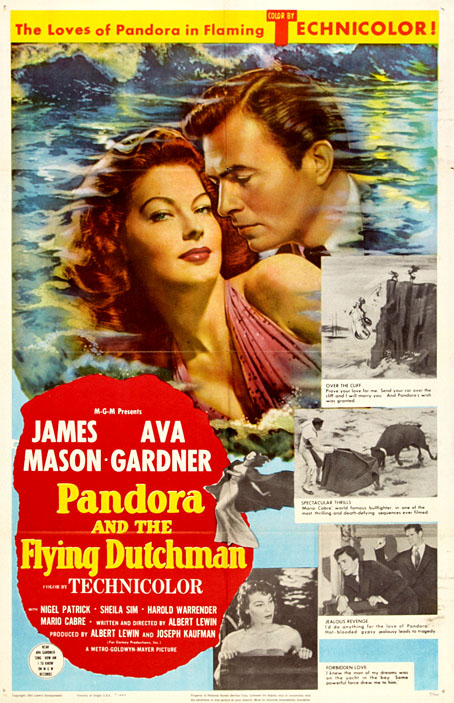
Continuing an occasional series about artworks in feature films. This is a minor entry but a worthwhile one if only to draw some attention to an unusual fantasy film by Albert Lewin, an equally unusual director. Pandora and the Flying Dutchman was made in 1951, a British film with an American star (Ava Gardner) and a Spanish setting. Gardner plays Pandora Reynolds, an American nightclub singer living in the coastal town of Esperanza where she’s the centre of attention for the small colony of stuffy middle-class Brits who also live there. Like her mythical namesake, Pandora is a source of endless trouble, only in this case the evils are the result of the romantic chaos she provokes. Her own romantic desires are upset when a mysterious yacht anchors off the coast, its sole occupant being Hendrik van der Zee (James Mason) who we soon learn is the Flying Dutchman of legend, doomed to sail the seas until he can find salvation in the love of a woman who will die for him.

pandora6.jpg

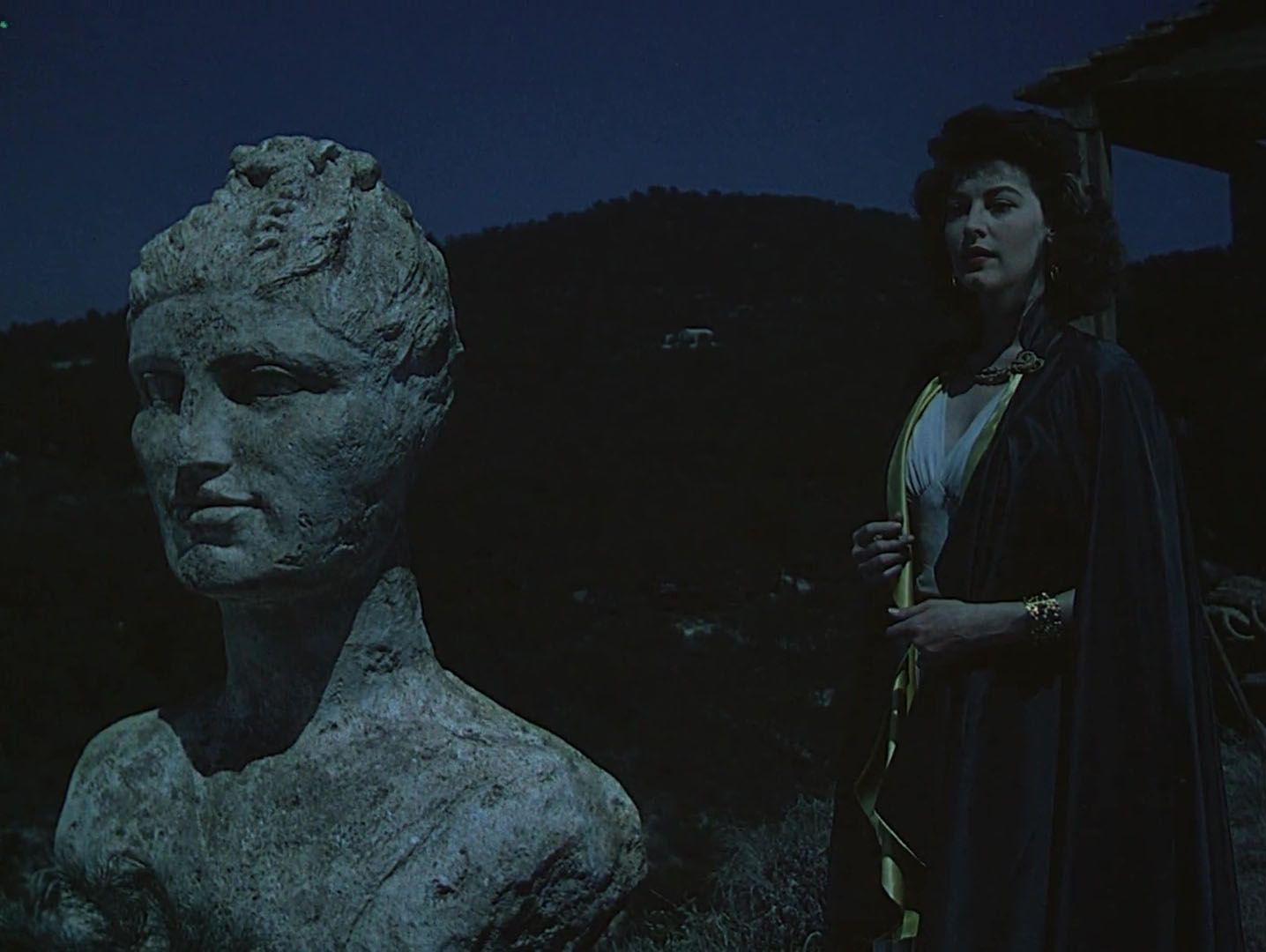
Pandora with one of the many statues that surround the home of Fielding the archaeologist.

Lewin’s film was restored recently after having been out of circulation for many years. I’d been intending to see it again after reading about the restoration which could only be an improvement on the terrible copy that used to turn up late at night on British TV. Further impetus was prompted by a book review for The Spectator in which Michael Moorcock notes similarities between the film and the stories by JG Ballard which were collected as Vermilion Sands. I’ve never seen Ballard mention the film but the Vermilion Sands stories have long been favourites of mine. The film moved to the top of the viewing list.

pandora7.jpg

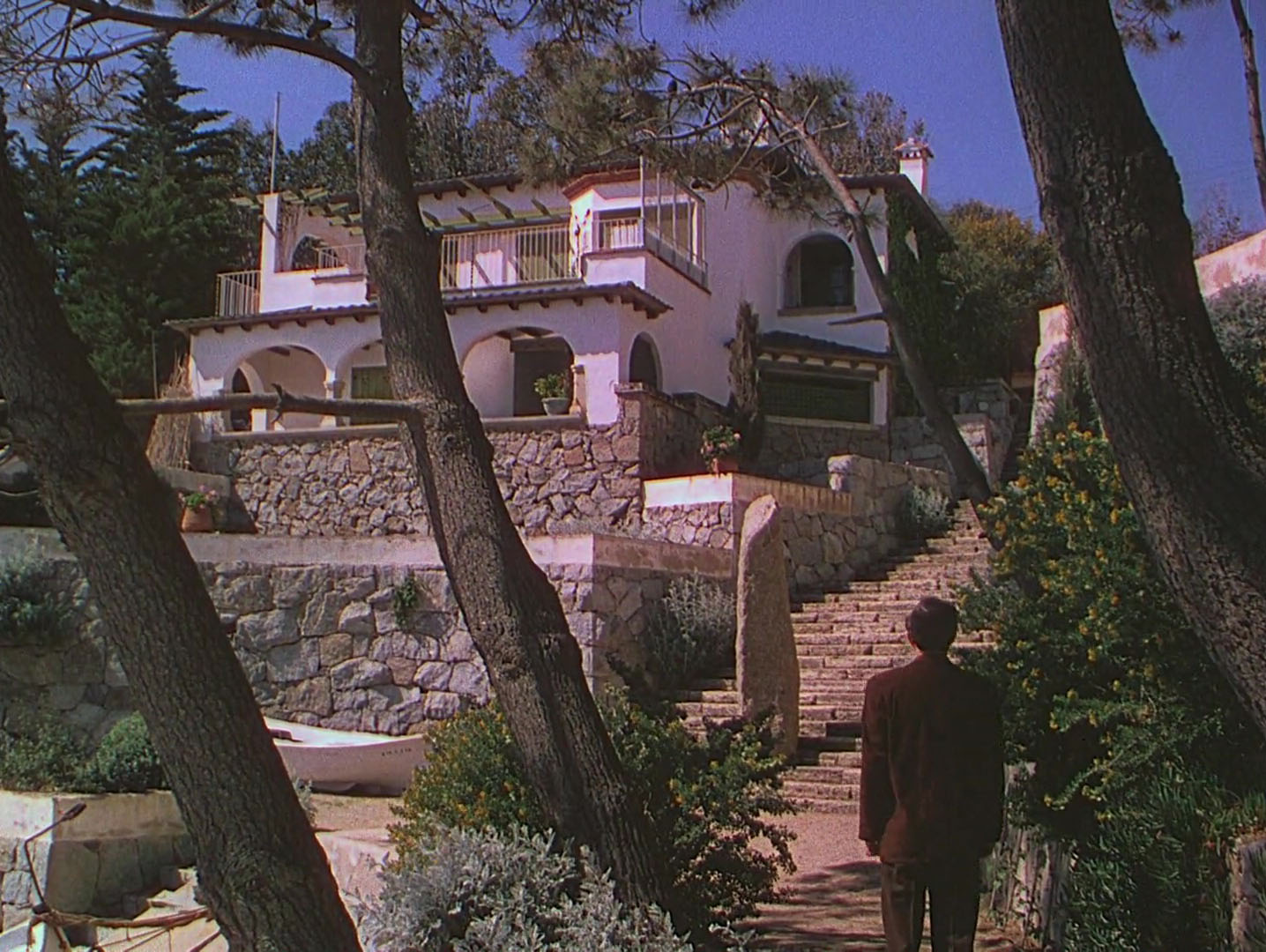
Esperanza or Vermilion Sands? Hendrik is lured by Pandora’s piano-playing.

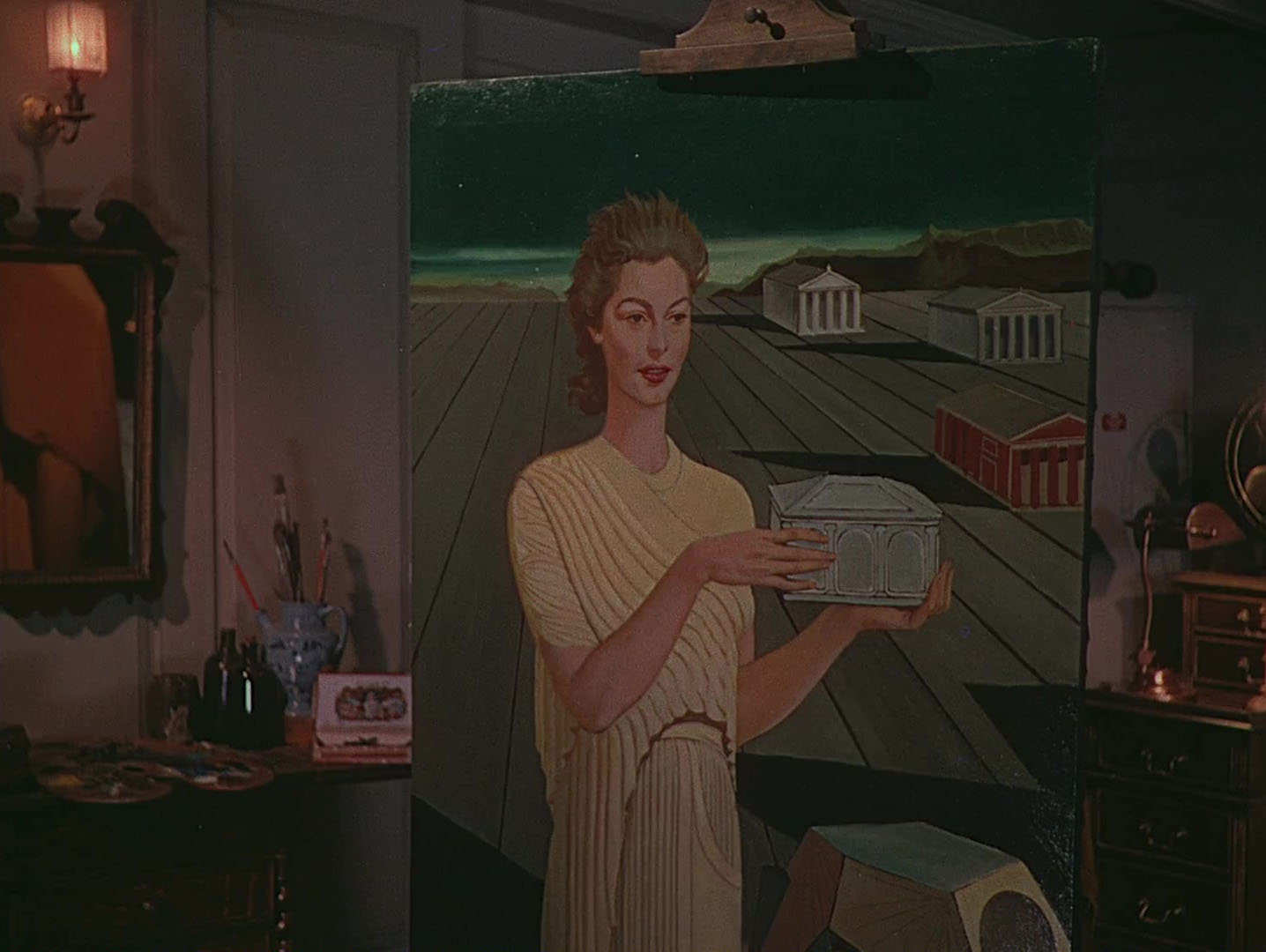
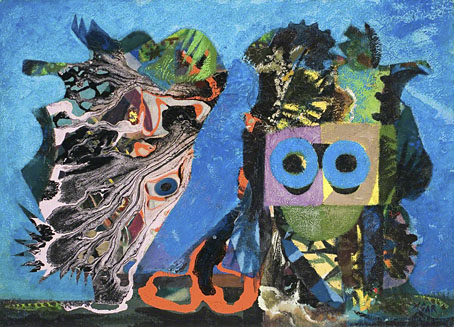
The key connection to Ballard is Surrealist (or-pre-Surrealist) painting, a detail of Pandora and the Flying Dutchman that I’d forgotten all about. Albert Lewin only directed six films; he also wrote each one, and was very determined in his attempts to bring a touch of artistic class to Anglophone cinema. Pandora and the Flying Dutchman was his fourth feature after The Moon and Sixpence and The Picture of Dorian Gray—each an adaptation of a novel where painting is an important element of the story—and The Private Affairs of Bel Ami, a film that was promoted with a Surrealist painting competition on the theme of the temptation of St Anthony. Max Ernst won the competition, and his picture appears at the end of the film, a colour insert in an otherwise black-and-white feature. Lewin did the same for The Picture of Dorian Gray, another black-and-white film where the portrait paintings (including Ivan Albright’s unforgettably corrupted canvas) are shown in colour inserts.

pandora2.jpg

Continue reading “Art on film: Pandora and the Flying Dutchman”

Dell Mapbacks

mapback08.jpg

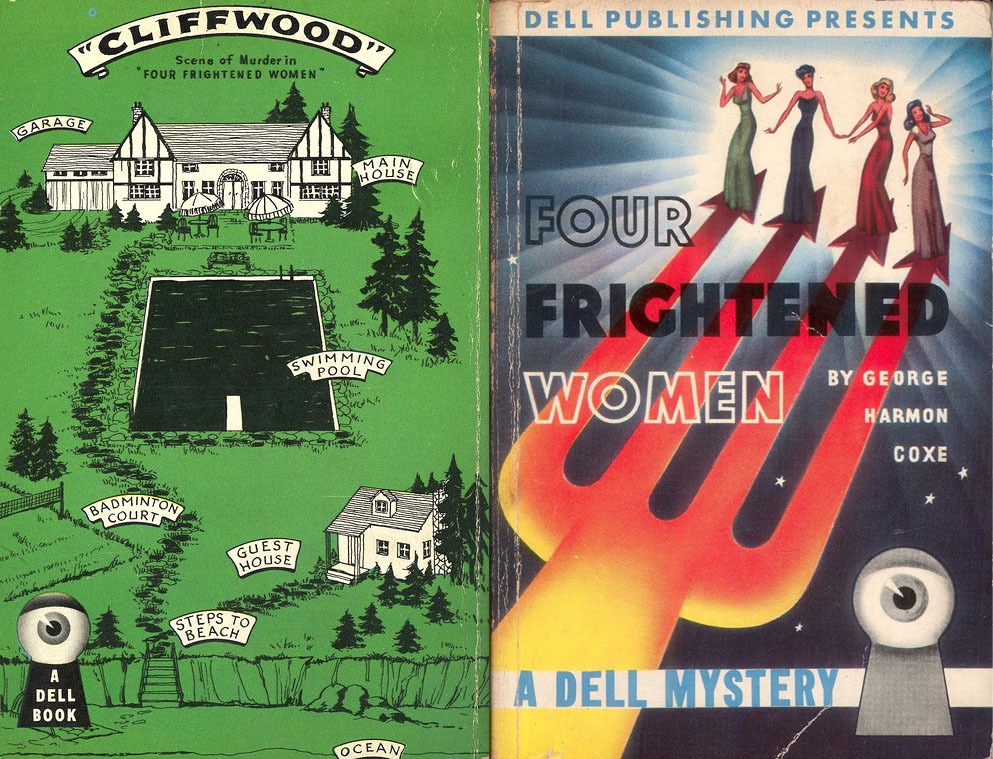
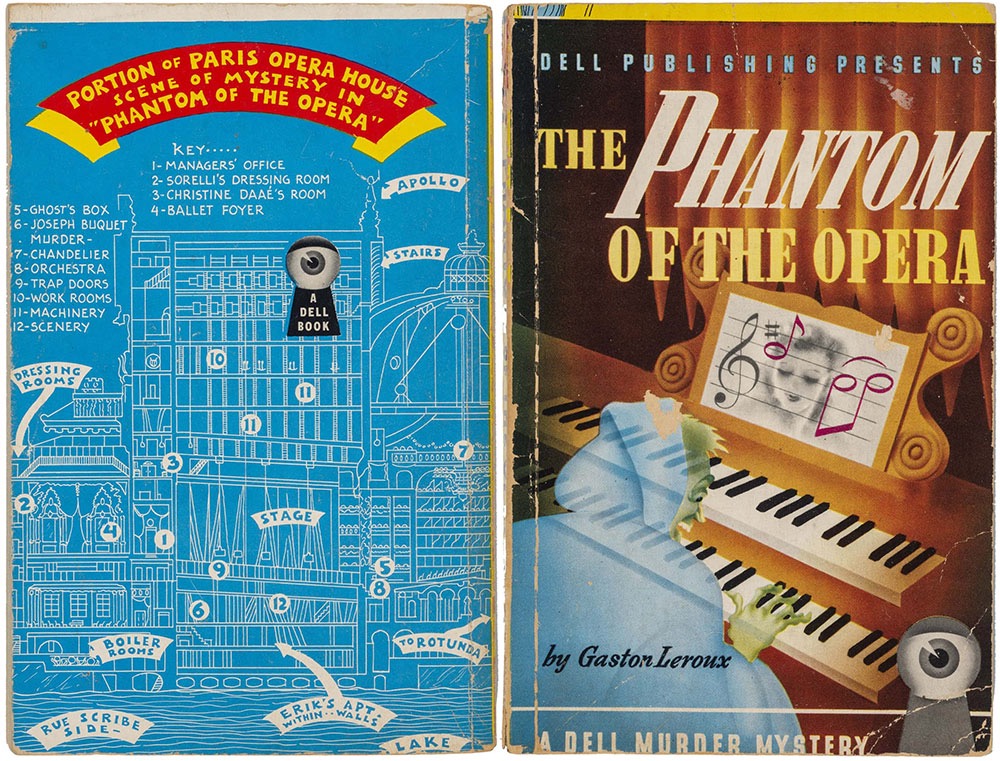
Dell 5, Four Frightened Women by George Harmon Coxe, was the first of the mapbacks. On the back cover of each of these books is, naturally, a map—a cutaway bird’s-eye view of the apartment building, house, hotel or city-section in which the events of the book take place. These drawings were generally quite faithful to the books; the most careful one was probably the map sketched by author Hake Talbot for his own book, Rim of the Pit (Dell 173), and executed, as were most of the mapbacks, by Ruth Belew.

Almost all Dell Books published until 1951 were provided with a mapback; beginning in that year, the practice was gradually abandoned. Dell’s sales department hated the idea; they found the maps unnecessary and noncommercial, and felt that back covers could better be reserved for advertising blurbs.

The Book of the Paperback: A Visual History of the Paperback Book (1982) by Piet Schreuders

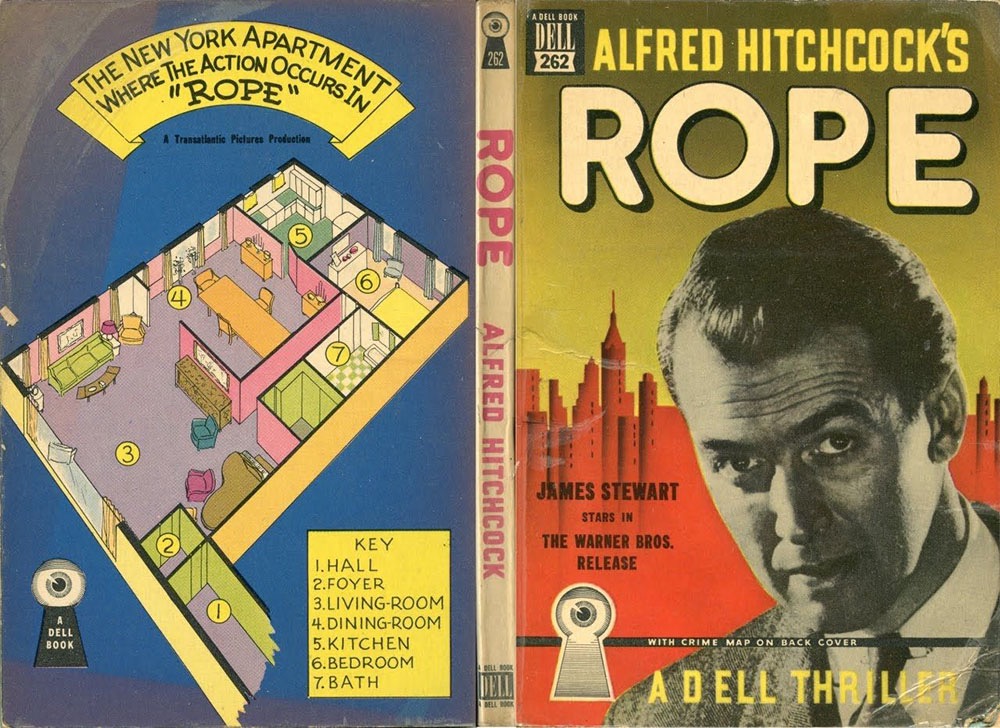
I’ve long been fascinated by the Dell Mapbacks even though I’ve only ever seen pictures of them. (And to stave off the inevitable emails: no, I don’t want to buy any.) They form a truncated path in the evolution of the paperback book, one where the gimmick of creating a map for each title was globally applied, regardless of whether the contents warranted such a thing. Dell began life as a publisher of mysteries, hence the logo of an eye peeping through a keyhole. Maps are more justifiable if applied to a detective story, where a map may help the reader picture the layout of a location or trace the movements of a character. But once Dell branched out into other areas of fiction the maps seemed increasingly superfluous, especially those that limit themselves to the plan of an office or apartment. For some there’s also the question of accuracy. The novelisation of Alfred Hitchcock’s Rope shows a map of the apartment that doesn’t correspond to the layout of the rooms as they’re seen on the screen, something that readers who’d seen the film would have been quick to recognise.

mapback04.jpg

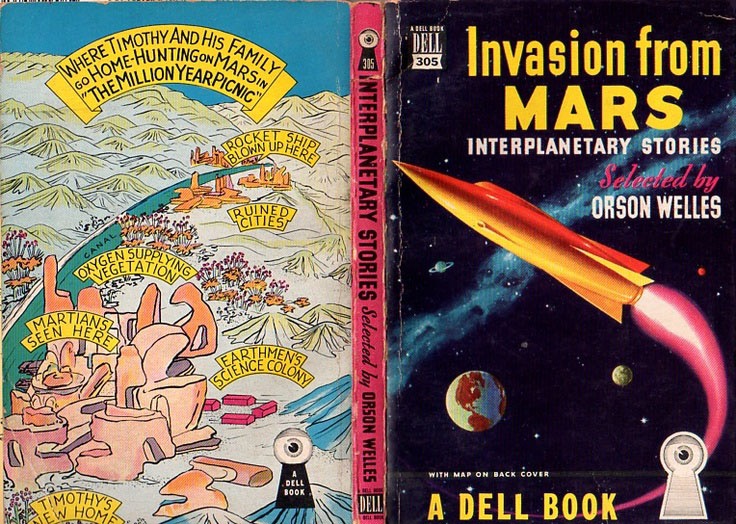
For this post I went looking for a few of the more unusual mapbacks, prompted by the discovery of Invasion from Mars. I’d been watching an Orson Welles’ question-and-answer session from 1982 which was recorded after a screening of Welles’ adaptation of The Trial. Welles declares at one point that he “used to write for the pulps, as we called them then”. The claim surprised me. I knew that Welles had been writing newspaper columns in the 1940s; he’s also credited as the author of a novel, Mr Arkadin (1955), which was actually written by a Frenchman, Maurice Bessy, whose serialised adaptation of Welles’ Mr Arkadin screen story was published in novel form. Invasion from Mars seems to be Welles’ sole encounter with pulp-land unless you include the pulpy origins of The Lady from Shanghai and Touch of Evil. Invasion from Mars collects a handful of Mars-related SF stories, together with the Howard Koch script for the Mercury Theatre radio broadcast of The War of the Worlds. The superfluous map on this occasion is for The Million Year Picnic, one of Ray Bradbury’s Martian Chronicles stories. Dell didn’t publish very much science fiction so the Mars book and First Men in the Moon are the only titles I’ve seen with maps showing extraterrestrial locations. Would-be collectors may like to know that after writing a history of the paperback book Piet Schreuders put together a short guide to collecting this series, The Dell “Mapbacks”, which was published in 1997.

• Further reading: Dell Mapbacks: A History.
Dell Mapbacks (sorted). An extensive cover collection at Flickr.

mapback03.jpg

mapback06.jpg

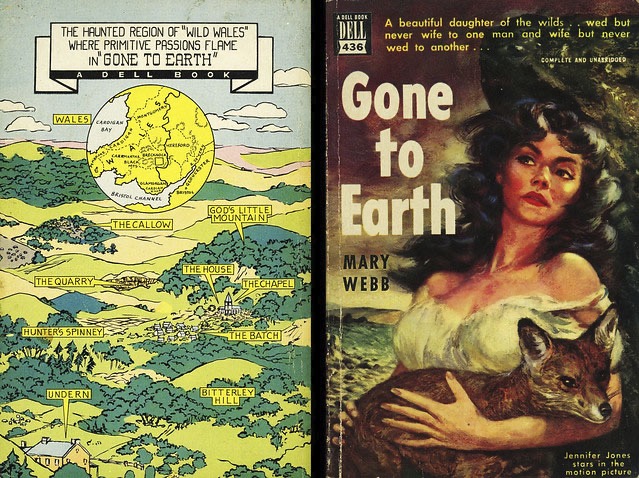
Another film tie-in, published for the US release of Powell & Pressburger’s Gone To Earth (1950).

mapback01.jpg

Continue reading “Dell Mapbacks”

Weekend links 808

kometen.jpg

Comets from Meyers Konversationslexikon (1885–90).

• At The Daily Heller: Steven Heller reviews A Life in Ink, a new monograph about the art of Ralph Steadman. Heller is full of praise for Steadman, and discusses commissioning his work for The New York Times. But in his bewilderment at Steadman’s lack of a knighthood he seems unaware of the degree to which state honours are frequently refused by Britons, especially those who position themselves in opposition to the established order. Americans are obsessed with awards and “halls of fame”, and appear to regard Britain’s state honours as something like the Oscars with a royal seal, rather than what JG Ballard once described as “a Ruritanian charade that helps to prop up the top-heavy monarchy.” If Steadman has deliberately shunned the honours list he’d be joining a venerable company.

• “In mid-19th century Italy, two eccentric aristocrats set forth on parallel projects: constructing ostentatious castles in a Moorish Revival style. Iván Moure Pazos tours the psychedelic chambers of Rochetta Mattei, optimised for electrohomeopathic healing, and Castello di Sammezzano, an immersive, orientalist fever dream.”

• New music: Ithaqua by Cryo Chamber Collaboration is this year’s installment in the Lovecraft-themed album series (previously) from Cryo Chamber. Also this week: Analog 2025 by Various Artists; and Flux (music for a performance by still still / Marta & Kim) by Rutger Zuydervelt and Lucija Gregov.

For all their bravura and maximalism, Powell and Pressburger understood the power of leaving things out, building into their films chasms that the mind must leap, gaps that the imagination must fill. Like Joan Webster, we discover that we don’t want things to be made too easy. We want to catch our own fish rather than have them delivered, to swim in the ocean rather than in a pool.

Imogen Sara Smith on I Know Where I’m Going, one of the films from Michael Powell and Emeric Pressburger’s golden decade, the 1940s

• Among the new titles at Standard Ebooks, the home of free, high-quality, public-domain texts: In the Days of the Comet by HG Wells.

• At the BFI: David Parkinson selects 10 great Sherlock Holmes films and TV adaptations.

• Winning entries for the Capture The Atlas Northern Lights Photographer of the Year.

• Books and original drawings by Austin Osman Spare on sale at Gerrish Fine Art.

• At Unquiet Things: The art of Chie Yoshii.

Kohoutek-Kometenmelodie (1973) by Kraftwerk | Cometary Wailing (1981) by Bernard Xolotl | Kometenmelodie Part 1 (1994) by 300,000 VK

Weekend links 714

agar.jpg

An Exceptional Occurrence (1950) by Eileen Agar.

• New music: The Endless Echo by Pye Corner Audio, coming soon from Ghost Box. PCA continue to fly the flag for the original Ghost Box mission of bringing various forms of weirdness to electronic music. The new album “draws inspiration from scientific and science-fictional notions about the nature of time and the idea that it may be entirely unreal”. Over at Bandcamp there’s Here by Stefano Guzzetti and Ian Hawgood.

• “Powell and Pressburger emerge from this film, more than ever, as sui generis: inventors of their own kind of film, gentleman amateurs of cinema in some ways…” Peter Bradshaw reviewing Martin Scorsese’s Made in England: The Films of Powell and Pressburger.

Velocity and Creation, a pair of short films by Vadim Sherbakov made with magnets, glitter and inks. The scores are too bombastic but I like the visuals.

Art is for increasing life. That, I believe, after all the other purposes receive their due, is really what it’s for—why we revere it, why we give our hearts to it. What do I mean by increasing life? How can we live more, given that we can’t live longer? Through attention and intensity. Being fully present to the world, and feeling without reservation: the two things that making art requires and that experiencing it involves.

William Deresiewicz on thirteen ways of looking at art

Modern Illustration is a project by illustrator Zara Picken, featuring print artefacts from her extensive personal collection.

• Mix of the week: Aquarium Drunkard presents Pulp Jazz: Twenty-First Century Groove Music. Great stuff.

• At Public Domain Review: Tales of the Catfish God: Earthquakes in Japanese Woodblock Prints.

• At The Quietus: Jonathan Meades interviews Saint Leonard. And vice versa.

• At Dennis Cooper’s: Michelangelo Antonioni Day.

• The Strange World of…Bill Laswell.

Creation (1971) by Arthur Brown’s Kingdom Come | Création Du Monde (1971) by Vangelis | Creation (1977) by Tangerine Dream

Peeping Tom: A Very British Psycho

pt1.jpg

Peeping Tom is a very tender film, a very nice one. Almost a romantic film. I was immediately fascinated by the idea: I felt very close to the hero, who is an “absolute” director, someone who approaches life like a director, who is conscious of and suffers from it. He is a technician of emotion. And I am someone who is thrilled by technique, always mentally editing the scene in front of me in the street, so I was able to share his anguish.

Michael Powell quoted in Powell, Pressburger and Others, edited by Ian Christie, 1978

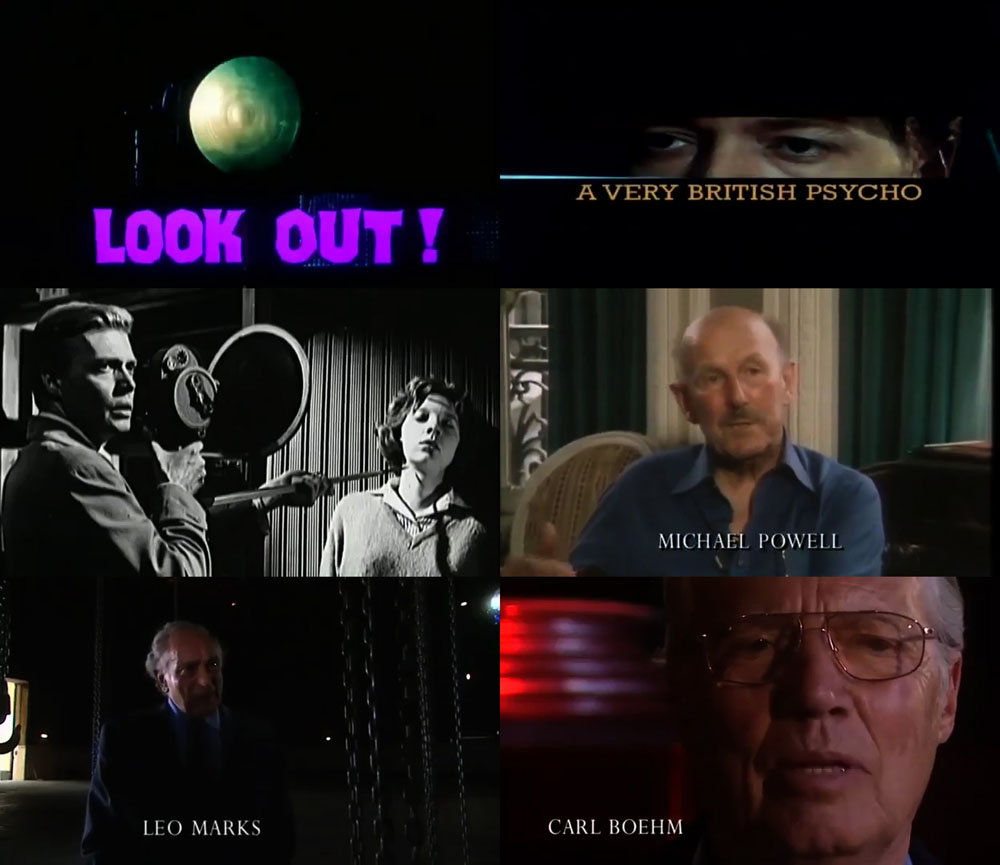
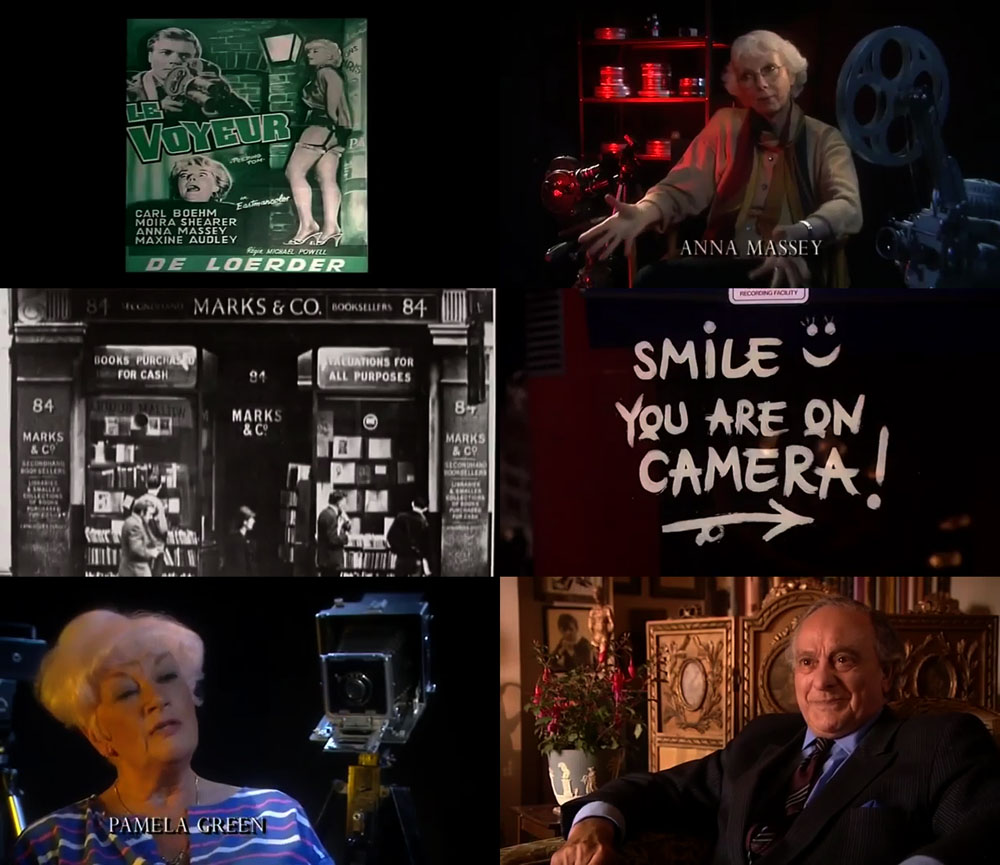
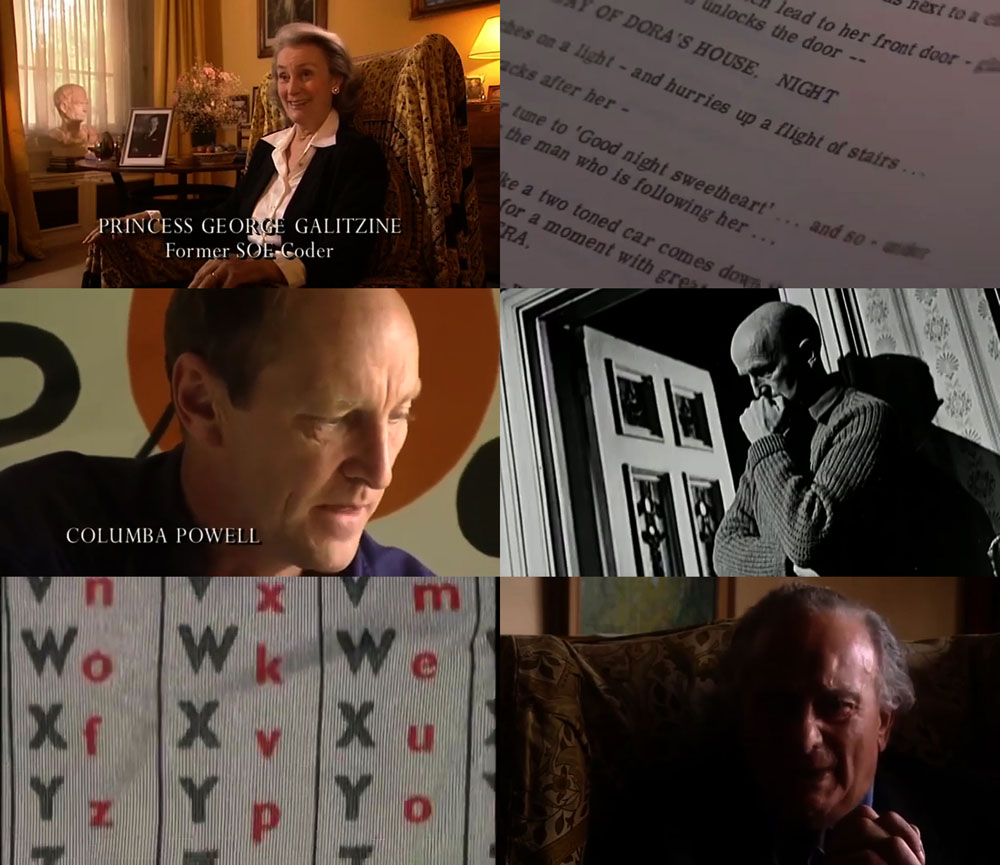
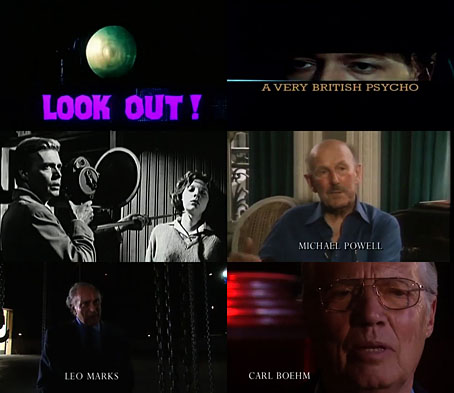
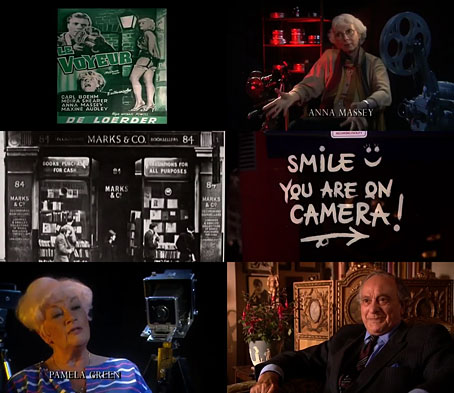
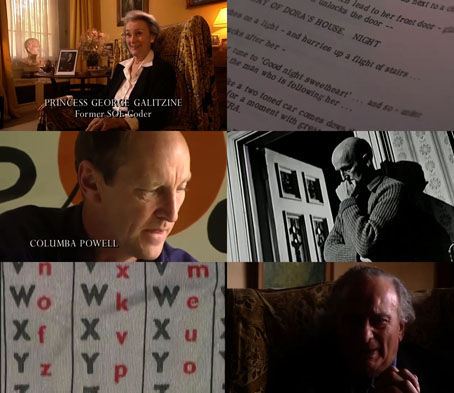
Michael Powell’s Peeping Tom (1960) has been released on disc several times in recent years, but Christopher Rodley’s Channel 4 TV documentary about the film and its writer, Leo Marks, has so far only been reissued on a Criterion DVD which appeared in 1999. A Very British Psycho, which was made in 1997, deserves to be paired with its subject more than most film documentaries since this is the only substantial film portrait of Leo Marks (1920–2001), a figure whose contribution to the film is often overshadowed by discussion of Michael Powell’s career. Marks was a fascinating character, the son of Benjamin Marks, owner of the famous bookshop at 84 Charing Cross Road, and a man obsessed with riddles and codes, a preoccupation that led to his employment at the Special Operations Executive during the Second World War. The years he spent devising codes for British spies, many of whom never returned from their missions, is explored at some length in Rodley’s film. After the war Marks turned to screenwriting. Peeping Tom came about when he and Powell were planning a film on the life of Freud which was pre-empted by John Huston’s film dealing with the same subject. Peeping Tom still contains a fair amount of Freudian symbolism—staircases, keys, ladders, psychoanalysts, not to mention the phallic camera/weapon that the killer uses—but the premise is much more interesting than a Freudian biopic would have been.
pt2.jpg

Rodley’s title—A Very British Psycho—explicitly pits Powell’s film against the more famous Hitchcock murder mystery that was released in its wake. Much as I like Hitchcock’s films, especially his own examination of the peeping tom theme, Rear Window, everything in Hitchcock is always subservient to the story. Peeping Tom has a storyline that’s satisfying enough but the script is self-conscious and cerebral in a way that Hitchcock never was. Marks and Powell undertake a psychosexual analysis of cinema itself, presented in the guise of a story about a film-obsessed killer whose impulses have been caused by the traumas induced by his psychoanalyst father. There was no precedent for this in British cinema, and there wouldn’t be much like it in cinema intended for a general audience for at least another ten years. A list of the film’s many cinematic allusions and in-jokes is beyond the remit of this post but allow me to mention: the comparison drawn between the red lights favoured by prostitutes, and the red lights of photographic darkrooms and film studios; the numerous references to vision and the lack of it, with a blind woman played by a sighted actress (Maxine Audley), and an inept film director played by a partially-sighted actor (Powell regular Esmond Knight); the jokey names: the inept director is “Arthur Baden” (a play on the founder of the Scout movement, Baden-Powell, which suggests that without a Powell this is what British cinema ends up with), while the cost-conscious studio boss, “Don Jarvis” is a reference to John Davis, the head of the Rank organisation. Powell and Marks implicate themselves in the cinematic crimes in a manner that Hitchcock never would have done, with the killer, Mark Lewis, having a name that’s a reversal of Leo Marks, while Powell himself appears in home-movie flashbacks as the traumatising father, with one of Powell’s own sons playing Lewis as a child.
pt3.jpg

The grown-up son, Columba Powell, is one of Rodley’s interviewees, together with actors Carl Boehm, Anna Massey and Pamela Green. Also interviewed are some of the British critics who condemned the film on its release, and thus ended Powell’s career in Britian. One of these, the often splenetic Alexander Walker, suggests that Hitchcock wisely avoided showing Psycho to the British press to avoid a similar scandal, but Hitchcock’s oeuvre was filled with psycho-killers all the way back to the silent era, which suggests to me that the reaction wouldn’t have been the same at all. The problem for Powell was that nothing in his career could have led anyone to expect a film as nasty as Peeping Tom, and he had the audacity to put himself into the picture as the prime cause of all the nastiness. Critics had often accused Powell and Emeric Pressburger of lapses in taste but the pair were highly regarded in the 1940s; A Matter of Life and Death was the first film to be screened at a Royal Film Performance in 1946. Powell and Marks discomforted the British press by showing pornography being created in a room above a typical corner newsagents, with the resulting photographs being sold in the shop downstairs while young girls are buying sweets. And that’s before you get to the more insidious discomfort induced in an audience watching a film about murders that features the killer watching his own films of the killings. French critics were fascinated by all of this but their enthusiasm wasn’t enough to save Powell’s career or even do much for the film itself. The reappraisal only began in 1978 with the first BFI retrospective of Powell’s work. As for Leo Marks, nothing else he worked on was this memorable. He had another stab (so to speak) at the psycho theme in 1968 with Twisted Nerve, directed by Roy Boulting, but the only good thing about that film is the score by Bernard Herrmann.

The copy of A Very British Psycho at YouTube is complete but slightly altered by having all the film clips reduced to sequences of stills, no doubt to avoid copyright complaints. The soundtrack is still intact, however. I don’t mind this too much since I dislike those disc extras that always start off by showing you several minutes of the film you’ve just been watching.

Previously on { feuilleton }
Powell’s Bluebeard on blu-ray
The South Bank Show: Michael Powell
Powell & Pressburger: A Pretty British Affair
The Rite of Spring and The Red Shoes
Michael Powell’s Bluebeard revisited
The Tale of Giulietta