
Weekend links 833

hyde.jpg

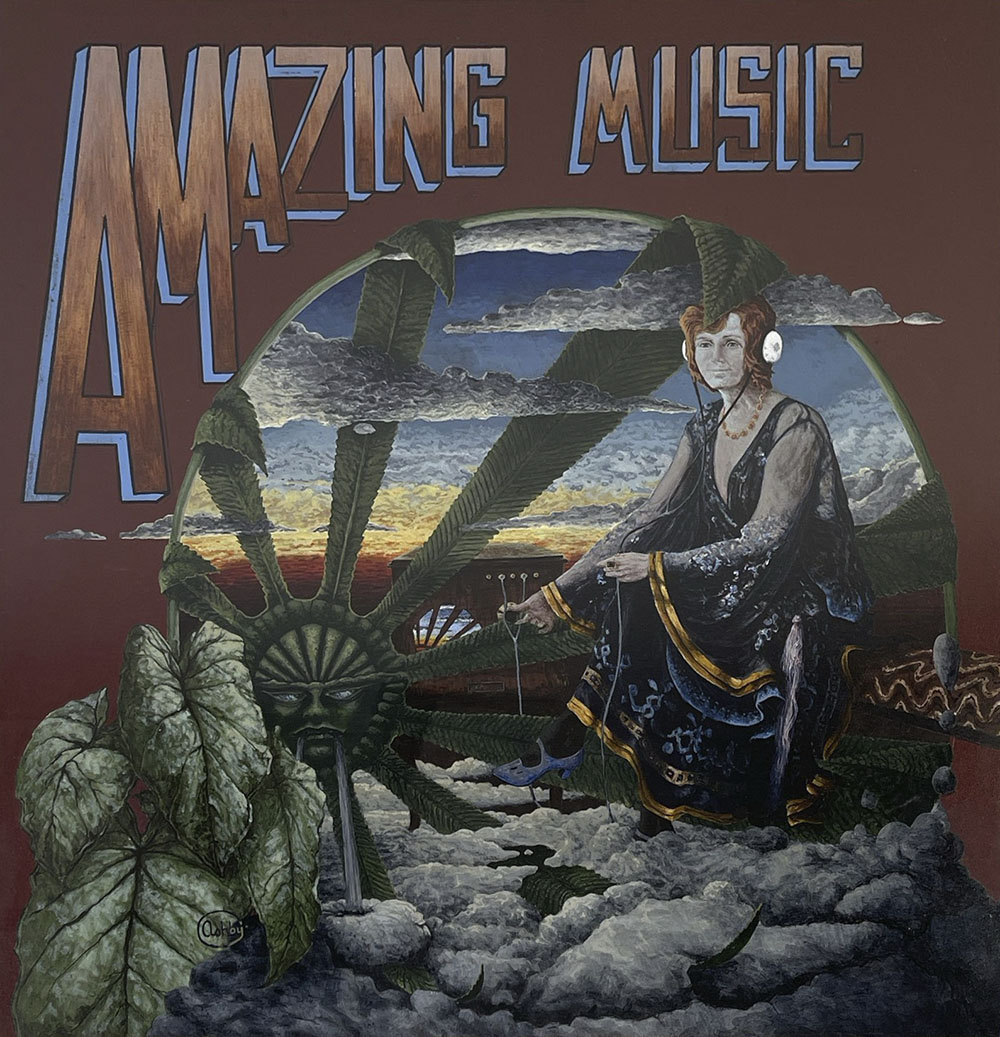
Tony Hyde’s original artwork for the front cover of Astounding Sounds, Amazing Music by Hawkwind. The painting is being auctioned later this month.

• At the Daily Heller: Steven Heller reprints his 2012 Atlantic review of The Graphic Canon, a three-volume collection of visual adaptations of works of literature. The collection was edited by the late Russ Kick, and includes my own condensation of The Picture of Dorian Gray.

• At Dennis Cooper’s: Bill Hsu presents…21st Century Nightmares: Dark Animations by Cristóbal León/Joaquín Cociña, Hugo Covarrubias, Christiane Cegavske, John Frame, Saori Shiroki, Joe Hsieh, Phil Tippett, Robert Morgan, Shengwei Zhou.

• At Colossal: In Los Angeles, 70 artists transform a vacant hospital into a sprawling art experience.

What we were doing was rooted in that specific moment, but looking back, it also seems to resonate strongly with the present—particularly in terms of how we understand media, perception, and reality itself. This is something I’ve been thinking about again recently, especially with the renewed activity around Cabaret Voltaire. It brings into focus the extent to which earlier work now reads almost as a form of prefiguration. At the time, though, much of it was intuitive. We didn’t necessarily have a fully formed theoretical framework for what we were doing—we were artists, and we were working instinctively. It’s really only in retrospect that some of those ideas begin to take on a clearer shape and meaning.

Stephen Mallinder talking to Nicolas Ballet about Cabaret Voltaire, the group’s history and working methods

• New music: The Endless Dance by Hannah Peel; Helt by Fjall; Air Signs by Anthéne.

Adam Rowe is writing a new book about science fiction art.

• Steven Heller’s font of the month is Brutal Types.

• Mix of the week: Isolatedmix 135 by Aspetuck.

Brute Reason (1983) by Bernard Szajner | Let’s Get Brutal (1986) by Nitro Deluxe | Brutal But Clean (1994) by Cabaret Voltaire

Weekend links 808

kometen.jpg

Comets from Meyers Konversationslexikon (1885–90).

• At The Daily Heller: Steven Heller reviews A Life in Ink, a new monograph about the art of Ralph Steadman. Heller is full of praise for Steadman, and discusses commissioning his work for The New York Times. But in his bewilderment at Steadman’s lack of a knighthood he seems unaware of the degree to which state honours are frequently refused by Britons, especially those who position themselves in opposition to the established order. Americans are obsessed with awards and “halls of fame”, and appear to regard Britain’s state honours as something like the Oscars with a royal seal, rather than what JG Ballard once described as “a Ruritanian charade that helps to prop up the top-heavy monarchy.” If Steadman has deliberately shunned the honours list he’d be joining a venerable company.

• “In mid-19th century Italy, two eccentric aristocrats set forth on parallel projects: constructing ostentatious castles in a Moorish Revival style. Iván Moure Pazos tours the psychedelic chambers of Rochetta Mattei, optimised for electrohomeopathic healing, and Castello di Sammezzano, an immersive, orientalist fever dream.”

• New music: Ithaqua by Cryo Chamber Collaboration is this year’s installment in the Lovecraft-themed album series (previously) from Cryo Chamber. Also this week: Analog 2025 by Various Artists; and Flux (music for a performance by still still / Marta & Kim) by Rutger Zuydervelt and Lucija Gregov.

For all their bravura and maximalism, Powell and Pressburger understood the power of leaving things out, building into their films chasms that the mind must leap, gaps that the imagination must fill. Like Joan Webster, we discover that we don’t want things to be made too easy. We want to catch our own fish rather than have them delivered, to swim in the ocean rather than in a pool.

Imogen Sara Smith on I Know Where I’m Going, one of the films from Michael Powell and Emeric Pressburger’s golden decade, the 1940s

• Among the new titles at Standard Ebooks, the home of free, high-quality, public-domain texts: In the Days of the Comet by HG Wells.

• At the BFI: David Parkinson selects 10 great Sherlock Holmes films and TV adaptations.

• Winning entries for the Capture The Atlas Northern Lights Photographer of the Year.

• Books and original drawings by Austin Osman Spare on sale at Gerrish Fine Art.

• At Unquiet Things: The art of Chie Yoshii.

Kohoutek-Kometenmelodie (1973) by Kraftwerk | Cometary Wailing (1981) by Bernard Xolotl | Kometenmelodie Part 1 (1994) by 300,000 VK

Weekend links 792

caroff.jpg

West Side Story (1961) poster designed by Joe Caroff.

• “From the very moment of its inception, the Wound Man was an image intimately tied to actual practice. He was in fact many, many things at once: epistemic diagram, medical tool, affective muse, technical spur, international artwork.” Jack Hartnell explores the tortured paths of book illustration known as the Wound Man.

• At The Daily Heller: The late Joe Caroff, who Steven Heller calls “the most prolific designer you’ve never heard of”.

• From V to Vineland and Inherent Vice: John Keenan ranks Thomas Pynchon’s books.

• Sometimes Easy, Sometimes Hard: Toby Manning on Harmonia’s Deluxe at 50.

• At Unquiet Things: The infinite cosmos of Martina Hoffmann.

• Mix of the week: A mix for The Wire by Sanam.

• The Strange World of…Joe McPhee.

• RIP Terence Stamp.

Gravity’s Angel (1984) by Laurie Anderson | Wounder (2006) by Burial | Melodie Is A Wound (2025) by Stereolab

Weekend links 783

robinson.jpg

An illustration by William Heath Robinson for A Midsummer Night’s Dream (1914).

• New music: How To Shoulder The Radiance Of Revelations by Dadub; Leviathan by Stephen Roddy; and Echoes Of The Hollow Earth by Cryo Chamber.

• At Sight & Sound: “Every time I look at the film, it gets better.” Steven Soderbergh on Jaws.

• At Public Domain Review: The Language of Form: Lothar Schreyer’s Kreuzigung (1920).

Leafing through the merveilleux-scientifique novels today allows for a dual rediscovery: firstly, it uncovers the previously unrecognised richness of Belle Époque scientific fiction, which did not perish with the works of Verne. The stories take in journeys to Mars, solar cataclysms, reading of auras, psychic control, weighing of souls, death rays, alien invasions, even strolls among the infinitesimally small. But exploring the genre also offers insights into the cultural history of the era, marked by a significant permeability between science and pseudo-science. Reading this work, we can learn a lot about the aspirations, fears and beliefs of early 20th-century Europe.

Fleur Hopkins-Loféron on the evolution of French science fiction after Jules Verne

• Mix of the week: A Twin Peaks mix for The Wire by Lori Eschler & Dean Hurley.

• Steven Heller’s font of the month is Kefir.

Patrick Wolf’s favourite albums.

ultrawolvesunderthefullmoon

Frou-Frou Foxes In Midsummer Fires (1990) by Cocteau Twins | Midsummer Night (2010) by The Time And Space Machine | Midsummer Boulevard (2022) by Hawksmoor

Weekend links 768

glitch.jpg

The Mona Lisa as it looks run through the Random Pixelate setting in Glitch Lab.

• “We don’t have enough Dada in this world of too much data. Something is needed to break-through the over-curated simulacrum that is the online world in order to let in a bit of non-artificial light. One way to make a break is through the deliberate cultivation of the glitch.” Justin Patrick Moore on circuit-bending, glitch music and Surrealist composition.

• The seventh installment of Smoky Man’s exploration of The Bumper Book of Magic has been posted (in Italian) at (quasi). There’s an extract in English at Alan Moore World.

• New music: Remember The Clouds by Philippe Deschamp, and Requiem For The Ontario Science Centre by Tony Price.

• Michael Brooke offers suggestions for where to begin with Polish film director Wojciech Has

• At Printmag: A new book shares the artistic odyssey of Iranian designer Farshid Mesghali.

The Letraset Graphic Materials Handbook for the year 1987.

• Steven Heller’s font of the month is Cubo.

• Yet more Polish film posters.

A cat’s eye view of Japan.

• RIP Roy Ayers.

Glitch (1993) by Moody Boyz | Glitch (1994) by Autechre | Glitch (2011) by Brian Eno And The Words Of Rick Holland