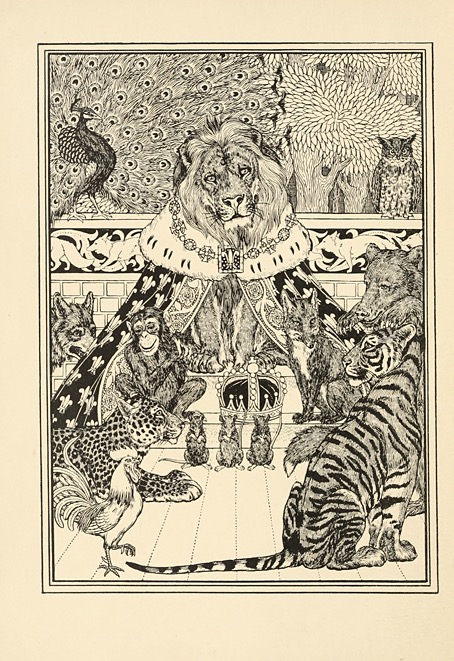
Gargoyles, Chimeres, and the Grotesque in French Gothic Sculpture

gargoyles01.jpg

Good books about gargoyles aren’t easy to find but this one, edited by Lester Burbank Bridaham, is better than many I’ve seen. Gargoyles, Chimeres, and the Grotesque in French Gothic Sculpture was published in 1930, and is mostly a collection of photographs, with the text kept to a minimum at the front of the book. The nature of the subject—eroded soot-stained sculptures seen against eroded soot-stained walls—doesn’t always help the photographer but the book makes up in quantity what it lacks in quality. There are many photographs here, often four to a page over 200 pages. Dover reprinted the book in a large-format edition in 2006.

gargoyles02.jpg

These gargoyles and grotesques show very plainly the complete freedom under which the old craftsmen worked and the immense originality and variety that were the result. Here are hundreds of spontaneous creations, each as individual as possible, and not only this but many of them show a brilliancy of space composition and a fineness of line that would not shame a great sculptor. Craftsmen these, but also creative artists.

Ralph Adams Cram in the introduction

gargoyles03.jpg

The authors divide their study according to subject: Last Judgments, Gargoyles of different ages, Chimeras (or hybrid creatures), and Heads. Gargoyles are often hybrid creatures, of course, but the broad difference between a gargoyle and a chimera in the architectural sense would be that gargoyles often serve a purpose as a waterspout whereas chimeras are solely decorative. Gargoyles are a good example of an architectural solution that evolved into an element of architectural style. Spouts were required to direct rainwater away from the lower areas of the building; decoration helped incorporate the spouts into the building’s structure then the decoration became a traditional part of the Gothic style. For a time, anyway. You don’t see many gargoyles among the buildings designed by the rather pious English revivalists in the 19th century, but the great French revivalist and restorer, Eugène Viollet-le-Duc, enjoyed the grotesquery of the old cathedrals, and it’s he who was responsible for the famous chimeras that look down on Paris from the balconies of Notre Dame.

gargoyles04.jpg

gargoyles05.jpg

Continue reading “Gargoyles, Chimeres, and the Grotesque in French Gothic Sculpture”

Stone Elegy

stone-elegy.jpg

A new piece of work which I completed recently, this is a poster for a short film, Stone Elegy, written and directed by Shane Smith. The film is a drama set in Ireland during the Iron Age, with a narrative that encompasses lost love, armed conflict and a touch of magic. The brief from Thin Veil Pictures was for something in the style of the cover I created for Alan Moore’s Voice of the Fire, a window-like frame of multiple panels in which various figures and details from the story could be seen. The Moore cover is very hard-edged and brightly coloured, going deliberately for a stained-glass window effect. The director and producer liked the formal frame but wanted the look of the poster to be darker, softer and more diffuse which has led to my doing this in a much more painterly style than I’d normally use. I’m very pleased with the results (as are the film-makers), in part because achieving this look with digital tools is no longer the chore I’ve felt it to be in the past. This has been achieved by a great deal of trial and error over the past few years, fine-tuning a small range of digital brushes that now behave in the ways I’d want a regular paintbrush to behave. One thing you never want when drawing or painting is to feel that the tools are getting in your your way.

Stone Elegy was a crowd-funded project so the poster is being used in part as a reward for the backers of the film. The print version will have the credits running at the foot of the poster. There’s a teaser for the film here (actually a self-contained piece), and a proper trailer here.

Previously on { feuilleton }
Voice of the Fire by Alan Moore

Weekend links 836

narcissus.jpg

Narcissus (1881) by Gyula Benczúr.

• AnOther reposts an old interview with Dennis Bell of the Bob Mizer Foundation to coincide with an exhibition of homoerotic drawings from Physique Pictorial at JW Anderson Soho, London. The drawings by the pseudonymous (and still unidentified) “Spartacus” don’t bear comparison to those by Mizer’s celebrated discovery, Tom of Finland, but they’re part of a pioneering history. There’s more “Spartacus” at Wallpaper*.

• “Ever the deviant, Bidgood initiated a style that rebelled against the dominant sensibility of his physique-magazine peers, treating his subjects with the same love that a studio-era auteur may have bestowed upon his leading ladies.” Mayukh Sen on the tawdry, opulent world of James Bidgood’s underground classic Pink Narcissus.

• “Düsseldorf. Düsseldorf. Düsseldorf.” Samuel Cox on 50 years of La Düsseldorf by La Düsseldorf.

[Adrian] Sherwood argues that Perry’s antics often mask his genius. “What upset me in later years was people marvelling at him as some kind of joke,” says Sherwood. People saw a clown, when they should have seen someone who re-engineered music. From reimagining the studio as an instrument, pushing dub reggae to the sonic limits or inventing sampling, few producers have come anywhere close to matching Perry’s impact.

Lanre Bakari on the life and musical work of Lee “Scratch” Perry

• New music: Arles 75 Drei by Can; Voyager by PJ Harvey; Fantasy by Julia Holter.

• At the BFI: Adam Nayman chooses 10 great Canadian debut features.

• At Colossal: James Turrell’s 100th Skyscape opens in Aarhus.

• At The Daily Heller: Vector art by Catalina Estrada.

• A belated RIP for writer Sandy Robertson.

Sky – Rhythm (1972) by Dub Specialist | Skyliner (2006) by Boards Of Canada | The Sky Torn Apart (2018) by Paul Schütze

The Father of Serpents

yig1.jpg

The legend of Yig, Father of Serpents, remained figurative no longer, and I started with loathing when told of the monstrous nuclear chaos beyond angled space which the Necronomicon had mercifully cloaked under the name of Azathoth. — The Whisperer in Darkness

Another month, another Lovecraftian portrait. Yig was the last of the Photoshop melanges from 1999 that I felt a need to replace for the new edition of The Haunter of the Dark, which means that the whole of the Great Old Ones section of the book is now complete. Back in 1999 I wasn’t really sure what to do with Yig. The snake god described as “the Father of Serpents” was partly an invention of Zealia Bishop who paid HP Lovecraft to flesh out a trio of outlines which were subsequently sold as stories to Weird Tales.

yig-wt.jpg

Illustration by Hugh Rankin, 1929.

The first of these, The Curse of Yig, was published in November 1929, and credited to Zealia Brown Reed as Bishop was then known. The piece is essentially a revenge scenario in which a woman in the wilds of 19th-century Oklahoma has to suffer the supernatural consequences when she kills a nest of rattlesnakes, consequences which, as in The Dunwich Horror, result in monstrous births. The god that protects the snakes is described in Native American tellings as “an odd half-anthropomorphic devil of highly arbitrary and capricious nature”. Lovecraft typically expands the scope of the tale with suggestions that Yig is connected to the Aztec and Mayan myths of Quetzalcōātl and Kukulkan. The “Father of Serpents” is more corporeal than Lovecraft’s nebulous interdimensional entities but Yig was quickly added to the Mythos pantheon, being named along with Cthulhu and Shub-Niggurath in another Bishop/Lovecraft story, The Mound.

yig2.jpg

My 2015 illustration for Rattled by Douglas Wynne.

For my 1999 portrait I used a number of old snake illustrations that I collaged and mutated until they formed an appropriate composition. As with some of the other portraits in this section of the book, the final piece looked okay for the time but my satisfaction with it didn’t last. The new version is based in part on an earlier portrait of Yig that I drew in 2015 for Rattled, a story by Douglas Wynne that was published in The Gods of HP Lovecraft. Wynne’s story is closer to The Curse of Yig than to Lovecraft’s more cosmic excursions, and required a suitably earthbound illustration.

The new portrait follows the form of several of the other Great Old Ones pieces by being hieratic and almost completely symmetrical. Our bodies are generally symmetrical but absolute symmetry is a rare thing in nature, which may explain why you see it so often in religious art. Perfect symmetry suggests a supernatural purity that can’t be achieved outside mathematics, thus an ideal quality for the depiction of supernatural entities.

sephiroth.jpg

The Sephiroth chart from the second edition of the book, 2006.

If you’re a regular reader you’ll know by now that The Great Old Ones was a collaboration with Alan Moore in which Alan mapped the Mythos gods across the Kabbalistic Tree of Life, while also writing an occult evocation for each. Yig is placed at Tiphereth, the sphere of beauty, which occupies an important central position on the Kabbalistic Tree. I remember Alan being surprised and pleased when I sent him a print of the artwork which had a radiant halo of snake tails positioned at the top of the picture. I didn’t know that Yig was going to be assigned to Tiphereth but the snake halo is a fitting symbol for a sphere associated with the Sun, and whose corporeal symbol is a splendid king. My new portrait acknowledges these aspects while bearing in mind that the Great Old Ones are closer to the demonic entities of the Qliphoth than to the traditional god forms of the Kabbalah. The new Yig has a spiky crown and a multitude of arms that correspond with the position of Tiphereth at the intersection of multiple Kabbalistic paths. (The arms also refer to the multi-armed Christ-like figure that I drew for the Tiphereth page in the Bumper Book of Magic.) As for the wings, these may be taken as a nod to Quetzalcōātl, the Feathered Serpent who happens to be named in Alan’s accompanying text. It’s not necessary for a reader to catch any of these references to appreciate either the text or the artwork but the details add a layer of additional meaning for the initiated.

Elsewhere on { feuilleton }
The Lovecraft archive

Previously on { feuilleton }
The Black Goat
Tsathoggua rising
H.P.L.
The return of the Crawling Chaos
Lettering Lovecraft
Weird ekphrasis and the Dunwich Horrors
Kadath and Yog-Sothoth
Another view over Yuggoth
Nyarlathotep: the Crawling Chaos

Weekend links 835

kites.jpg

Kites of Fukuroi and Distant View of Akiba in Totomi Province, from the series One Hundred Famous Views in the Various Provinces (1859) by Utagawa Hiroshige II.

• Coming soon from Strange Attractor: International Freak: Robin Farquharson and the Dream of Psychedelic Revolt by M. Syd Rosen.

• At the Daily Heller: the Brooklyn Botanical Garden looks back at the psychedelic Sixties with Flower Power.

• At the BFI: Sophia Satchell-Baeza selects 10 great queer American underground features of the 1970s.

• At Colossal: “Surreal Figures Step from Leonora Carrington’s Paintings into Shape of Dreams”.

• At Unquiet Things: The Surreal Paperback Visions of Richard Powers.

• The Reinvention of the Guitar in 13 Albums by Simon Reynolds.

• At Public Domain Review: The Art of Kite Flying (1430–1929).

• Mix of the week: DreamScenes – June 2026 at Ambientblog.

• New music: Cloud Machines by Berndt / Schmidt.

Kites (1967) by Simon Dupree And The Big Sound | Kites I (1999) by Brian Eno | Nuclear Kites (2023) by Hawksmoor