Weekend links 825

demeric.jpg

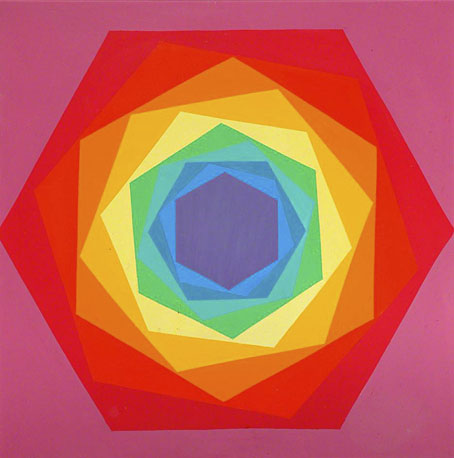
Hexagon Sequence II (c. 1970) by Rosalie de Meric.

• Boards Of Canada obsessives have been in a frenzy this week following the appearance of mysterious VHS cassettes sent at random to a small number of users of the Warp Records mail-order service. The contents of the tapes look like this. With the group having been silent for the past thirteen years there’s been an understandable flood of wild speculation on the BOC Reddit page, the supposition being that the tapes (and now an equally cryptic set of posters) mean that a new record release is on the way. We’ll find out soon enough. In the meantime, here’s DJ Food’s O Is For Orange 2025 (version 3), a Boards Of Canada-themed mix that I neglected to link to last year.

• “There is no artistic process that isn’t magical in that it’s an attempt to magically conjure an idea, something that is invisible and intangible, into material form…” Alan Moore (again) talking to Dominique Musorrafiti about art and magic. Also the comics business, which people really ought to stop asking him about when his reluctance to discuss his old work is so evident.

• “I’m not a commercial director—I’m not even a professional film-maker.” Jim Jarmusch talking to Amy Raphael about his career and his latest film, Father Mother Sister Brother. At Little White Lies, Claire Biddle examines the music in Jarmusch’s films and his collaborative albums.

• “Painting and sculpture influenced me greatly. You start to see the world, the outside, everything around you, the tone, with the eyes of seeing a picture that’s framed.” Irmin Schmidt talking to Adelle Stripe about his early life and Requiem, his new album.

• New music: All Clouds Bring Not Rain by Memorials; Afterlife Requiem by Those Who Walk Away; Where Light Pauses In The Silence Of The Sun by Abul Mogard & Rafael Anton Irisarri.

• At Colossal: Daniel Sackheim traverses Los Angeles’ noir side in The City Unseen.

• At Bandcamp Daily: Jim Allen on the sound of the ’70s French Underground.

• At the BFI: Rory Doherty selects 10 great Australian debut features.

NASA Johnson

Hexagon (1990) by Ruins | Octagon (1994) by Basic Channel | Triangles And Rhombuses (1998) by Boards Of Canada

Weekend links 799

cope.jpg

A Night Alarm: The Advance! (1871) by Charles West Cope.

• At Spoon & Tamago: Meet the artist creating humorous, nihonga-style images of daily life with their rescue cat.

• The thirteenth installment of Smoky Man’s exploration of The Bumper Book of Magic has been posted (in Italian) at (quasi).

• New music: I Remember I Forget by Yasmine Hamdan; Clearwater by Maps And Diagrams.

His boss was a cards-to-his-chest type named Boynt Crosstown—and here I admit to having dropped that in as the merest excuse to revel right now in more of Pynchon’s christenings: Dr. Swampscott Vobe, Wisebroad’s Shoes, Connie McSpool, Glow Tripworth de Vasta, Cousin Begonia, “child sensation Squeezita Thickly”—for this author’s longstanding genius there on that private swivel chair of the Department of Character Appellations matches long-gone Lord Dunsany’s for imaginary gods and cities.

William T. Vollmann reviews Shadow Ticket, the new novel by Thomas Pynchon

• At Colossal: Twelve trailblazing women artists transform interior spaces in Dream Rooms.

• At Public Domain Review: Ballooning exploits in Travels in the Air (1871 edition).

• At the BFI: Josh Slater-Williams on where to begin with the films of Satoshi Kon.

Colm Tóibín explains why he set up a press to publish László Krasznahorkai.

• At Print Mag: Ken Carbone on a pool of perfection in Paris.

• Mix of the week: Bleep Mix #310 by Rafael Anton Irisarri.

• Steven Heller’s font of the month is OTC Textura.

Ron Mael’s favourite albums.

Shadowplay (1979) by Joy Division | Shadow (1982) by Brian Eno | Shadows (1994) by Pram

Weekend links 784

ford.jpg

An illustration by HB Ford for The Violet Fairy Book (1906), edited by Andrew Lang.

• New music: An Aesthetic – Experiments in Tape by Hawksmoor; Leylines (2025 remaster) by Aes Dana; A Fragile Geography (10th Anniversary Reissue) by Rafael Anton Irisarri.

• “Skoda Auto designers reimagine Ferat Vampire car from cult classic 1981 Czech horror film”.

• At Colossal: Chris Ware illustrates a postwoman’s day to celebrate 250 years of USPS.

Seen today, the failure of Sorcerer looks like a grim prophecy of where the film industry would be headed in the years to come. It signaled that the creative ambitions of the New Hollywood, and its indulgence of stubborn renegade auteurs, had been cast aside for a new and dispiriting blockbuster ethos. Decades later, that ethos is still with us: a Hollywood dominated by digitally smoothed, effects-encrusted moviemaking, where every backdrop looks fake (even the real ones) and action sequences carry no physical weight. It’s a wretched landscape, and Sorcerer positively towers over it. To watch the film now, from its electric opening moments through its gaspingly bleak denouement, is to encounter something more than just a magnificent ruin or an object of cultish reclamation: a thwarted masterwork that is thwarted no longer.

Justin Chang on the bleak magic of William Friedkin’s Sorcerer.

• At the BFI: The Red Shoes wallpaper by the film’s designer Hein Heckroth.

All This Violence by Caspar Brötzmann Massaker.

• RIP Lalo Schifrin and Rebekah del Rio.

• The Strange World of…Jon Spencer.

In Ultra-Violet (1983) by Cinema 90 | Violet Ray Gas (2009) by Violet | Violetta (2012) by Demdike Stare

Miasmah in Manchester

miasmah.jpg

Out again to Trinity Church in Salford for an evening of musical performance from the Miasmah label. “Miasma” was a fitting word for this event since all three artists proved very adept at filling the humid air with great clouds of treated guitar chords, loops and electronic noise.

The aural miasms created by The Sight Below, aka Rafael Anton Irisarri and Simon Scott, reminded me of favourites Main whose Hz album I’d been playing earlier in the day. Main were among the first musicians in the 1990s to extend the sound of the electric guitar through samples and other processing, and everyone at the Trinity tonight was following a similar path, albeit with very distinctive, individual styles. The Sight Below add a pulse of heavy rhythm to their sheets of distortion. Svarte Greiner (Erik Skodvin of Deaf Center) meanwhile, played some great bowed Stratocaster then some even better squalls of Strat feedback. Very impressive all round and the combination of volume plus environment (old church carefully lit and perfumed by clouds of incense) showed again why these kind of intimate performances often trump their recorded equivalents; sometimes you just have to be there.

Previously on { feuilleton }
Deaf Center in Manchester
Machinefabriek in Manchester
Trinity rendezvous
Main