Weekend links 827

phillips.jpg

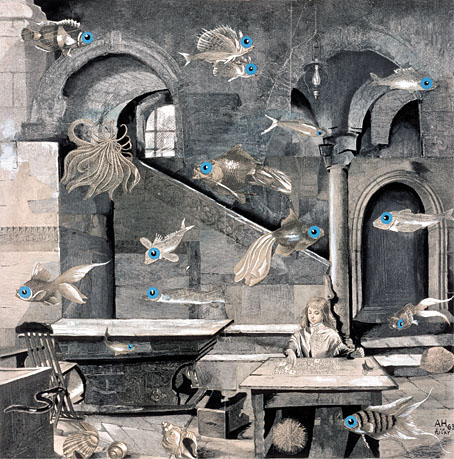
Dante in his Study with Episodes from the Inferno (1978) by Tom Phillips.

• “This set, featuring two of the surviving members of Cabaret Voltaire, is as clear and powerful as any of the live albums the group released while Richard H. Kirk was alive.” Derek Walmsley, reviewing what we’ve been told will be the last ever Cabaret Voltaire album. I can also vouch for its excellence but then I’m not what you might call an impartial listener. My copy arrived in the post only a couple of hours before Boards Of Canada made the announcement they’d been teasing for the past two weeks—the new BOC album, Inferno, will be released at the end of May—a coincidence that felt vaguely significant. “How random is random?” as William Burroughs used to say. It’s tempting to describe the moment as the passing of a creative torch but I doubt either of the groups would agree. Boards Of Canada’s approach to electronic music has always been very different to that of Cabaret Voltaire: less aggressive, more melodic, more pastoral, more concerned with memories and the past than with the present or the near future. But the promotional videos for Inferno are reminiscent of the scratch videos that Cabaret Voltaire were creating in the 1980s: degraded VHS assemblages collaged from TV broadcasts and home-movie footage, visual equivalents of a tuning dial running through the shortwave radio spectrum. Then there’s the latest BOC album art which, when taken with details from the teaser video, foregrounds the same fascination with American bastardisations of Christianity that the Cabs were referring to in Sluggin’ Fer Jesus and The Covenant, The Sword And The Arm Of The Lord. I’ll leave it to others to play with the interpretations that can be brought to an album title like Inferno. We’ll no doubt be seeing a great deal of journalistic musing around this and related issues before and after the end of May.

• Jiří Barta’s Expressionist animated adaptation of the Pied Piper story, Krysař (1985), has turned up in high definition at YouTube. Ignore the credit for Wilfred Jackson, an American animation director who had nothing to do with Barta’s film.

• At Public Domain Review: Magic by return of post: Allan Johnson explores the history of those mail-order occult outfits whose ads fill out the pages of the early American pulps.

Visual Music: a lecture by Simon Reynolds describing the use of electronic music as a soundtrack for abstract cinema.

• At the BFI: Anton Bitel selects 10 great Brazilian horror films.

• There’s more intermediate eyeball fodder at Unquiet Things.

Your Name in Landsat

FruitierThanThou

Disco Inferno (1976) by The Trammps | Inferno (Main Title Theme) (1980) by Keith Emerson | Om Riff From The Cosmic Inferno (2005) by IAO Chant From The Cosmic Inferno

Weekend links 826

vasarely.jpg

Hexa (1971) by Victor Vasarely.

• New music of the week is Tape 05, three minutes from Boards Of Canada following their thirteen-year silence, which was released on Thursday after several days of the group and their record label teasing a comeback with mysterious VHS cassettes and cryptic posters. I’ve been listening to the Sandison brothers’ discography for most of the week while trying to get a major illustration commission finished; this revelation has been the icing on a deteriorated, over-processed cake. I’m now looking forward to whatever emerges next.

The Long London Uncovered: Alan Moore (again) and Iain Sinclair (again) in conversation. Alan’s second novel in the Long London cycle, I Hear A New World, will be published next month.

• RIP Chris Mullen. Not a name that most will recognise but Mullen’s sprawling website, The Visual Telling of Stories, has been linked here on many occasions. A remarkable resource.

• More new music: Boots On The Ground by Massive Attack, Tom Waits; Angel Lost by Luca Formentini; Phaser For The Ocean, Chorus For The Moon by Hatchback.

• Coming soon from Strange Attractor: Sensual Laboratories, Light Shows, Experimental, Film and Psychedelic Art by Sophia Satchell-Baeza.

• At Public Domain Review: “A beautiful purplish hue”: Frank Dudley Beane’s experience with ergot and Cannabis Indica (1884).

• Mixes of the week: An Invisible Jukebox mix for Irmin Schmidt at The Wire; and DreamScenes – April 2026 at Ambientblog.

• At The Quietus: Greg Anderson and Stephen O’Malley of Sunn O))) discuss their love of hiking.

• At Film Quarterly: Elinor Dolliver on the surprising folklore of analogue horror.

• Steven Heller’s font of the month is Gilway Paradox.

• The Strange World of…Spacemen 3.

Tape Kebab (1974) by Can | The Attic Tapes (1975/6) by Cabaret Voltaire | The Black Mill Video Tape (2012) by Pye Corner Audio

Weekend links 825

demeric.jpg

Hexagon Sequence II (c. 1970) by Rosalie de Meric.

• Boards Of Canada obsessives have been in a frenzy this week following the appearance of mysterious VHS cassettes sent at random to a small number of users of the Warp Records mail-order service. The contents of the tapes look like this. With the group having been silent for the past thirteen years there’s been an understandable flood of wild speculation on the BOC Reddit page, the supposition being that the tapes (and now an equally cryptic set of posters) mean that a new record release is on the way. We’ll find out soon enough. In the meantime, here’s DJ Food’s O Is For Orange 2025 (version 3), a Boards Of Canada-themed mix that I neglected to link to last year.

• “There is no artistic process that isn’t magical in that it’s an attempt to magically conjure an idea, something that is invisible and intangible, into material form…” Alan Moore (again) talking to Dominique Musorrafiti about art and magic. Also the comics business, which people really ought to stop asking him about when his reluctance to discuss his old work is so evident.

• “I’m not a commercial director—I’m not even a professional film-maker.” Jim Jarmusch talking to Amy Raphael about his career and his latest film, Father Mother Sister Brother. At Little White Lies, Claire Biddle examines the music in Jarmusch’s films and his collaborative albums.

• “Painting and sculpture influenced me greatly. You start to see the world, the outside, everything around you, the tone, with the eyes of seeing a picture that’s framed.” Irmin Schmidt talking to Adelle Stripe about his early life and Requiem, his new album.

• New music: All Clouds Bring Not Rain by Memorials; Afterlife Requiem by Those Who Walk Away; Where Light Pauses In The Silence Of The Sun by Abul Mogard & Rafael Anton Irisarri.

• At Colossal: Daniel Sackheim traverses Los Angeles’ noir side in The City Unseen.

• At Bandcamp Daily: Jim Allen on the sound of the ’70s French Underground.

• At the BFI: Rory Doherty selects 10 great Australian debut features.

NASA Johnson

Hexagon (1990) by Ruins | Octagon (1994) by Basic Channel | Triangles And Rhombuses (1998) by Boards Of Canada

M-A-N-C-H-E-S-T-E-R

manchester.jpg

Presenting a new item for sale at Redbubble. I was intending to upload this quickly then get on with other things, but after examining the artwork it became apparent that the piece would benefit from an overhaul in order to make something that worked well at poster size. The original design dates from 2004 when I was asked by friends at the Manchester District Music Archive to contribute to a limited run of postcards they were putting together based on Manchester’s music history. Since I was working for postcard size I didn’t finesse the artwork as much as I would have done had I been working for a larger printing. What you see here is a replication of the original design at a much larger size, with a couple of details adjusted and a more substantial change in the substitution of the black-and-white photo (see below).

The original postcard set appeared two years before I began writing these posts so I’ve never had the chance to compile a list of all the references. Some of these will be familiar to Mancunians (and many Britons) of a certain age but I was trying to be allusive rather than obvious while also following three simple rules:
1) Ten panels, each one of which contains a different letter of the city’s name in a different typeface.
2) Each panel referring to a different musical trend, a notable group or venue.
3) The whole design to proceed chronologically, from the 1960s to the present day.


M.jpg

The music: Psychedelia.
The type design: Decorated 035.

The first two letters are rather vague attributions since the city didn’t have much of a national musical profile until the late 1970s. Popular Manchester groups of the 1960s included The Hollies, Herman’s Hermits, and The Mind Benders but there wasn’t a discernible Manchester scene the way there was with post-Beatles Liverpool. So “M” stands for the psychedelic era in general, while Decorated 035 is one of the typical mid-century sign fonts that you would have seen around the city.


A.jpg

The venue/music: The Apollo Theatre/Punk.
The type design: Jackson.

“A” is for the Apollo Theatre in Ardwick Green, the city’s most prominent music venue in the 1970s, although I doubt that anyone would guess the attribution. The Art Deco building is a good venue but here’s never been anything distinctive about its signage, hence the choice of Jackson, another very decade-specific font which has conveniently wide letterforms. The rip refers to torn posters and punk graphics while the opposed green/red colour scheme is borrowed from one of the Virgin label designs of the late 70s, something that might also be taken as a very tenuous reference to the Virgin Megastore in Market Street.


N.jpg

The music: Buzzcocks.
The type design: A pair of Zs from the cover of Orgasm Addict.

The first Buzzcocks single featured a striking sleeve by Malcolm Garrett (design) and Linder (collage) which provide the graphics here, with the “N” being formed by two letters from the band’s name which was printed vertically on the cover.


C.jpg

The music: Joy Division.
The type design: A letter from the cover of Substance.

Substance
, the first Joy Division compilation, was released in 1988 so this is a little anachronistic but Brett Wickens’ letter is a more recognisable detail than one from the cover of Closer. The textured sleeve of the group’s debut album, Unknown Pleasures, is referred to by the panel background.

Continue reading “M-A-N-C-H-E-S-T-E-R”

Weekend links 711

paalen.jpg

Les Étrangers (1937) by Wolfgang Paalen.

• “I was picturing Monty Python’s spoof Pasolini cricket film The Third Test Match, a man frantically rubbing his groin with a cricket ball.” Paul Gallagher writing about the time that Kenneth Anger wanted to make a film about cricket.

• The week in deserts: This camera is taking a 1,000-year-long exposure photo of Tucson’s desert landscape; Explore the surface of Mars in spectacular 4K resolution.

• At the Wired YT channel: puzzle-box maker Kagen Sound talks about the creation and operation of his amazing boxes.

• RIP Wayne Kramer, the MC5’s other incendiary guitarist. Here they are kicking out the jams on Beat-Club in 1972.

• National Gallery of Ireland acquires Harry Clarke artwork for national collection.

• At Bajo el Signo de Libra: The (mostly homoerotic) Italy photographed by Herbert List.

• New music: Fragmented by Parallel Worlds, and The Crystal Parade by Cate Brooks.

• At Wormwoodiana: Aquarius, Arcania, Arcturus: Exploring New Age shops.

• At Public Domain Review: Early modern blackwork prints.

Sun In Aquarius (1970) by Pharoah Sanders | Aquarius (1998) by Boards Of Canada | Aquarius (2018) by Beautify Junkyards