
Weekend links 827

phillips.jpg

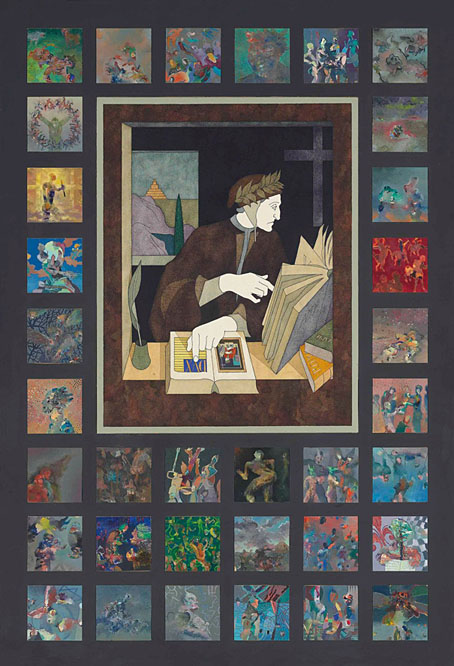
Dante in his Study with Episodes from the Inferno (1978) by Tom Phillips.

• “This set, featuring two of the surviving members of Cabaret Voltaire, is as clear and powerful as any of the live albums the group released while Richard H. Kirk was alive.” Derek Walmsley, reviewing what we’ve been told will be the last ever Cabaret Voltaire album. I can also vouch for its excellence but then I’m not what you might call an impartial listener. My copy arrived in the post only a couple of hours before Boards Of Canada made the announcement they’d been teasing for the past two weeks—the new BOC album, Inferno, will be released at the end of May—a coincidence that felt vaguely significant. “How random is random?” as William Burroughs used to say. It’s tempting to describe the moment as the passing of a creative torch but I doubt either of the groups would agree. Boards Of Canada’s approach to electronic music has always been very different to that of Cabaret Voltaire: less aggressive, more melodic, more pastoral, more concerned with memories and the past than with the present or the near future. But the promotional videos for Inferno are reminiscent of the scratch videos that Cabaret Voltaire were creating in the 1980s: degraded VHS assemblages collaged from TV broadcasts and home-movie footage, visual equivalents of a tuning dial running through the shortwave radio spectrum. Then there’s the latest BOC album art which, when taken with details from the teaser video, foregrounds the same fascination with American bastardisations of Christianity that the Cabs were referring to in Sluggin’ Fer Jesus and The Covenant, The Sword And The Arm Of The Lord. I’ll leave it to others to play with the interpretations that can be brought to an album title like Inferno. We’ll no doubt be seeing a great deal of journalistic musing around this and related issues before and after the end of May.

• Jiří Barta’s Expressionist animated adaptation of the Pied Piper story, Krysař (1985), has turned up in high definition at YouTube. Ignore the credit for Wilfred Jackson, an American animation director who had nothing to do with Barta’s film.

• At Public Domain Review: Magic by return of post: Allan Johnson explores the history of those mail-order occult outfits whose ads fill out the pages of the early American pulps.

Visual Music: a lecture by Simon Reynolds describing the use of electronic music as a soundtrack for abstract cinema.

• At the BFI: Anton Bitel selects 10 great Brazilian horror films.

• There’s more intermediate eyeball fodder at Unquiet Things.

Your Name in Landsat

FruitierThanThou

Disco Inferno (1976) by The Trammps | Inferno (Main Title Theme) (1980) by Keith Emerson | Om Riff From The Cosmic Inferno (2005) by IAO Chant From The Cosmic Inferno

Weekend links 800

goya.jpg

Plate 43 from Los Caprichos: The sleep of reason produces monsters (El sueño de la razon produce monstruos) (1799) by Francisco Goya.

• At Senses of Cinema: An interview with Jacques Rivette from 2001 in which the director passes judgment on a variety of feature films, old and new. Having read a couple of Cocteau-related books recently, I was pleased to see his comments about the importance of Cocteau’s example for his own film-making. Via MetaFilter.

• “Why is sleep, which literally occurs daily on a planetary scale, so often taken for granted, and not only by most people but even by scientists? Perhaps because its essence, its key property, is to be elusive, out of sight?” A long read by Vladyslav Vyazovskiy on the nature of sleep.

• “Often one cannot be sure if an object in a Welch picture is drawn from life or from other depictions of it, in sculpture, porcelain, woodwork or embroidery.” Alan Hollinghurst on the paintings and drawings of Denton Welch. (Previously.)

• At Colossal: Sinister skies set the scene for derelict buildings in Lee Madgwick’s surreal paintings.

• New music: The Mosaic Of Starlight Slips Back Like The Lid Of An Opening Eye by Paul Schütze.

• At Public Domain Review: Charles le Brun’s Human-Animal Hybrids (1806).

• Mix of the week: DreamScenes – October 2025 at Ambientblog.

• At the BFI: Anton Bitel chooses 10 great French horror films.

Winners of the 2025 Photomicrography Competition.

• RIP Diane Keaton.

Sleep (1981) by This Heat | Sleep (1995) by Paul Schütze | Sleep (2006) by DJ Olive

Weekend links 796

wright

Academy by Lamplight (1770) by Joseph Wright of Derby.

• “He recounts, for example, the death of the custom of ‘Stephening’ in Drayton Beauchamp, Buckinghamshire, where ‘all the inhabitants used to go on St. Stephen’s Day to the Rectory, and eat as much bread and cheese, and drink as much ale as they chose, at the expense of the Rector’. Stephening was discontinued by the Rector, as the event ‘gave rise to so much rioting’.” Ross MacFarlane on A Collection of Old English Customs, and Curious Bequests and Charities (1842).

• “He should be known as a film music revolutionary”: Milos Hroch on revitalising the legacy of Czech composer Zdeněk Liška.

• At The Wire: Read an extract from Ian Thompson’s Synths, Sax And Situationists: The French Musical Underground 1968-1978.

Wright’s choice of subject matter was not only contemporary, but bordered on the heretical. In his candlelight paintings of the orrery, the air pump and the alchemist at work, he not only employed dramatic lighting and plunging shadows to heighten the drama, but the scenes themselves dealt in mortality and the insignificance of man in relation to the natural world, as well as suggesting that the scientist was now usurping the divine creator.

Charlotte Mullins on the chiaroscuro paintings of Joseph Wright of Derby

• New music: Daylight Daylight by Steve Gunn; Hard Ware by Patrick Cowley; WhiteOut by Lawrence English.

• At Spoon & Tamago: GAKUponi: A self-sustaining loop of fish and plants that hangs on the wall.

• Mix of the week: DreamScenes – September 2025 at Ambientblog.

• At the BFI: Anton Bitel chooses 10 great German horror films.

• At Unquiet Things: A conversation with Benz and Chang.

• RIP Robert Redford.

The Fish (Schindleria Praematurus) (1972) by Yes | Fish Culture (1980) by Marc Barreca | Filter Fish (1995) by Leftfield

Weekend links 760

varo.jpg

Ermitaño Meditando (1955) by Remedios Varo.

• Public Domain Review announces the Public Domain Image Archive. I’ve added it to the list. Meanwhile, the PDR regular postings include Francis Picabia’s 391 magazine (1917–1924).

• Among the new titles at Standard Ebooks, the home of free, high-quality, public-domain texts: The Well at the World’s End by William Morris.

• At Smithsonian Magazine: “See 25 incredible images from the Wildlife Photographer of the Year Contest”.

The ideas are more complex than the presentation suggests, but not vastly. Neither is it exactly breaking new ground. Art is everywhere, they say, from fingernails to fine dining; art is not a message to be decoded, but takes on new meanings in the mind of each viewer; art allows us to experience emotions in a “safe” context, like a form of affective practice; art helps us to imagine new worlds, thereby expanding the boundaries of what’s possible in the real world. The point isn’t to be original, though, but to distil a lifetime’s worth of practical wisdom and reflection. The result is a kind of joyous manifesto: just the thing to inspire a teenager (or adult) into a new creative phase. Eno and Adriaanse conclude with a “Wish”: that the book helps us understand that “what we need is already inside us”, and that “art – playing and feeling – is a way of discovering it”.

Brian Eno and Bette Adriaanse talking to David Shariatmadari about their new book, What Art Does: An Unfinished Theory

• “Crunchie: The Taste Bomb!” DJ Food unearths four psychedelic posters promoting Fry’s Crunchie bars.

• New music: Music For Alien Temples by Various Artists, and Awakening The Ancestors by Nomad Tree.

• At Wormwoodiana: Mark Valentine lays out a history of the Tarot in England.

Sun Ra & His Intergalactic Research Arkestra live on German TV, 1970.

• At Dennis Cooper’s: Chris Marker Day (restored/expanded).

• At the BFI: Anton Bitel on 10 great Mexican horror films.

Matt Berry’s favourite albums.

Tarot (Ace of Wands Theme) (1970) by Andrew Bown | Tarotplane (1971) by Captain Beefheart And His Magic Band | Tarot One (2012) by Tarot Twilight