It’s Fantastic! It’s Futuristic! It’s Fatalistic! It’s Science Fiction!

SF1.jpg

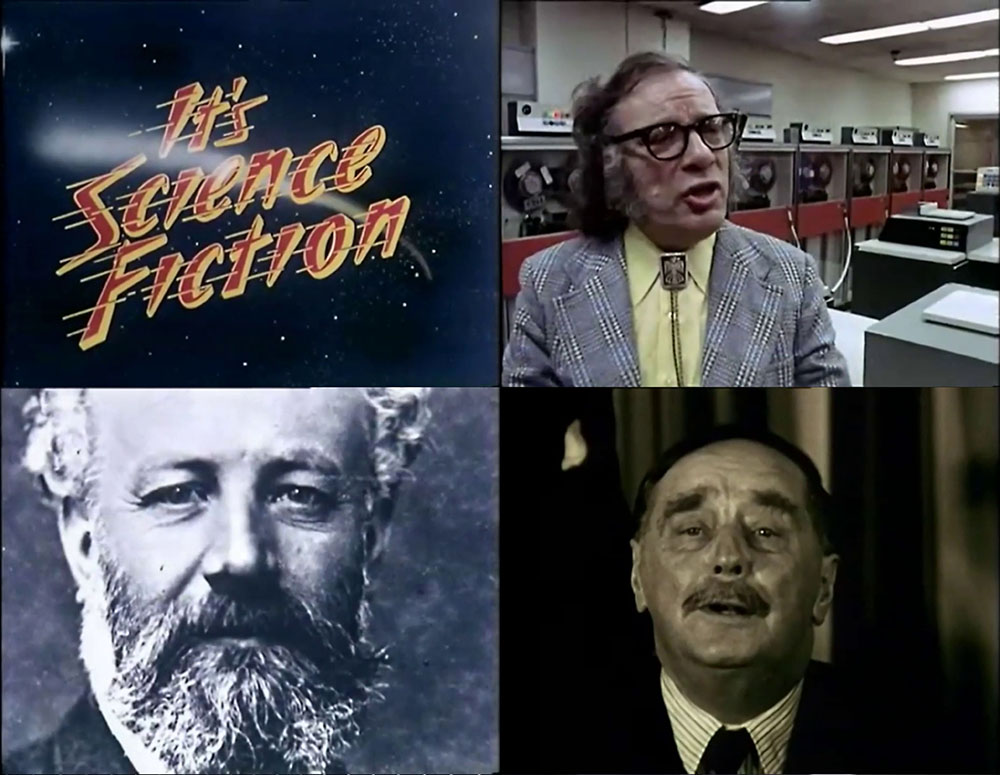
There’s a worthwhile documentary struggling to be born in this film which is compromised by its hyperbolic title and a running time of 48 minutes, not nearly enough to contain a history of science fiction, past and present. I’m not a media historian so I can’t say whether this was the first serious examination of written science fiction made for British TV but if it wasn’t there wouldn’t have been many that preceded it. It’s Fantastic! It’s Futuristic! It’s Fatalistic! It’s Science Fiction! was broadcast in 1973 as part of the BBC’s Omnibus art strand; Harley Cokeliss (credited here as “Cokliss”) was the director, and also the co-writer with Michael Abrams. Two years prior to this Cokeliss had made a shorter BBC film, Crash!, which explored JG Ballard’s ongoing preoccupation with automobile accidents via the rehearsals for Crash in The Atrocity Exhibition. Ballard turns up again here, theorising energetically about his usual concerns (mass advertising, the media landscape, etc) from a balcony overlooking Heathrow airport.

SF2.jpg

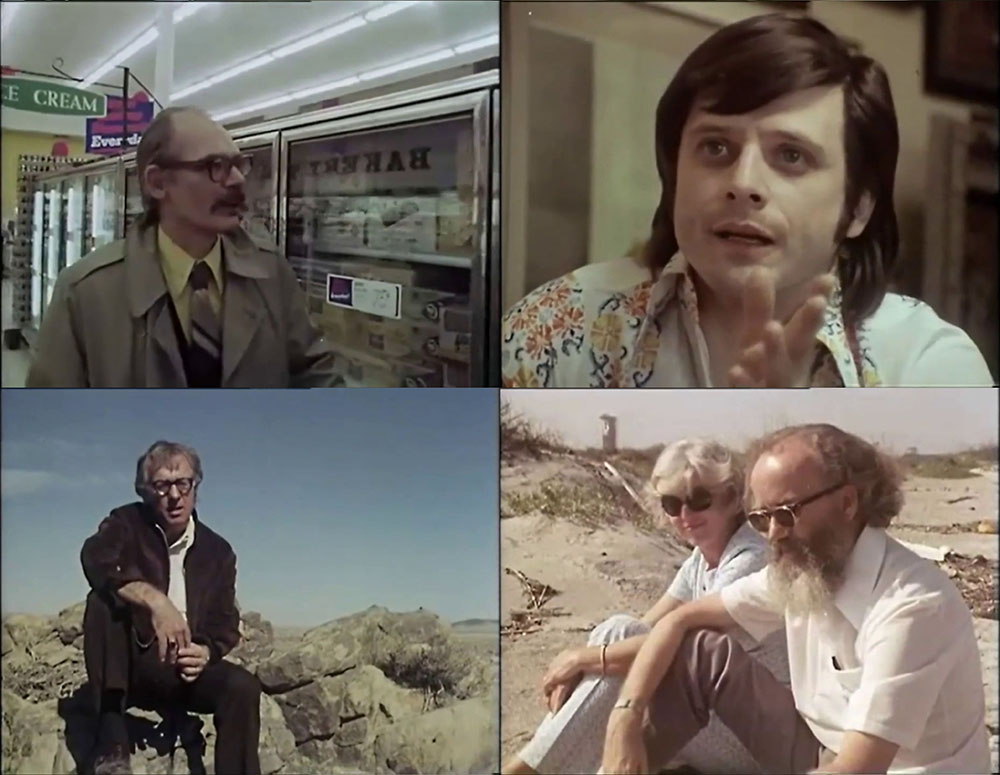
Cokeliss opens proceedings with the inevitable collage of clips from Flash Gordon and Hollywood films of the 1950s, most of which are appalling quality. If nothing else, this is a good reminder of how terrible feature films used to look when shown on TV. More interesting for today’s viewer is the record of a handful of writers who were seldom personally visible in the mass media even while their stories were being adapted by film and television. Ballard and Brian Aldiss are the representative Brits, all the other writers are Americans: Isaac Asimov, Ray Bradbury, Harlan Ellison, Damon Knight, Frederik Pohl and Kurt Vonnegut. Also interviewed is Fritz Lang, who repeats his anecdote about Metropolis being inspired by his visit to New York in the 1920s, and Forrest J. Ackerman is filmed inside his memorabilia-filled house. The absence of women interviewees is unfortunately typical of the time. Kate Wilhelm appears on camera with husband Damon Knight but it’s Knight that does all the talking.
SF3.jpg

All of the interviews are far too brief for such a wide-ranging subject but it’s still fascinating to see Harlan Ellison at his peak, talking (and typing) at speed. It’s also surprising to find JG Ballard and Frederik Pohl in near agreement when they both describe science fiction as being a reflection of the present as much as it is it is a look into the near or distant future, “a mythology of the Space Age” as Ballard liked to describe it. Science fiction is often both these things simultaneously, predictive and reflective, something its critics don’t always seem to appreciate.

SF4.jpg

Documentaries also reflect the times in which they’re made, and this is another arts documentary that plunders the prog-rock shelves for its soundtrack music, placing a few bars of Close To The Edge by Yes over shots of New York’s teeming crowds. Harley Cokeliss really should have been given a series instead of a single film in which he flies all over America to capture nothing more than a few brief soundbites. But in 1973 the genre was lucky to get this much attention from one of the BBC’s serious arts outlets. Managerial attitudes did change later in the decade, probably as a result of the resurgence in popularity of SF cinema. In 1979 the BBC made a five-part series about science fiction, Time Out of Mind, where four of the programmes were profiles of single writers—Arthur C. Clarke, John Brunner, Michael Moorcock, and Anne McCaffrey—with other writers appearing in each film. A fifth episode concerned the SF convention that took place in Brighton that year. Ray Bradbury was given the full Omnibus treatment a year later in The Illustrated Man, a typically fine David Wheatley profile, while Philip K. Dick received a posthumous appraisal from Arena in 1994.

Here in 2026 we find ourselves in the future being grasped at in the 1970s where television has now abandoned expensive author profiles unless the author in question is massively popular or the winner of a Nobel prize. With everyone owning a pocket-sized recording device anyone can now make their own television, and so YouTube fills up with hours of amateurish video of people talking into laptops and webcams with poor visuals and dreadful sound. A good documentary is always more than a stream of raw footage; contextualisation and editorial point-of-view are essential, as well as whatever artistry the director might bring to the material. The frame is important, in other words, however compromised that frame may be.

Previously on { feuilleton }
Future Life magazine
Science Fiction Monthly

Weekend links 814

dameron.jpg

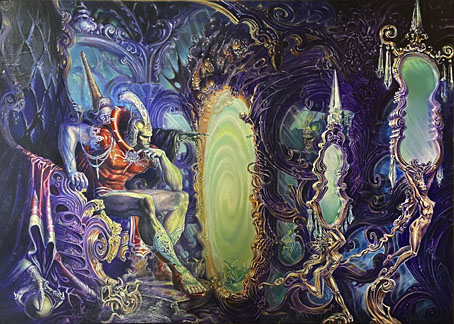
Kull of Atlantis—The Mirrors of Tuzun Thune by Ned Dameron for Kull (1985) by Robert E. Howard. Via.

Jeremy Allen reviews the latest reissue of The New Worlds Fair by Michael Moorcock and The Deep Fix, describing the album as “a fascinating and quixotic document from the time it was made, deserving to be taken seriously in its own right”.

• Among the new titles at Standard Ebooks, the home of free, high-quality, public-domain texts: Short Fiction, a small collection of early stories by Clark Ashton Smith.

• New music: Geometry of Murder: Extra Capsular Extraction Inversions by Earth x Black Noi$e; Live At Nonseq by WNDFRM.

The book is not just loaded with words or tongues. Its also loaded with genres, or more accurately, different modes of literature. And one of the modes I particularly enjoyed this time around is, appropriately, the Weird. In ways long noted on forlorn and unspeakable subreddits, there is a decidedly Lovecraftian dimension to Melville’s Whale, which the Master of Providence did read and enjoy months before writing his game-changing “Call of Cthulhu.” We begin the novel with a sick soul, who may or may not be named after an Old Testament outcast, wandering through a macabre and fetid New England whale-town, following grim portents that lead him on towards a cursed ship doomed to confront a monster who sleeps or at least feeds, and presumably dreams, at the bottom of the sea. And that’s just the first couple of chapters.

Erik Davis on the pleasures of re-reading Moby-Dick, in a piece which makes me want to read the novel again

• At the BFI: Phil Hoad on David Lynch’s efforts to keep making films in an industry resistant to his kind of art.

• Exploration Log 12: Adam Rowe on the best retro science fiction art collections.

• At Public Domain Review: The Nine Birds of Jacques de Fornazeris (1594).

Winners and finalists for the 2025 Ocean Art Contest.

• Mix of the week: A mix for The Wire by Hilary Woods.

The Whale (1977) by Electric Light Orchestra | Don’t Kill The Whale (1978) by Yes | School For Whales (1980) by Marc Barreca

Weekend links 796

wright

Academy by Lamplight (1770) by Joseph Wright of Derby.

• “He recounts, for example, the death of the custom of ‘Stephening’ in Drayton Beauchamp, Buckinghamshire, where ‘all the inhabitants used to go on St. Stephen’s Day to the Rectory, and eat as much bread and cheese, and drink as much ale as they chose, at the expense of the Rector’. Stephening was discontinued by the Rector, as the event ‘gave rise to so much rioting’.” Ross MacFarlane on A Collection of Old English Customs, and Curious Bequests and Charities (1842).

• “He should be known as a film music revolutionary”: Milos Hroch on revitalising the legacy of Czech composer Zdeněk Liška.

• At The Wire: Read an extract from Ian Thompson’s Synths, Sax And Situationists: The French Musical Underground 1968-1978.

Wright’s choice of subject matter was not only contemporary, but bordered on the heretical. In his candlelight paintings of the orrery, the air pump and the alchemist at work, he not only employed dramatic lighting and plunging shadows to heighten the drama, but the scenes themselves dealt in mortality and the insignificance of man in relation to the natural world, as well as suggesting that the scientist was now usurping the divine creator.

Charlotte Mullins on the chiaroscuro paintings of Joseph Wright of Derby

• New music: Daylight Daylight by Steve Gunn; Hard Ware by Patrick Cowley; WhiteOut by Lawrence English.

• At Spoon & Tamago: GAKUponi: A self-sustaining loop of fish and plants that hangs on the wall.

• Mix of the week: DreamScenes – September 2025 at Ambientblog.

• At the BFI: Anton Bitel chooses 10 great German horror films.

• At Unquiet Things: A conversation with Benz and Chang.

• RIP Robert Redford.

The Fish (Schindleria Praematurus) (1972) by Yes | Fish Culture (1980) by Marc Barreca | Filter Fish (1995) by Leftfield

Weekend links 623

blot.jpg

A symmetrical ink blot from Gobolinks, or Shadow Pictures for Young and Old (1896) by Ruth McEnery Stuart & Albert Bigelow Paine, a book where the blots are much more interesting than the interpretative verses that accompany them.

• “…within a year, they were on The Tube, performing their German-language extrapolation of Throbbing Gristle’s Discipline to a visibly nonplussed audience.” Alexis Petridis on the return of Propaganda. The group’s debut album, A Secret Wish (previously), has long been an obscure object of desire round here.

• RIP Alan White, drummer in Yes for much of the 1970s (see Sound Chaser for details), and also—although nobody mentioned this at the time—the originator of the drum sounds sampled on a Fairlight for Beat Box by the Art Of Noise.

• “For the anthropologist Stewart Guthrie, pareidolia is not a fringe phenomenon: it is at the core of religious experience.” Hunter Dukes on the interpretation of ink blots.

• “…self-righteousness is the one thing that I don’t agree with,” says John Waters. “We used humour to fight when I was young.”

• New music: October Cut Up by Black Glass Ensemble, and New Witness by Michael Begg.

• Also RIP Shiv Kumar Sharma, master of the santoor.

• “Scientists recreate Cleopatra’s favourite perfume.

Simon Fisher Turner’s favourite albums.

• At Dennis Cooper’s: Len Lye Day.

Cleopatra’s Barge (1962) by Alex North | Cleopatra’s Needle (1963) by Ahab And The Wailers | Cleopatra King Size (2002) by Jah Wobble & Temple Of Sound

Solid Space: Jon Anderson’s cosmic voyage

olias1.jpg

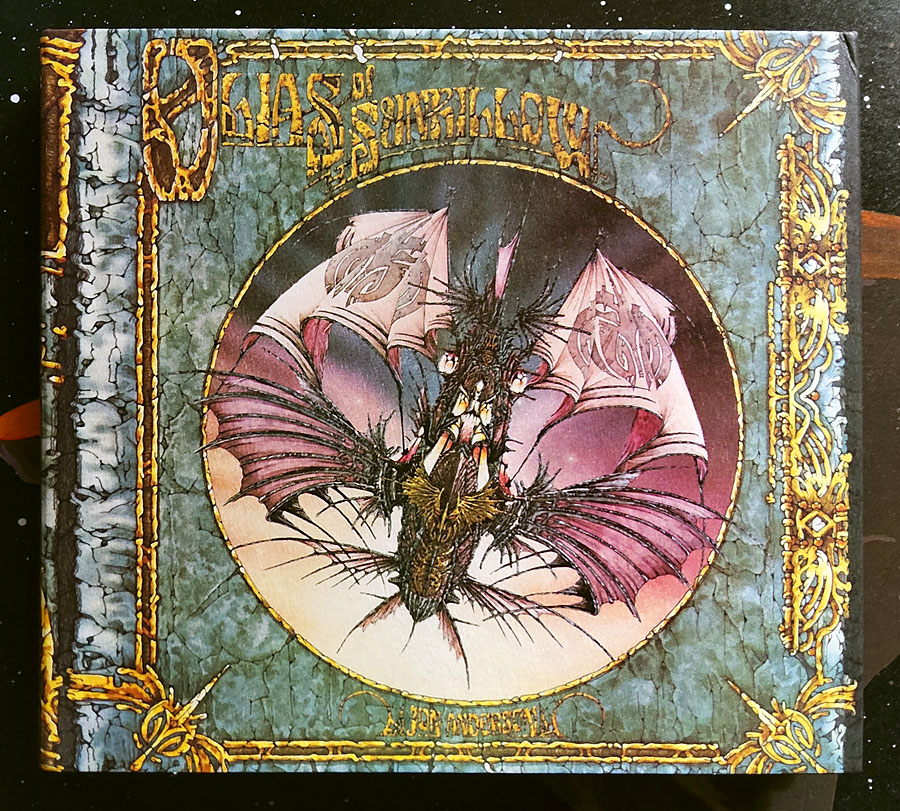
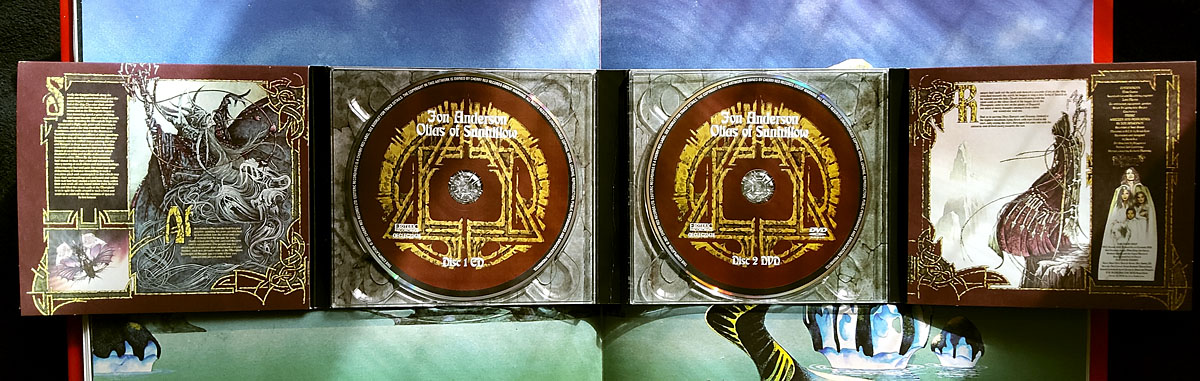
Jon Anderson’s solo debut, Olias Of Sunhillow, is reissued this week in a double-disc set comprising a remastered CD plus an audio DVD. I’d been hoping for some time that this album might be given a proper reissue, it’s one I like a great deal but my old CD has never sounded as good as it ought to. The album may command cult status round here but you don’t see it mentioned anywhere outside Yes forums or partisan enclaves like the Prog Archives. This post may be taken as a small corrective to the neglect.

olias2.jpg

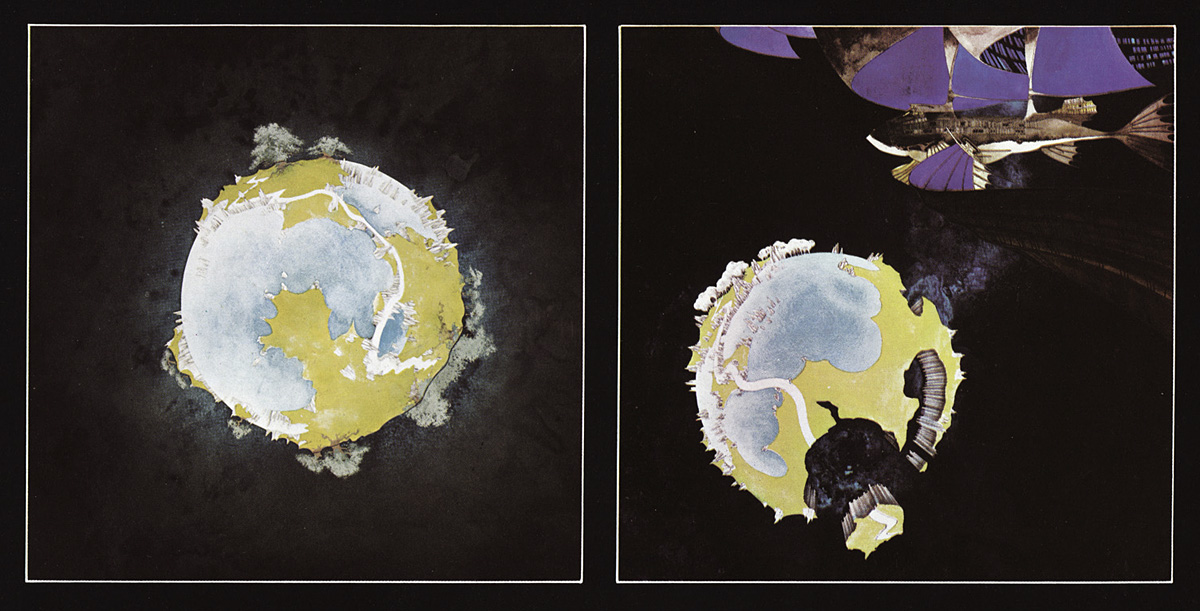
Olias Of Sunhillow was released in 1976, and was the most unusual of all the solo albums recorded by the individual members of Yes in the mid-70s, being a spin-off from some of the group’s early albums, or at least their cover art. Roger Dean’s first cover work for the group was on Fragile in 1971, for which he painted a miniature world rather like one of MC Escher’s planetoids. This was Dean’s idea, the band had suggested a broken piece of porcelain as the cover image. The back cover of the album showed the same planet in a state of fragmentation with a fish-like spaceship floating above it (see below). Another drawing of the fish-ship was added to the front cover before the album’s release, and it’s this ship, and the narrative it suggests, that leads eventually to Anderson’s solo album. Two years after Fragile, the planetary disintegration had turned into an exodus on the group’s triple-live album, Yessongs, the back cover of which shows pieces of planet being towed through space by a similar fish-ship. The other panels of the cover depict the arrival of these fragments on a newer, larger world. Anderson’s album takes this sequence of events then filters them through Vera Stanley Alder’s mysticism to craft a musical odyssey which Discogs describes as:

…the story of an alien race and their journey to a new world due to catastrophe. Olias, the title character, is the chosen architect of the glider Moorglade, which will be used to fly his people to their new home. Ranyart is the navigator for the glider, and Qoquaq is the leader who unites the four tribes of Sunhillow to partake in the exodus.

olias3.jpg

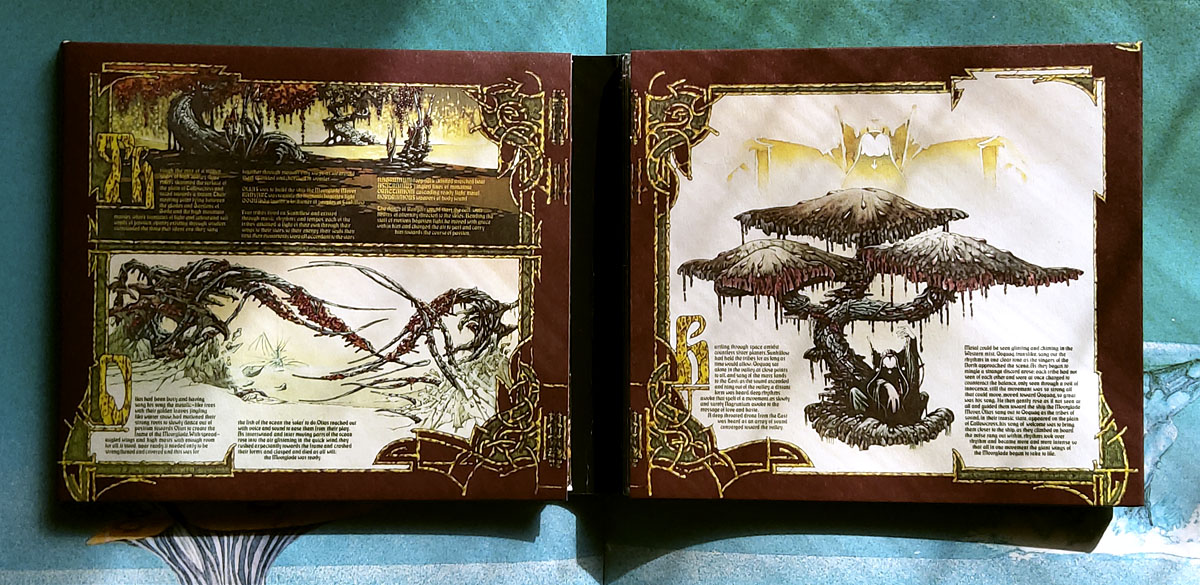
For many years in British music circles it would have been a grave error to even acknowledge this album’s existence, never mind admit to actually liking it. This was partly the old animus against progressive rock, an unexamined prejudice that lasted well into the 1990s, but Anderson’s album had so many strikes against it that it might have stood as the winner of a disapproval lottery for the more ideologically rigid writers and readers of the NME. It’s Jon Anderson (strike 1), the lead singer of progressive rock (2) group Yes (3), whose album is a science fiction (4)/ fantasy (5) concept (6), littered with Tolkien-like invented names and words (7), and with a multi-page sleeve embellished with detailed fantasy illustrations (8) by David Fairbrother-Roe. The design was art directed by Hipgnosis, who subsequently designed the next two Yes albums. Anderson originally wanted Roger Dean to create the packaging, which would have provided a further strike of disapproval against the album, but Dean’s career had gone into overdrive following the publication of Views so he either didn’t have the time or didn’t want to be involved. In Views Dean mentions “another project” based on the fish-ship’s journey which may be a reference to Anderson’s forthcoming album, the credits of which thank Dean for “planting the seed”.

views1.jpg

Roger Dean’s original artwork for Fragile (1971). Another fish-ship was added to the final cover art.

Continue reading “Solid Space: Jon Anderson’s cosmic voyage”