Weekend links 834

hockney.jpg

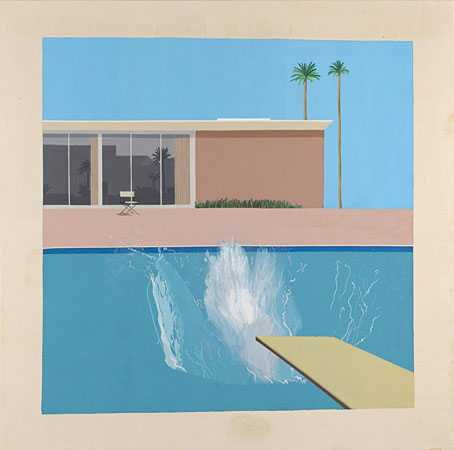
A Bigger Splash (1967) by David Hockney.

• I was interviewed this week at Retrofuturista, the first interview I’ve done in a while, and more wide-ranging than they sometimes are. Subjects covered include illustration, design, weird fiction, the Reverbstorm comics, the Bumper Book of Magic, underground culture, and the deficiencies of AI art. Also my ongoing, mostly unseen, Axiom project.

• At Nautilus: Kristen French conducts a lengthy and fascinating interview with Andrew Gallimore and Donald Hoffman, a pair of reseachers seeking to upend theoretical physics by making consciousness the foundation of reality, rather than its inconvenient and inexplicable by-product.

• “My audience is film-smart, and I always say, ‘If they don’t get something, then do your homework.’ Sometimes you have homework when you come to see my movies to figure out what the references are.” John Waters talking to Marya E. Gates at RogerEbert.com.

• The Morgan Library & Museum in NYC launches an exhibition later this month: Tarot! Renaissance Symbols, Modern Visions. At Colossal there’s a look at some of the 20th-century art, while Smithsonian Magazine has a selection of older card designs.

Inferno by Boards Of Canada is “probably as close to a political statement as these mystery men will ever approach.” Thus Simon Reynolds looking back over the history of the group following the release of their marvellous new album.

• Among the new titles at Standard Ebooks, the home of free, high-quality, public-domain texts: The Necromancers by Robert Hugh Benson.

• New music: Demand To Be Taken To Heaven Alive by Horse Lords; A Wave Of Alarm by Comdex; Teleportations by Danalogue.

Dennis Cooper’s favourite fiction, poetry, non-fiction, film, art, and internet of 2026 so far. Thanks again for the link here!

• At Public Domain Review: Venetian Bridge Brawls in 17th and 18th Century Art.

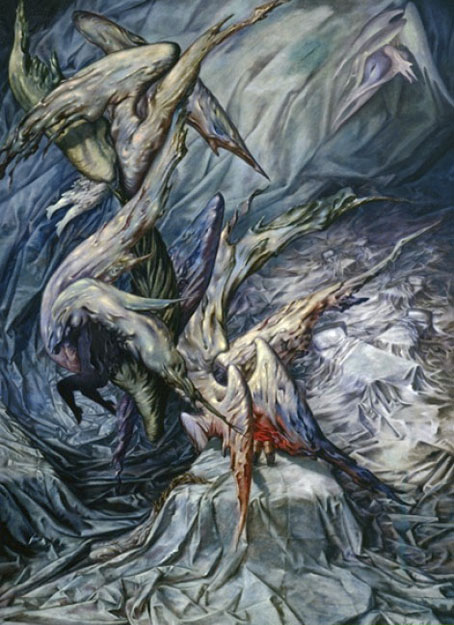
• At Door of Perception: Sibylle Ruppert—The Inward Gaze of the Flesh.

• RIP David Hockney and James Blood Ulmer.

• The Strange World of…Melinda Gebbie.

Splash One (Now I’m Home) (1966) by 13th Floor Elevators | Splash (1968) by Miles Davis | Splash (1974) by Can

The art of Denton Welch, 1915–1948

welch04.jpg

Symbolist Figure (1946).

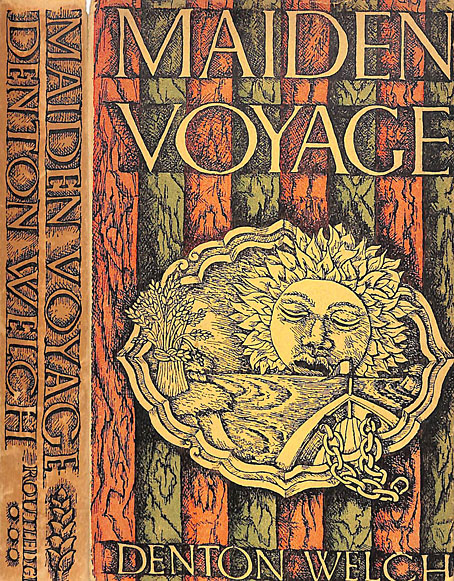
The visual art, that is, not the novels and short stories. Last month I finally got round to reading Denton Welch’s first two novels, Maiden Voyage (1943) and In Youth is Pleasure (1945). Finally, because I’ve known Welch’s name for a long time, mostly via William Burroughs—who dedicated The Place of Dead Roads to him—and John Waters—who often lists In Youth is Pleasure as one of his favourite novels. This was also the book that Burroughs favoured, and he wrote an introduction for a US reprint in 1983. At first glance, Welch would seem a surprising choice for the pair: the protagonist in each book is a thinly fictionalised avatar of the author—he’s even named Denton Welch in the first—an effete upper-middle-class English teenager who hates his school and most of the people he meets, and who spends as much time as possible wandering alone, looking for affordable antiques and any old buildings that may be of interest. The homosexual undercurrents in each book generate persistent tensions which are an obvious attraction for many readers, even though nothing is ever stated overtly and there’s no hand-wringing over unrequited passions. Welch’s boys are most passionate about the things they collect, and their determination to be left alone to pursue their interests when all the adults around them are trying to push them in different directions. Having been a similar school-hating, art-obsessed, introverted teenager, if I’d read In Youth is Pleasure when I was the same age as the beleaguered Orvil Pym it would have made a huge impression.

welch07.jpg

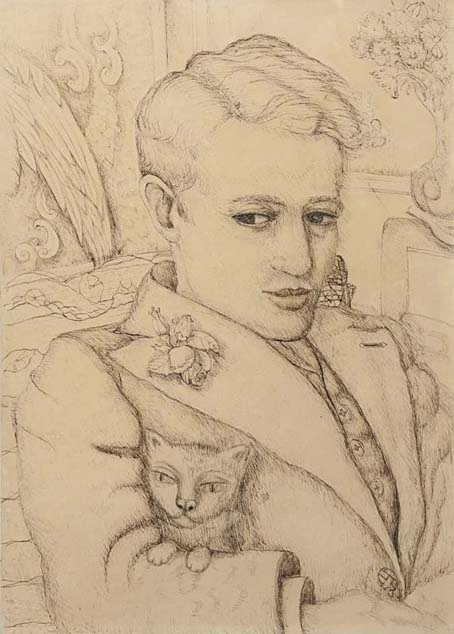
Self-portrait With Cat.

Art was the interest that Welch most wanted to pursue but it’s the writing for which he’s remembered. Few people have good things to say about his drawings and paintings but there’s a strange quality to many of them that I like, an atmosphere of menace that lurks beneath the often naive renderings. I was surprised how gloomy and claustrophobic many of them are. The refined sensibilities in the novels lead you to expect something lighter, frivolous even, like the paintings and illustrations of his contemporary, Rex Whistler, or other artists of the Neo-Romantic school of the 1930s. In fact looking at Whistler’s work again, it’s the Whistler style I most expected even though it’s unfair to compare the two. Welch and Whistler shared a taste for pictorial decoration, and a blithe indifference to the avant-garde trends of the day, but Whistler was a formidable talent, the kind of successful illustrator that Welch could only dream of being. (That said, both artists were commissioned by Shell for the company’s poster series showing views of Britain.) Yet lack of ability sometimes takes an artist into places that a professional wouldn’t reach. Whistler would have given us a perfect cat, not the strange creatures with almost human faces that Welch liked to draw. I’m curious to know which, if any, contemporary artists Welch preferred. His diaries are now earmarked for a future reading.

A Voice Through A Cloud: Discovering Denton Welch

welch05.jpg

Hadlow Castle, Kent (1937).

welch06.jpg

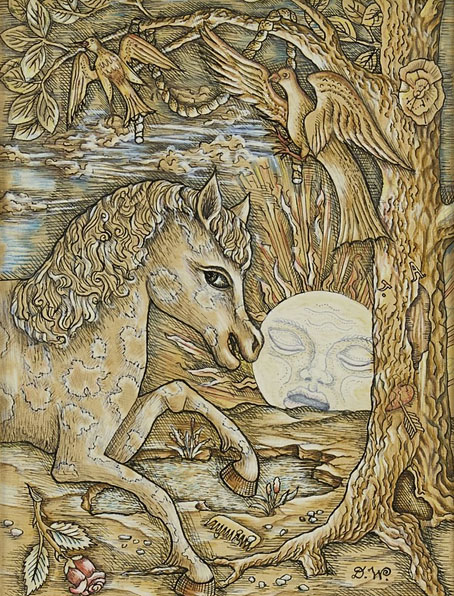
Horse and Moon (1943).

welch03.jpg

Continue reading “The art of Denton Welch, 1915–1948”

Weekend links 709

tanning.jpg

Guardian Angels (1946) by Dorothea Tanning.

• “If photographs can outlive their subjects, and memory works like photography, do images somehow endure in the brain after death? Could these undead memories be recovered with the right technologies?” Speculative fiction from 1899 in Dr Berkeley’s Discovery by Richard Slee and Cornelia Atwood Pratt.

• Mix of the week: Astral Loitering: Excursions In New Age, 1970–1989: 210 minutes of well-chosen selections that continue where I Am The Center left off. In a similar zone, albeit more recent, there’s the regular monthly report from Ambientblog, DreamScenes—January 2024.

• At American Scientist: The Source of Europe’s Mild Climate: “The notion that the Gulf Stream is responsible for keeping Europe anomalously warm turns out to be a myth”. An article from 2006 that you’d think would be more widely known today.

The Anomalist: “World News on UFOs, Bigfoot, the Paranormal, and Other Mysteries at the Edge of Science”. Too many of the links lead to worthless tabloid filler but the headlines can be fun.

• Coming soon from Strange Attractor: Two-Headed Doctor: Listening for Ghosts in Dr John’s Gris-Gris, a book by David Toop which analyses the Doctor’s voodoo-themed debut album.

• At Unquiet Things: Beyond The Shadows Of The Labyrinth: Exploring the Groovy Kaleidoscope of Ted CoConis’ Art.

• DJ Food unearths a batch of Portuguese Hauntology via Prisma Sonora Records.

• At Dennis Cooper’s: John Waters Day (restored/expanded).

• New music: Moon by Retep Folo & Dorothy Moskowitz.

New Age (live) (1969) by The Velvet Underground | New Age (1980) by Chrome | 1966 – Let The New Age Of Enlightenment Begin (2014) by Sinoia Caves

Weekend links 639

alphaville.jpg

Japanese poster for Alphaville (1965).

Peter Bogdanovich: I think we’d better have your thoughts on Godard.

Orson Welles: Well, since you’re so very firm about it. He’s the definitive influence if not really the first film artist of this last decade, and his gifts as a director are enormous. I just can’t take him very seriously as a thinker—and that’s where we seem to differ, because he does. His message is what he cares about these days, and, like most movie messages, it could be written on the head of a pin. But what’s so admirable about him is his marvellous contempt for the machinery of movies and even movies themselves—a kind of anarchistic, nihilistic contempt for the medium—which, when he’s at his best and most vigorous, is very exciting.

• RIP JLG. I was watching Alphaville again just two weeks ago after a DVD turned up in the local charity shop. Still the only Godard film I like 100% but “liking” seems beside the point. His influence today is everywhere, so fully absorbed into the language of cinema that people barely notice it.

• “The things that cause my gaze to linger are usually the portraits or landscapes that spark a feeling of unease, disquiet and discomfort. A shadow amongst the summer trees, a lurking silhouette reflected in a perfect blue iris, a vibrant flower in the early stages of decay.” S. Elizabeth talking to Beautiful Bizarre about her new book, The Art of Darkness: A Treasury of the Morbid, Melancholic and Macabre.

• Allow John Waters (again) to dictate your film viewing with a Letterboxd list of his favourite films, based on comments in his writings and interviews. On the subject of Godard, Waters’ Crackpot book contains a whole chapter about Hail Mary.

• Astor’s Electrical Future: Iwan Rhys Morus explores a vision of the year 2000 recounted in A Journey in Other Worlds (1894), a “scientific romance” by John Jacob Astor IV, with illustrations by Daniel Carter Beard.

• Strange Attractor has announced a Kickstarter campaign to fund the publication of an Austin Osman Spare Tarot deck.

• At Wormwoodiana: The Parrot, the Unicorn and the Golden Dragon: Some 17th Century Booksellers’ Signs.

• At Bandcamp: Andy Thomas on Chris Watson‘s post-Cabaret Voltaire career in nature recordings.

• A new outlet for cinematic obscurities: Radiance Films.

Alphaville (1978) by Klaus Schulze | Alphaville (1979) by The Monochrome Set | Alphaville (1999) by Scanner

Weekend links 638

feherlofia.jpg

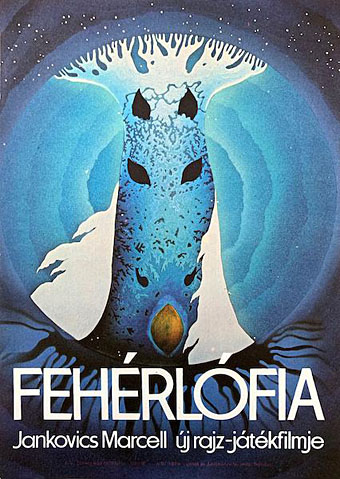
• After writing about Hungarian animator Marcell Jankovics back in January, I left a comment expressing the hope that Arrow or Eureka might give us a Region B blu-ray of Son of the White Mare (aka Fehérlófia), Jankovics’s “psychedelic” animated feature from 1982. Fast-forward nine months to Eureka’s announcement that they’ll be doing exactly this in November. Watch the trailer. The release will include some of the director’s short films plus his first feature, Johnny Corncob (1973), a historical tale presented in the “groovy” style (previously) popularised by Yellow Submarine. If idle wishes can be granted so easily then I’ll hope again that Eureka might do the same for René Laloux’s second and third animated features, the Moebius-designed Time Masters (1982) (made in the same studio as Son of the White Mare) and the Caza-designed Gandahar (1987). Fingers crossed.

• “I don’t think anybody copies me, but Harmony Korine, Todd Solondz, Bruno Dumont, Gaspar Noé, I like those kinds of directors. They’re sometimes not funny at all. They’re very serious and eerily melodramatic. I just like movies that surprise me.” John Waters (yet again) talking to Conor Williams about films, writing and a prayer for Pasolini.

• “There is something profoundly haunting about a master artist’s last painting left unfinished upon its easel…” Kevin Dann on The Mermaid (1910) by Howard Pyle.

• At Bandcamp: Navigating the Nurse With Wound List: A Gateway to Far-Flung Sounds.

• “Juicy With Meaning”: Alex Denney chooses five essential films by David Cronenberg.

• Mix of the week: Discovering 1970s jazz fusion with Kerri Chandler.

• Coming soon from Strange Attractor: Purgatory by Ken Hollings.

• Steven Heller’s font(s) of the month: Farandole & Lustik.

Dennis Cooper’s favourite albums.

• RIP Peter Straub.

White Horses (1968) by Jacky | Five White Horses (1968) by Sun Dragon | Ride A White Horse (2006) by Goldfrapp