
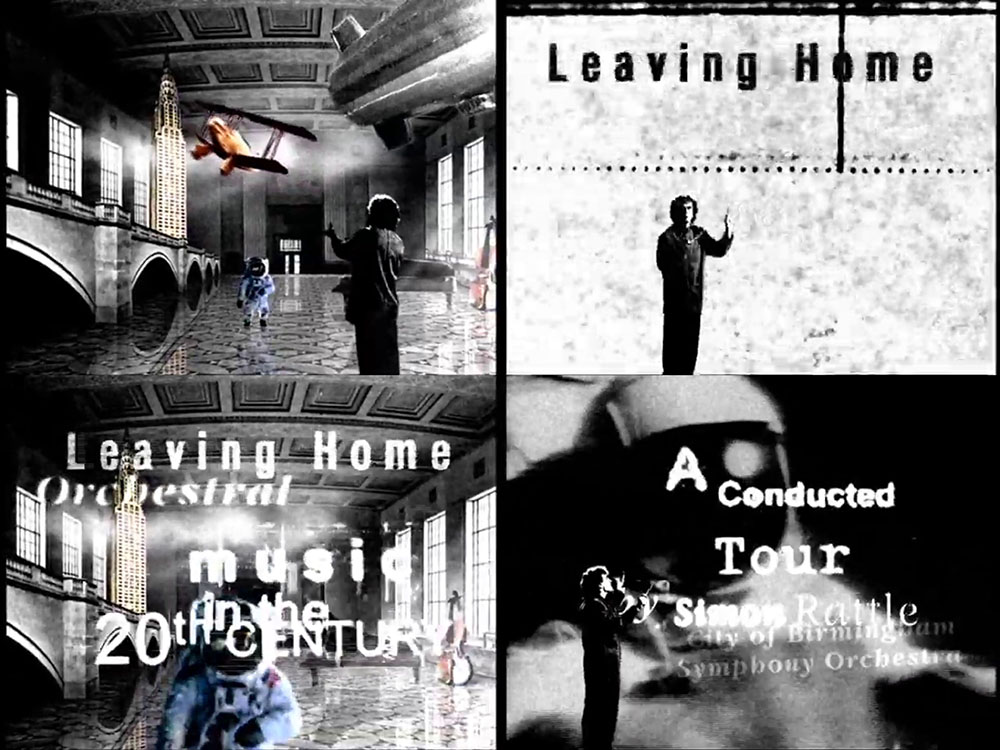
In which orchestral conductor Simon Rattle explores a century of music in much the same way that Robert Hughes explored a century of art in The Shock of the New. Or almost… It’s unfair to compare this more modest TV series to a landmark which was shot on film and with a budget large enough to allow Hughes to present his art history from locations all around the world.
If you’ve ever felt in need of an intelligent introduction to the challenges of orchestral music then Leaving Home is the ideal guide. The series was broadcast by Channel 4 (UK) in 1996, a time when the channel still was still devoting a considerable portion of its programming to the arts. Simon Rattle was a wise choice as a presenter, being a conductor with a less intimidating demeanour than some, as well as a proselytising nature. His intention here was to dispel the difficulty which many people still feel when faced with atonal compositions (twelve-tone music, aleatory music, serialism) by explaining how these musical forms evolved and why they’re not so difficult at all once you appreciate the reasoning behind them and the context out of which they emerged. Music is a curious medium in this respect. Where other art forms can start to feel distinctly old-fashioned and even thoroughly antiquated once a few decades have elapsed, there’s a lot of European music which is well over a hundred years old yet can still challenge and disturb an audience today if that audience is unprepared. Rattle’s explanations parallel The Shock of the New by dividing a century of artistic evolution into distinct modes or themes. The structure of the series and the music under discussion is as follows:
Programme 1: Dancing on a Volcano
Wagner, Prelude to Tristan and Isolde
Schoenberg, Transfigured Night
Mahler, Symphony no. 7
Strauss, Elektra
Schoenberg, Five Orchestral Pieces, op. 16, nos. 1 and 2
Webern, Five Orchestral Pieces, op. 10, nos. 3, 4 and 5
Berg, Violin Concerto
Programme 2: Rhythm
Stravinsky, The Rite of Spring
Varèse, Ionisation
Mahler, “Abschied” from Das Lied von der Erde
Ligeti, Atmosphères
Reich, Music for Pieces of Wood
Nancarrow, Piano Roll no. 21
Boulez, Rituel in Memoriam Bruno Maderna
Messiaen, Turangalîla Symphony
Programme 3: Colour
Debussy, Prélude à l’après-midi d’un faune
Stravinsky, The Firebird
Ravel, Daphnis et Chloé
Debussy, Jeux
Schoenberg, Five Orchestral Pieces, op. 16, no. 3 “Farben”
Boulez, Notations
Messiaen, Et expecto resurrectionem mortuorum
Takemitsu, Dream/Window
Programme 4: Three Journeys through Dark Landscapes
Bartók, Duke Bluebeard’s Castle
Bartók, Music for Strings, Percussion and Celesta
Bartók, The Miraculous Mandarin
Bartók, Concerto for Orchestra
Shostakovich, Symphony no. 4
Shostakovich, Symphony no. 5
Shostakovich, Symphony no. 14
Lutosławski, Concerto for Orchestra
Lutosławski, Venetian Games
Lutosławski, Symphony no. 3
Programme 5: The American Way
Gershwin, Rhapsody in Blue
Ives, Decoration Day
Carter, A Celebration of Some 100 x 150 Notes
Copland, Appalachian Spring
Weill, “Lonely House” from Street Scene
Bernstein, “Symphonic Dances” from West Side Story
Cage, Sonatas and Interludes
Cage, First Construction in Metal
Feldman, Madame Press Died Last Week at 90
Riley, In C
Adams, Harmonium
Programme 6: After the Wake
Strauss, “Im Abendrot” from Four Last Songs
Schoenberg, A Survivor from Warsaw
Boulez, Le marteau sans maître
Webern, Five Orchestral Pieces, op. 10, no. 4
Stockhausen, Gruppen
Britten, Serenade for tenor, horn and strings
Stravinsky, Agon
Programme 7: Threads
Berio, Laborintus II
Henze, Symphony no. 8
Gubaidulina, Zeitgestalten
Kurtág, Grabstein für Stefan
Birtwistle, Ritual Fragment
Turnage, Drowned Out
Knussen, Flourish with Fireworks
“Leaving home” in Rattle’s explanation is a phrase that refers to music leaving behind the rules and harmonic bases of the previous centuries. It also refers to various forms of exile and social change, departures from earlier orthodoxies. Much of the music explored here was created in years and nations beset by wars and revolutions, and, as Rattle notes, art created under such conditions can’t help but reflect its time. I have the book of the series by Michael Hall which is very good in its own way, filled with a more detailed history and musicology, as well as many photographs and paintings relevant to the compositions. What the book lacks is the music itself, and this is the real strength of the TV series. Rattle spends each programme either sitting at a piano or conducting the City of Birmingham Symphony Orchestra who play extracts of all the pieces under discussion. Rattle is a proficient pianist which that means in the first couple of programmes he’s able to physically emphasise some of his talking points, in particular those instances when a composer deliberately deviates from expectation. Watching an orchestra perform a composition you’ve just heard described is much more effective than listening to a recording, especially when we reach the 1950s with extracts from a performance of Stockhausen’s Gruppen.
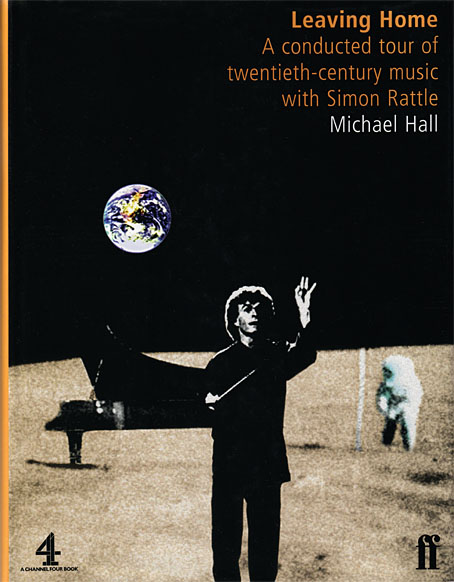
Looking through Hall’s book again after writing the above I re-read Rattle’s foreword in which he mentions The Shock of the New as a precursor of the series, a detail I’d forgotten. The foreword is worth quoting in full:
The genesis of Leaving Home stemmed from my desire to bring the music of our wonderful, infuriating century to a wider public, to attempt to piece together some of the connections without which this artistic journey can seem bewildering. At least this is how it all looks in retrospect. At the time I was first approached, fear dominated all my responses. How could this unruly beast be tamed, let alone explained? How could we hope to find a coherent thread through such a rich but tangled store of works? At first, I hardly dared to ask myself the obvious question of what to choose, struck as I was by the essential problem of music on TV, which is that it must take place in time. The great art documentaries, of which Kenneth Clark’s Civilisation and Robert Hughes’ The Shock of the New have been particularly influential and memorable, had the enormous advantage of presenting a wide swathe of work rapidly. In an hour, it is perfectly possible to present fifty or sixty works of art—even a few seconds can make a point. Music, however, cannot be taken in at a glance—that is simultaneously its blessing and its curse—and any one programme could only deal with, say, half a dozen pieces without taking on the character of some purgatorial spot-the-masterpiece quiz. It became apparent very quickly that the series could not attempt to be comprehensive, either historically or in viewpoint, and that we had to concentrate on music that somehow drove the century forward. Inevitably, much has been omitted, including a great deal of my favourite music: no Szymanowski or Prokofiev, no Sibelius, Nielsen, Janáček, Elgar, Tippett; the list is painful, but is the result of hard-argued choice. This book has the possibility to cast its net wider, more generously, and for that I am profoundly grateful, as I am for its thoughtful and revealing analysis of the main musical trends of our time.
But this is enough explanation of what the series is not— I make no apologies for the music that we have been able to choose, or for the fact that they are all, without exception, pieces that I love. As I said in the introduction to my last programme, it has been like compiling a taster menu that people will come back to for more, exploring tastes and textures that might initially seem strange or foreign. The music of our century is an inexhaustible gold mine. I hope that our series encourages people to dig out their own nuggets, and that they will use Michael Hall’s informative book as their guide to ever richer seams.
It’s been a great pleasure watching these programmes again, not least because I’ve spent the past thirty years involved in my own explorations of 20th-century orchestral music which means that I’m now much more familiar with much of the music. Rattle’s comments can be a little awkward at times—in this respect he’s no Robert Hughes, as I’m sure he wouldn’t claim to be—but his enthusiasm and love of music is never in doubt. Leaving Home is sending me back to the CD shelves with new insights and a determination to explore further.
Previously on { feuilleton }
• Firebirds
• All Clouds are Clocks: György Ligeti
• Powell’s Bluebeard on blu-ray
• György Ligeti, a film by Michel Follin
• George Crumb – His Life and Work
• Something Rich and Strange: The Life and Music of Iannis Xenakis
• The music of Igor Wakhévitch