
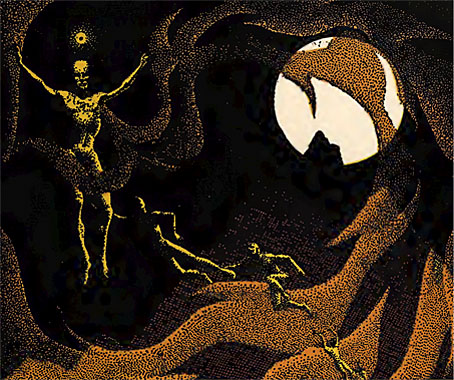
The cropped and tinted copy of Bok’s illustration from The Fantasy Book, 1978.
After writing about my portrait of the King in Yellow last week I was looking through the Robert W. Chambers listings at ISFDB to see who else had illustrated his stories. I’ve examined the covers of reprints of Chambers’ book on many occasions, and almost secured a cover of my own several years ago when a Chinese publisher paid me for a much older piece of artwork which they intended for an edition that seems not to have been published. Despite all this I hadn’t noticed before that Hannes Bok was the first artist to illustrate any of the four King in Yellow stories aside from Chambers himself. Bok was never asked to create any cover art, unfortunately, but in 1943 he illustrated The Yellow Sign and The Mask when Famous Fantastic Mysteries ran them in consecutive issues. Famous Fantastic Mysteries specialised in reprints of imaginative fiction, mostly publishing stories or abridged novels which had never appeared before in US periodicals. It wasn’t the first magazine to do this but its illustration standards were much higher than Weird Tales in its early years, when exceptional stories old or new would be presented with mediocre artwork. In 1928 Weird Tales reprinted Chambers’ time-shift fantasy, The Demoiselle d’Ys, but persisted in neglecting Chambers’ much weirder stories. The same story appeared in Famous Fantastic Mysteries at the end of 1942 with an illustration by Virgil Finlay, the magazine’s regular cover artist together with his equally prolific colleague, Lawrence Sterne Stevens (aka “Lawrence”).
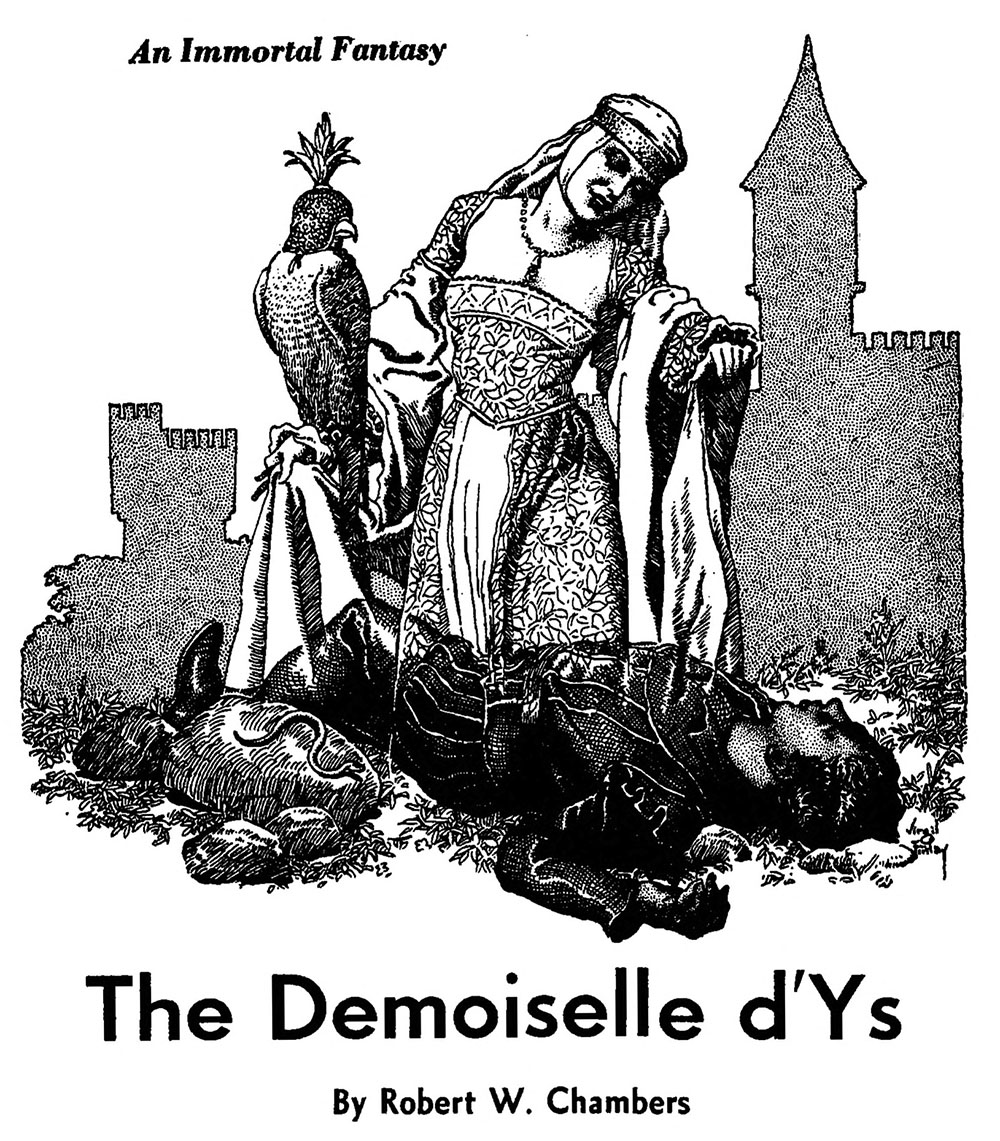
Illustration by Virgil Finlay for Famous Fantastic Mysteries, November 1942.
Another distinguishing feature of Famous Fantastic Mysteries was a tendency to commission two illustrations per story, or more than two if a novel was being illustrated. Thus it is that we have four Hannes Bok illustrations for the Chambers stories, one of which provided my first encounter with Bok’s artwork when it appeared in tinted form in the Franz Rottensteiner book I’ve referred to on many occasions, The Fantasy Book: The Ghostly, the Gothic, the Magical, the Unreal (Thames & Hudson, 1978). Rottensteiner’s book was also the first place I saw any mention of The King in Yellow although I had to wait a while before finding copies of the stories. The Yellow Sign was the first of these, always the easiest to find when its overt ghastliness and weird atmosphere has ensured a long life in horror collections. It’s notable that although The Mask precedes The Yellow Sign in most copies of The King in Yellow, Famous Fantastic Mysteries ran the more horrific of the two stories first.
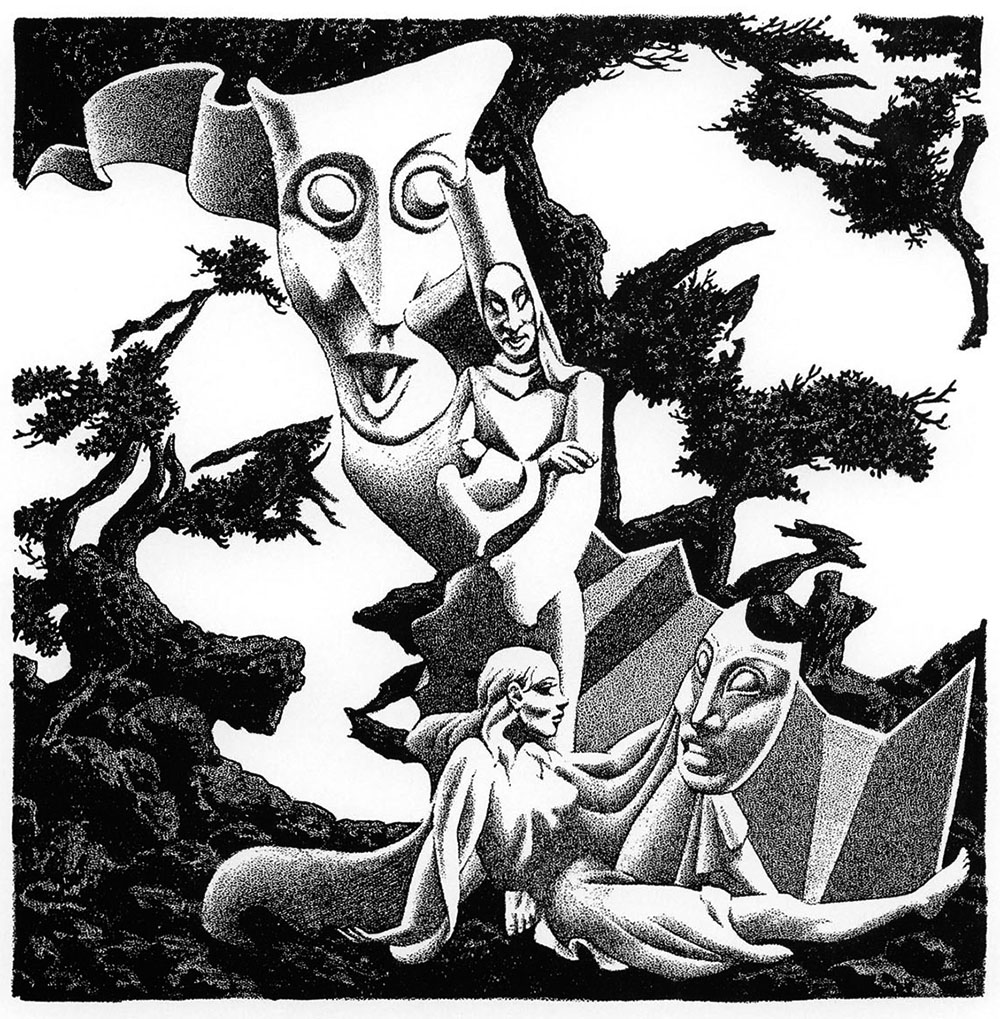
Bok’s title drawing for The Yellow Sign is easily the best of the quartet, and the only Bok drawing I’ve seen in which he plays with the viewer’s perception to create forms with negative space. We’re fortunate that the original of this piece (or a very good copy) was reproduced in A Hannes Bok Treasury in 1993 since the online scans of the magazine spoil his careful shading. The faces are those of the story’s doomed lovers, while the identity of the standing figure is unclear. If this is the King in Yellow (and there isn’t really another alternative) then it’s the first drawing of the character after Chambers’ own.
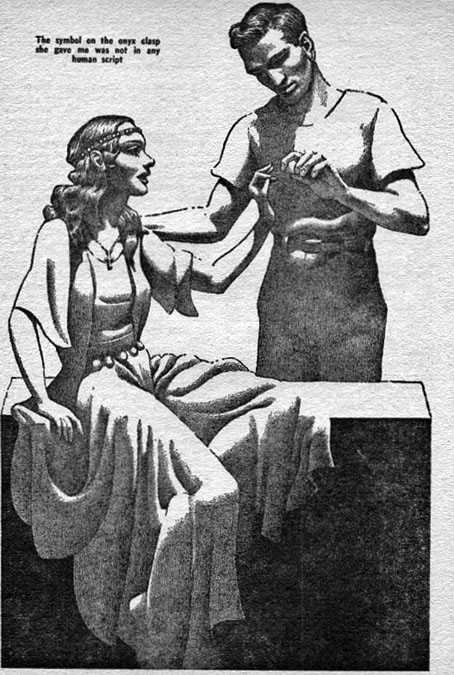
Many illustrators working with this story would choose to show us the corpse-like watchman whose repeated question, “Have you found the Yellow Sign?”, runs throughout the piece. Either that or they’d show us the Yellow Sign itself, a symbol which—like the text of the story’s forbidden play—can never be offered to a reader without deflating expectations. That Chaosium-derived squiggle that so many artists insist on perpetuating is not the Yellow Sign.
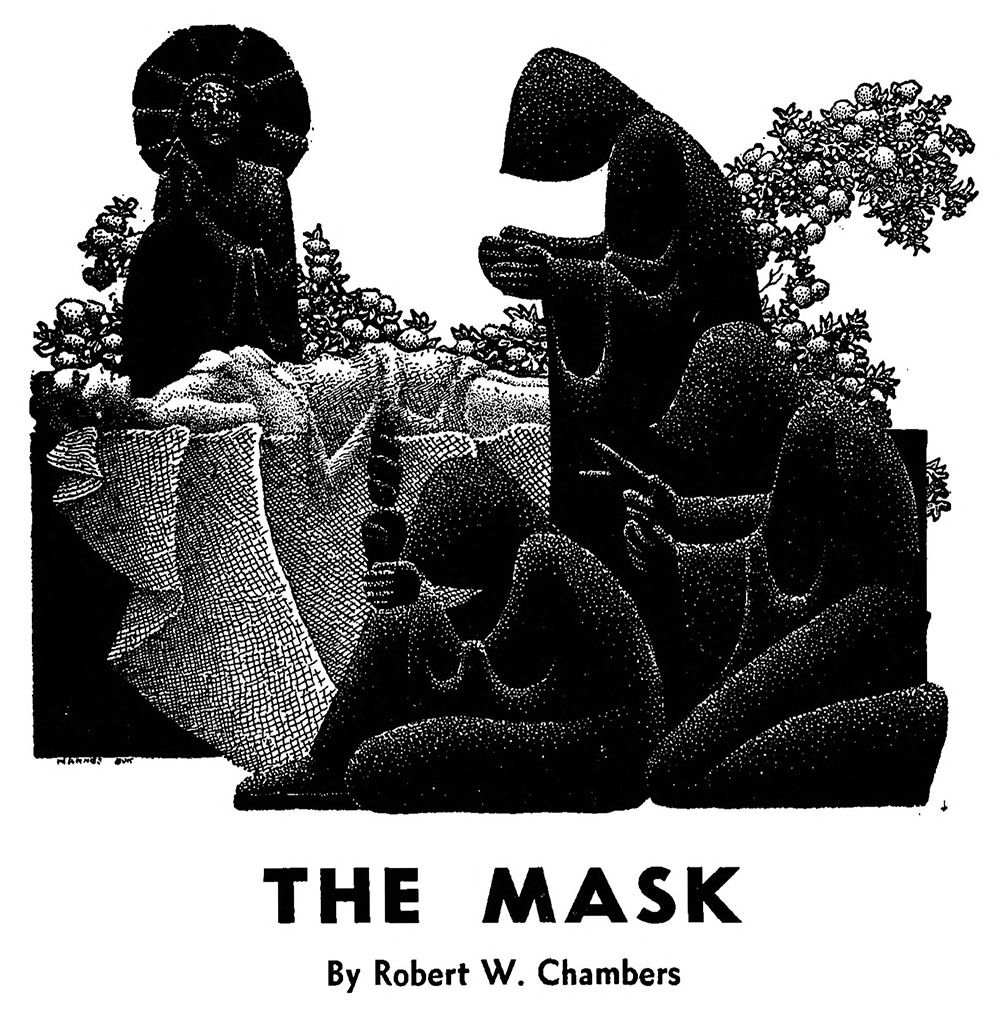
There’s more ambiguity in Bok’s title illustration for The Mask, which could be a symbolic portrait of the dead Geneviève or (more likely) a depiction of the sculpture group, “The Fates”, which is mentioned in both The Mask and The Repairer of Reputations. It may well be both, of course…
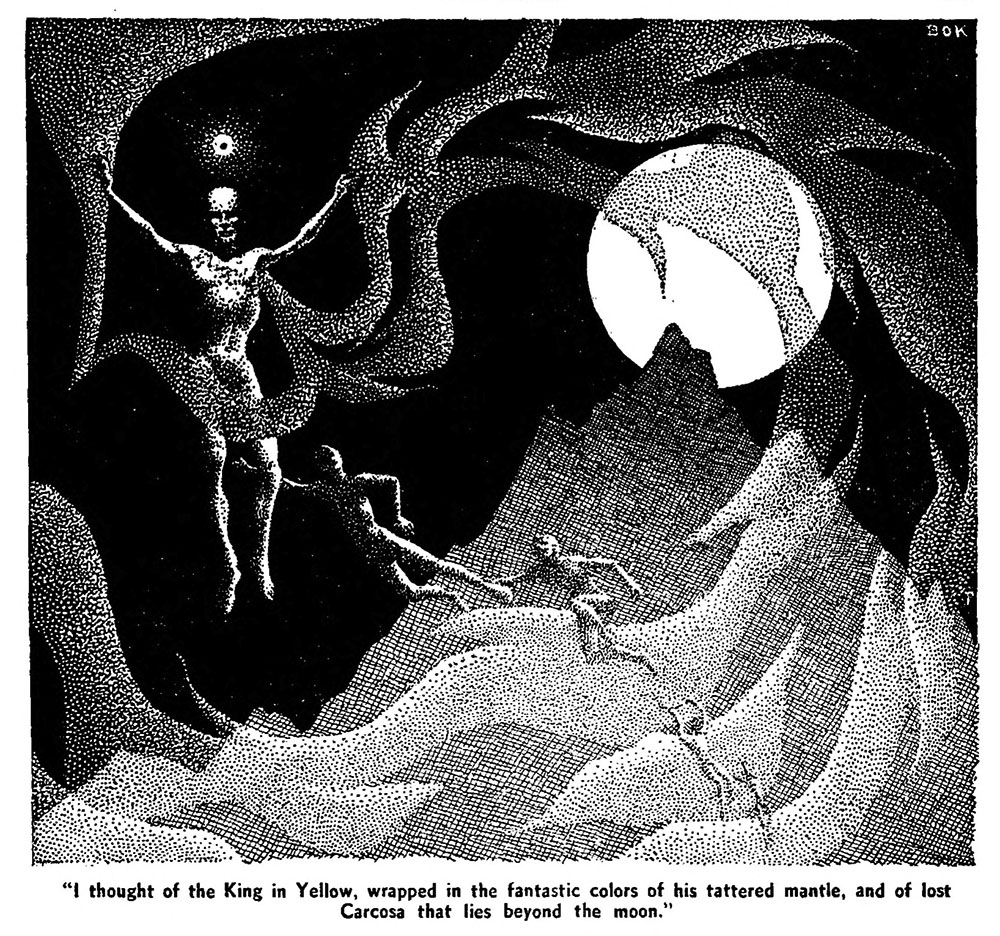
But there’s no ambiguity about the final illustration which is a King in Yellow portrait like no other. This is one of the few illustrations I seen for any of these stories which gives a sense of the cosmic nature of Chambers’ creation. It’s a reminder that this remarkable collection is one of the earliest manifestations of cosmic horror, maybe the first of all. As Franz Rottensteiner notes in The Fantasy Book, Chambers’ stories are “…a good example of the way in which fantastic fiction, even when not particularly successful in commercial terms, may be kept alive for a long period through the enthusiasm of a small circle of devoted readers.”
A postscript: While researching this post I found an essay by Lee Weinstein which examines Chambers’ quartet of stories, their influences and some of the fiction they’ve influenced in the 20th century. It’s a necessarily spoilerish piece but good reading for aficionados.
Elsewhere on { feuilleton }
• The illustrators archive
Previously on { feuilleton }
• The Winged King
• In Carcosa
• The art of Hannes Bok, 1914–1964
• Eldritch idols
• In the Key of Yellow
• Lovecraft’s Monsters
• The Court of the Dragon
• The King in Yellow