
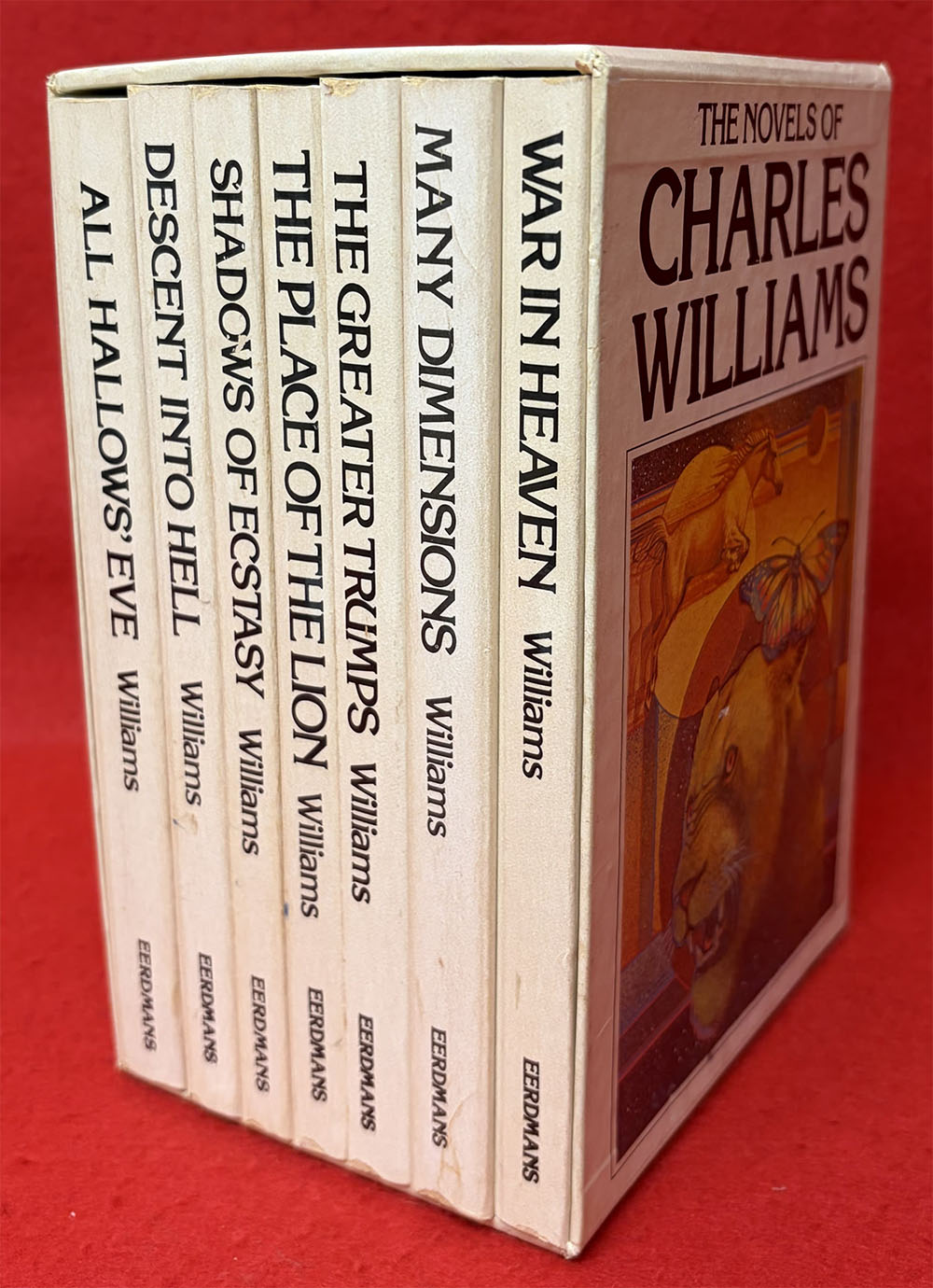
A boxed set of novels published by Eerdmans in 1981. Not something I own, unfortunately.
A couple of years ago I decided to read in order all seven of Charles Williams’ supernatural thrillers: War in Heaven (1930), Many Dimensions (1930), The Place of the Lion (1931), The Greater Trumps (1932), Shadows of Ecstasy (1933), Descent into Hell (1937) and All Hallows’ Eve (1945). The plan foundered at the end of Shadows of Ecstasy when I felt in need of a break from Williams’ fiction but this week I’m reading Descent into Hell and feeling the opposite, happy to be back in Williams’ world. This in turn gives me an opportunity to draw attention to Jim Lamb’s covers for the books, created in the late 1970s when they were reprinted in the USA by Eerdmans as a set of matching paperback editions.
Charles Williams occupies a curious position today, often referred to as “the third Inkling” along with JRR Tolkien and CS Lewis while being utterly eclipsed by the celebrity which has accrued to his friends and their works. Williams doesn’t write about fantastic lands but about a very particular time and place—Britain in the 1930s, either London or “the home counties“—and a variety of metaphysical intrusions into this world. The Narnia novels by CS Lewis have connections to the same time and place but are generally removed from it. If Lewis had only written his three science fiction novels—which few people seem to read today—he might be joining Williams in posthumous obscurity. Williams’ obscurity is such that his novels have had few reprints, which makes the Jim Lamb covers not only the best to date but also one of the few sets given over to a talented illustrator. You’d think novels which have been praised by (among others) TS Eliot, William Lindsay Gresham, M. John Harrison and Tim Powers might warrant a little more attention, but readers and publishers prefer Narnia and Middle Earth.
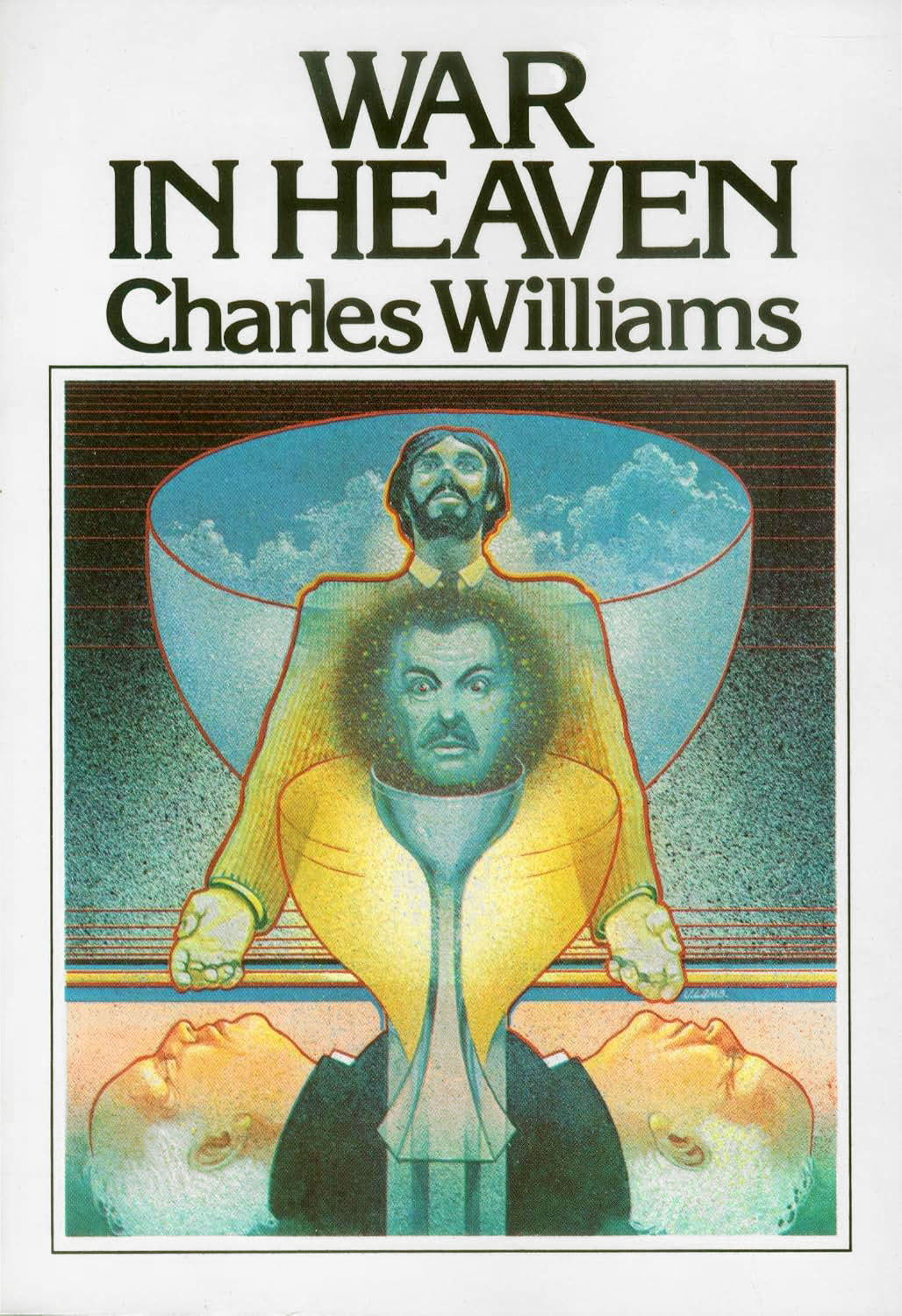
The Holy Grail surfaces in an obscure country parish and becomes variously a sacramental object to protect or a vessel of power to exploit.
(All the story descriptions have been lifted from Wikipedia.)
The first one I read after it turned up as one of the paperback reprints that Sphere were publishing in the 1970s as the “Dennis Wheatley Library of the Occult”. Wheatley provided an introduction for each book, and this one is close enough to his own supernatural fiction that I wonder whether it was an influence. The novel itself is actually more like a story by Arthur Machen—who also wrote about the Holy Grail—or HG Wells, the latter in its conjunction of miraculous events and very mundane London settings. Where Wheatley has the agents of Satanic Powers living in well-heeled splendour, here they make their plans in the back rooms of a chemist’s shop off the Finchley Road.
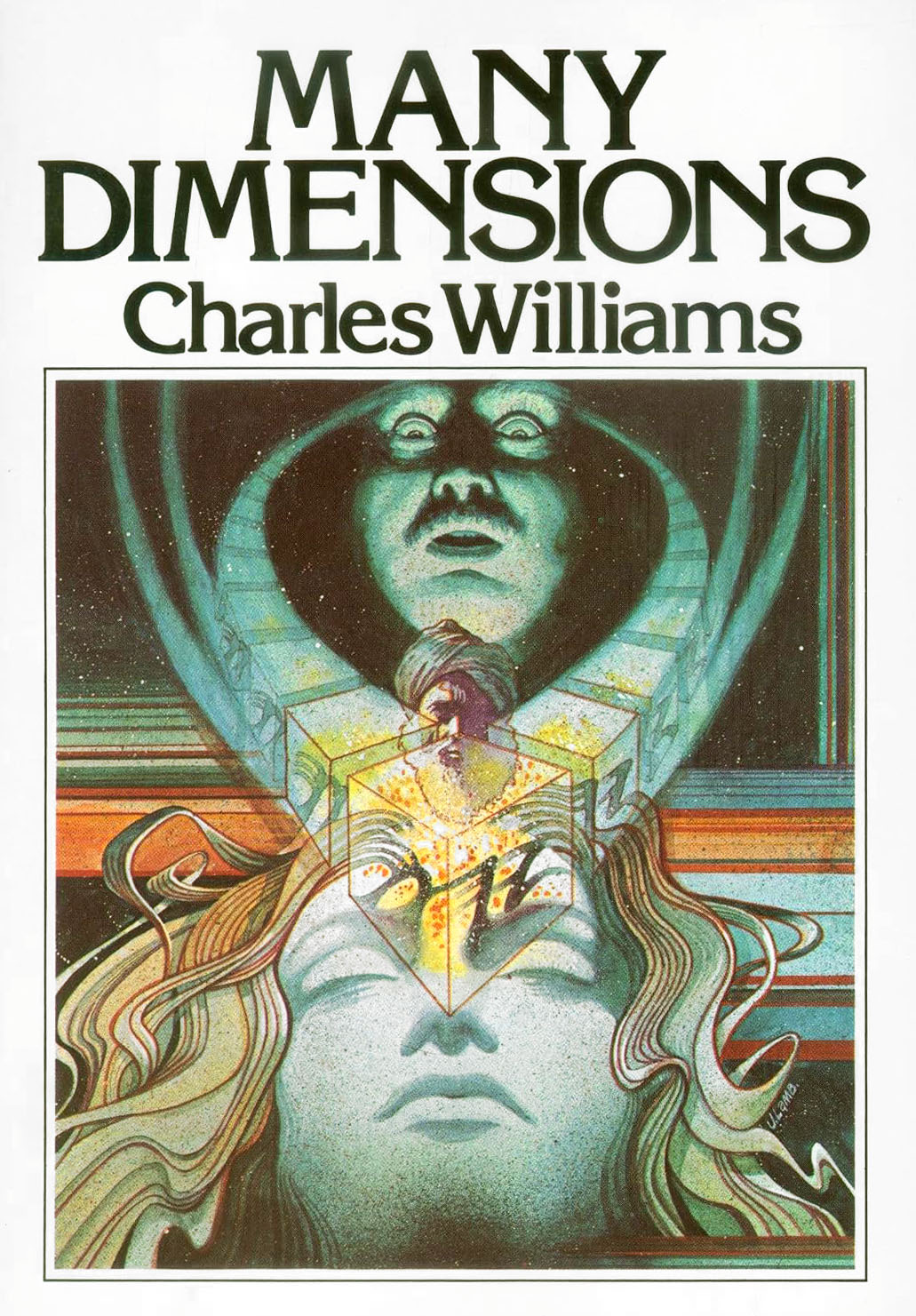
An evil antiquarian illegally purchases the fabled Stone of Suleiman from its Islamic guardian and returns to England to discover not only that the Stone can multiply itself infinitely without diminishing the original, but that it also allows its possessor to transcend the barriers of space and time.
The second one I read, and a book I’ve read three times so far. I wouldn’t mind paying another visit, it’s a fantastic novel in every sense, and the closest that Williams gets to science fiction. It’s also a surprise to find Muslim mysticism given a sympathetic presentation after the overtly Christian mysticism of War in Heaven.
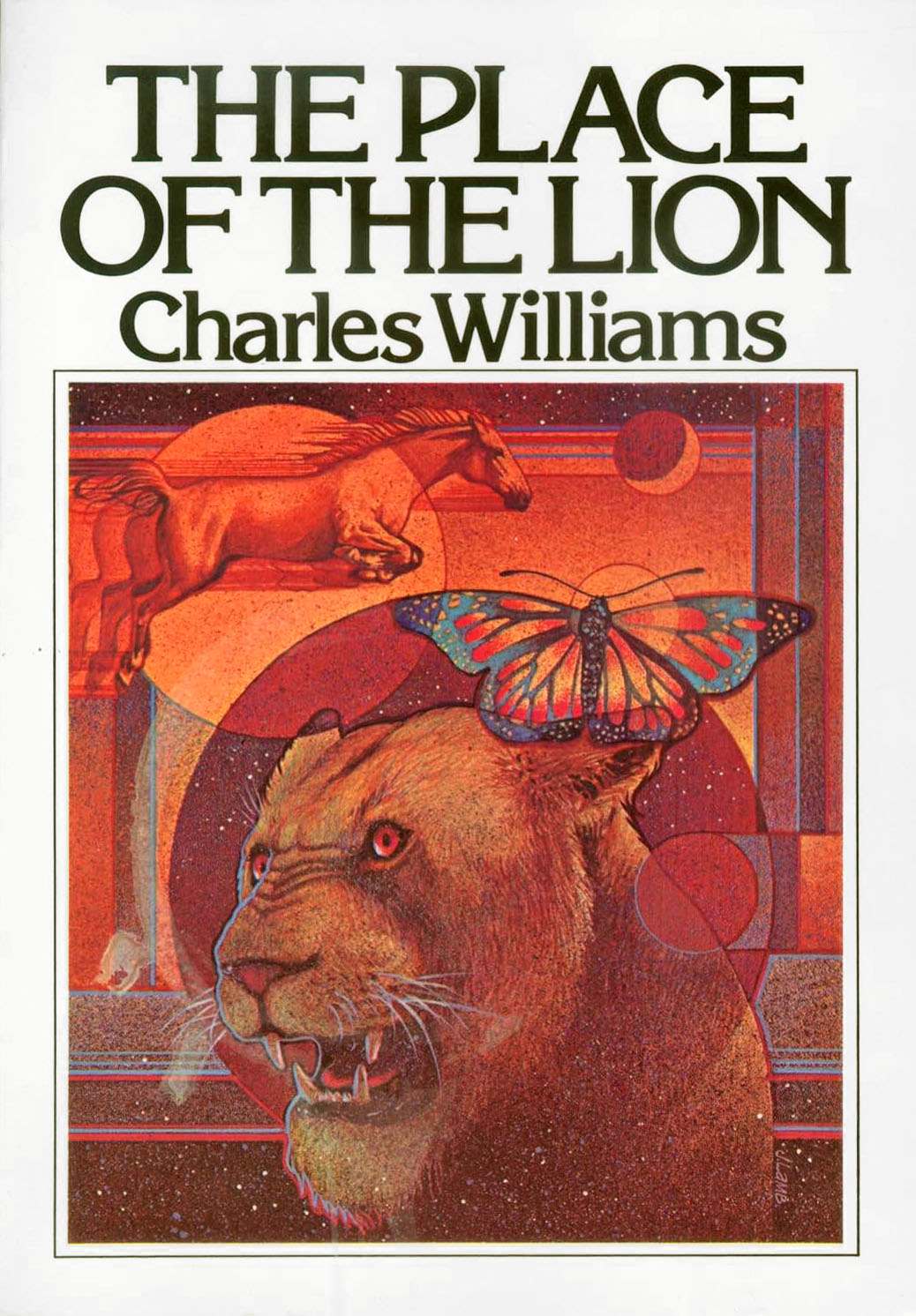
Platonic archetypes begin to appear around an English country town, wreaking havoc and drawing to the surface the spiritual strengths and flaws of individual characters.
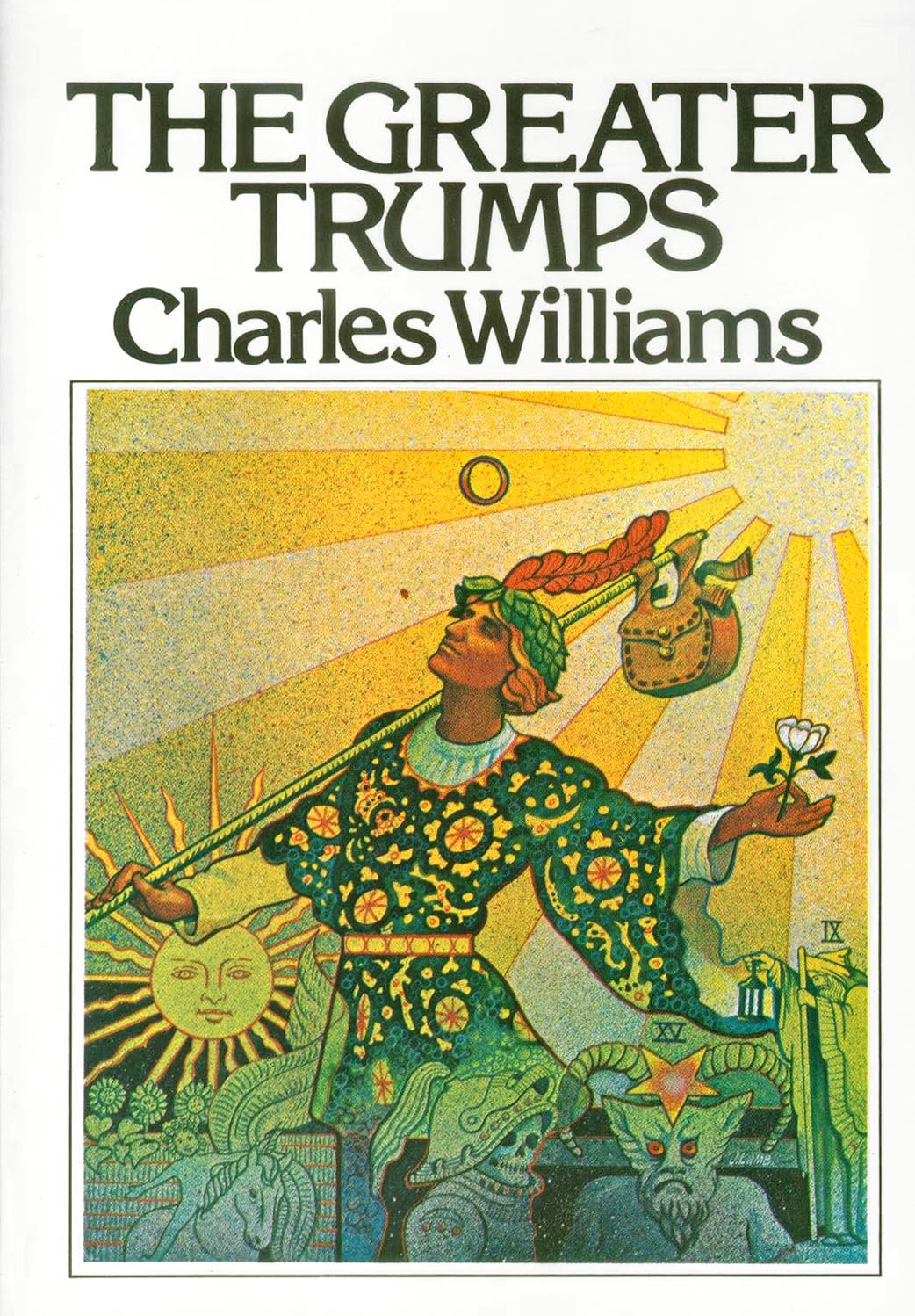
The original Tarot deck is used to unlock enormous metaphysical powers by allowing the possessors to see across space and time, create matter, and raise powerful natural storms.
Another novel which was part of the Dennis Wheatley Library of the Occult, The Great Trumps promises much but doesn’t really deliver despite dealing with the richly symbolic world of the Tarot. Tim Powers’ Last Call would seem to owe something to this, and to The Place of the Lion in its staging of a Tarot-related metaphysical conflict which takes place in and around Las Vegas.
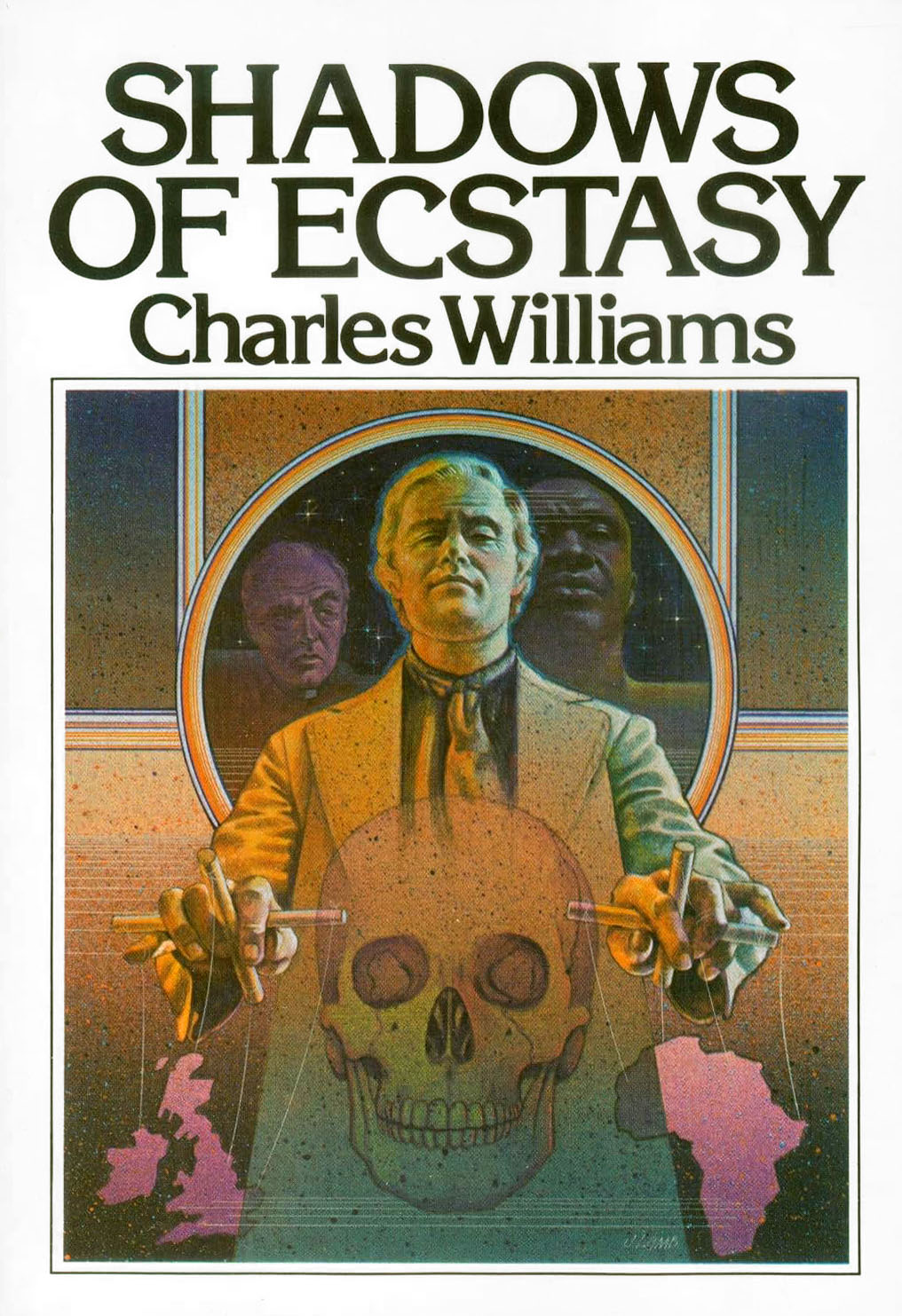
A humanistic adept has discovered that by focusing his energies inward he can extend his life almost indefinitely. He undertakes an experiment using African lore to die and resurrect his own body thereby assuring his immortality. His followers begin a revolutionary movement to supplant European civilisation.
Since I’ve read this it comes to mind any time there’s a mention of one of those wealthy men who believes he can live forever by swallowing pills or having regular blood transfusions. Jim Lamb seems to have used Anton Diffring as a model for the man on the left. And is the central figure based on Marlon Brando?
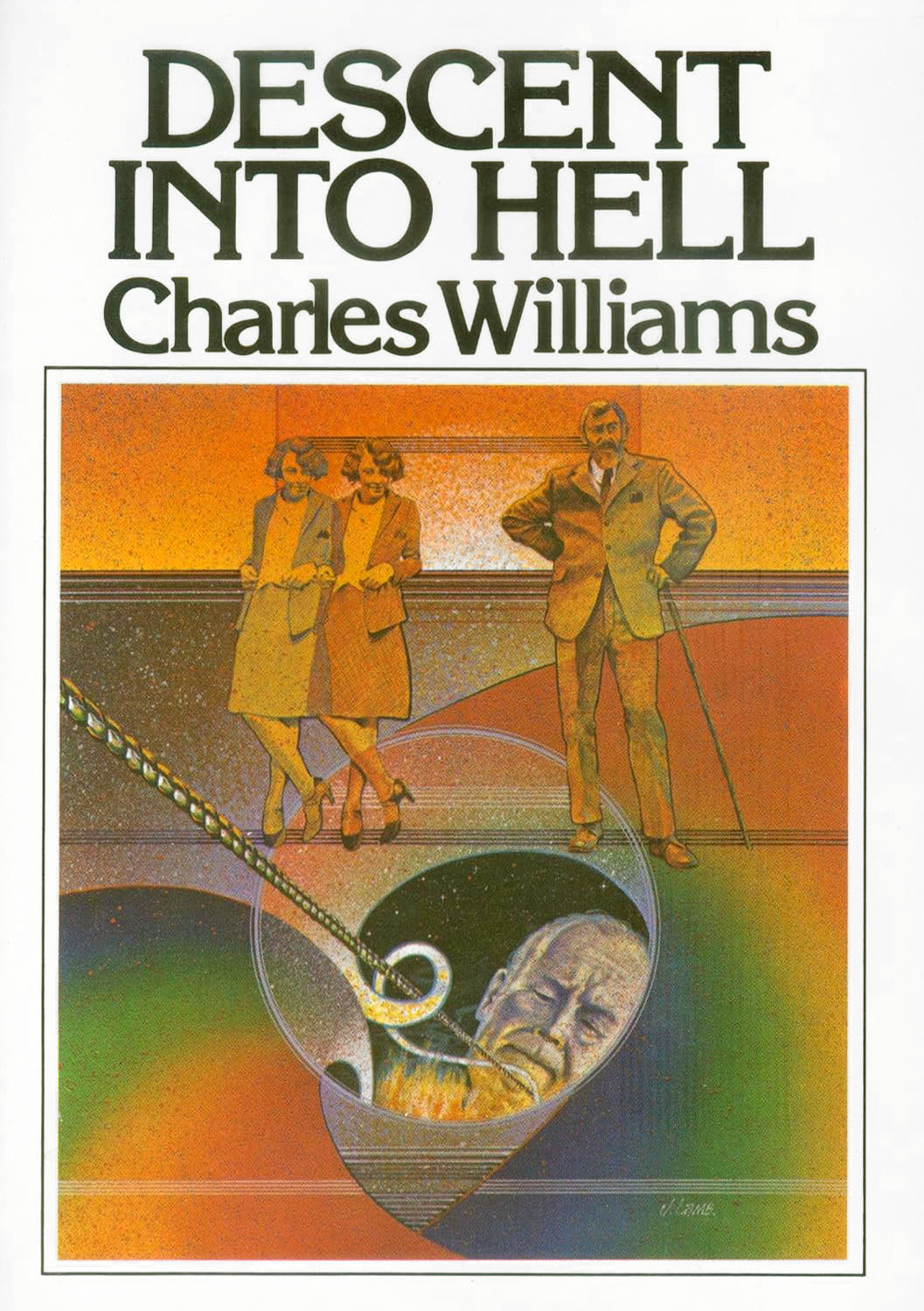
…deals with various forms of selfishness, and how the cycle of sin brings about the necessity for redemptive acts. In it, an academic becomes so far removed from the world that he fetishises a woman to the extent that his perversion takes the form of a succubus. Other characters include a doppelgänger, the ghost of a suicidal Victorian labourer, and a playwright modelled in some ways on the author.
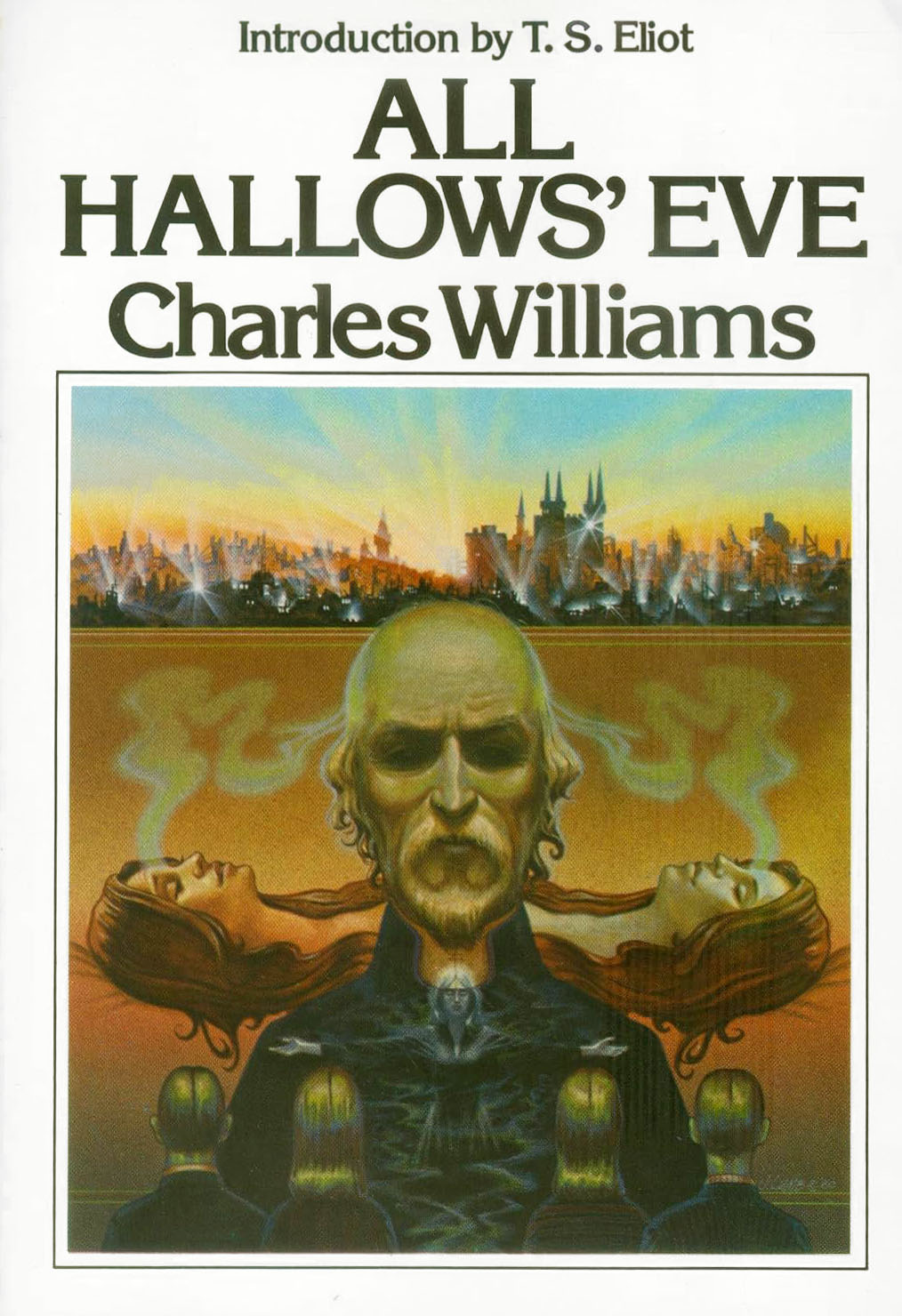
Follows the fortunes of two women after death and their interactions with those they knew before, contrasting the results of action based either on selfishness or an accepting love.
Elsewhere on { feuilleton }
• The illustrators archive
Previously on { feuilleton }
• Nightmare Alleys
Started ‘War in Heaven’ this Halloween after learning about Charles Williams through ‘feuilleton’. It reminded me of ‘A Voyage to Arcturus’. Williams, like David Lindsay, writes as though he may have been of the Devil’s party without knowing it.
Thanks, Thom, I hope you enjoy it. The Inklings were aware of Lindsay’s novel, I think Lewis said it gave him the key for how to write his own brand of science fiction. As for Williams, he was involved for a while with real-life occult groups so he was certainly writing as an insider, unlike Dennis Wheatley and co.