
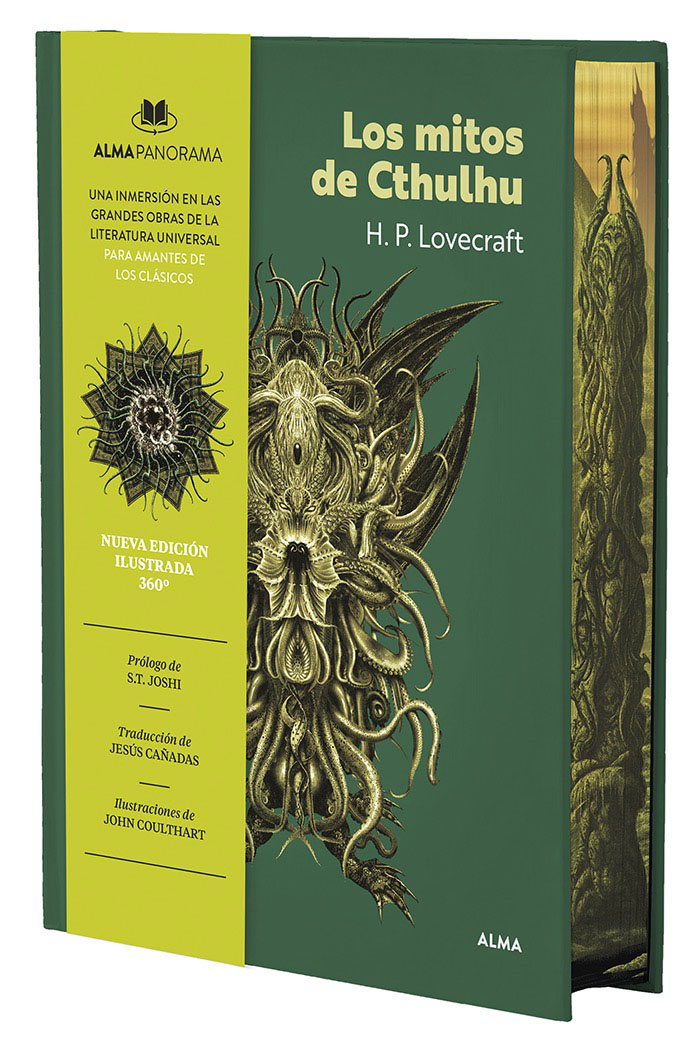
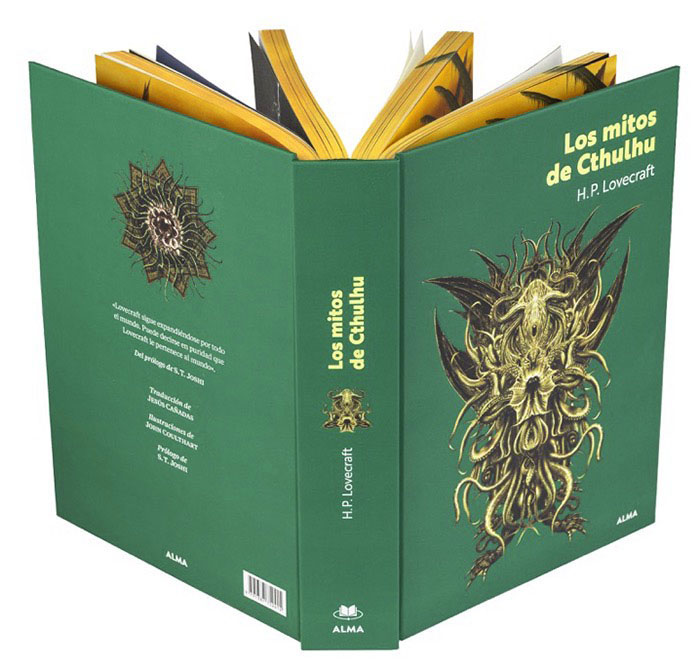
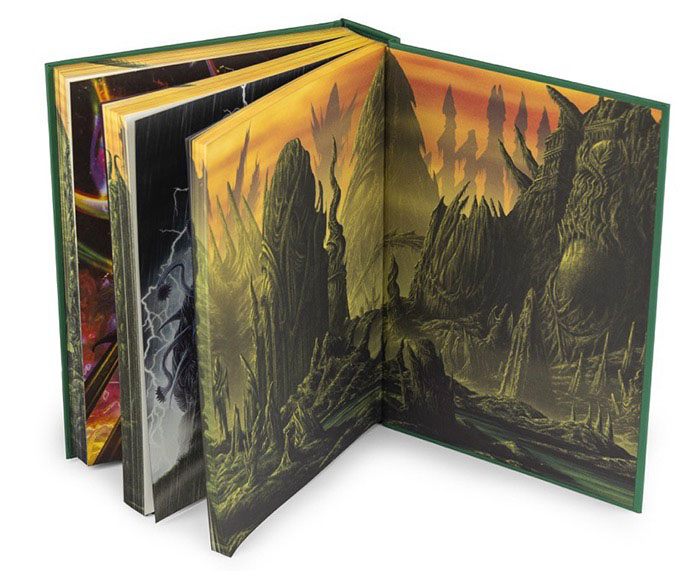
Appearing on Spanish bookshelves this month is Los mitos de Cthulhu, a 576-page story collection which I spent the first six half of this year illustrating. This is my third illustrated Lovecraft for Editorial Alma, with an introduction by ST Joshi and translations by Jesús Cañadas, and is easily the biggest to date in both size and page count. The book is a hardback with an obi strip, and includes a feature which Alma have been applying to other titles in this series, with a single illustration (in this case a panorama of the risen R’lyeh) that covers the front and back endpapers while also wrapping across the sprayed page edges. You may have noticed that sprayed edges have become a minor trend in the publishing world especially with big collections like this one. The edition of Frankenstein that I illustrated for Alma was given sprayed edges when reprinted at a larger size in the USA and Poland but Los mitos de Cthulhu is the first book I’ve worked on where I’ve had to create something specifically for this effect. What I’ve yet to see is another publisher spraying the page edges with a single illustration that runs inside and outside the book.
Where the interiors are concerned, the brief was to create ten full colour, double-page illustrations for a collection of twelve stories, with the choice of illustrations being left in my hands. This was obviously going to involve a lot of work but I was pleased to be given an opportunity to create a new series of digital paintings in full colour. In recent years I’ve done so much digital collage, monochrome drawing or vector illustration that the realistic painted side of my work feels unduly neglected. Some of the stories I ended up choosing were ones I’d illustrated before but a few of them I was tackling for the first time.
In rough order of completion, the story list is as follows:
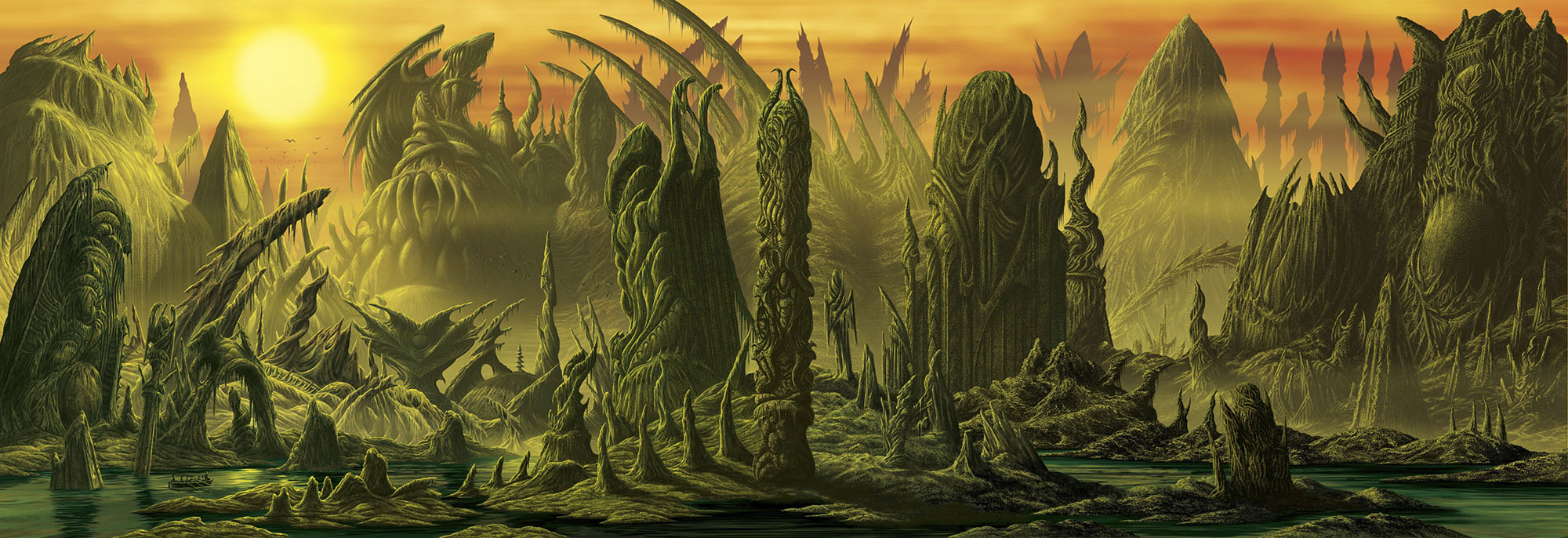
The Call of Cthulhu
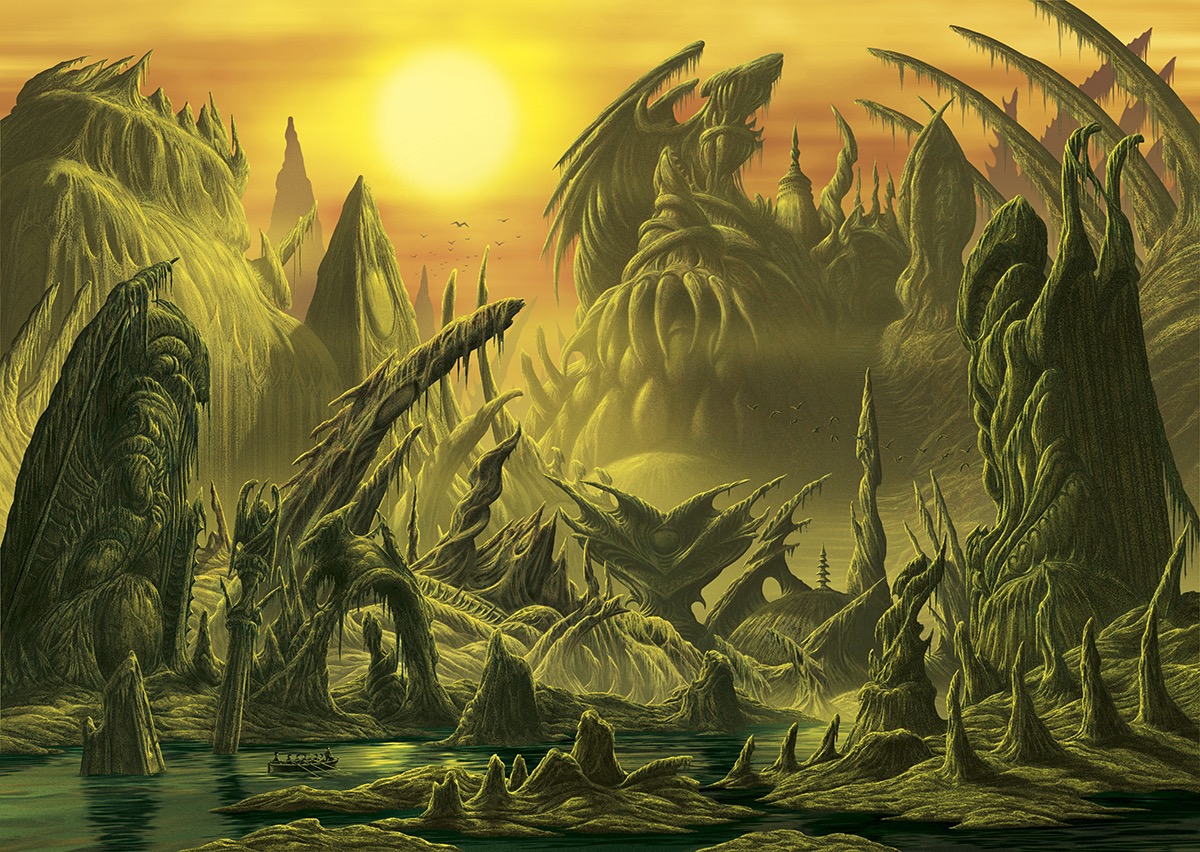
Not my first view of R’lyeh but this is the first one I’ve done where the ruins look like they’ve been underwater for a very long time. The book’s endpapers were created last, when all the illustrations had been completed. This required adding an extension to the piece above, a tricky business with a digital artwork but not as difficult as it would have been using physical media.
The Shadow Over Innsmouth
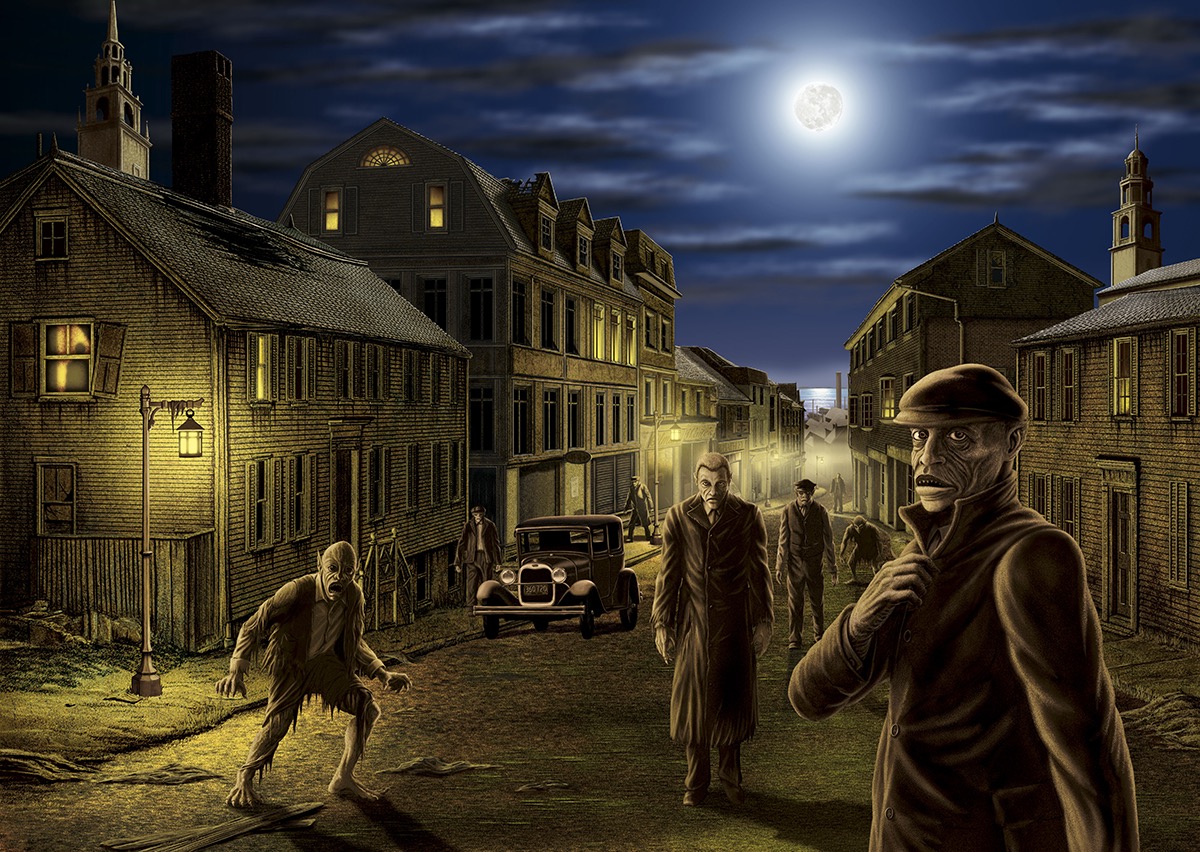
This, on the other hand, is my first visit to Innsmouth. Since all these illustrations run across two pages I’ve tried to give both halves of each picture a point of interest while avoiding the placement of anything important in the centre. Among other things this has avoided my usual propensity towards compositions based on a central vertical axis.
The Dunwich Horror
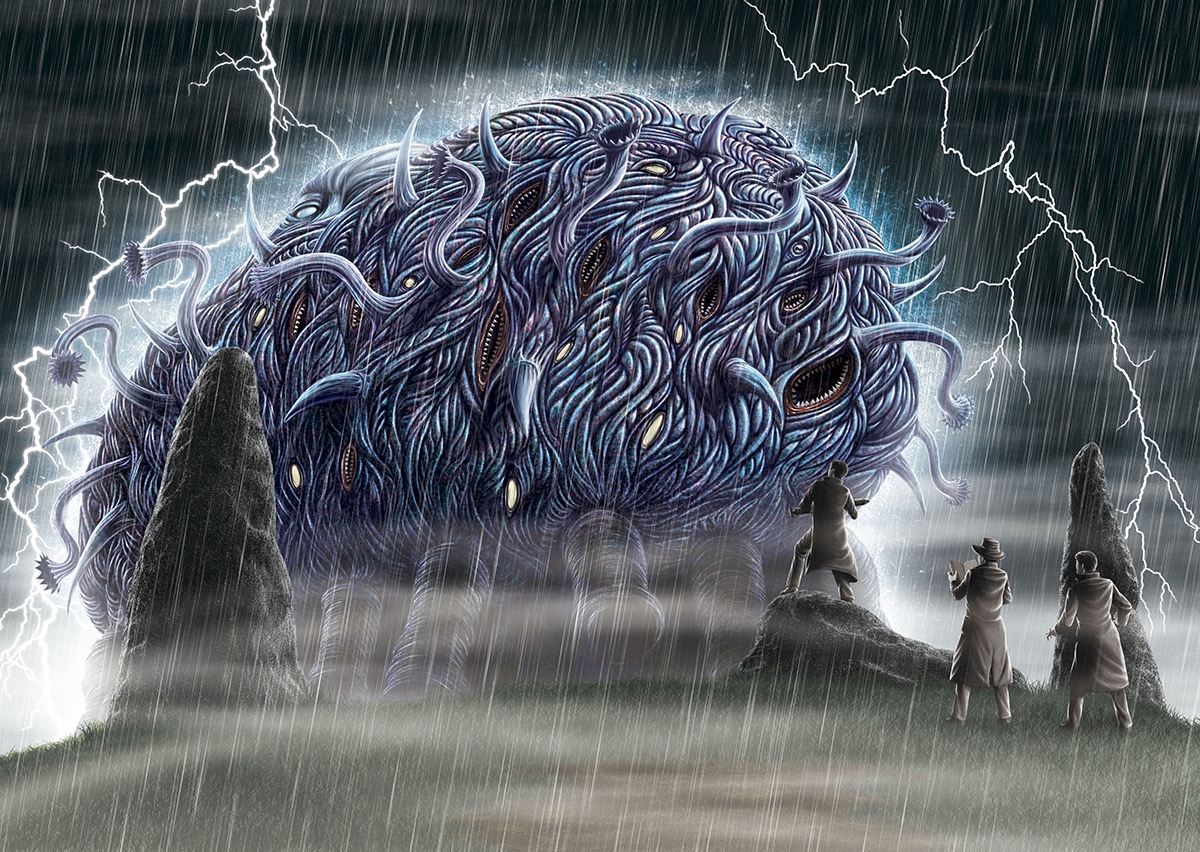
Here once again is the story which has been filling most of my waking moments for the past two years… I’m still a long way from dealing with this climactic confrontation in my comic-strip adaptation, as a result of which I almost omitted choosing the story in order to save the surprise (for myself) until later. With scenes like these I try to avoid over-sketching anything. When I was drawing The Call of Cthulhu in 1987 I didn’t make any sketches of the real Cthulhu (as opposed to the statuary, etc) until the day I had to start drawing the page where the abomination emerges from its lair. I’d been planning on doing the same for the climax of The Dunwich Horror but I spent so long working on the perspective of those Innsmouth buildings that I wanted the next picture to be something that wouldn’t take an equivalent amount of time, and ended up sketching this scene in a couple of hours. Now that Wilbur Whateley’s monstrous brother has been revealed I’ll probably be doing something very similar to this scene for the comic-strip version.
The Nameless City
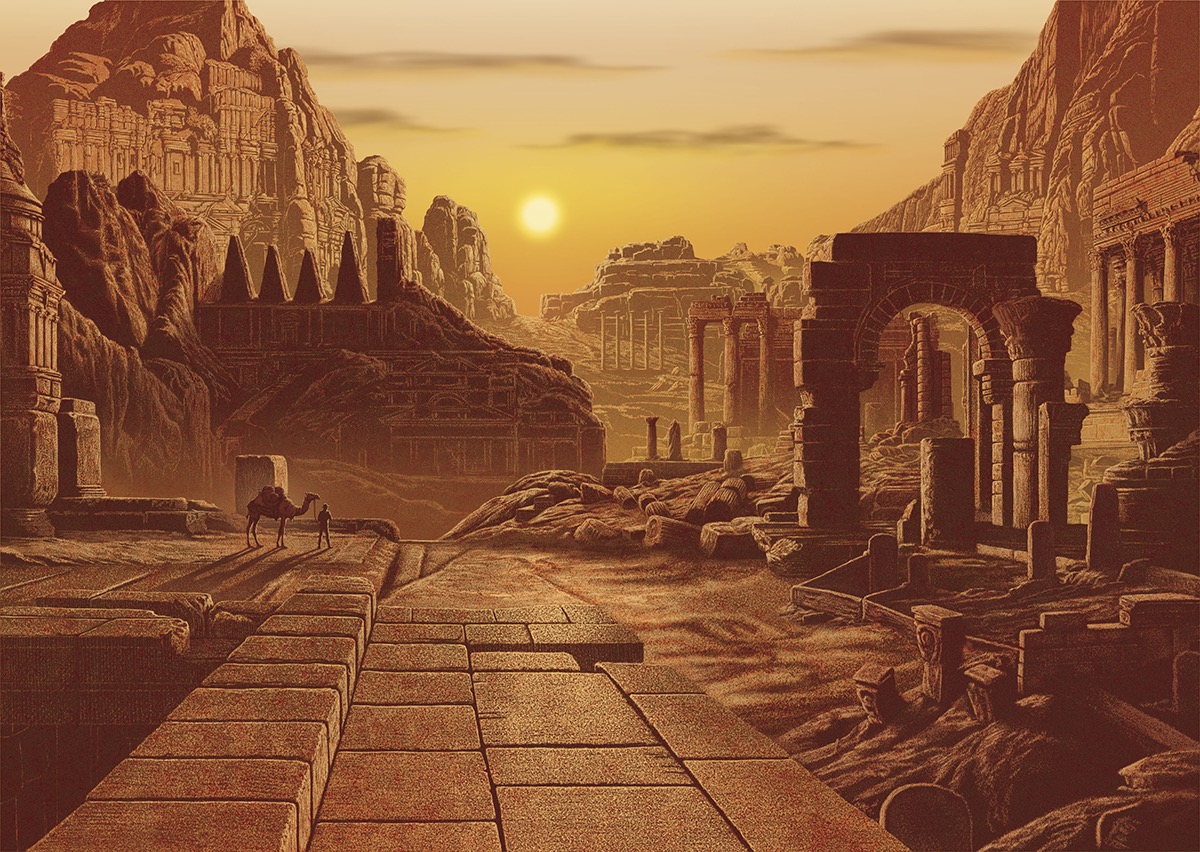
Despite having dealt with the ends of stories in the illustrations above I’ve generally tried to avoid being too spoilerish with these pictures. It’s easy to think that everyone knows all the stories by now but there will always be readers encountering them for the first time. This picture is a scene-setting piece for a story that ST Joshi describes as one of Lovecraft’s worst weird tales. I don’t think it’s that bad—it gives us our first quote from the Necronomicon while being a kind of sketch for At the Mountains of Madness—but the later scenes take place in narrow and very dark underground passages. I might have done something with one of these scenes for a single-page illustration but double-page spreads require something a little more grand and cinematic.
At the Mountains of Madness
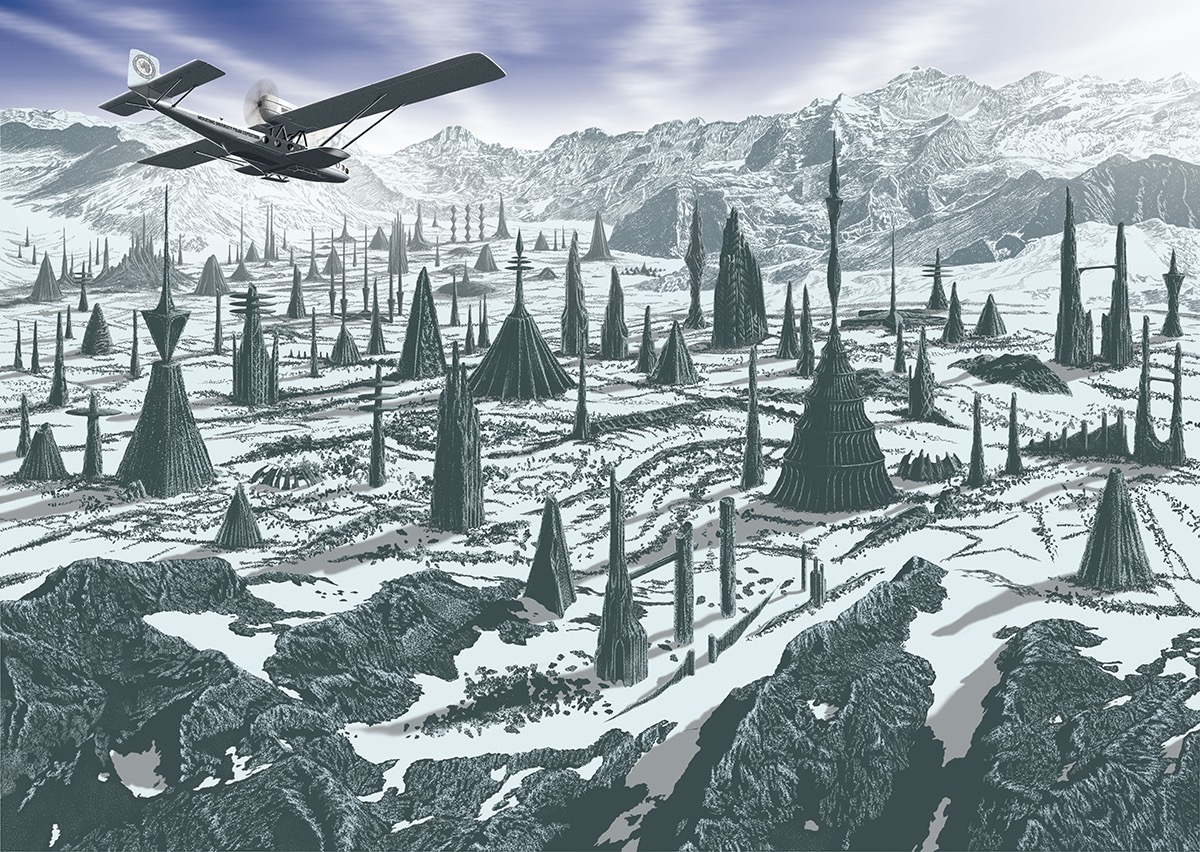
From ruins in the sand desert to ruins in the ice desert. This is the scene from the middle of the story when the explorers’ plane discovers that the centre of Antarctica is home to vast architectural structures that shouldn’t be there at all. Lovecraft describes a vista of these ruined towers stretching for miles into the distance amid a labyrinth of smaller structures. If I was going to do justice to the story (and I’d still like to one day) the scene should really look like an extraterrestrial equivalent of Manhattan Island surrounded by mountains; but if I’d committed to that level of detail I’d probably still be working on the book today. Deadlines often force your hand, and by the time I was working on this picture I was worried I was falling behind in my schedule. Think of this, then, as the outskirts of the alien city, with much more still to be revealed.

A note about the aircraft: Lovecraft mentions the Miskatonic expedition bringing with them four Dornier planes but doesn’t say which model of Dornier they use, a detail which caused a headache when I was looking for reference material. In the end I decided on a Dornier Do J Wal, a small flying-boat used by Roald Amundsen in a North Pole expedition which artist/Lovecraft scholar Jason C. Eckhardt had earlier identified as one of the planes used in the story. In addition to fretting over the aircraft details I also designed an emblem for the expedition.
The Festival
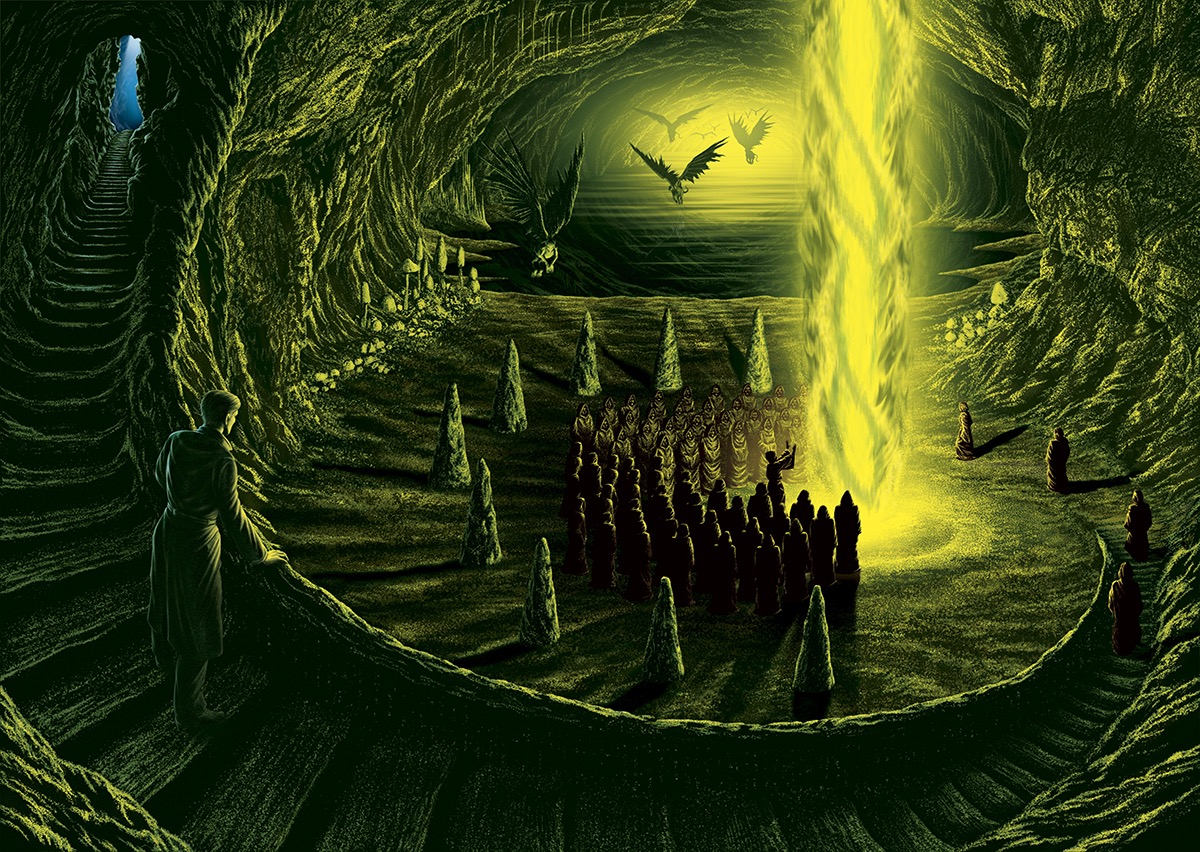
Another minor story which I hadn’t tackled before but, unlike The Nameless City, a tale with a visually interesting climax. The double-page composition worked out well for this one, a spiral arrangement that takes in the descent from the upper world, the robed figures gathering around a pillar of green fire, and the winged creatures flapping out of the underworld.
The Shadow Out of Time
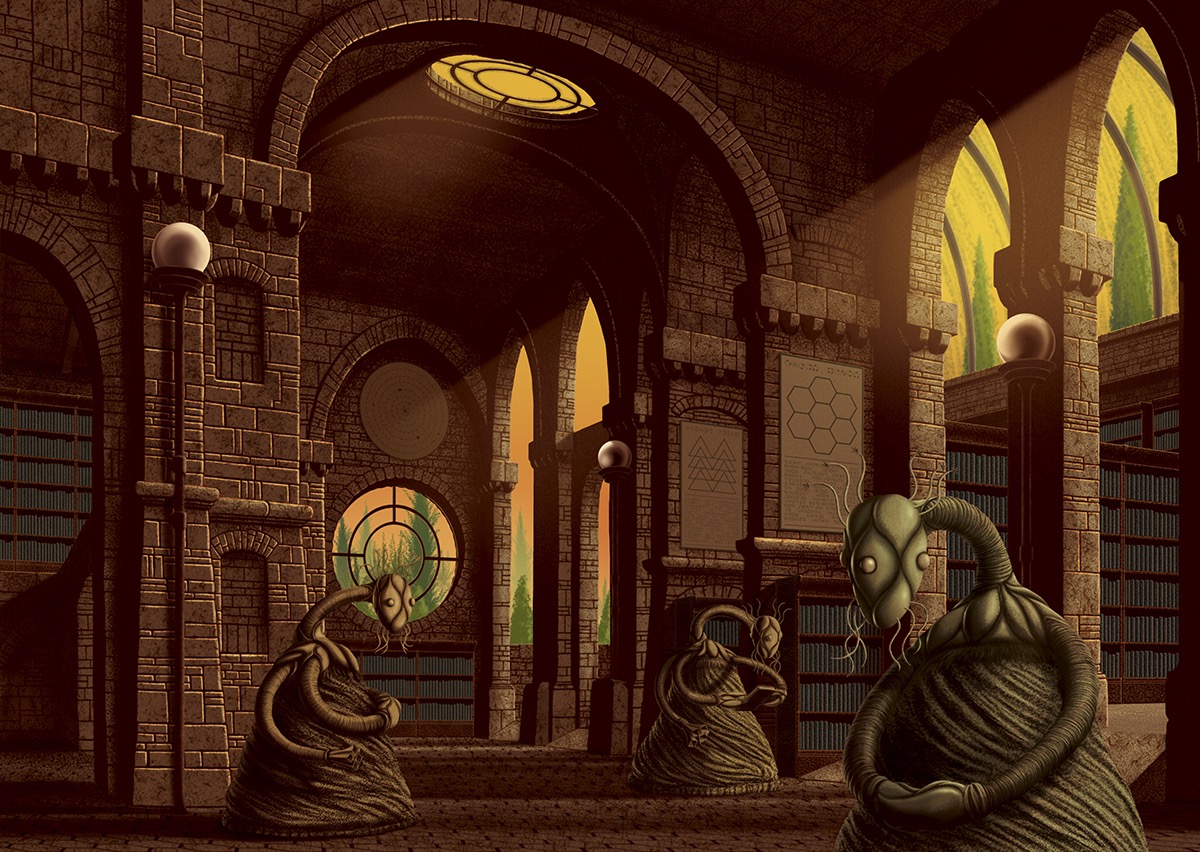
With this one I was torn between inventing a very alien interior versus a more recognisable Earth-like scene. The latter won out, obviously, because the clock was ticking and I still had more stories to deal with. The Great Race of Yith are aliens but they’re also librarians and archivists so I’d expect them to inhabit an orderly environment while pursuing their project of documenting the entire history of the Earth. Lovecraft describes them occupying a series of huge towers, some of which, I suggest here, might have been constructed along Earth-like principles as a result of all their mind-swapping with the planet’s future population.
The Statement of Randolph Carter
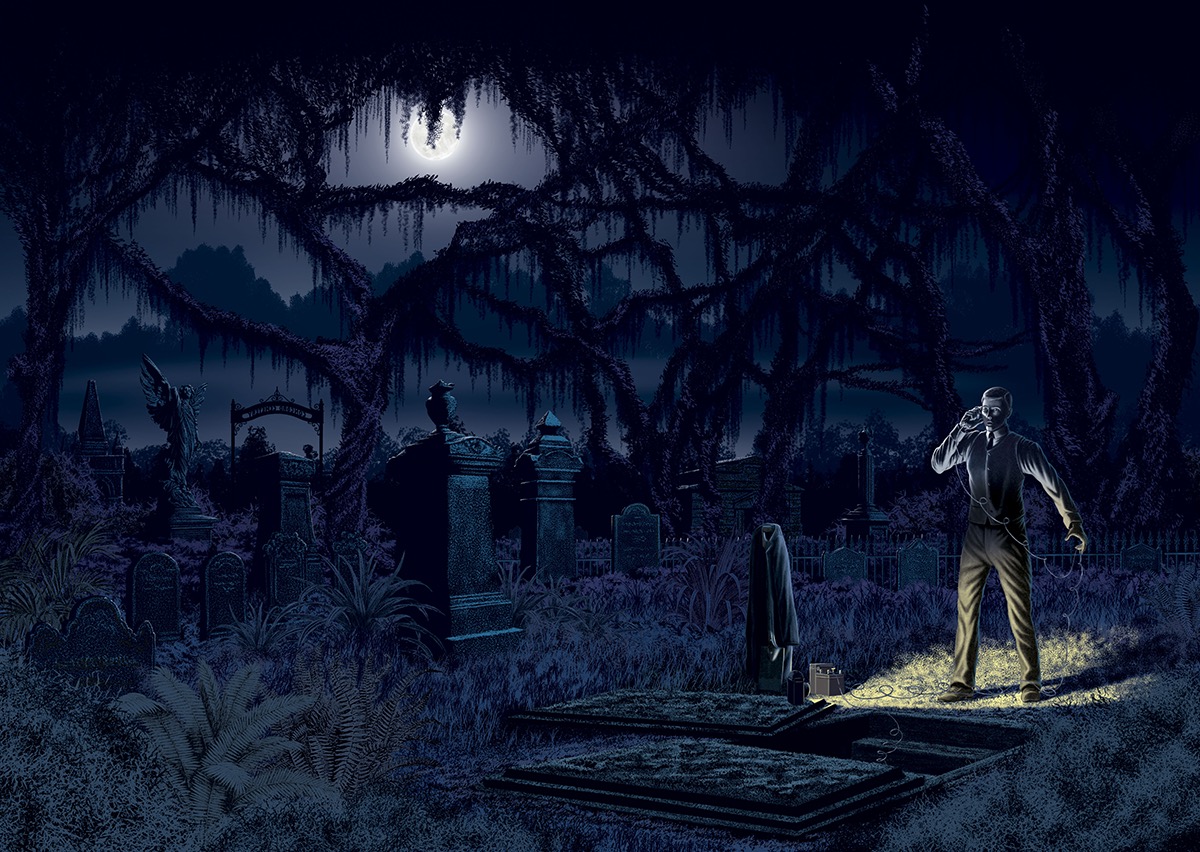
Another one I hadn’t illustrated before. Lovecraft doesn’t give a location for the cemetery but it’s described as being located in an overgrown swampy region that may be somewhere like Georgia or Florida, hence the moss hanging from the trees.
Through the Gates of the Silver Key
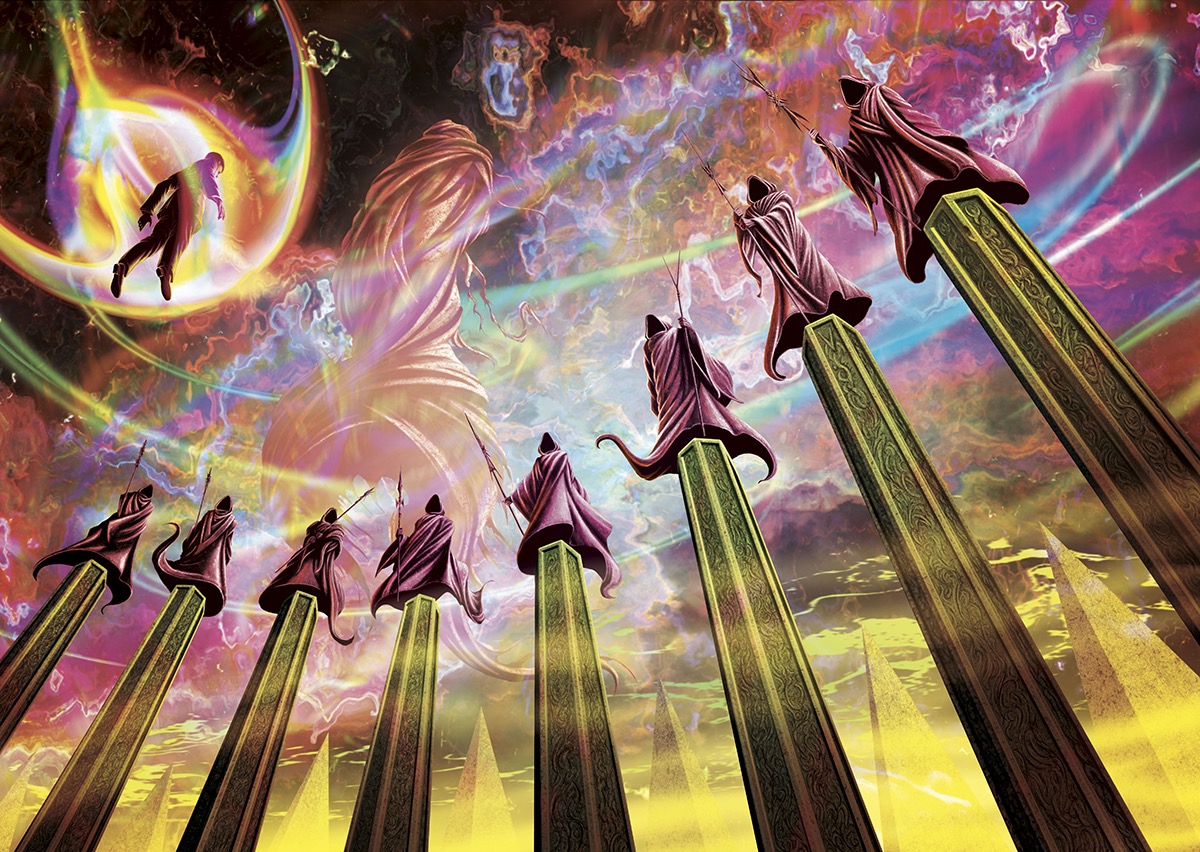
This was the only picture of the ten that gave me any problems because I couldn’t get the colours of the sky to look the way I wanted. The story is one of several in which Lovecraft describes unearthly colours, here manifesting in the skies of another dimension. The finished picture shows the third draft of the sky which is a composite of about eight different layers that give the turbulent and liquid polychrome appearance I was after. Much of this was achieved using Glitch Lab, a photo-filter suite which has a prismatic distortion setting among its range of effects. I was intending to do more with the picture as a whole but by the time it was finished I’d hit the deadline and still had one more to do.
The Rats in the Walls
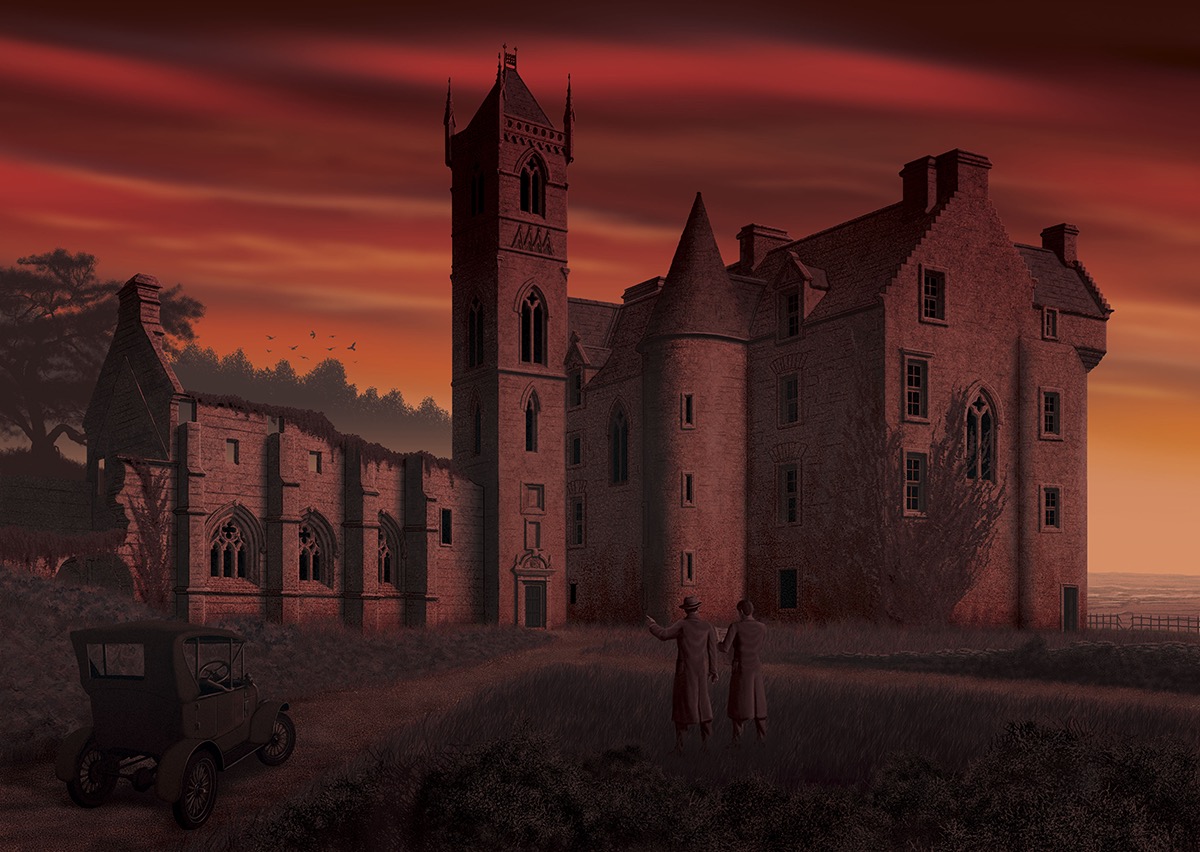
The climax of this story takes place in a vast cavern underneath the house but I’d already drawn one cave and was reluctant to do another. The cannibal theme of the story is alluded to by the bloody sunset and the red stains creeping up the walls of the buildings from the surrounding earth.
The two unillustrated stories in the collection are The Thing on the Doorstep—rejected for being light on visual drama aside from brief mentions of a “pit of shoggoths”—and The Haunter of the Dark—rejected because I’d have to either spoil another climax (which in any case takes place in total darkness) or draw another building, and I’d recently drawn the real church that was the basis for the Starry Wisdom headquarters in Tachyon’s Lovecraft’s Brood. I was offered a couple more story options, among them Pickman’s Model which I nearly opted to include. The trouble with this story is that I’ve never found the idea of corpse-eating ghouls to be very interesting even though you obviously wouldn’t want to meet such a creature. And Lovecraft’s descriptions of Pickman’s paintings build up the expectations of the reader to such a degree that anything you do to illustrate one of these scenes is bound to be a disappointment, even if you can paint like Velázquez or Salvator Rosa.
Now that this book is in print I imagine people will be asking me about a US edition. Nothing is planned at the moment but it remains a possibility even though the Lovecraft reprint market feels increasingly crowded, especially for Anglophone readers. People are still buying copies of older books despite the texts being freely available online. I never expected my edition of Frankenstein to be reprinted in the US because it’s so easy to find elsewhere, and I really didn’t expect it to sell the 20,000 copies that it subsequently did. The Lovecraft reprint market may be a crowded one but many of those editions are cheaply done and will be taking their texts from earlier printings of the stories like the ones in Weird Tales, some of which introduced typographic errors. Let the reader beware.
Elsewhere on { feuilleton }
• The Lovecraft archive
Previously on { feuilleton }
• Illustrating Lovecraft again
• The Thing on the Doorstep