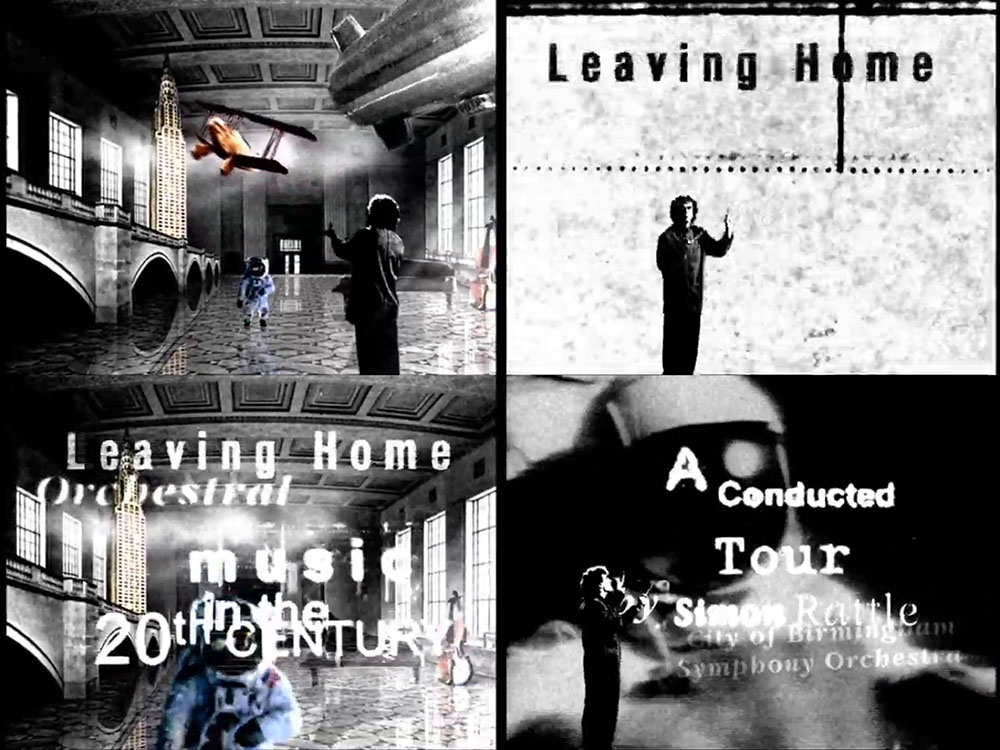
Leaving Home: Orchestral Music in the 20th Century

leaving1.jpg

In which orchestral conductor Simon Rattle explores a century of music in much the same way that Robert Hughes explored a century of art in The Shock of the New. Or almost… It’s unfair to compare this more modest TV series to a landmark which was shot on film and with a budget large enough to allow Hughes to present his art history from locations all around the world.

If you’ve ever felt in need of an intelligent introduction to the challenges of orchestral music then Leaving Home is the ideal guide. The series was broadcast by Channel 4 (UK) in 1996, a time when the channel still was still devoting a considerable portion of its programming to the arts. Simon Rattle was a wise choice as a presenter, being a conductor with a less intimidating demeanour than some, as well as a proselytising nature. His intention here was to dispel the difficulty which many people still feel when faced with atonal compositions (twelve-tone music, aleatory music, serialism) by explaining how these musical forms evolved and why they’re not so difficult at all once you appreciate the reasoning behind them and the context out of which they emerged. Music is a curious medium in this respect. Where other art forms can start to feel distinctly old-fashioned and even thoroughly antiquated once a few decades have elapsed, there’s a lot of European music which is well over a hundred years old yet can still challenge and disturb an audience today if that audience is unprepared. Rattle’s explanations parallel The Shock of the New by dividing a century of artistic evolution into distinct modes or themes. The structure of the series and the music under discussion is as follows:
leaving2.jpg

Programme 1: Dancing on a Volcano
Wagner, Prelude to Tristan and Isolde
Schoenberg, Transfigured Night
Mahler, Symphony no. 7
Strauss, Elektra
Schoenberg, Five Orchestral Pieces, op. 16, nos. 1 and 2
Webern, Five Orchestral Pieces, op. 10, nos. 3, 4 and 5
Berg, Violin Concerto
leaving3.jpg

Programme 2: Rhythm
Stravinsky, The Rite of Spring
Varèse, Ionisation
Mahler, “Abschied” from Das Lied von der Erde
Ligeti, Atmosphères
Reich, Music for Pieces of Wood
Nancarrow, Piano Roll no. 21
Boulez, Rituel in Memoriam Bruno Maderna
Messiaen, Turangalîla Symphony
leaving4.jpg

Programme 3: Colour
Debussy, Prélude à l’après-midi d’un faune
Stravinsky, The Firebird
Ravel, Daphnis et Chloé
Debussy, Jeux
Schoenberg, Five Orchestral Pieces, op. 16, no. 3 “Farben”
Boulez, Notations
Messiaen, Et expecto resurrectionem mortuorum
Takemitsu, Dream/Window
leaving5.jpg

Programme 4: Three Journeys through Dark Landscapes
Bartók, Duke Bluebeard’s Castle
Bartók, Music for Strings, Percussion and Celesta
Bartók, The Miraculous Mandarin
Bartók, Concerto for Orchestra
Shostakovich, Symphony no. 4
Shostakovich, Symphony no. 5
Shostakovich, Symphony no. 14
Lutosławski, Concerto for Orchestra
Lutosławski, Venetian Games
Lutosławski, Symphony no. 3
leaving6.jpg

Programme 5: The American Way
Gershwin, Rhapsody in Blue
Ives, Decoration Day
Carter, A Celebration of Some 100 x 150 Notes
Copland, Appalachian Spring
Weill, “Lonely House” from Street Scene
Bernstein, “Symphonic Dances” from West Side Story
Cage, Sonatas and Interludes
Cage, First Construction in Metal
Feldman, Madame Press Died Last Week at 90
Riley, In C
Adams, Harmonium
leaving7.jpg

Programme 6: After the Wake
Strauss, “Im Abendrot” from Four Last Songs
Schoenberg, A Survivor from Warsaw
Boulez, Le marteau sans maître
Webern, Five Orchestral Pieces, op. 10, no. 4
Stockhausen, Gruppen
Britten, Serenade for tenor, horn and strings
Stravinsky, Agon
leaving8.jpg

Programme 7: Threads
Berio, Laborintus II
Henze, Symphony no. 8
Gubaidulina, Zeitgestalten
Kurtág, Grabstein für Stefan
Birtwistle, Ritual Fragment
Turnage, Drowned Out
Knussen, Flourish with Fireworks

“Leaving home” in Rattle’s explanation is a phrase that refers to music leaving behind the rules and harmonic bases of the previous centuries. It also refers to various forms of exile and social change, departures from earlier orthodoxies. Much of the music explored here was created in years and nations beset by wars and revolutions, and, as Rattle notes, art created under such conditions can’t help but reflect its time. I have the book of the series by Michael Hall which is very good in its own way, filled with a more detailed history and musicology, as well as many photographs and paintings relevant to the compositions. What the book lacks is the music itself, and this is the real strength of the TV series. Rattle spends each programme either sitting at a piano or conducting the City of Birmingham Symphony Orchestra who play extracts of all the pieces under discussion. Rattle is a proficient pianist which that means in the first couple of programmes he’s able to physically emphasise some of his talking points, in particular those instances when a composer deliberately deviates from expectation. Watching an orchestra perform a composition you’ve just heard described is much more effective than listening to a recording, especially when we reach the 1950s with extracts from a performance of Stockhausen’s Gruppen.

Continue reading “Leaving Home: Orchestral Music in the 20th Century”
Weekend links 850

drury.jpg

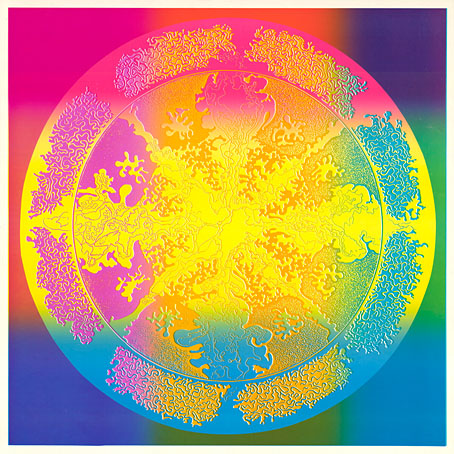
Peacock Mandala (no date) by Judith Drury.

• A few links related to my own activities this week. Firstly, the mix of the week is a guest mix I put together for The Invisible College. I haven’t made a properly mixed mix for a while. This one was made with Audacity, an application that’s free, open source and multi-platform. Secondly, there’s the news that Ghosts on the Cam, another collection of spectral tales compiled by Robert Lloyd Parry, will be published by Swan River Press in December. I’ll have more to say about my cover art for the book at a later date. And on the subject of cover art, my cover for The Legend of Charlie Fish by Josh Rowntree is being reused by Planeta9 for a Czech edition of the novel.

• Halloween approaches. At Wormwoodiana Mark Valentine looks at the first modern ghost story anthology, The Ghost Book edited by Cynthia Asquith, which was published 100 years ago this month.

• At Smithsonian Magazine: “The Icebergs is one of Frederic Edwin Church’s most spectacular paintings. For decades, no one knew where it was.”

• New music: Passage by Chris Meyer’s Alias Zone featuring Robert Rich; Window To Askoy by Strugatsky Brothers.

• RIP Mighty Sparrow. Related: Two hours of Mighty Sparrow’s music at The Explorer’s Room.

• At the BFI: Josh Slater-Williams chooses 10 great South Korean science-fiction films.

• At Nautilus: This obscure 1960s guide to LSD holds up. Kristen French reports.

• At Colossal: The painted mandalas of Mu Pan.

• The Strange World of…Steve Reich.

• Bastardica

• Mandala (1973) by Stomu Yamash’ta’s Red Buddha Theatre | Mandala (1980) by Fondation | Sand Mandala (1997) by Philip Glass

Weekend links 849

mushroom.jpg

Mushroom Lady poster (1967) by East Totem West.

• “I want to be able to hear the process happening throughout the sounding music.” Composer Steve Reich talks to Flora Willson about his long career. More Reich: live performances from 1976 by Steve Reich and Musicians of Six Pianos and Music For Mallet Instruments, Voices And Organ.

• At Aeon: Eric Leas on toadstools and toxins. “When I found the mushroom Amanita muscaria being sold in candy wrappers, I uncovered legal loopholes, dangerous dosages and more.”

• At Little White Lies: Nicolas Winding Refn on his return to cinema—and from the dead—with a neon-hued fable about a father-daughter relationship from hell.

• At Bandcamp Daily: Faust reunite without reuniting. The surviving members of the group return with four solo albums.

• New music: Noon by Richard Skelton and Lawrence English.

• Mix of the week: a mix for The Wire by Kaja Draksler.

• Winners of Bird Photographer of the Year 2026.

• At Dennis Cooper’s it’s Luchino Visconti‘s Day.

• Wyrd Daze relaunches with a new issue.

• Rainy Day Mushroom Pillow (1967) by The Strawberry Alarm Clock | Amanita Kingdom (2014) by Moon Coven | Amanita (2025) by Huong Federkeil

Ear to the Ground

tieghem.jpg

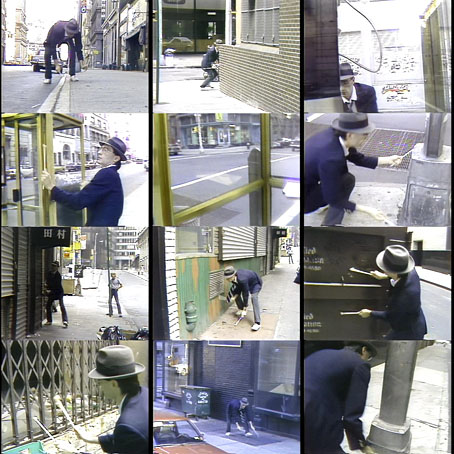
The name of percussionist David Van Tieghem won’t be familiar to most people, but if you’ve ever heard Eno & Byrne’s My Life In The Bush Of Ghosts, Speaking In Tongues by Talking Heads, any of Laurie Anderson’s early albums or Steve Reich’s Music For 18 Musicians then you’ve heard some of Van Tieghem’s session work.

For Ear to the Ground, a four-minute video piece by John Sanborn & Kit Fitzgerald, Van Tieghem leaves the recording studio to play the city streets of New York: pavements, fences, doorways, etc. This may be a typical product of the NYC art crowd of the late 1970s but it also seems prescient for the way it predicts the urban percussion/performance that would flourish a couple of years later in Europe, a micro-genre exemplified by Einstürzende Neubauten, 23 Skidoo, Test Department, the Bow Gamelan Ensemble and others. Watch Ear to the Ground at Ubuweb.

The music of Igor Wakhévitch

igor1.jpg

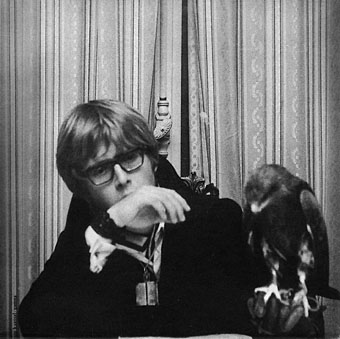
Igor Wakhévitch and feathered friend.

Continuing the Francophile theme, I felt that now was a good time to plumb the mysteries of the enigmatic Igor Wakhévitch. Who? Well… In 20th century music there’s strange and there’s weird and then there’s off-the-wall unclassifiable which is the place where we have to file Igor’s compositions. After half a lifetime spent trawling record shops for unusual music these albums had somehow managed to remain off the radar until a CD reissue set, Donc…, appeared courtesy of Fractal Records and a friend with similarly outré tastes (hi Gav!). The obscurity of these remarkable recordings can’t solely be due to Monsieur Wakhévitch being French; Richard Pinhas, Bernard Szajner and (of course) Magma, have been given enough attention over the years.

So what does this stuff sound like? Thankfully the redoubtable Alan Freeman tackled the problem of describing the albums in Audion (reproduced below), a task I would have found rather daunting. Docteur Faust is probably my favourite, a crazily eclectic and doomy album which lurches from rock freakout to contemporary orchestral/choral to electro-acoustics and back again. Imagine the witch cult from Rosemary’s Baby jamming with Alpha Centauri-era Tangerine Dream while Peter Maxwell Davies and Amon Düül 2 slug it out in the background. The clincher is a great cover by French comic artist Philippe Druillet.

One other notable album that the Donc… collection omits is the 1974 recording of Salvador Dalí’s opera, Être Dieu. Dalí wrote the libretto in 1927 with Federico Garcia Lorca but the piece wasn’t recorded until Wakhévitch provided a score. The result is pretty much the same as Wakhévitch’s other work, with the added bonus of the Surrealist master declaiming and frequently shrieking over the music.

For more information about Donc… and Igor Wakhévitch see the Fractal Records review page.

Continue reading “The music of Igor Wakhévitch”