It’s Fantastic! It’s Futuristic! It’s Fatalistic! It’s Science Fiction!

SF1.jpg

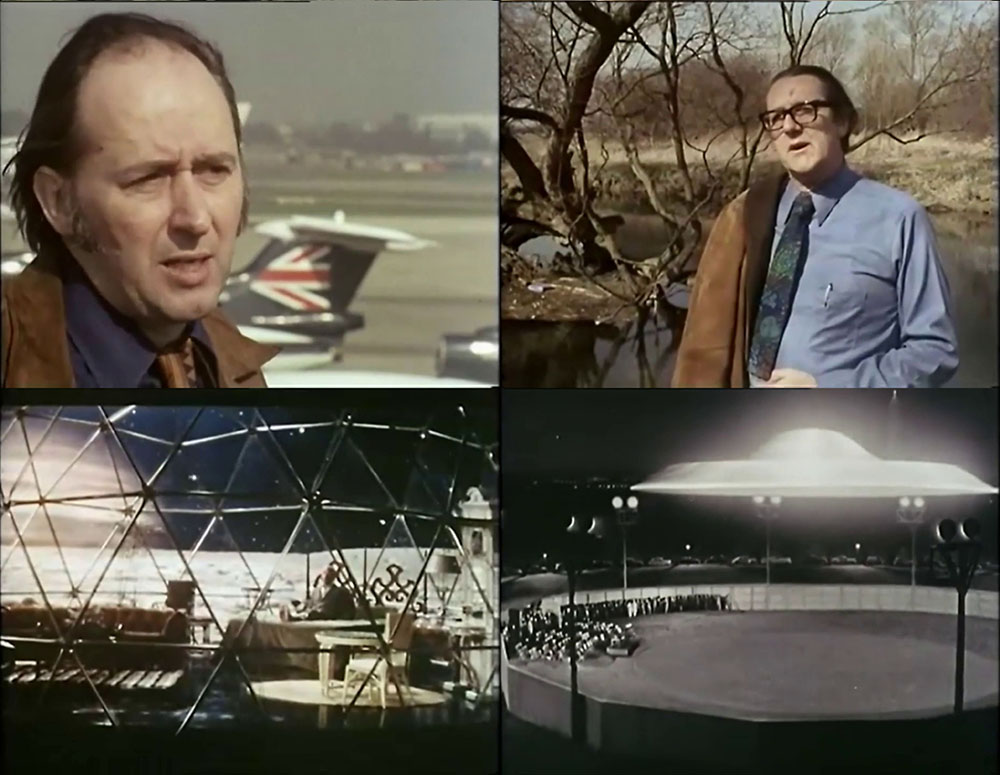
There’s a worthwhile documentary struggling to be born in this film which is compromised by its hyperbolic title and a running time of 48 minutes, not nearly enough to contain a history of science fiction, past and present. I’m not a media historian so I can’t say whether this was the first serious examination of written science fiction made for British TV but if it wasn’t there wouldn’t have been many that preceded it. It’s Fantastic! It’s Futuristic! It’s Fatalistic! It’s Science Fiction! was broadcast in 1973 as part of the BBC’s Omnibus art strand; Harley Cokeliss (credited here as “Cokliss”) was the director, and also the co-writer with Michael Abrams. Two years prior to this Cokeliss had made a shorter BBC film, Crash!, which explored JG Ballard’s ongoing preoccupation with automobile accidents via the rehearsals for Crash in The Atrocity Exhibition. Ballard turns up again here, theorising energetically about his usual concerns (mass advertising, the media landscape, etc) from a balcony overlooking Heathrow airport.
SF2.jpg

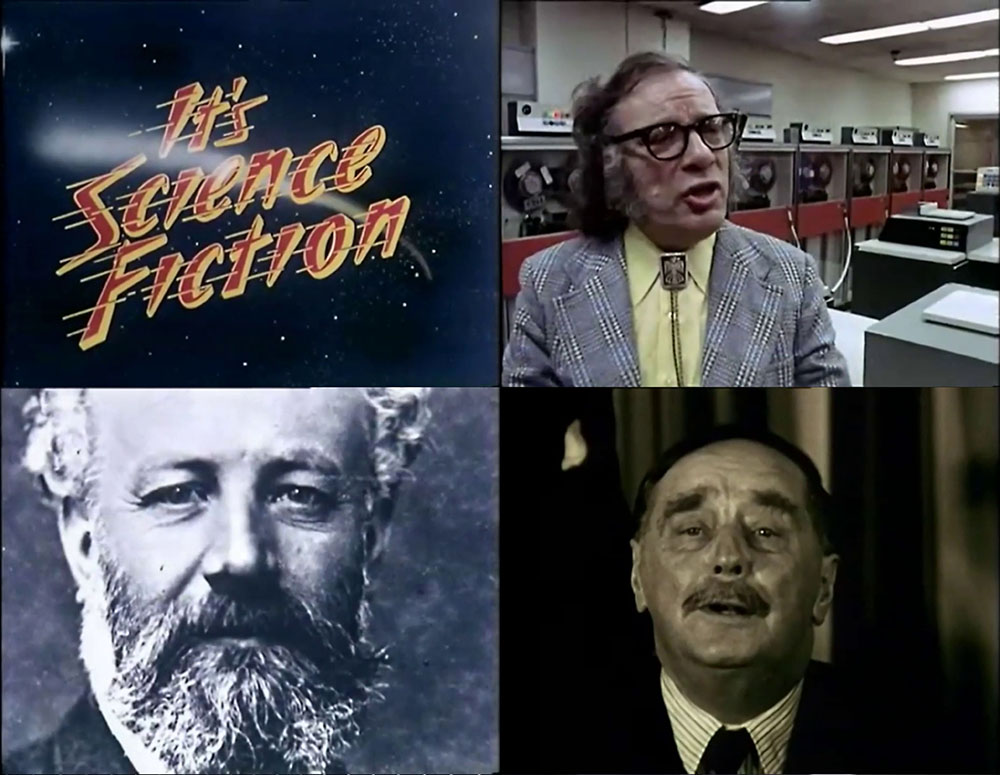
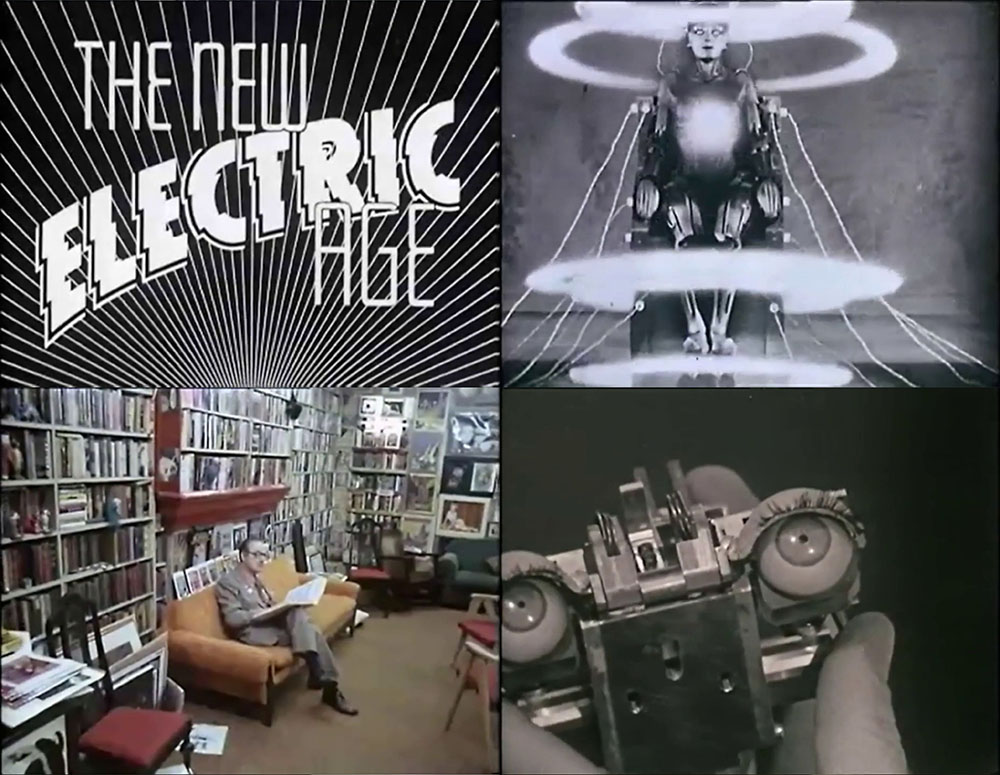
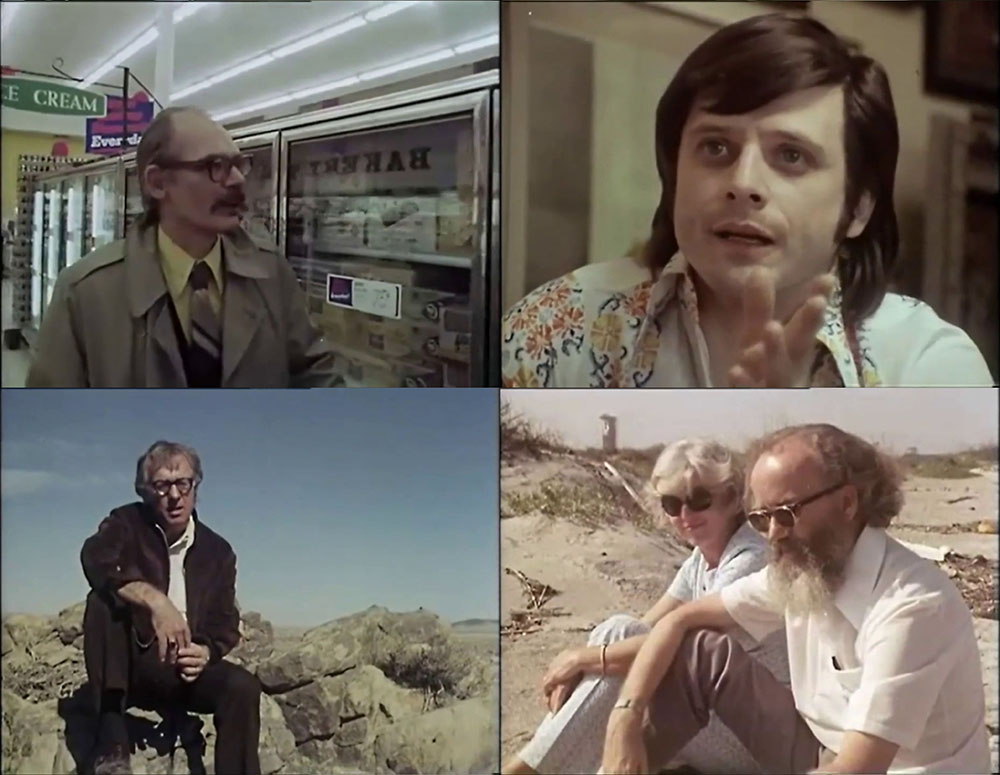
Cokeliss opens proceedings with the inevitable collage of clips from Flash Gordon and Hollywood films of the 1950s, most of which are appalling quality. If nothing else, this is a good reminder of how terrible feature films used to look when shown on TV. More interesting for today’s viewer is the record of a handful of writers who were seldom personally visible in the mass media even while their stories were being adapted by film and television. Ballard and Brian Aldiss are the representative Brits, all the other writers are Americans: Isaac Asimov, Ray Bradbury, Harlan Ellison, Damon Knight, Frederik Pohl and Kurt Vonnegut. Also interviewed is Fritz Lang, who repeats his anecdote about Metropolis being inspired by his visit to New York in the 1920s, and Forrest J. Ackerman is filmed inside his memorabilia-filled house. The absence of women interviewees is unfortunately typical of the time. Kate Wilhelm appears on camera with husband Damon Knight but it’s Knight that does all the talking.
SF3.jpg

All of the interviews are far too brief for such a wide-ranging subject but it’s still fascinating to see Harlan Ellison at his peak, talking (and typing) at speed. It’s also surprising to find JG Ballard and Frederik Pohl in near agreement when they both describe science fiction as being a reflection of the present as much as it is it is a look into the near or distant future, “a mythology of the Space Age” as Ballard liked to describe it. Science fiction is often both these things simultaneously, predictive and reflective, something its critics don’t always seem to appreciate.
SF4.jpg

Documentaries also reflect the times in which they’re made, and this is another arts documentary that plunders the prog-rock shelves for its soundtrack music, placing a few bars of Close To The Edge by Yes over shots of New York’s teeming crowds. Harley Cokeliss really should have been given a series instead of a single film in which he flies all over America to capture nothing more than a few brief soundbites. But in 1973 the genre was lucky to get this much attention from one of the BBC’s serious arts outlets. Managerial attitudes did change later in the decade, probably as a result of the resurgence in popularity of SF cinema. In 1979 the BBC made a five-part series about science fiction, Time Out of Mind, where four of the programmes were profiles of single writers—Arthur C. Clarke, John Brunner, Michael Moorcock, and Anne McCaffrey—with other writers appearing in each film. A fifth episode concerned the SF convention that took place in Brighton that year. Ray Bradbury was given the full Omnibus treatment a year later in The Illustrated Man, a typically fine David Wheatley profile, while Philip K. Dick received a posthumous appraisal from Arena in 1994.

Here in 2026 we find ourselves in the future being grasped at in the 1970s where television has now abandoned expensive author profiles unless the author in question is massively popular or the winner of a Nobel prize. With everyone owning a pocket-sized recording device anyone can now make their own television, and so YouTube fills up with hours of amateurish video of people talking into laptops and webcams with poor visuals and dreadful sound. A good documentary is always more than a stream of raw footage; contextualisation and editorial point-of-view are essential, as well as whatever artistry the director might bring to the material. The frame is important, in other words, however compromised that frame may be.

Previously on { feuilleton }
Future Life magazine
Science Fiction Monthly

Metropolis Magazine, 1927

metropolis1.jpg

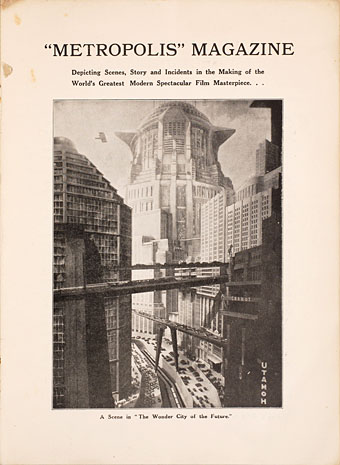
When Fritz Lang’s Metropolis was released in Britain the distributors, Wardour Films Ltd, produced a 32-page guide to the film filled with production stills and brief pieces written by the cast and crew. I have a facsimile copy of this publication, a limited reprint by Phantasm Press, but the original document is also available for reading or downloading at the Internet Archive. Publications like this were the standalone equivalent of promotional pieces created for the readers of film magazines; Metropolis was Ufa’s most expensive production to date so there would have been a need for serious promotion.

metropolis2.jpg

None of this effort helped make the film a success, however. Lang’s epic is a masterpiece of direction and production design but Thea von Harbou’s script was the kind of absurd and naive fare you often get from writers incapable of projecting the complexities of the present day into their visions of the future. (HG Wells was unsparing in his review of “the silliest film”.) A lack of audience enthusiasm prompted foreign distributors to take out their editing scissors, but cutting a quarter of the footage didn’t help either, especially when the cuts made nonsense of the motivations of Rotwang the inventor. One thing you can see in the programme is shots from sequences like the race-track scene which were subsequently removed and wouldn’t be seen in anything other than still form for many decades.

Previously on { feuilleton }
Blade Runner vs Metropolis
The Metropolis of Tomorrow by Hugh Ferriss
Metropolis!
Metropolis posters

Hands with a mind of their own

orlac1.jpg

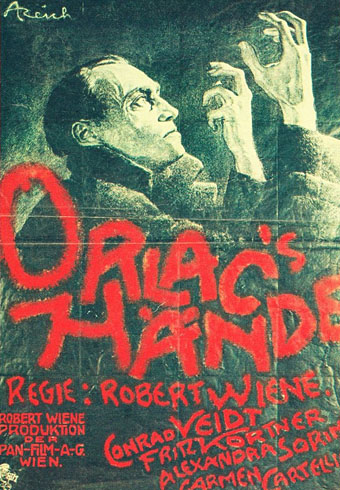
My weekend viewing included two films based on The Hands of Orlac (1920), a novel by Maurice Renard. This is one of those books that remains little read and seldom discussed even though its central idea—a concert pianist injured in a train wreck is given the hands of an executed murderer in a transplant operation—has prompted many film adaptations, almost enough to make the novel the origin of a sub-genre of hand-transplant horror. Robert Wiene’s The Hands of Orlac was the first screen adaptation made in 1924, and is another in the long list of silent films I’ve known about for decades but had to wait until now to see. The film is notable for reuniting the director of The Cabinet of Dr Caligari with Conrad Veidt, the actor who portrayed Caligari’s murderous somnambulist, Cesare, in a mute role that mostly required stalking around acutely-angled sets in a black body stocking.

orlac3.jpg

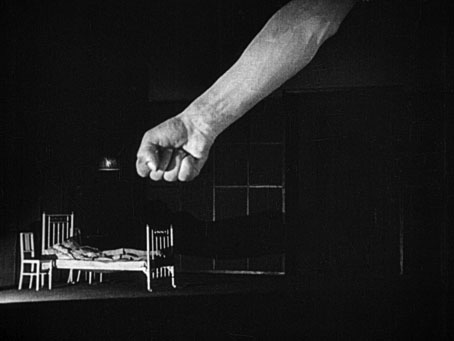
The Hands of Orlac: Paul Orlac (Conrad Veidt) is besieged by nightmares in his colossal hospital room.

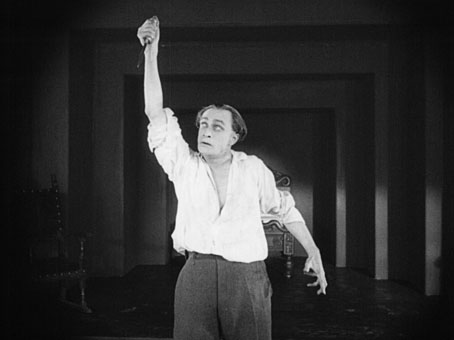
Veidt has much more to do as the lead in The Hands of Orlac, giving a suitably tormented performance as the pianist convinced that his new hands retain the violent impulses of their former owner. The acting from Veidt and Alexandra Sorina as Orlac’s wife, Yvonne, is often wildly emotive, surprisingly so for a film made near the end of the silent era when the mannerisms of early silent pictures were being replaced by greater naturalism. Lotte Eisner in The Haunted Screen explains this in terms of the Expressionist influence which was still prevalent in German cinema, and which extends beyond lighting and set design. A scene in which Orlac is overwhelmed by his predicament is described by Eisner as “an Expressionist ballet”; when Orlac holds a dagger aloft this becomes an unmistakable mirroring of a climactic moment in Caligari.

orlac5.jpg

Continue reading “Hands with a mind of their own”

The Thousand Eyes of Dr Mabuse

mabuse1.jpg

Among the weekend’s viewing was the third and final film in Fritz Lang’s Mabuse cycle, The Thousand Eyes of Dr Mabuse (1960). This was also Lang’s final feature, made after his return to Germany in the late 1950s, and another film of his that for many years I knew only as an impossible-to-find title. I’d read about the Mabuse series in Lotte Eisner’s study of Lang’s career even before the name and character was co-opted by Propaganda for their first single in 1984, but the only films of Lang’s that ever used to appear on TV were the Hollywood features or, if you were lucky, a poor print of Metropolis. Mabuse was a source of fascination for the way the character connected the beginning and ends of the director’s career, as well as being a German take on the Moriarty-like super-criminal. The first film in the series, Dr Mabuse, the Gambler (1922), condenses the corruption of Weimar Germany into a potent physical icon, while the sequel, The Testament of Dr Mabuse (1933), reflects the fevered moment when real super-criminals were taking control of the nation. The Nazis were sufficiently discomforted by Testament to ban it shortly after its release.

mabuse2.jpg

Cornelius the psychic with insurance salesman Hieronymus B. Mistelzweig and police inspector Kras.

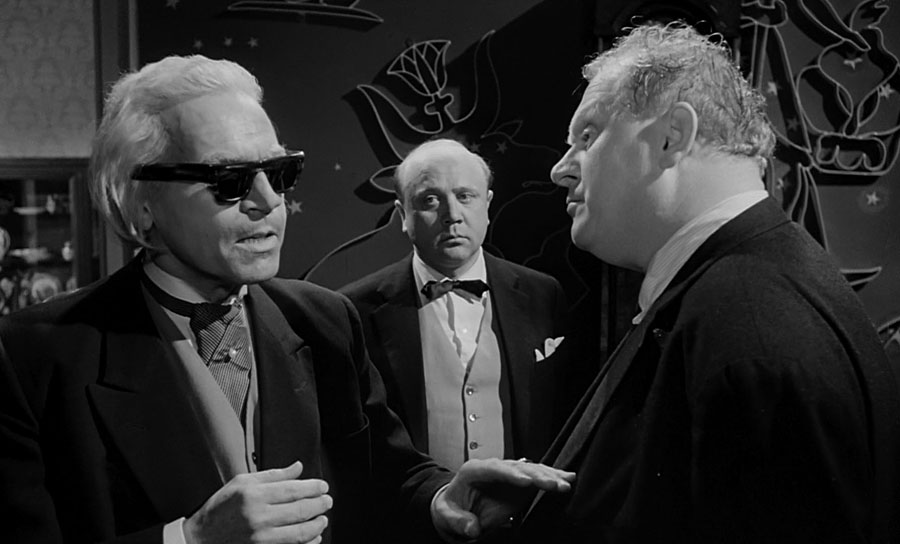
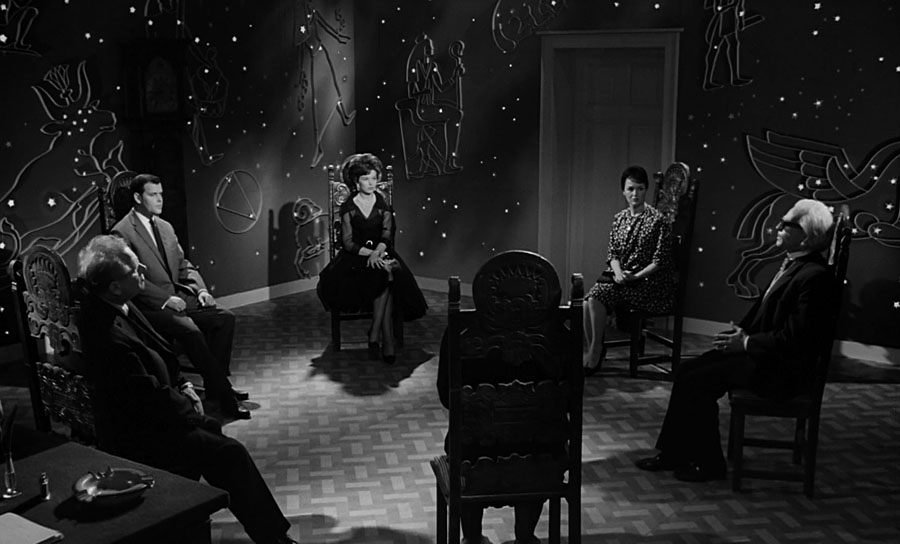
The Thousand Eyes of Dr Mabuse appeared just as new super-villains were emerging to oppose James Bond and his imitators. One of Bond’s early adversaries, Auric Goldfinger, was portrayed on screen by Gert Fröbe who appears here on the opposite side of the law as homicide inspector Kras. Fröbe’s tenacious policeman is one of the few fixed points in a plot filled with twists and deceptive identities. Assassinations and double-crosses are a staple of this type of thriller but Lang also gives us an early example of electronic surveillance in a contemporary setting, together with a séance that harks back to a similar scene in the first Mabuse film. The séance is an unusual touch in a story otherwise devoid of similar moments, prompted by the film’s most mysterious character, Cornelius the blind psychic. With an appearance reminiscent of the late Karl Lagerfeld, Cornelius is an overt throwback to Lang’s pre-war films, many of which hinted at the mystical or supernatural even when such hints seemed unnecessary; Rotwang, the robot-builder in Metropolis (played by the original screen Mabuse, Rudolph Klein-Rogge) is a mechanical genius who just happens to live in a house more suited to an alchemist, with a huge inverted pentagram on one of its walls. The sinister motives of Cornelius aren’t so baldly stated but his consulting room is lavishly decorated with astrological diagrams. The psychic, together with the criminals and the police inspector, create a problem common to films of this kind in which the more colourful characters generate greater interest for the viewer than do the romantic leads. After a succession of breathless opening scenes, Thousand Eyes sags a little while wealthy industrialist Henry Travers (Peter Van Eyck) is getting to know Marion Menil (Dawn Addams), a woman he rescues from a suicide attempt. The film also lacks the subtext of the earlier episodes, although Mabuse’s scheme turns out to be diabolical enough for any of James Bond’s Cold War enemies.

mabuse3.jpg

The séance.

Continue reading “The Thousand Eyes of Dr Mabuse”

Weekend links 323

taylor.jpg

Mescaline Woods (1969) by Gage Taylor.

• The soundtrack to The Man Who Fell to Earth will be released for the first time next month in a double-disc set (CD & vinyl). This isn’t, as some people have hoped, David Bowie’s unheard music for the film, but a collection of the pre-existing songs and other pieces, plus the original compositions by John Phillips. Consequence of Sound has a track list.

• At Scream Addicts: Joe R. Lansdale talks about the only film adaptation of Shirley Jackson’s The Haunting of Hill House that you need to see: the 1963 version directed by Robert Wise.

• The new wave of new age: How music’s most maligned genre finally became cool by Adam Bychawski.

• Transmissions From The Abyss: Dark ambient music for the perfect headspace by S. Elizabeth.

Jason Farrago reviews Art Aids America, an exhibition at the Bronx Museum, New York.

Curse Go Back: a limited reissue of tape experiments by William Burroughs.

Samuel Wigley on Notorious at 70: toasting Hitchcock’s dark masterpiece.

Toyah Willcox remembers working with Derek Jarman on The Tempest.

• “Why are musicians so obsessed with David Lynch?” asks Selim Bulut.

• Read the original 32-page programme for Fritz Lang’s Metropolis.

David Parkinson chooses 10 essential films starring Oliver Reed.

• Mixes of the week: The Sounds of the Dawn NTS radio shows.

Keith Haring envisions Manhattan as a kingdom of penises.

Frank Guan on Massive Attack’s Blue Lines, 25 years on.

Honky Tonk Pts 1 & 2 (1956) by Bill Doggett | I’ve Told Every Little Star (1961) by Linda Scott | I’m Deranged (1995) by David Bowie