
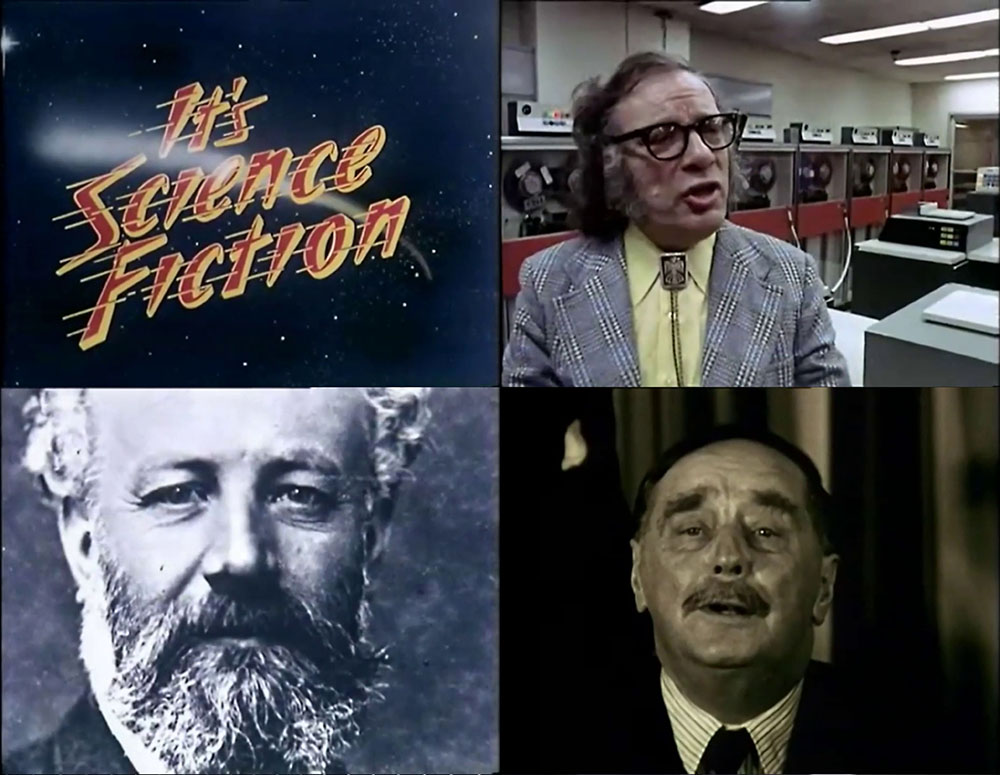
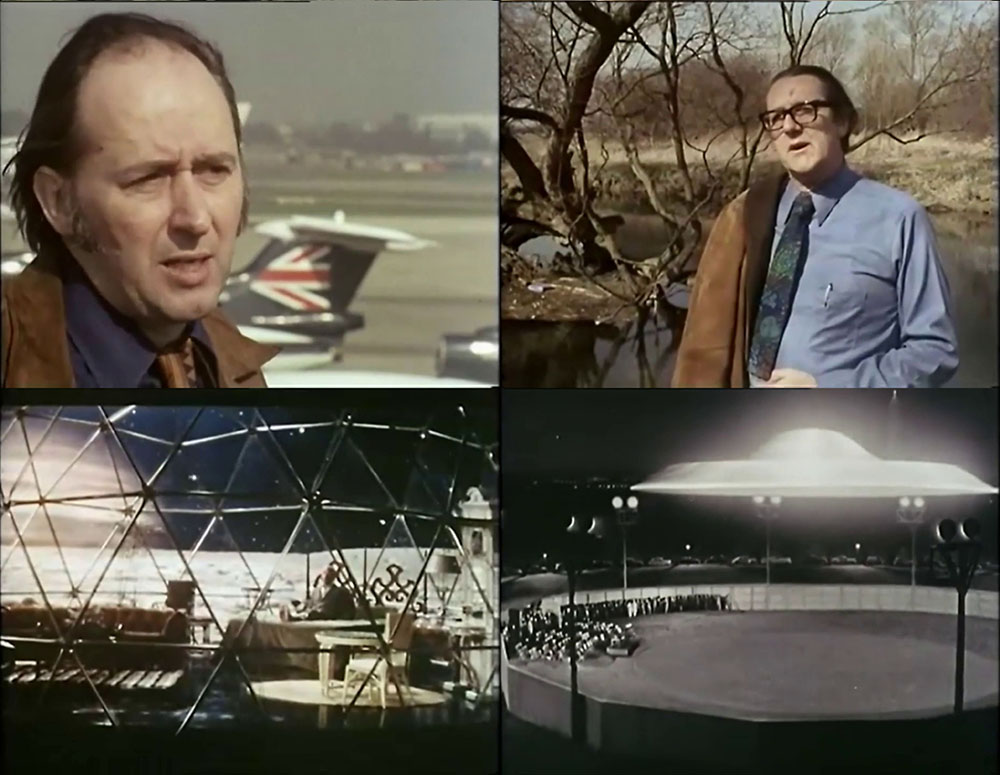
There’s a worthwhile documentary struggling to be born in this film which is compromised by its hyperbolic title and a running time of 48 minutes, not nearly enough to contain a history of science fiction, past and present. I’m not a media historian so I can’t say whether this was the first serious examination of written science fiction made for British TV but if it wasn’t there wouldn’t have been many that preceded it. It’s Fantastic! It’s Futuristic! It’s Fatalistic! It’s Science Fiction! was broadcast in 1973 as part of the BBC’s Omnibus art strand; Harley Cokeliss (credited here as “Cokliss”) was the director, and also the co-writer with Michael Abrams. Two years prior to this Cokeliss had made a shorter BBC film, Crash!, which explored JG Ballard’s ongoing preoccupation with automobile accidents via the rehearsals for Crash in The Atrocity Exhibition. Ballard turns up again here, theorising energetically about his usual concerns (mass advertising, the media landscape, etc) from a balcony overlooking Heathrow airport.
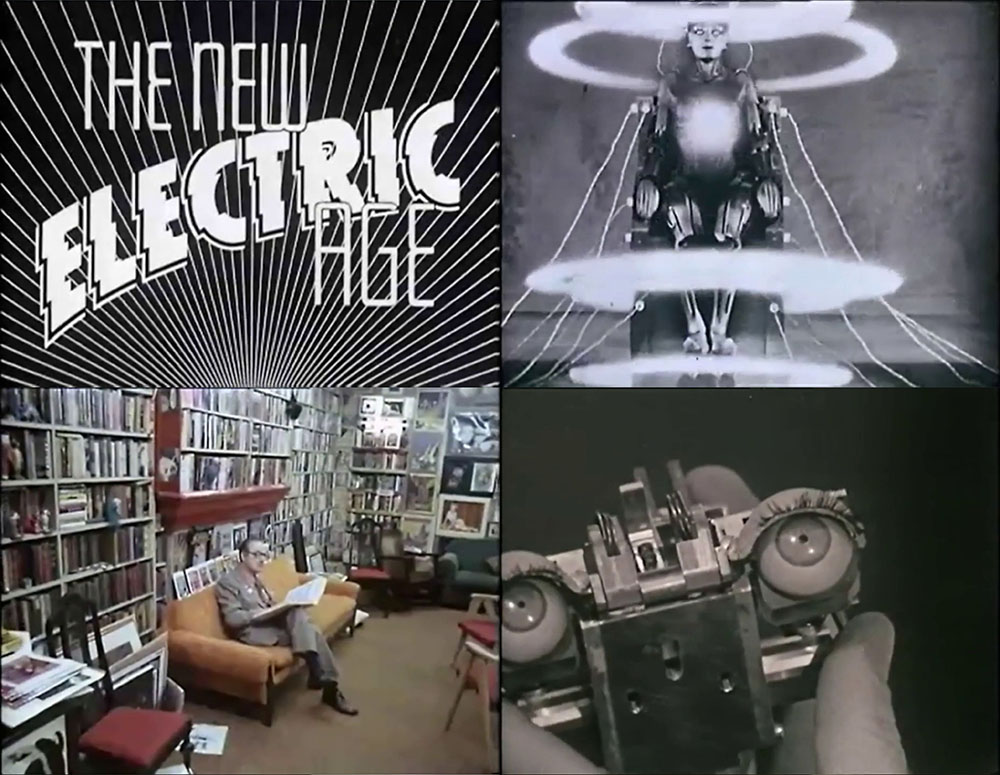
Cokeliss opens proceedings with the inevitable collage of clips from Flash Gordon and Hollywood films of the 1950s, most of which are appalling quality. If nothing else, this is a good reminder of how terrible feature films used to look when shown on TV. More interesting for today’s viewer is the record of a handful of writers who were seldom personally visible in the mass media even while their stories were being adapted by film and television. Ballard and Brian Aldiss are the representative Brits, all the other writers are Americans: Isaac Asimov, Ray Bradbury, Harlan Ellison, Damon Knight, Frederik Pohl and Kurt Vonnegut. Also interviewed is Fritz Lang, who repeats his anecdote about Metropolis being inspired by his visit to New York in the 1920s, and Forrest J. Ackerman is filmed inside his memorabilia-filled house. The absence of women interviewees is unfortunately typical of the time. Kate Wilhelm appears on camera with husband Damon Knight but it’s Knight that does all the talking.
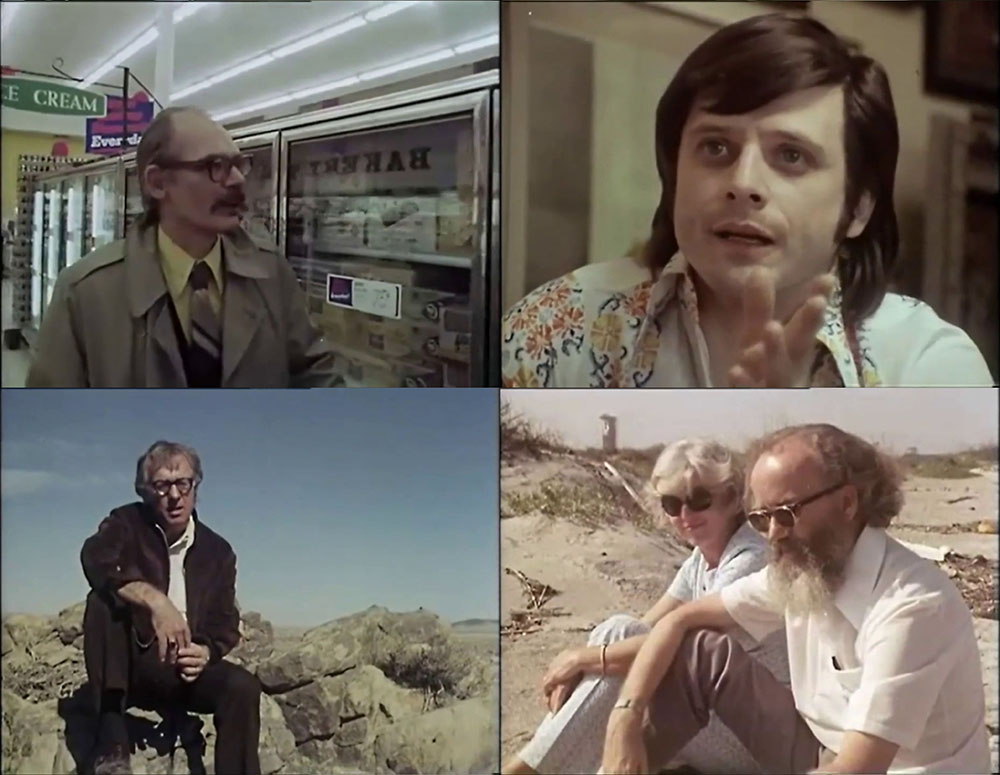
All of the interviews are far too brief for such a wide-ranging subject but it’s still fascinating to see Harlan Ellison at his peak, talking (and typing) at speed. It’s also surprising to find JG Ballard and Frederik Pohl in near agreement when they both describe science fiction as being a reflection of the present as much as it is it is a look into the near or distant future, “a mythology of the Space Age” as Ballard liked to describe it. Science fiction is often both these things simultaneously, predictive and reflective, something its critics don’t always seem to appreciate.
Documentaries also reflect the times in which they’re made, and this is another arts documentary that plunders the prog-rock shelves for its soundtrack music, placing a few bars of Close To The Edge by Yes over shots of New York’s teeming crowds. Harley Cokeliss really should have been given a series instead of a single film in which he flies all over America to capture nothing more than a few brief soundbites. But in 1973 the genre was lucky to get this much attention from one of the BBC’s serious arts outlets. Managerial attitudes did change later in the decade, probably as a result of the resurgence in popularity of SF cinema. In 1979 the BBC made a five-part series about science fiction, Time Out of Mind, where four of the programmes were profiles of single writers—Arthur C. Clarke, John Brunner, Michael Moorcock, and Anne McCaffrey—with other writers appearing in each film. A fifth episode concerned the SF convention that took place in Brighton that year. Ray Bradbury was given the full Omnibus treatment a year later in The Illustrated Man, a typically fine David Wheatley profile, while Philip K. Dick received a posthumous appraisal from Arena in 1994.
Here in 2026 we find ourselves in the future being grasped at in the 1970s where television has now abandoned expensive author profiles unless the author in question is massively popular or the winner of a Nobel prize. With everyone owning a pocket-sized recording device anyone can now make their own television, and so YouTube fills up with hours of amateurish video of people talking into laptops and webcams with poor visuals and dreadful sound. A good documentary is always more than a stream of raw footage; contextualisation and editorial point-of-view are essential, as well as whatever artistry the director might bring to the material. The frame is important, in other words, however compromised that frame may be.
Previously on { feuilleton }
• Future Life magazine
• Science Fiction Monthly