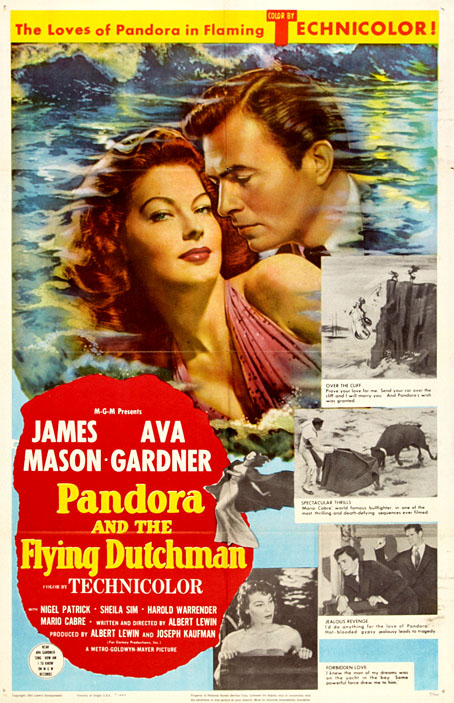
Art on film: Pandora and the Flying Dutchman

pandora1.jpg

Continuing an occasional series about artworks in feature films. This is a minor entry but a worthwhile one if only to draw some attention to an unusual fantasy film by Albert Lewin, an equally unusual director. Pandora and the Flying Dutchman was made in 1951, a British film with an American star (Ava Gardner) and a Spanish setting. Gardner plays Pandora Reynolds, an American nightclub singer living in the coastal town of Esperanza where she’s the centre of attention for the small colony of stuffy middle-class Brits who also live there. Like her mythical namesake, Pandora is a source of endless trouble, only in this case the evils are the result of the romantic chaos she provokes. Her own romantic desires are upset when a mysterious yacht anchors off the coast, its sole occupant being Hendrik van der Zee (James Mason) who we soon learn is the Flying Dutchman of legend, doomed to sail the seas until he can find salvation in the love of a woman who will die for him.
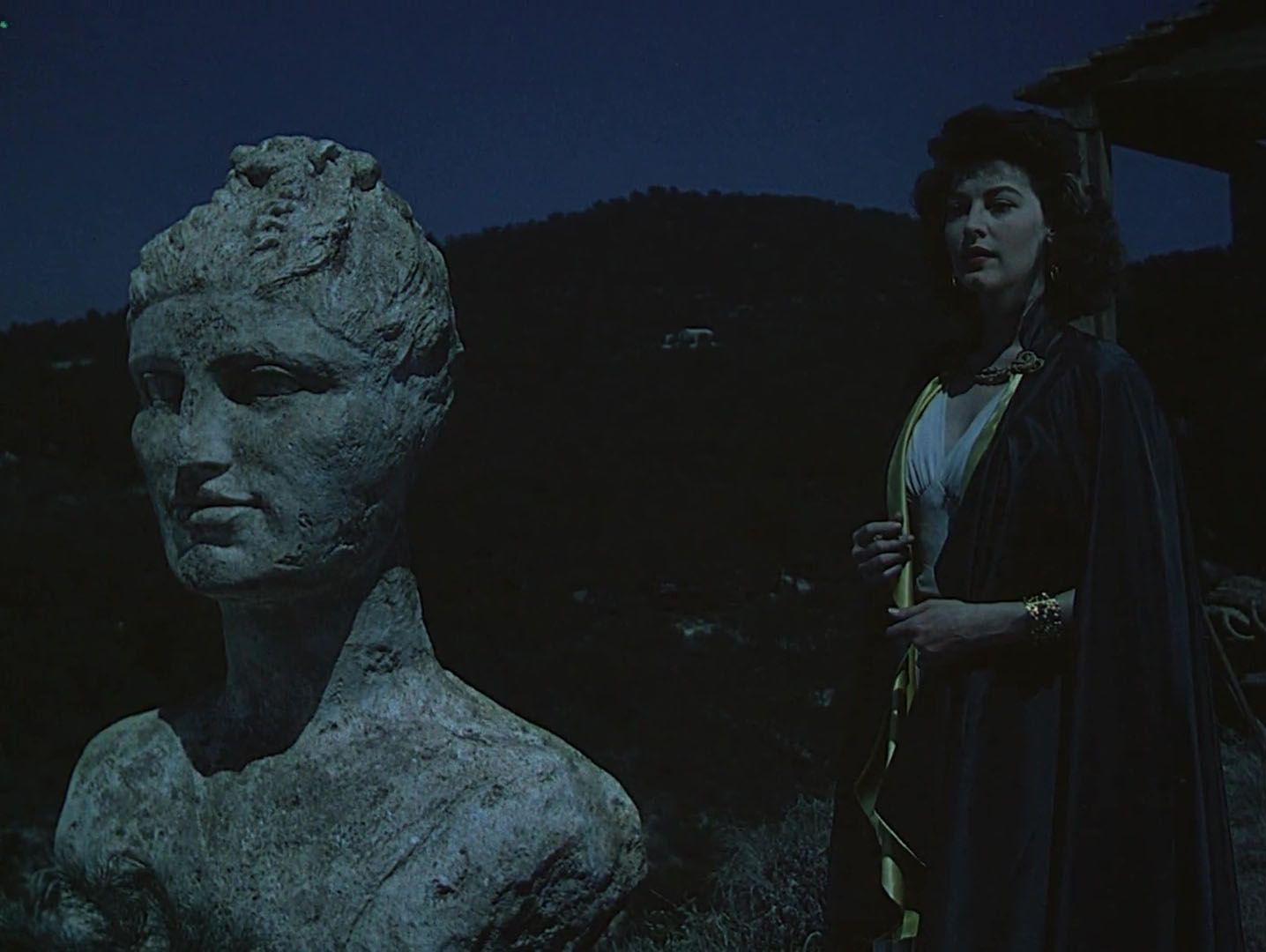
pandora6.jpg

Pandora with one of the many statues that surround the home of Fielding the archaeologist.

Lewin’s film was restored recently after having been out of circulation for many years. I’d been intending to see it again after reading about the restoration which could only be an improvement on the terrible copy that used to turn up late at night on British TV. Further impetus was prompted by a book review for The Spectator in which Michael Moorcock notes similarities between the film and the stories by JG Ballard which were collected as Vermilion Sands. I’ve never seen Ballard mention the film but the Vermilion Sands stories have long been favourites of mine. The film moved to the top of the viewing list.
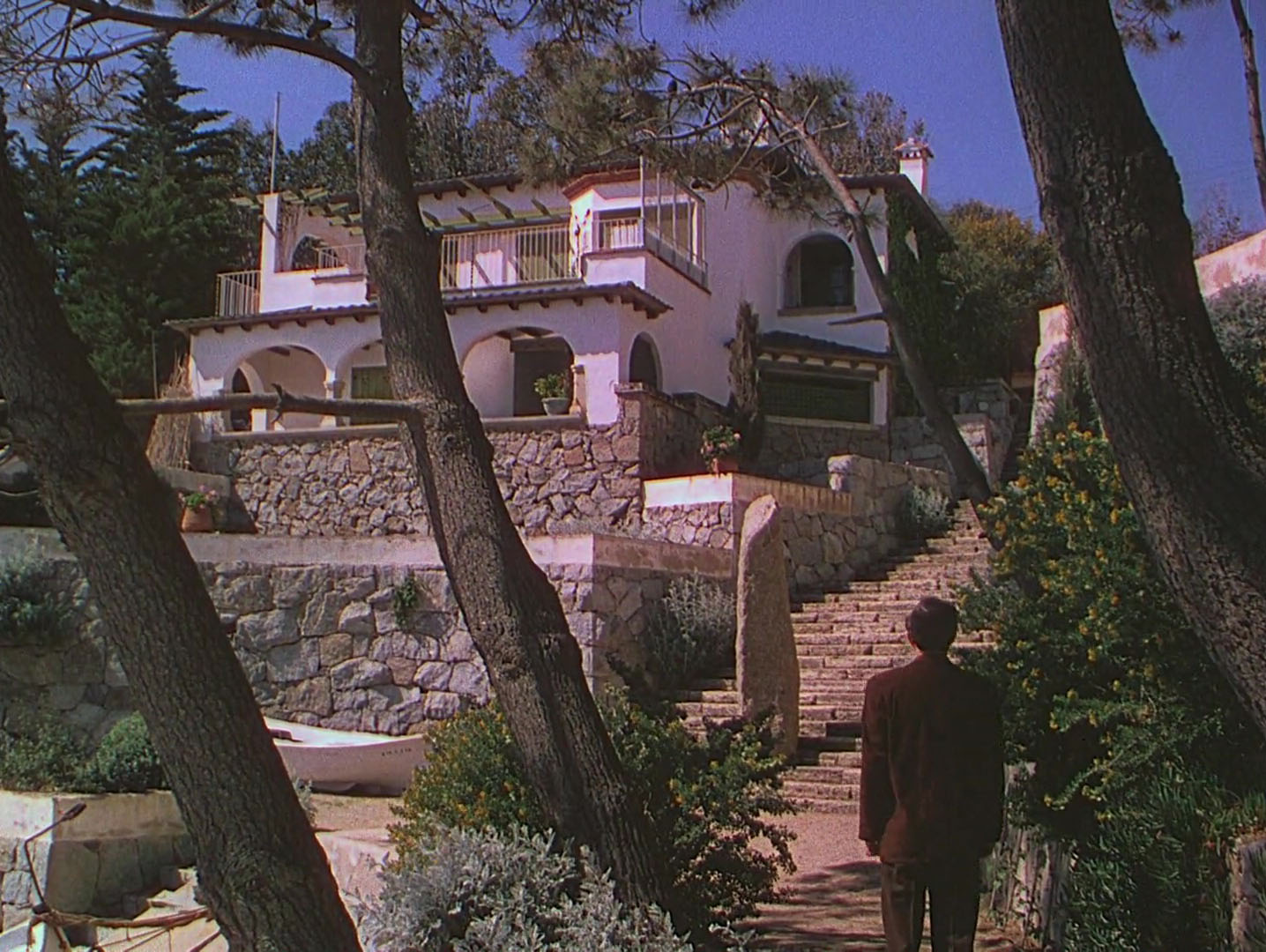
pandora7.jpg

Esperanza or Vermilion Sands? Hendrik is lured by Pandora’s piano-playing.

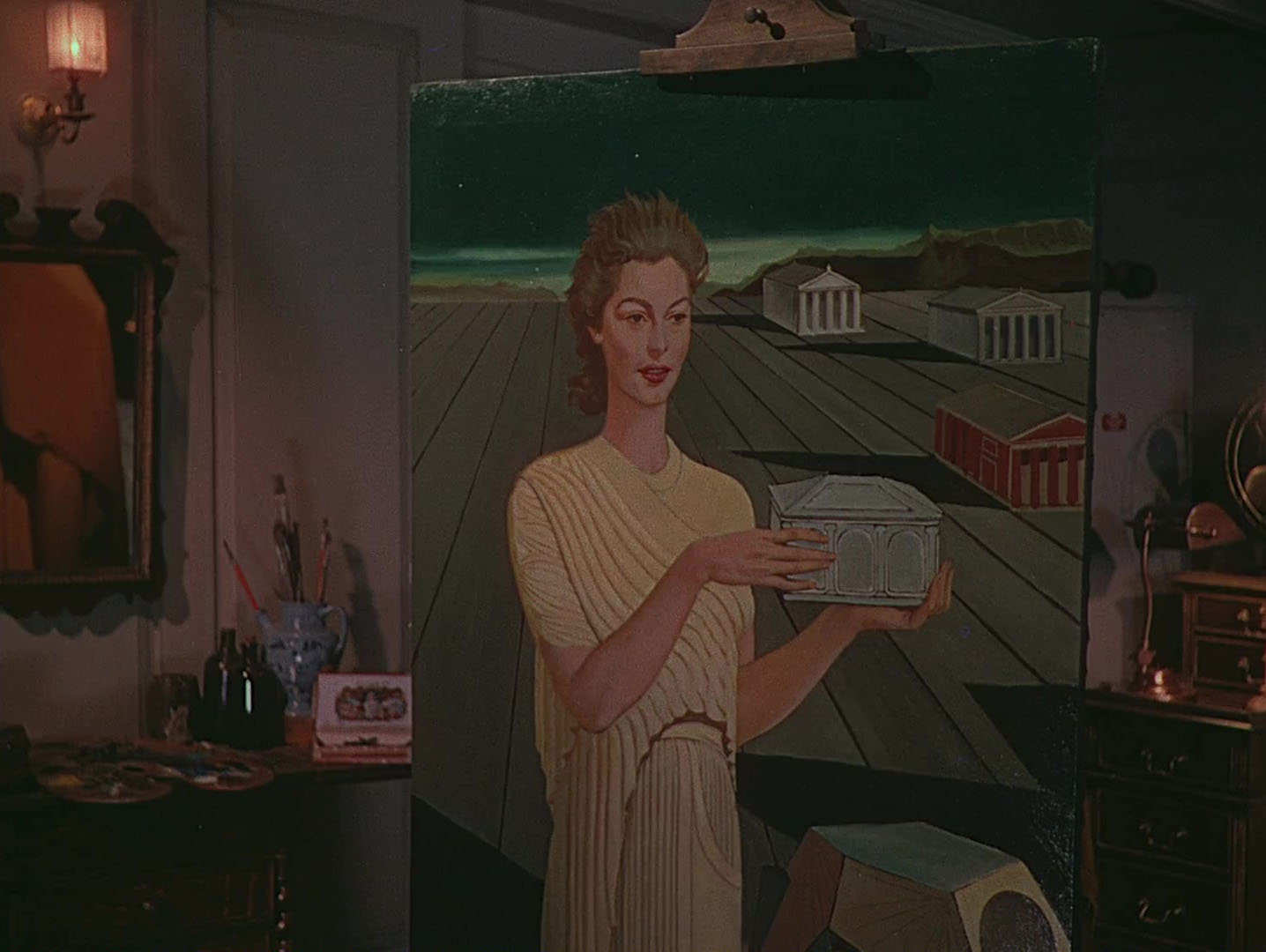
The key connection to Ballard is Surrealist (or-pre-Surrealist) painting, a detail of Pandora and the Flying Dutchman that I’d forgotten all about. Albert Lewin only directed six films; he also wrote each one, and was very determined in his attempts to bring a touch of artistic class to Anglophone cinema. Pandora and the Flying Dutchman was his fourth feature after The Moon and Sixpence and The Picture of Dorian Gray—each an adaptation of a novel where painting is an important element of the story—and The Private Affairs of Bel Ami, a film that was promoted with a Surrealist painting competition on the theme of the temptation of St Anthony. Max Ernst won the competition, and his picture appears at the end of the film, a colour insert in an otherwise black-and-white feature. Lewin did the same for The Picture of Dorian Gray, another black-and-white film where the portrait paintings (including Ivan Albright’s unforgettably corrupted canvas) are shown in colour inserts.
pandora2.jpg

Continue reading “Art on film: Pandora and the Flying Dutchman”
Temptations

catalogue.jpg

Exhibition catalogue.

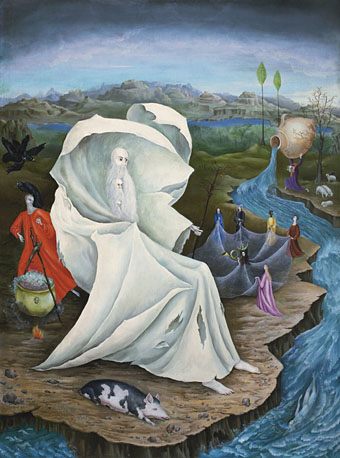
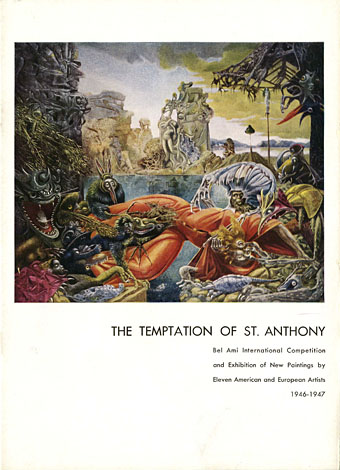
In one of the many recent features about Leonora Carrington I noticed a mention of her Temptation of St Anthony painting from 1945 (see below). This was one of eleven works on the theme submitted by different artists for a competition staged to promote Albert Lewin’s The Private Affairs of Bel Ami (1947), a film adaptation of the Guy de Maupassant novel. Carrington is often mentioned when this competition is discussed, along with the other big names, Max Ernst (the winner) and Salvador Dalí. But you seldom see mention of any of the other competitors, hence this post, an attempt to find all of the competition entries.

carrington.jpg

Leonora Carrington. St. Anthony is often shown with a pig companion but only Carrington depicted the animal for this competition. When asked why the saint had three heads, she replied “Why not?”

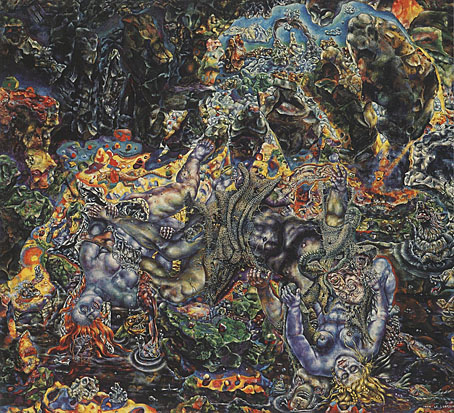
Albert Lewin didn’t make many films but he had a predilection for arty subjects, The Private Affairs of Bel Ami being preceded by adaptations of The Moon and Sixpence (1942) and The Picture of Dorian Gray (1945). All three films star George Sanders, and all feature special colour sequences when a painting is revealed. 1945 was the peak of America’s brief infatuation with Surrealism (Hitchcock had Dalí working on Spellbound at this time) so Lewin asked a number of Surrealists to take up the challenge. I was surprised to find that Stanley Spencer was one of the entrants, a name you almost never see in this company; less surprising was Ivan Albright whose painting of the decayed Dorian Gray is one of the highlights of Lewin’s earlier film. Leonor Fini was also asked to take part but she didn’t produce anything. The judges were Marcel Duchamp, Alfred J. Barr, Jr, director of the Museum of Modern Art, and art dealer Sidney Janis. Ernst won a cash prize variously reported as $2500–3000, while the other entrants received smaller sums. The paintings toured the USA and Britain during 1946–7.

As to the film, I can’t say what this is like because it’s one I’ve yet to see but Self-Styled Siren’s witty review goes into some detail. Hollywood apparently had problems with the adult subject matter (Sanders’ character is described as a sexually predatory social climber), and Lewin was forced to tone things down.

albright.jpg

Ivan Albright.

Albright’s contribution is so frenzied and detailed it approaches psychedelia. Best seen in this large view at Flickr.

Continue reading “Temptations”

Polanski details

polanski01.jpg

Roman Polanski as Alfred in Dance of the Vampires (1967).

I’ve always admired the attention to detail in Roman Polanski’s films, a quality evident not only in his careful adaptations but also in areas that lesser filmmakers might ignore. Dance of the Vampires (1967) is a good example (sorry, I refuse to call it by the title MGM used for its edited US release): the sets and decor are remarkable, and the editing and camera work so skilfully blends studio constructions with location shots that for years I was convinced the film was made in a genuine European castle. The atmosphere is so carefully sustained that I found the whole thing as terrifying on first viewing as any Hammer film, despite the broad humour. In the set-piece moments Polanski (and soundtrack composer Krzysztof Komeda) put many of the later Hammer vampire films to shame.


The Vampire Portraits

polanski02.jpg

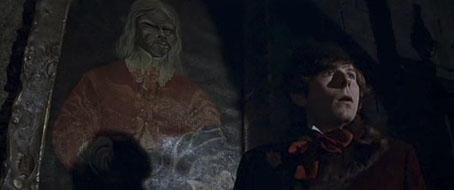
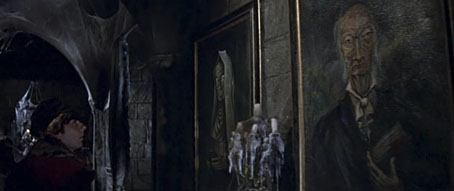
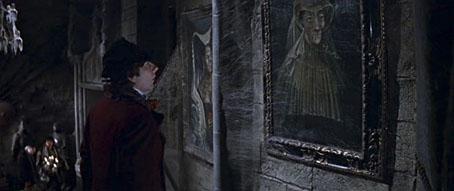
The production design and art direction for Dance of the Vampires was created by Wilfred Shingleton and Fred Carter, both of whom later worked on Polanski’s Macbeth, and who fill the rooms with mouldering furnishings and rotting decoration. One striking sequence concerns a walk through a gallery of vampire portraits that are the creepiest paintings seen on film since Ivan Albright’s portrait of a decrepit Dorian Gray. Film credits in the 1960s were sparse so there’s no indication of the artist responsible. However, one portrait glimpsed at the end of the gallery (below) is a copy of the “Ugly Duchess” painting by Quinten Matsys.

polanski03.jpg


Rosemary’s Book

polanski04.jpg

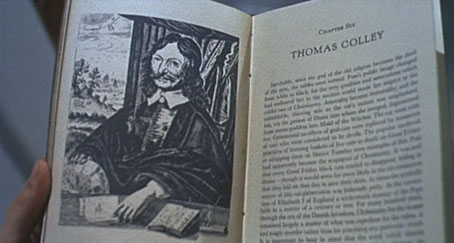
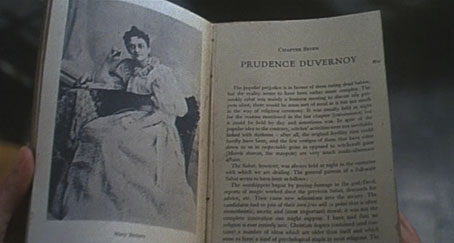
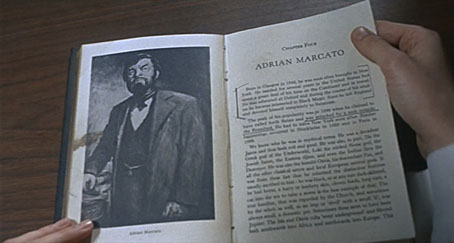
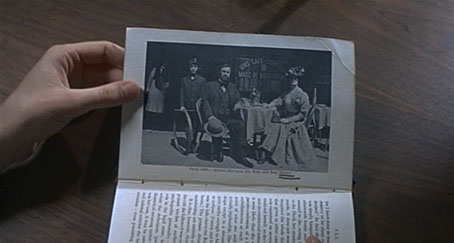
A sign that filmmakers care about detail is when they make their fictional books look like the genuine article. The history of witchcraft in Rosemary’s Baby (1968) could easily have been glimpsed very briefly but Polanski shows Rosemary leafing through its pages in a sequence of Hitchcock-like view-reaction-view shots that make it appear as convincing as possible. The shots also make the viewer examine the book through Rosemary’s eyes, something Polanski does throughout the film.

polanski05.jpg

polanski06.jpg

polanski07.jpg


Trelkovsky’s Paintings

polanski09.jpg

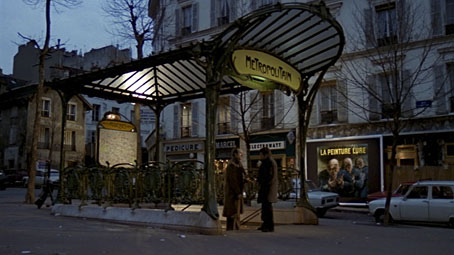
The Tenant (1976) is Polanski’s third study of apartment-dwelling paranoia, a superb adaptation of Roland Topor’s novel, Le Locataire chimérique (1964). The screenplay removes some of Topor’s ambiguity—and the film is spoiled by unsympathetic dubbing of the French actors—but in every other respect it’s as good as Repulsion for its portrait of an isolated individual (here portrayed by Polanski himself) surrendering to madness.

polanski10.jpg

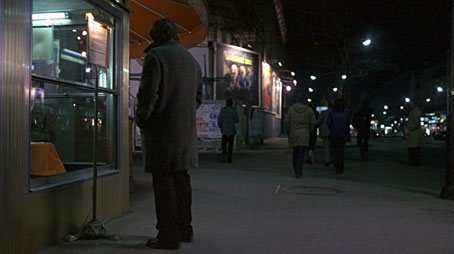
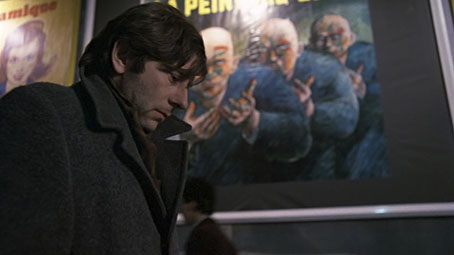
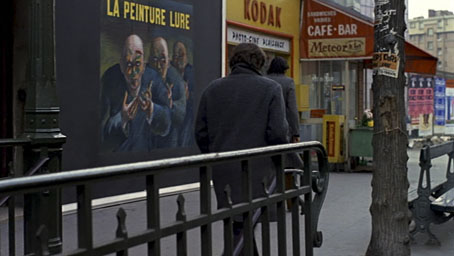
Among the many visual details which add to the unease is the appearance halfway through the film of billboards advertising…what? A painting exhibition? Or something more sinister? We never find out. The presence of these figures and their slogan—”La Peinture Lure”—remains as cryptic as many of the other unresolved questions which prey upon the beleaguered Trelkovsky.

polanski11.jpg

polanski12.jpg


Corso’s Postcard

polanski13.jpg

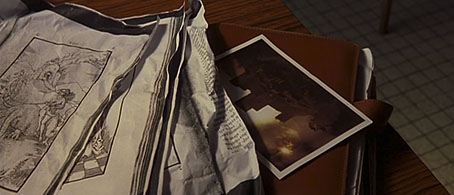
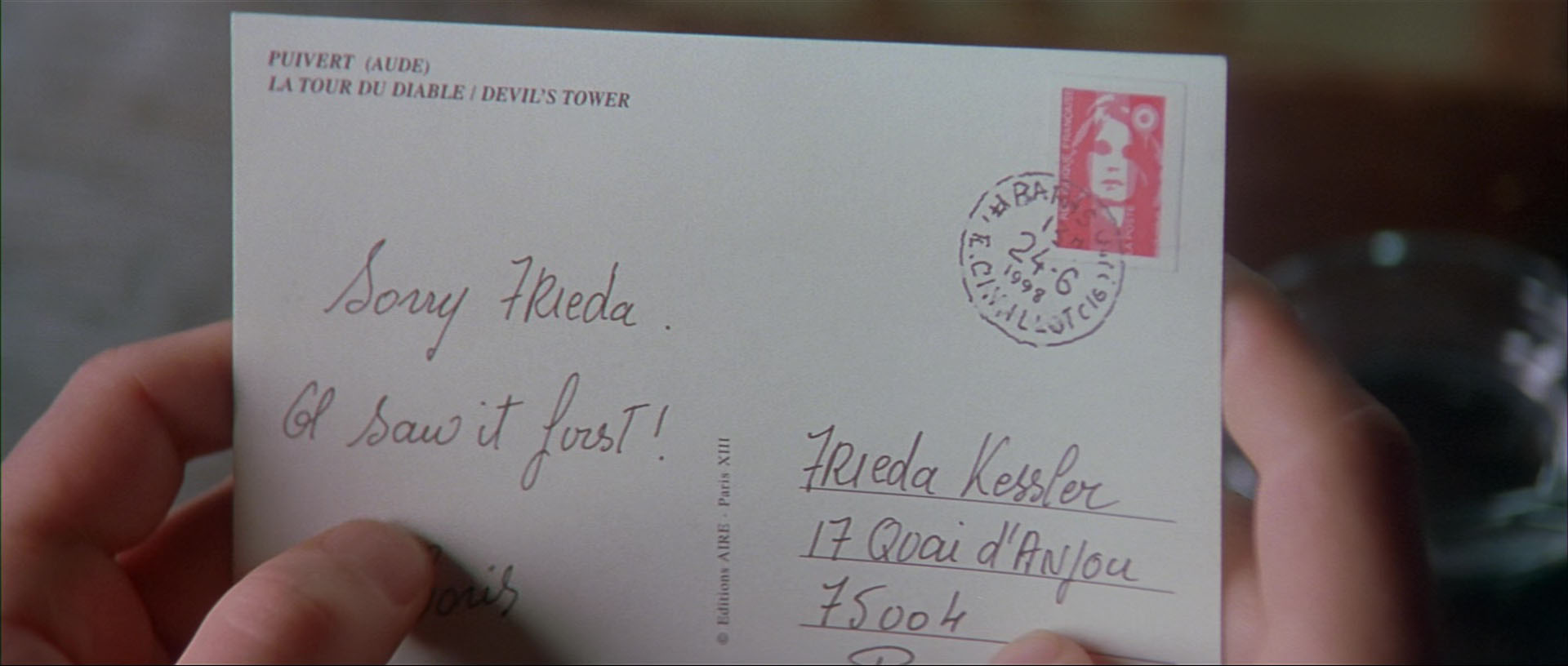
I’m in the minority of people who like The Ninth Gate (1999) a great deal even though it takes some liberties with Arturo Pérez-Reverte’s wonderful novel The Dumas Club. Once again, the bibliographic details are perfectly done, a crucial matter in a film about the antiquarian book trade. Near the end of the film Dean Corso (played by Johnny Depp) finds a postcard that leads him to the final location. On the back of the card there’s a blink-and-you-miss-it detail. Polanski’s wife, Emmanuelle Seigner, plays the mysterious and nameless woman who follows Corso throughout the film. By this point we already know she possesses occult powers so it’s not really surprising to see her face in the postage stamp, something that Corso doesn’t seem to notice.

polanski14.jpg

Previously on { feuilleton }
Repulsion posters
Atalanta Fugiens
Le Grand Macabre
Les Temps Morts by René Laloux
The writhing on the wall

Wildeana 6

robinson1.jpg

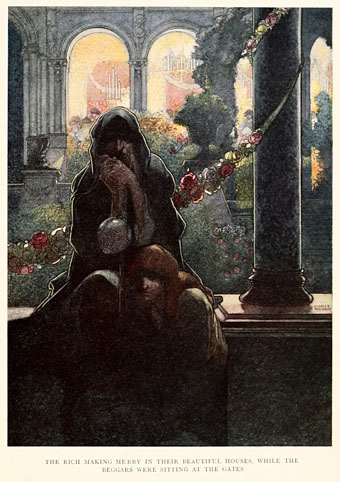
“The rich making merry in their beautiful houses, while the beggars were sitting at the gates.” Above and below: illustrations by Charles Robinson from The Happy Prince and Other Tales, an edition from 1920.

Continuing an occasional series. I’ve yet to see a copy of the recent annotated and unexpurgated edition of The Picture of Dorian Gray but Alex Ross wrote a marvellous essay for the New Yorker about the novel, its creation, its public reception, and Wilde’s decision to tone down the overt homoeroticism of its earlier drafts. This is one of the best pieces I’ve seen for a while about Wilde, replete with choice detail:

The gay strain in Wilde’s work is part of a larger war on convention. In the 1889 story “The Portrait of Mr. W. H.,” a pseudo-scholarly, metafictional investigation of Shakespeare’s sonnets to a boy, Wilde slyly suggests that the pillar of British literature was something other than an ordinary family man. In the 1891 play “Salomé,” Wilde expands a Biblical anecdote into a sumptuous panorama of decadence. Anarchists of the fin de siècle, especially in Germany, considered Wilde one of their own: Gustav Landauer hailed Wilde as the English Nietzsche. Thomas Mann expanded on the analogy, observing that various lines of Wilde might have come from Nietzsche (“There is no reality in things apart from their experiences”) and that various lines of Nietzsche might have come from Wilde (“We are basically inclined to maintain that the falsest judgments are the most indispensable to us”). Nietzsche and Wilde were, in Mann’s view, “rebels in the name of beauty.”

As for the novel, I’m feeling rather Dorian Grayed-out at the moment, having recently completed ten illustrations based on the story for a forthcoming anthology. More about that later.

Elsewhere, the William Andrews Clarke Memorial Library in Los Angeles has been running an exhibition, Oscar Wilde & the Visual Art(ists) of the Fin-de-Siecle, since July, and will continue to do so until the end of September. No word about what’s on display but this page on their website has details of their collection of Wilde materials which they say is the most comprehensive in the world.

Finally, the majority of visits to these pages in recent days have come from this post about Ivan Albright’s astonishing Dorian Gray painting in the Art Institute of Chicago. The post links to an earlier one of mine about the paintings used in Albert Lewin’s 1945 film of the book.

robinson2.jpg

Elsewhere on { feuilleton }
The Oscar Wilde archive

The real Basil Hallwards

dorian.jpg

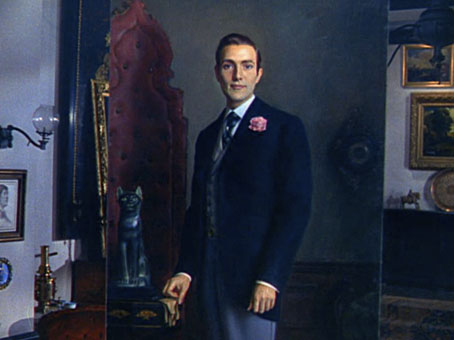
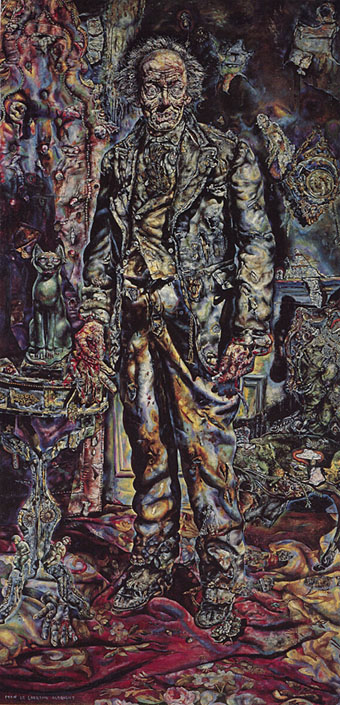
Well, two of them anyway… Discussion with commenter Noel in one of my old (and rather scant) posts about Albert Lewin’s 1945 film of The Picture of Dorian Gray touched on the fate of the original version of Dorian’s portrait (above). For some reason I’d always assumed this to have been produced by MGM’s art department despite a clear credit at the opening of the film for artist Henrique Medina (1901–1988). I no doubt miss this since my eyes always go to the credit for Ivan Albright (1897–1983), the artist responsible for the famous deteriorated final state of the picture (below). That painting is so splendidly grotesque its presence almost overpowers the entire film but its power would be lessened without the contrast of Medina’s elegant original. Examples of Medina’s other portrait works show a distinct similarity.

albrights.jpg

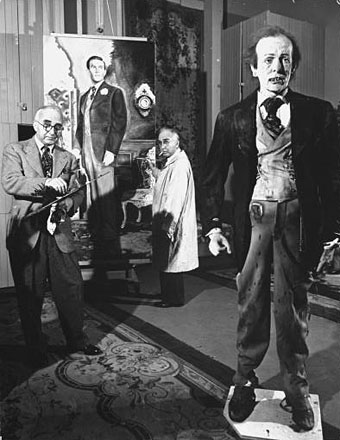
Noel pointed the way to photos from the LIFE magazine archives which show Ivan Albright and his identical twin brother, Malvin, at work on the portrait. (Another here.) Fascinating not only to see an early stage of the painting but also a dummy of the decayed Dorian they were using as a model.

albright.jpg

Albright’s dissolute masterpiece can be seen at the Art Institute of Chicago, together with a number of his other works. Noel notes that Medina’s picture was bought at auction for $25,000 but its current whereabouts and ownership remain a mystery. If anyone knows more about this, please leave a comment.

Elsewhere on { feuilleton }
The Oscar Wilde archive