Weekend links 846

borges.jpg

Design by Randoll Coate for the Labirinto Borges, a hedge maze at the Giorgio Cini Foundation, Venice, which was renovated earlier this year.

• “Code was probably our most overtly political record, which is interesting, touring and playing it in these very different but scary political times.”​ Stephen Mallinder of Cabaret Voltaire talking about the experience of touring America again.

• At The Daily Heller: A look at the work of designer/illustrator George Hardie whose five-decade career is to be celebrated in a retrospective exhibition in London. There’s more George Hardie here.

• “Almost as soon as weird began circulating outside of Macbeth, its meaning broadened too, from ‘eerie’ and ‘uncanny’ to ‘odd’ or ‘unusual’.” Colin Gorrie on the weird history of the word “weird”.

• At The Quietus: Toby Manning on 40 years of Gone To Earth by David Sylvian. A minor nitpick: the album’s art and design was by Russell Mills, not Vaughan Oliver.

• New music: Burning Song by Kali Malone; Obsessive Surrealism by Parallel Worlds.

• At Door Of Perception: The radical architectural designs of Eugene Tssui.

• DJ Food’s latest accumulation of psychedelic graphics from the desktop.

• Old music: When The Music’s Over (Live, 1970) by The Doors.

Arthur Brown‘s favourite songs.

Weird Dream (1976) by Harmonia | It’s So Weird (1983) by Bush Tetras | Ballad Of The Weird Sisters (2013) by Blood Ceremony

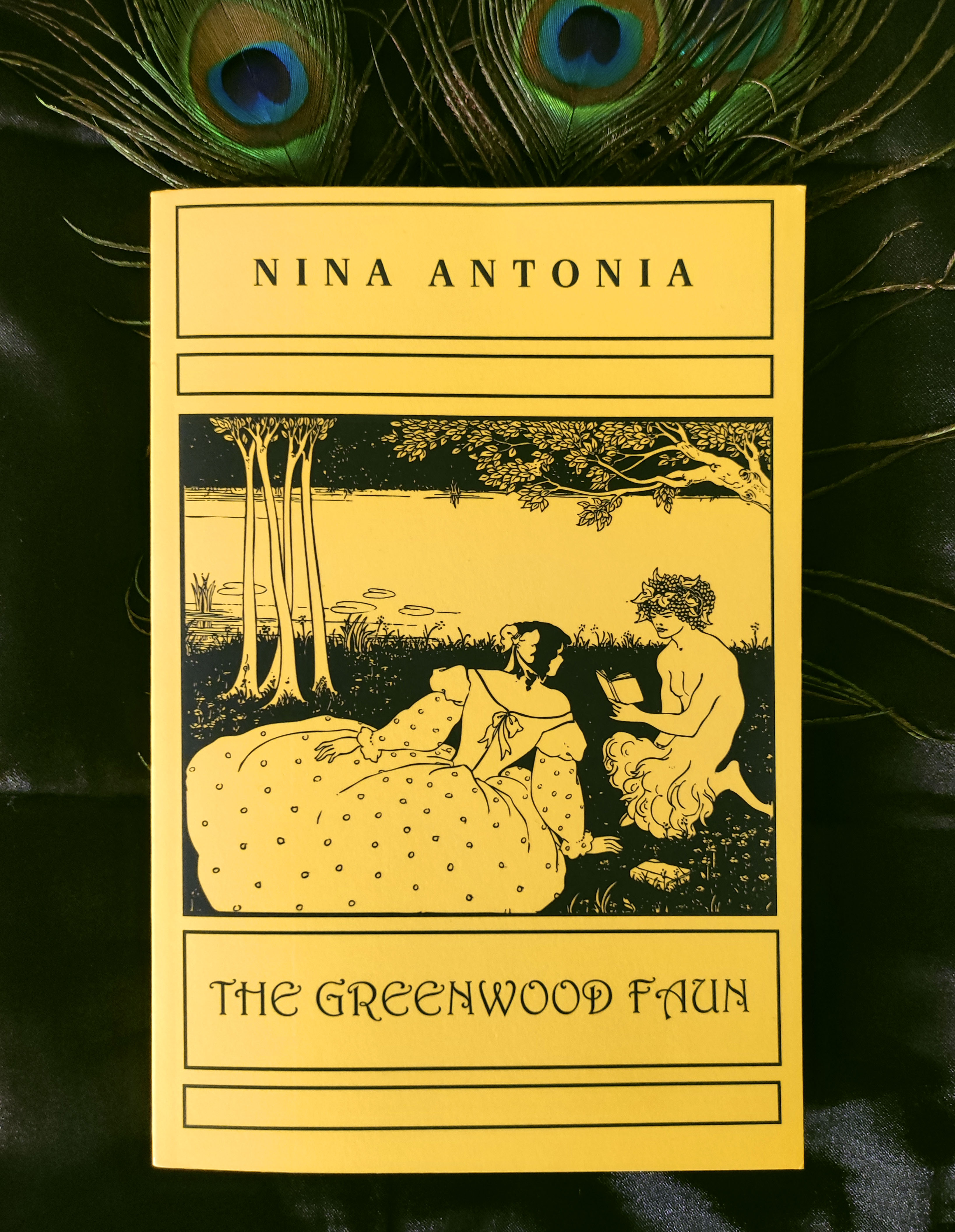
The Greenwood Faun

antonia.jpg

Arthur Machen isn’t usually considered to be a Decadent author even though it was in the Mauve Decade of the 1890s that he first established himself as a writer. Machen knew Oscar Wilde well enough to recount an anecdote in later life, and two of Machen’s earliest books were published with covers designed by Aubrey Beardsley. But Machen outlived Wilde and Beardsley and all the other writers and artists who expired prematurely around the turn of the century, while Machen’s 20th-century stories are now so enmeshed with the evolution of weird fiction that the world of the weird has claimed him as one of its own.

The Greenwood Faun is a novel by Nina Antonia which plays with both these phases of Arthur Machen’s career. This is a ghost story to some degree, in which the shade of Decadent poet Lionel Johnson wanders the streets of London in various stages of corporeality, as well as a tale of the dysfunctional Hartington Leacock-Jones family whose entanglements with a mysterious book—The Greenwood Faun by Lucian Taylor—comprise the main substance of the novel. Machen aficionados will recognise Lucian Taylor as being the central character of Machen’s semi-autobiographical The Hill of Dreams, a detail which makes Antonia’s story a novel about a novel from a novel.

It’s never entirely clear how the world of The Greenwood Faun manages to have Arthur Machen in it as the author of a novel called The Hill of Dreams while also containing the central character from that novel whose death has occurred before the story begins. The important element is Lucian Taylor’s unpublished book, discovered in manuscript form then printed in a limited edition (books like these are always limited editions) with faun-embossed boards and pages that exude a sylvan fragrance. Jorge Luis Borges would have enjoyed the intertextuality—he enjoyed inventing books, and also enjoyed Arthur Machen’s writing—which is paralleled to a small degree by Alan Moore’s The Great When in which we find another book from a Machen story—A London Walk by the Reverend Thomas Hampole—manifesting in the real world. (This isn’t to suggest any influence; Antonia’s book was first published in 2017.) The Greenwood Faun extends a fateful influence over the Hartington Leacock-Jones family, either chiming sympathetically with those receptive to its magical charm or repulsing those whose characters are blind to its visionary qualities. Roger, the oldest of the trio of siblings, is a worldly materialist who remains immune to the spell of the book, whereas Conrad, his dreamy younger brother, is a poète maudit in embryo, equally responsive to the lure of the novel and to the romantic seductions of the ghostly Lionel Johnson. The thorn in this world is Giles Gorse, a literary critic soon to be married to Violet, the brothers’ sister. Gorse has his own designs on The Greenwood Faun, seeing the novel as something he can republish as his own, if only the book would behave more like a book and less like an object endowed with magical life.

Nina Antonia’s novel is a treat for Decadent enthusiasts, littered with references and borrowings from the Mauve Decade, and to writers like Saki and Ronald Firbank who carried its spirit into the 20th century. Saki is a good match for Machen even though one of Saki’s most memorable characters, the waspish Clovis Sangrail, would be appalled to find himself repurposed here as one of the lower orders. The mysticism that surfaces now and then in Saki’s stories reaches a Machenesque peak in The Music on the Hill, another of those Edwardian tales in which Pan is encountered in the English countryside. The story is quoted in epigraph at the opening of The Greenwood Faun, and it’s to this vision of a pagan deity that the novel pays homage, not the annihilating terror of Machen’s Great God Pan.

The Greenwood Faun is published by Snuggly Books which also has a paperback edition of N by Arthur Machen, the story that concerns that other fateful volume, The London Walk.

Previously on { feuilleton }
A Czech Machen
Ibrahim Ineke’s The White People
The White People
The Bowmen by Arthur Machen
Rex Ingram’s The Magician
The Great God Pan

Weekend links 811

reiniger.jpg

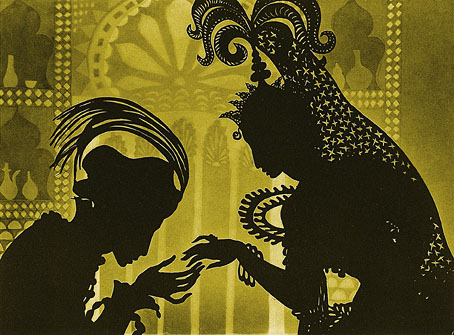
A still from The Adventures of Prince Achmed (1926), a feature-length animated film by Lotte Reiniger.

Hélice 39 is a speculative-fiction journal (in Spanish) whose current issue includes an article by Marcelo Sanchez: “What did Borges think of Lovecraft?”

• Among the new titles at Standard Ebooks, the home of free, high-quality, public-domain texts: The Maltese Falcon by Dashiell Hammett.

• Old music: Hydrophony For Dagon by Max Eastley & Michael Prime; The Adventures Of Prince Achmed by Morricone Youth.

Public Domain Review lists some of the writers whose works will enter the public domain this year.

• “Modern Japanese Printmakers celebrates vibrant mid-20th-century innovation“.

• At Nautilus: “Here’s what’s happening in the brain when you’re improvising.”

• At the BFI: Pamela Hutchinson selects 10 great films of 1926.

• New music: The Future Is Now by Pietro Zollo.

• At Dennis Cooper’s: Phil Solomon Day.

• 2026 is the Year of the Fire Horse.

Runaway Horses (“poetry written with a splash of blood”) (1985) by Philip Glass | Unicorns Were Horses (1996) by New Kingdom | Red Horse (2002) by Jack Rose

Weekend links 757

froebekapteyn.jpg

The Breath of Creation (c. 1926–34) by Olga Fröbe-Kapteyn.

• At Wormwoodiana: “…Gresham was well-read enough to know that while magic can be more than a MacGuffin in a fantasy story, neither fantasy nor thriller fiction lets magic unsettle readers much. […] Even when it is good, the supernatural is never safe in a Williams story. Not conventional fantasy by half.” G. Connor Salter on William Lindsay Gresham’s enthusiasm for Charles Williams’ novels.

• At Harper’s Magazine: Christopher Tayler reviews Lawrence Venuti’s translations of Dino Buzzati’s Il deserto dei Tartari (now titled The Stronghold) which was published last year, and The Bewitched Bourgeois: Fifty Stories which will be out in January.

Dennis Cooper’s favourite fiction, poetry, non-fiction, film, art, and internet of 2024. Thanks again for the link here!

• The Approach to J.L. Borges: A Borgesian pastiche in homage to the creator of Ficciones by Ed Simon.

• “HP Lovecraft meets Fafhrd and The Grey Mouser”: an essay from 1992 by Fritz Leiber.

Can performing live on The Old Grey Whistle Test in January, 1974.

• DJ Food says “Let’s have some psychedelia”.

• RIP Zakir Hussain.

Creation Dub 1 (1977) by Lee Perry & The Upsetters | Threat To Creation (1981) by Creation Rebel/New Age Steppers | Theme from ‘Creation’ (1992) by Brian Eno

Weekend links 739

burr.jpg

New Moon and Evening Star (c.1932) by George Elbert Burr.

• If you’re eager to see a physical copy of the forthcoming Moon and Serpent Bumper Book of Magic then Alan Moore World has screengrabs from a teaser video posted by US distributors Penguin/Random House to the social-media pit formerly known as Twitter. I’ve yet to receive a copy myself so I’m pleased to see the foil overlay on the cover looking as eye-catching as I’d hoped. Library Journal gave the book a starred review earlier this month.

• At Bandcamp: George Grella profiles Material, Bill Laswell’s long-running polycultural ensemble. Two of the albums on this list are all-time favourites of mine.

• Mix of the week: DreamScenes – August 2024 at AmbientBlog.

The Book of Sand by Jorge Luis Borges: A Hypertext.

• At Unquiet Things: Owls, Bats, and Moths in Art.

• At Dennis Cooper’s: Varvara Stepanova Day.

Jon Hopkins’ favourite music.

• RIP Gena Rowlands.

Desert Sands (1958) by Eugene LaMarr and His Magic Accordion | Grains Of Sand (1989) by Opal | Infinite Sands (1997) by Robert Henke