“A Love Vision”: Kenneth Anger in 1967

lucifer.jpg

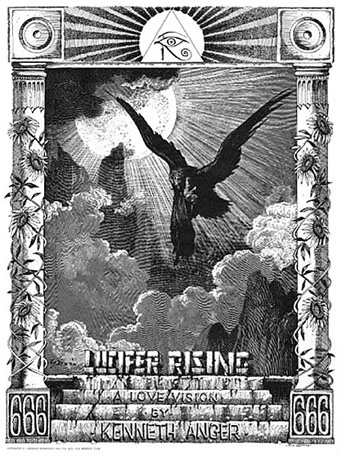
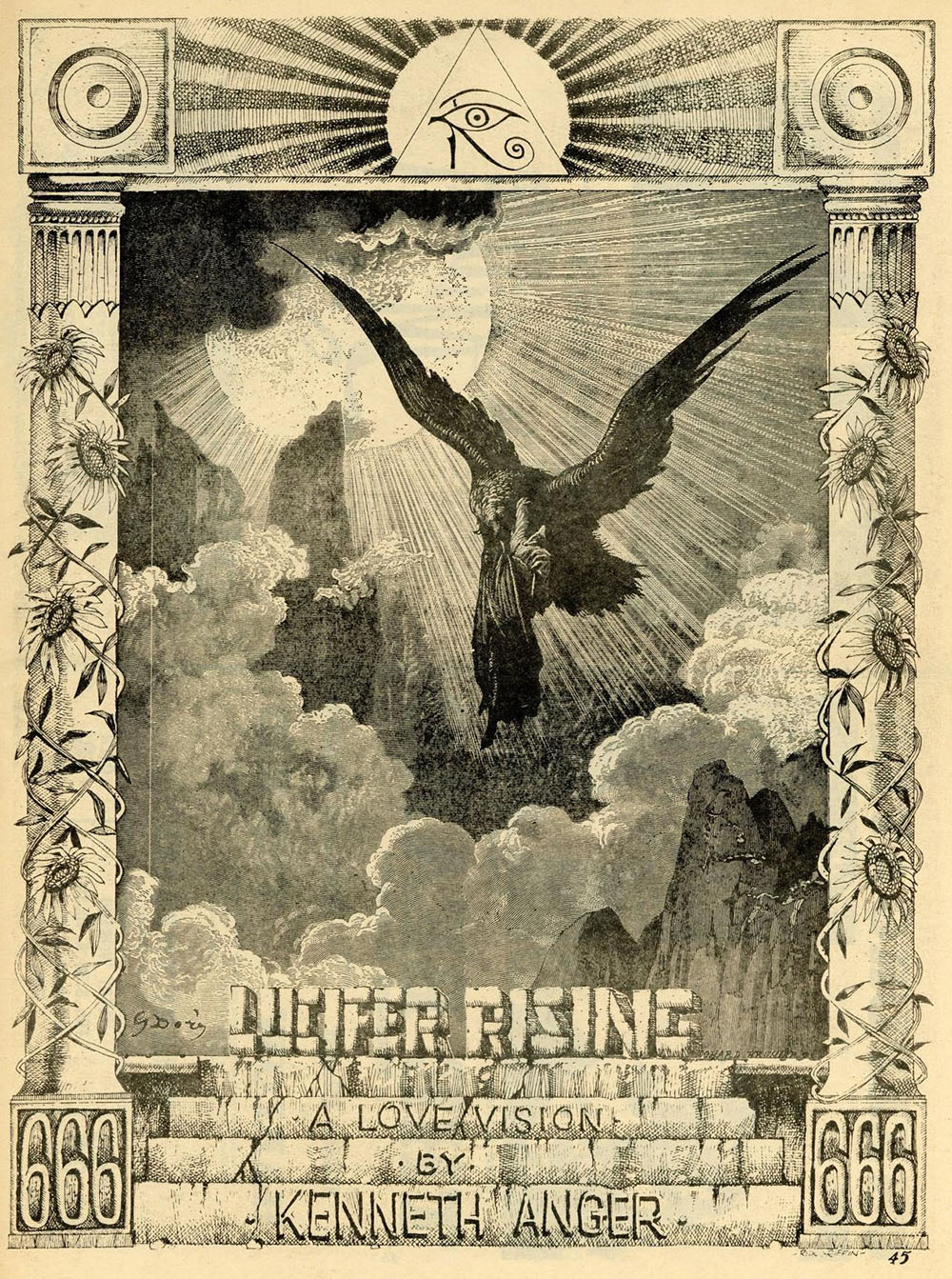
Art by Rick Griffin with Gustave Doré. San Francisco Oracle, Vol. 1 No. 7, February 1967.

In his later years Kenneth Anger often seemed to spend more time giving interviews than making films, even though he was keeping busy when out of the public eye. Most of the discussions cover familiar ground, recycling anecdotes about the creation of the Magick Lantern Cycle, and the people who contributed to the films. More interesting—and harder to find—are interviews from the time when Anger was still at work on his magnum opus, which is why this radio interview from 1967 is a very welcome discovery:

John Cott, host of the Coconut Grove show on KPFA, and co-hosts Tom Luddy and Juris Svendsen interview Kenneth Anger about his latest film, Lucifer Rising. At the time of the interview, Anger had not yet begun shooting Lucifer Rising; he discusses his vision for the film as a sequel to Scorpio Rising, talks about the film’s magick symbolism. The hosts play a tape of Anger performing an invocation for the film. He is joined in the studio by Gary (?), who is introduced as the star of the film, and Joy (no last name given), who plays music in the background throughout the interview and performs a song from the film. They are also briefly joined by author and critic Susan Sontag, who discusses her love of Anger’s films.

KPFA is a listener-funded radio station serving the San Francisco Bay area which is still active today. The interview, which is really more of a round-table discussion, took place in July 1967, when the “Summer of Love” was in full swing. Susan Sontag’s presence surprised me, I’ve never seen her mention Anger’s films anywhere yet here she is, declaring him to be the greatest living American director. She’s only there for a third of the discussion but during this time Juris Svendsen tries to isolate what it is that makes her regard Anger’s films so highly. Later on the conversation turns to the youthful demographic referred to as “the Love Generation”, a cohort who the participants all discuss as something separate from themselves. Kenneth Anger was 40 in 1967 yet he talks sympathetically about the youth of the day, seeing the hippies as catching up with many of the impulses that drove avant-gardists like himself in the 1950s: the growing interest in occultism, the disregard for the demands of “straight” society, and all forms of psychotropic exploration. When the discussion turns to Lucifer Rising, Anger emphasises the subtitle that appears on the film’s promotional poster by Rick Griffin: “A Love Vision”. It’s tempting to read this as opportunism, especially when the subtitle was missing from the film that was eventually released in 1980, but Anger regarded the original Lucifer Rising as an answer to the “Death Vision” of Scorpio Rising. Here, as elsewhere, he emphasises the positive aspects of Lucifer, the Bringer of Light, while love was an important component of the Thelemic philosophy which Anger followed: “Love is the law, love under will.”
equinox1.jpg

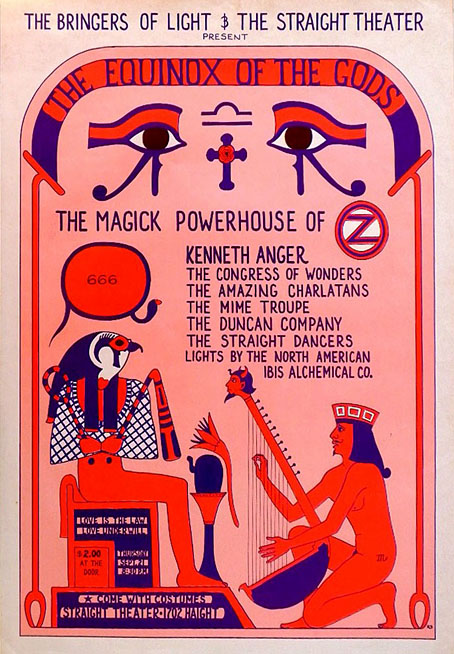
Art by Randy Salas.

Anger sounds relatively positive himself in the radio discussion but the rambling, unofficial biography by Bill Landis describes a not-so-love-filled atmosphere at the Russian Embassy in San Francisco where Bobby Beausoleil was supposed to be playing the part of Lucifer. I tend to be wary of the Landis account, he certainly did his research but isn’t always accurate, and some of the people he talked to (Anger wasn’t among them) would have been pushing their own agendas. A few months after the KPFA interview Anger and Beausoleil staged an occult ceremony/theatrical happening/musical concert at San Francisco’s Straight Theater. I used to think that the name of Beausoleil’s band, The Magickal Powerhouse of Oz, was a reference to Aleister Crowley’s Liber OZ (aka Liber LXXVII), a one-page distillation of the Law of Thelema which Anger happens to read out towards the end of the KPFA discussion. The band used the Crowlean spelling of Magick in their name but the Oz is merely a reference to the books by L. Frank Baum.
barb.jpg

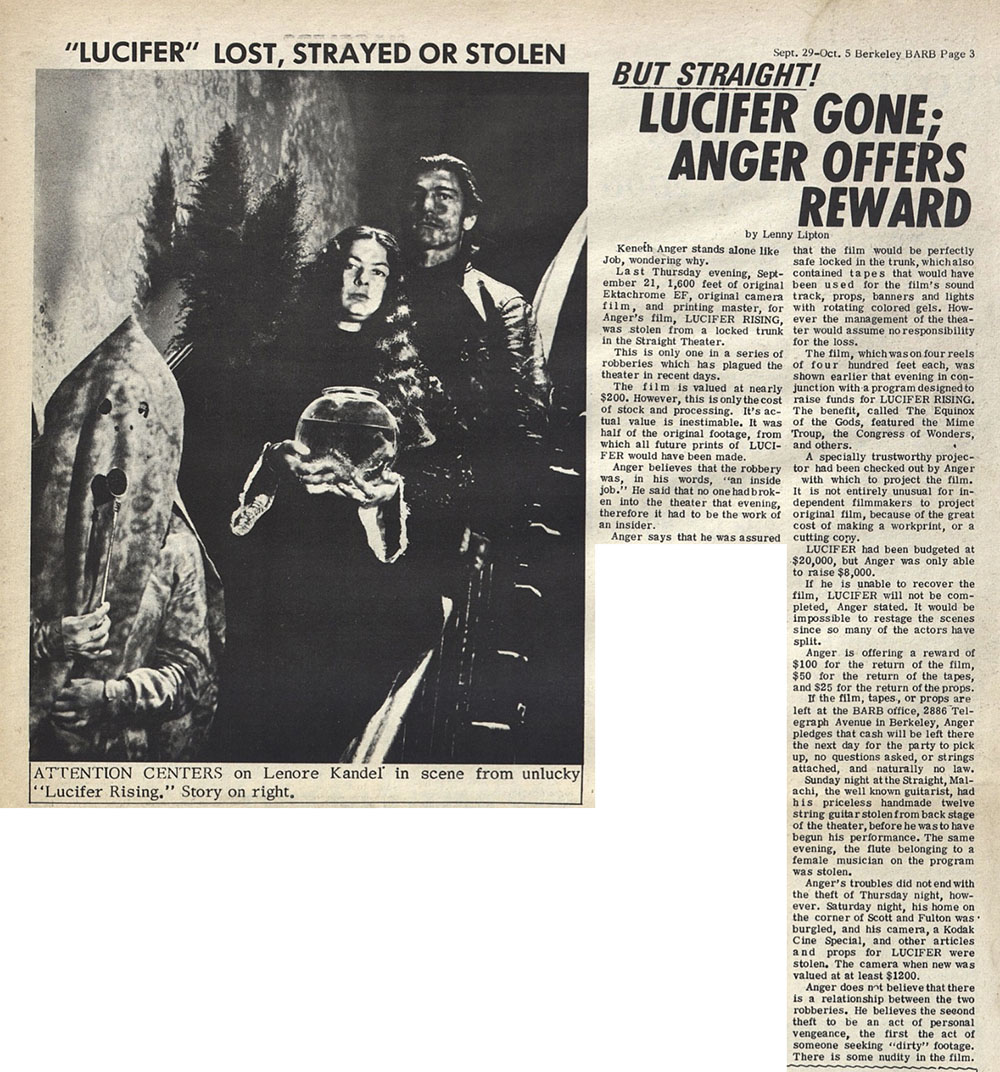
Berkeley Barb, Volume 5, Issue 12, Sept. 29–Oct. 5, 1967.

Fragments of the Equinox of the Gods performance may be the ones that appear in Invocation of My Demon Brother (Landis isn’t clear) but we do know that Anger’s 1969 film is made up of leftover footage from the original Lucifer Rising. The reporting here is confused by conflicting claims: Anger said that most of the original Lucifer footage was stolen from a car after the Straight Theater show; Beausoleil said that it was mainly equipment that was stolen since Anger hadn’t shot much film in the first place. Whatever the truth of the matter, the theft was reported as a news story in The Berkeley Barb at the end of September, something I was pleased to find while researching all of the above. I doubt that Anger would have gone to the press over a trivial loss but this is all rather academic now. Needless to say, whoever the thieves were they didn’t return Anger’s film which he why he spent the next decade remaking Lucifer Rising from scratch. Before he took off for London, however, he posted an ad in the Village Voice melodramatically announcing the end of his film-making career. I’ve always felt the thieves helped Anger rather than hindered him, even though he obviously wouldn’t have agreed at the time. The loss of the footage forced him to create a shorter film that wouldn’t otherwise have existed, one in which the “Death Vision” of Scorpio Rising is filtered through the hippy era to channel the growing negativity at the end of the decade: Vietnam, the Manson murders (in which Bobby Beausoleil was implicated), and Altamont (in which Mick Jagger was implicated), where the relatively harmless bikers of Scorpio Rising have been replaced by Hells Angels.

Previously on { feuilleton }
Kenneth Anger: Film als magisches Ritual
Kenneth Anger, 1927–2023
Anger Magick Lantern Cycle, 1966
Don’t Smoke That Cigarette by Kenneth Anger
Kenneth Anger’s Maldoror
Donald Cammell and Kenneth Anger, 1972
My Surfing Lucifer by Kenneth Anger
Inauguration of the Pleasure Dome: The Eldorado Edition
Brush of Baphomet by Kenneth Anger
Anger Sees Red
Kenneth Anger’s Hollywood Babylon
Lucifer Rising posters
Missoni by Kenneth Anger
Anger in London
Arabesque for Kenneth Anger by Marie Menken
Edmund Teske
Kenneth Anger on DVD again
Mouse Heaven by Kenneth Anger
The Man We Want to Hang by Kenneth Anger
Relighting the Magick Lantern
Kenneth Anger on DVD…finally
Kenneth Anger: Film als magisches Ritual

anger1.jpg

Writing about Steven Arnold last week I was wondering whether Arnold and Kenneth Anger had ever crossed paths. Anger moved to San Francisco in 1966 in order to channel the counter-cultural ferment into the film that would eventually become Lucifer Rising. I’m sure he must have been aware of Arnold’s midnight movie shows but if so there’s no mention of Arnold in the Bill Landis Anger biography.

anger2.jpg

When Anger died two years ago I posted links to some of the better online material related to the film-maker and his works. One of these was a German TV profile, Kenneth Anger–Magier des Untergrundfilms, a 53-minute documentary made in 1970 by Reinold E. Thiel for German TV channel WDR. The post included my complaint about the only copy of the film being blighted by an obtrusive graphic fixed to the footage by the person who uploaded it to YouTube a decade ago. The copy was further spoiled by burned-in subtitles but I felt sure that a better version would turn up eventually, and here we are with Kenneth Anger: Film als magisches Ritual, the same film under a different title, and free of obtrusive graphics. (There’s still that “WDR” in the corner but they paid for the damned thing so their proprietorial logo is at least justified.)

anger3.jpg

As a guide to Anger’s cinema, Thiel’s film only skates over the surface, with Anger being interviewed in piecemeal fashion, and explaining his work and magical philosophy to the camera. He doesn’t seem very happy in any of these sequences but WDR had paid to help with his own film so he was obliged to co-operate. We’re fortunate that they did. Thiel’s film is most valuable for having been made when Anger was shooting new scenes for Lucifer Rising in London. As far as I’m aware, this is the only documentary that shows Anger at work on any of the Magick Lantern films. The discussion of his career includes a mention of Rabbit’s Moon, the lost footage of which had been discovered in Paris but not yet pieced together into its finished form. The shots we see here are more rarities, being raw footage, untinted and unedited. The same goes for some of the shots from Lucifer Rising which include brief moments that didn’t make it to the final cut.

anger4.jpg

Anger had moved to London following his aborted attempts to make Lucifer Rising in San Francisco, a period which saw his first choice for the role of Lucifer remove himself from the production by means of suicide. His second choice, Bobby Beausoleil, fell out with Anger and stole most of the existing footage before being imprisoned for life as a result of his involvement with the Manson murders. The London phase of the film’s production was much more fruitful. In addition to the WDR funds and assistance from the Rolling Stones’ photographer, Michael Cooper, Anger was given a small grant by the BFI which helped pay for the sequences filmed in Germany and Egypt. Thiel’s footage shows Anger and assistants filming shots of the basement ritual with Aleister Crowley’s magic circle painted on the floor. Anger’s third Lucifer, Leslie Huggins, left the film before it was finished but we get to see him in several sequences, including shots of him wearing his “Lucifer” jacket. Thiel inadvertently clears up one minor mystery by revealing that the white-haired, ermine-robed Francis Cyril Rose is saying “Haven’t I seen you somewhere before?” to Huggins’ Lucifer during the ritual. In the finished Lucifer Rising we see Rose’s lips moving but the only words you ever hear in Anger’s films are the lyrics in the songs he uses.

anger5.jpg

Leslie Huggins doesn’t say a word either, even when Anger is directing his actions during the later sequences shot among the standing stones of Avebury, the same stones that would summon Derek Jarman to their circle a year later. Avebury’s megaliths have cultivated a great deal of mystery and legend but their aura is dispersed a little when you can hear an endless procession of motor traffic going by in the background. Anger shoots the stones from a low angle to make them seem more impressive, and also keep a flock of curious sheep out of the frame. Another minor mystery in Lucifer Rising was the shot of Huggins standing by the stones while making conjuring gestures towards a very stormy sky. Was the dark sky a special effect like some of the other shots in the film? Thiel reveals it to be a genuine Wiltshire thunderstorm which Anger hurries to photograph. The inhabitants of Avebury village were no doubt used to the sight of film crews gathered around the stones—a few years later the village became the location for an entire TV series—but even they must have been surprised by the sight of two film crews arriving simultaneously, with one of them filming the other. Thiel ends on a self-reflexive note, with a shot from Anger’s camera showing the camera filming him.

Previously on { feuilleton }
Kenneth Anger, 1927–2023
Anger Magick Lantern Cycle, 1966
Don’t Smoke That Cigarette by Kenneth Anger
Kenneth Anger’s Maldoror
Donald Cammell and Kenneth Anger, 1972
My Surfing Lucifer by Kenneth Anger
Inauguration of the Pleasure Dome: The Eldorado Edition
Brush of Baphomet by Kenneth Anger
Anger Sees Red
Kenneth Anger’s Hollywood Babylon
Lucifer Rising posters
Missoni by Kenneth Anger
Anger in London
Arabesque for Kenneth Anger by Marie Menken
Edmund Teske
Kenneth Anger on DVD again
Mouse Heaven by Kenneth Anger
The Man We Want to Hang by Kenneth Anger
Relighting the Magick Lantern
Kenneth Anger on DVD…finally
Weekend links 336

okanoue.jpg

Visit in Night (1951) by Toshiko Okanoue.

• Rhythms of the World: Bombay and All That Jazz; a 60-minute BBC documentary featuring Trilok Gurtu, L. Shankar, Don Cherry, Alice Coltrane, Zakir Hussain and others. The quality of the full-length copy is a little rough so it’s worth noting the six-part version here.

Adam Scovell talks to Leah Moore and John Reppion about adapting the ghost stories of MR James for the comics medium. Related: The Corner of Some Foreign Field, a short piece of folk horror written by Martin Hayes with art by Alfie Gallagher.

Callum James on the overtly gay nature of Films and Filming magazine (1959–1990). Having seen a few copies over the years I’d always suspected this but didn’t realise it was so persistent. Related: The Boy and the Wolf by Callum James.

• At Dangerous Minds: Lucifer Rising live in concert: Bobby Beausoleil and the Freedom Orchestra perform their Kenneth Anger soundtrack, 1978.

Simon Says: A rare cassette tape of instructions by Peter Levenda for using the Simon Necronomicon (1977) as a grimoire.

• Mixes of the week: Fact Mix 577 by Outer Space, and Incantations and Manifestations by Melmoth_The_Wanderer.

• At Dennis Cooper’s: _Black_Acrylic presents … Art Sex Music: A Cosey Fanni Tutti Day.

• Up from the Abyss: Brenda SG Walter on Rammstein, Lovecraft and Sea Zombies.

• Cinematic Alchemy: Christopher Gibbs on designing sets for Performance (1970).

• Magic carpets: the art of Faig Ahmed‘s melted and pixellated rugs.

• Drips, pop and Dollars: the music that made Ennio Morricone.

• At Bibliothèque Gay: Cocteau et quelques autres.

• “Sleepers Awake!” says Moon Wiring Club.

Can your city change your mind?

The Paul Laffoley Archive

The Ambivalent Abyss (2001) by Lustmord | Byss And Abyss (2004) by Espers | Dark Bullet From The Abyss (2010) by Pleq

Weekend links 306

midian.jpg

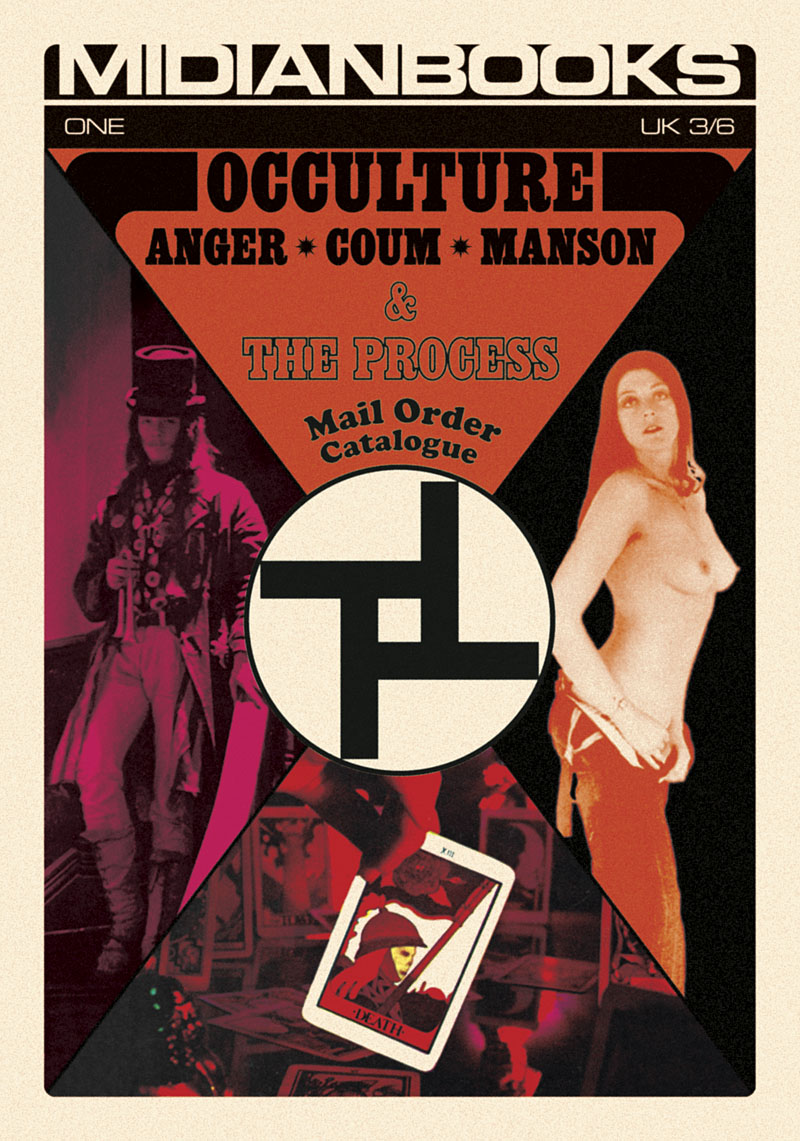
• The Midian Books Occulture catalogue launched this week sporting a cover that I pieced together for Midian’s Jonathan Davies. The design pastiches the look of the Process Church magazines of the early 1970s; inside there’s a haul of Process material on sale together with COUM/Throbbing Gristle ephemera (that’s Cosi Fanni Tutti on the right, as seen on her modelling business card), Kenneth Anger ephemera (that’s Bobby Beausoleil on the left) and much more.

• More occulture: Lost Envoy: The Tarot Deck of Austin Osman Spare launches on 11 May at Camden Arts Centre, Arkwright Road, London NW3 6DG, from 7–9pm. All are welcome.

• Out this week: Close To The Noise Floor – Formative UK Electronica 1975–1984: Excursions in Proto-Synth Pop, DIY Techno and Ambient Exploration.

• Mixes of the week: Spin Doctor’s All Vinyl Prince Tribute Mix, and the Rum Music Mix by Russell Cuzner.

David Gentleman’s illustrations for New Penguin Shakespeare books, 1967–1977.

• More electronica: Walberswick by Jon Brooks is now available in a digital edition.

• Blown up: Steve Rose on how cinema captured the dark heart of the swinging 60s.

• Six Quietus writers choose favourite Prince songs. Related: The A–Z of Prince

A Timeline of Slang Terms for Male Homosexuality by Jonathan Green.

Berenice Abbott’s views of New York streets then and now.

• Jan Švankmajer is crowd-funding his next film, Insects.

Laurie Anderson on the creation of O Superman.

• Blood Ceremony: The Great God Pan (2011) | Oliver Haddo (2011) | Ballad Of The Weird Sisters (2013) | Let It Come Down (2014)

Lucifer Rising posters

lucifer1.jpg

Lucifer Rising: A Love Vision by Kenneth Anger (1967) by Rick Griffin.

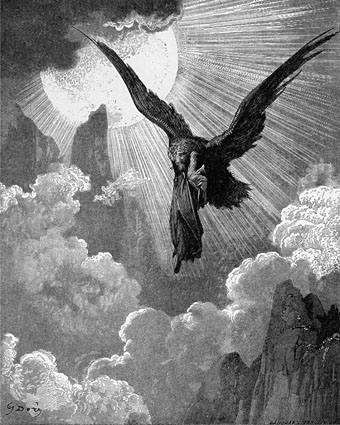
The status of Kenneth Anger’s Lucifer Rising as a kind of poly-cultural crossroads even extends to its poster art. The original poster by Rick Griffin dates back to the earliest drafts of the film, and with its swipe from Gustave Doré makes me think it’s the kind of thing Wilfried Sätty might have produced for Anger had he been asked. (They were both living in San Francisco at this time.)

dore.jpg

The San Francisco poster artists happily plundered the past for unusual images; Doré was a popular choice since his images are frequently striking and copies of the books (or reprints) would have been easy to find. This is one of the illustrations from the Purgatorio section of his illustrated Divine Comedy (1867) showing Dante being ferried up Mount Purgatory (“like Ganymede”) by a giant eagle.

lucifer2.jpg

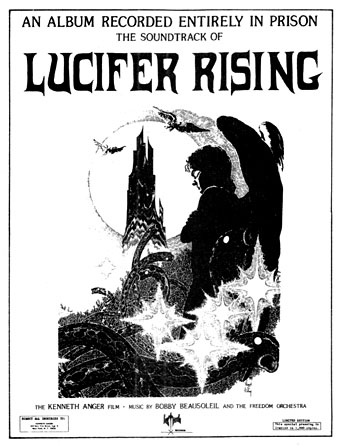
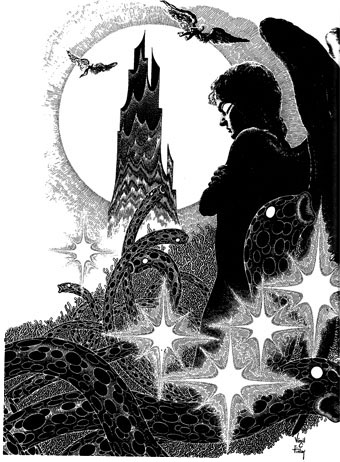
From Dante and Virgil to Virgil Finlay, one of whose illustrations was used on this promo sheet advertising a limited run of Bobby Beausoleil’s soundtrack for the film.

finlay.jpg

Earth’s Last Citadel (1950) by Virgil Finlay.

The illustration this time is for a reprint of Earth’s Last Citadel by CL Moore and Henry Kuttner in Fantastic Novels Magazine for July 1950. I’ve never seen any mention of William Burroughs meeting Kenneth Anger which is a shame since they had acquaintances in common and Burroughs occasionally showed an interest in some of Aleister Crowley’s ideas. The Henry Kuttner connection in this case would provide a link to some of the borrowings Burroughs himself made from Kuttner’s writing. But no, it’s too much of a reach.

lucifer3.jpg

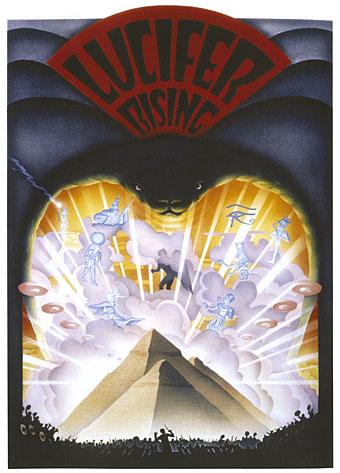
Lucifer Rising (1980) by Page Wood.

After all that the final poster is an original piece of work by Page Wood for a premier screening at the Whitney Museum, New York in 1980. The art avoids the overt occultism in favour of making a resolutely low-budget piece seem like a Hollywood epic. Given Anger’s lifelong obsession with Hollywood’s myths and tragedies I think he would have appreciated that.

Previously on { feuilleton }
Externsteine panoramas
San Francisco by Anthony Stern
The art of Alia Penner
Missoni by Kenneth Anger
Anger in London
Arabesque for Kenneth Anger by Marie Menken
Edmund Teske
Kenneth Anger on DVD again
Mouse Heaven by Kenneth Anger
The Man We Want to Hang by Kenneth Anger
Relighting the Magick Lantern
Kenneth Anger on DVD…finally