“A Love Vision”: Kenneth Anger in 1967

lucifer.jpg

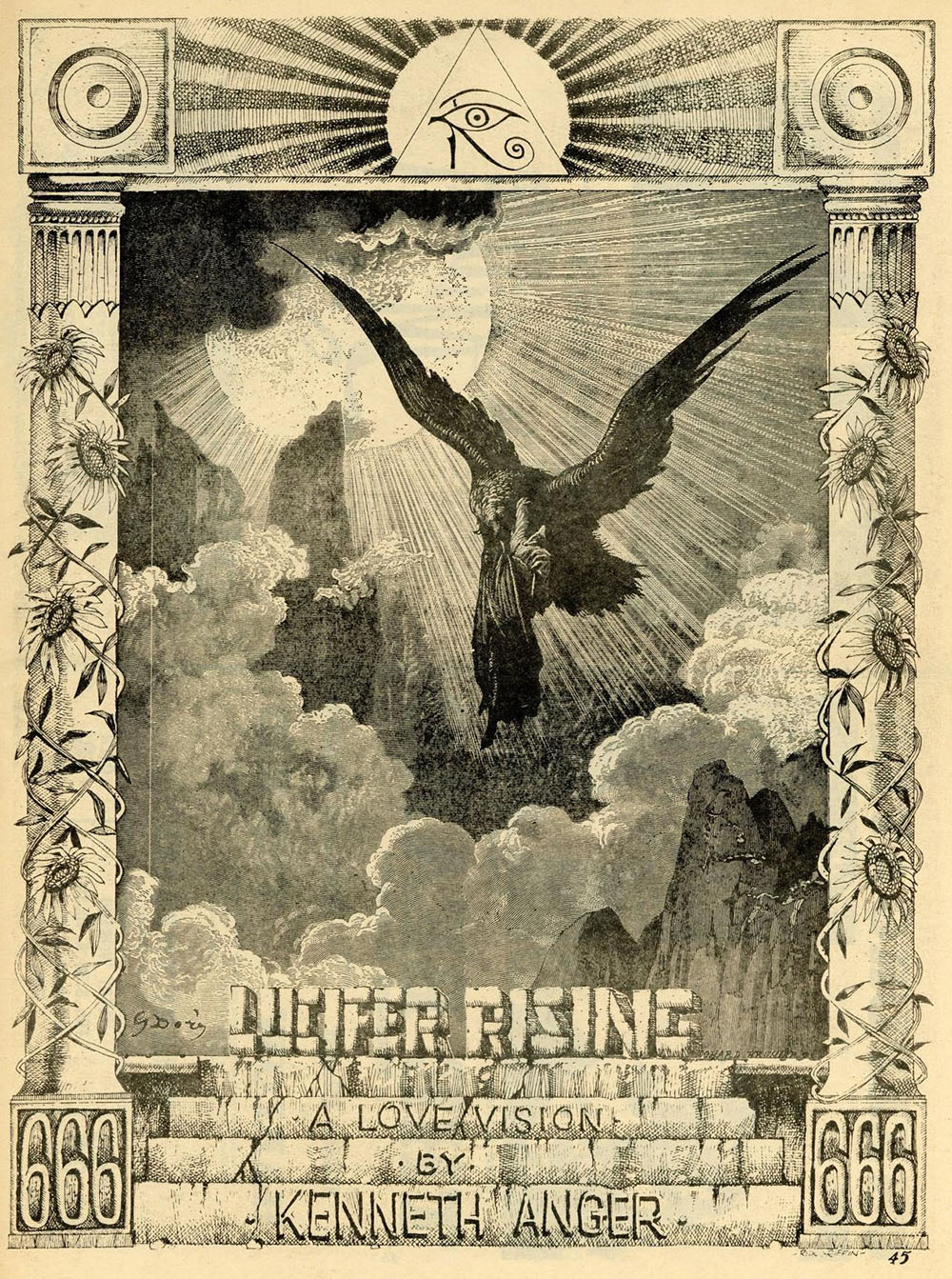
Art by Rick Griffin with Gustave Doré. San Francisco Oracle, Vol. 1 No. 7, February 1967.

In his later years Kenneth Anger often seemed to spend more time giving interviews than making films, even though he was keeping busy when out of the public eye. Most of the discussions cover familiar ground, recycling anecdotes about the creation of the Magick Lantern Cycle, and the people who contributed to the films. More interesting—and harder to find—are interviews from the time when Anger was still at work on his magnum opus, which is why this radio interview from 1967 is a very welcome discovery:

John Cott, host of the Coconut Grove show on KPFA, and co-hosts Tom Luddy and Juris Svendsen interview Kenneth Anger about his latest film, Lucifer Rising. At the time of the interview, Anger had not yet begun shooting Lucifer Rising; he discusses his vision for the film as a sequel to Scorpio Rising, talks about the film’s magick symbolism. The hosts play a tape of Anger performing an invocation for the film. He is joined in the studio by Gary (?), who is introduced as the star of the film, and Joy (no last name given), who plays music in the background throughout the interview and performs a song from the film. They are also briefly joined by author and critic Susan Sontag, who discusses her love of Anger’s films.

KPFA is a listener-funded radio station serving the San Francisco Bay area which is still active today. The interview, which is really more of a round-table discussion, took place in July 1967, when the “Summer of Love” was in full swing. Susan Sontag’s presence surprised me, I’ve never seen her mention Anger’s films anywhere yet here she is, declaring him to be the greatest living American director. She’s only there for a third of the discussion but during this time Juris Svendsen tries to isolate what it is that makes her regard Anger’s films so highly. Later on the conversation turns to the youthful demographic referred to as “the Love Generation”, a cohort who the participants all discuss as something separate from themselves. Kenneth Anger was 40 in 1967 yet he talks sympathetically about the youth of the day, seeing the hippies as catching up with many of the impulses that drove avant-gardists like himself in the 1950s: the growing interest in occultism, the disregard for the demands of “straight” society, and all forms of psychotropic exploration. When the discussion turns to Lucifer Rising, Anger emphasises the subtitle that appears on the film’s promotional poster by Rick Griffin: “A Love Vision”. It’s tempting to read this as opportunism, especially when the subtitle was missing from the film that was eventually released in 1980, but Anger regarded the original Lucifer Rising as an answer to the “Death Vision” of Scorpio Rising. Here, as elsewhere, he emphasises the positive aspects of Lucifer, the Bringer of Light, while love was an important component of the Thelemic philosophy which Anger followed: “Love is the law, love under will.”
equinox1.jpg

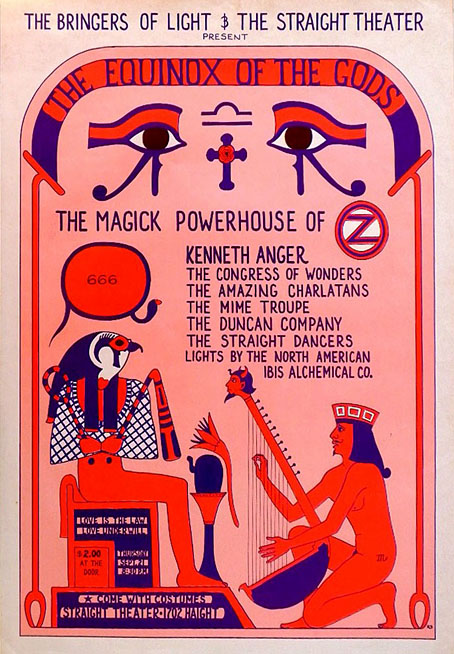
Art by Randy Salas.

Anger sounds relatively positive himself in the radio discussion but the rambling, unofficial biography by Bill Landis describes a not-so-love-filled atmosphere at the Russian Embassy in San Francisco where Bobby Beausoleil was supposed to be playing the part of Lucifer. I tend to be wary of the Landis account, he certainly did his research but isn’t always accurate, and some of the people he talked to (Anger wasn’t among them) would have been pushing their own agendas. A few months after the KPFA interview Anger and Beausoleil staged an occult ceremony/theatrical happening/musical concert at San Francisco’s Straight Theater. I used to think that the name of Beausoleil’s band, The Magickal Powerhouse of Oz, was a reference to Aleister Crowley’s Liber OZ (aka Liber LXXVII), a one-page distillation of the Law of Thelema which Anger happens to read out towards the end of the KPFA discussion. The band used the Crowlean spelling of Magick in their name but the Oz is merely a reference to the books by L. Frank Baum.
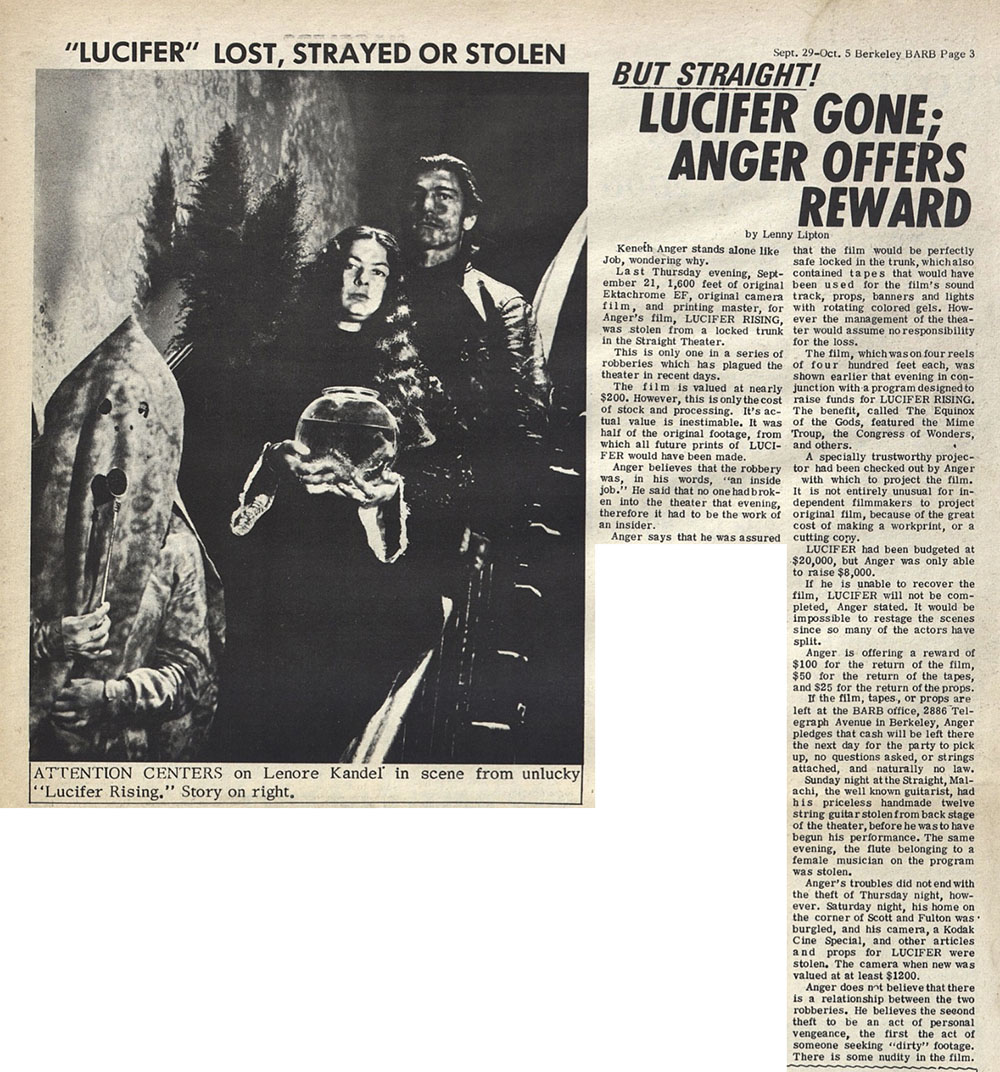
barb.jpg

Berkeley Barb, Volume 5, Issue 12, Sept. 29–Oct. 5, 1967.

Fragments of the Equinox of the Gods performance may be the ones that appear in Invocation of My Demon Brother (Landis isn’t clear) but we do know that Anger’s 1969 film is made up of leftover footage from the original Lucifer Rising. The reporting here is confused by conflicting claims: Anger said that most of the original Lucifer footage was stolen from a car after the Straight Theater show; Beausoleil said that it was mainly equipment that was stolen since Anger hadn’t shot much film in the first place. Whatever the truth of the matter, the theft was reported as a news story in The Berkeley Barb at the end of September, something I was pleased to find while researching all of the above. I doubt that Anger would have gone to the press over a trivial loss but this is all rather academic now. Needless to say, whoever the thieves were they didn’t return Anger’s film which he why he spent the next decade remaking Lucifer Rising from scratch. Before he took off for London, however, he posted an ad in the Village Voice melodramatically announcing the end of his film-making career. I’ve always felt the thieves helped Anger rather than hindered him, even though he obviously wouldn’t have agreed at the time. The loss of the footage forced him to create a shorter film that wouldn’t otherwise have existed, one in which the “Death Vision” of Scorpio Rising is filtered through the hippy era to channel the growing negativity at the end of the decade: Vietnam, the Manson murders (in which Bobby Beausoleil was implicated), and Altamont (in which Mick Jagger was implicated), where the relatively harmless bikers of Scorpio Rising have been replaced by Hells Angels.

Previously on { feuilleton }
Kenneth Anger: Film als magisches Ritual
Kenneth Anger, 1927–2023
Anger Magick Lantern Cycle, 1966
Don’t Smoke That Cigarette by Kenneth Anger
Kenneth Anger’s Maldoror
Donald Cammell and Kenneth Anger, 1972
My Surfing Lucifer by Kenneth Anger
Inauguration of the Pleasure Dome: The Eldorado Edition
Brush of Baphomet by Kenneth Anger
Anger Sees Red
Kenneth Anger’s Hollywood Babylon
Lucifer Rising posters
Missoni by Kenneth Anger
Anger in London
Arabesque for Kenneth Anger by Marie Menken
Edmund Teske
Kenneth Anger on DVD again
Mouse Heaven by Kenneth Anger
The Man We Want to Hang by Kenneth Anger
Relighting the Magick Lantern
Kenneth Anger on DVD…finally

Weekend links 464

picaud.jpg

13 Circles by Julien Picaud.

• The 50th anniversary of the Apollo Moon landing is only two months away so it’s no surprise that Brian Eno’s Apollo: Atmospheres And Soundtracks is being reissued. The latest release will include an additional disc of new music by Eno with his collaborators from the original sessions, Daniel Lanois and Roger Eno. Related: the Apollo 11 Command Module as an explorable (and printable) 3D model.

• From the real Moon to the presence of the satellite in myth and history, the next book from Strange Attractor will be Selene: The Moon Goddess & The Cave Oracle, a volume which is also the final work by the late Steve Moore. With a foreword by Bob Rickard, and an afterword by Alan Moore.

• Guitar-noise maestro Caspar Brötzmann released a handful of thrilling albums in the 1990s then disappeared from view. Spyros Stasis talked to Brötzmann about his hiatus and his recent resurfacing on the Southern Lord label.

• A year late, but I didn’t know Paul Schrader had written an updated introduction to his 1972 study of Ozu, Bresson and Dreyer, Transcendental Style in Film. I love the idea of “The Tarkovsky Ring” as a directorial event horizon.

• “Nothing written is utterly without value, as I proved to myself by reading two random works.” Theodore Dalrymple on the lasting worth of “worthless” books.

Cinemagician: Conversations with Kenneth Anger, a documentary by Carl Abrahamsson about the director/writer/magus.

• Mirror, Mirror: When Movie Characters Look Back at Themselves by Sheila O’Malley.

• From Susan Sontag to the Met Gala: Jon Savage on the evolution of camp.

• Mix of the week: Secret Thirteen Mix 289 by Mondkopf.

• Portrait of the Artist as a Consumer: Anne Billson.

• A video by IMPATV for Religion by Teleplasmiste.

Obscure Sound ~ Cosmic: a list.

Mira Calix‘s favourite records.

Transcendental Overdrive (1980) by Harald Grosskopf | Transcendental Moonshine (1991) by Steroid Maximus | The Transcendent (1999) by Jah Wobble

Weekend links 267

morgan.jpg

Black Fever (2010) by Polly Morgan.

• “She was something of an Auntie Mame figure for me. We spent years haunting secondhand bookstores in Berkeley, Los Angeles, and New York, talking for hours over ever more bizarre dishes of Chinese Hakka cuisine in a hole-in-the-wall eatery at Stockton and Broadway in San Francisco, watching Kenneth Anger flicks and the surrealistic stop-motion puppet masterpieces of Ladislas Starevich, which Tom Luddy would screen for us at the Pacific Film Archive, over and over again until our eyeballs nearly fell out.” Steve Wasserman remembers Susan Sontag.

California Dreams is “the first career-spanning compendium of Mouse’s work; it includes his recent landscapes and figurative paintings. Taken as a whole, the work is a weird, gilded, space-age, flame-licked way to chart the rise of late-twentieth-century youth culture”. Jeffery Gleaves on the psychedelic art of Stanley Mouse.

• “Not only does moral preoccupation corrupt the artfulness of fiction, but fiction is an inefficient and insincere vehicle for moralizing,” says Alice Gregory, joining Pankaj Mishra to address the question: “Do Moralists Make Bad Novelists?”

Nabokov’s posthumously published Lectures on Literature reprints a corny magazine ad that Nabokov liked to show to his students at Cornell, as an example of a certain kind of sunny American materialism and kitsch (or poshlost, in Russian): it’s an ad for flatware featuring a young housewife, hands clasped, eyes brimming as she contemplates a place setting. Nabokov titled it “Adoration of Spoons,” and it undoubtedly played a significant role in his creation of the suburban widow Charlotte Haze. From such strangely endearing trash was a masterpiece born.

John Colapinto reviewing Nabokov in America by Robert Roper

• “How many typefaces is too many typefaces?” asks Adrian Shaughnessy. “What happens to our ability to discriminate and exercise good judgment when we have a near-infinite number of possibilities?”

• At BUTT: a clip from one of the more dreamlike scenes in Wakefield Poole’s gay porn film, Bijou (1972). Poole’s “sensual memoir”, Dirty Poole, is published by Lethe Press.

John Banville reviews The Prince of Minor Writers, selected essays of Max Beerbohm edited by Phillip Lopate.

• My thanks once again to Dennis Cooper for featuring this blog on his list of cultural favourites.

• More Moogery: Sarah Angliss, Gazelle Twin and Free School in the Moog Sound Lab.

• Mix of the week: XLR8R Podcast 394 by Francesca Lombardo.

Atlas Obscura gets to grips with the enormous Devil’s Bible.

Feel You, a new song by Julia Holter.

Spoonful (1960) by Howlin’ Wolf | Spoon (1972) by Can | Spoon (2013) by Mazzy Star

Weekend links 160

floyd.jpg

Collage by Jeneleen Floyd.

• “…slowly, block-by-block, pedestrians are starting to take back the streets.” Wayne Curtis on the hazards of being a pedestrian in a world of cars.

• Michael Hann looks back at LA’s Paisley Underground, and also talks to some of its key members.

Meighan O’Toole interviews JL Schnabel about her Blood Milk jewellery designs.

My central thesis is that camp was always a kind of signifying practice invented out of necessity (both for survival and for sheer creative pleasure) by “queer” (in the classic sense) outsiders – fags, drag queens, transsexuals, deviants, sexual renegades – and that it was always by its very nature deeply political and committed: Some people dedicated their entire lives to it! Sontag’s interpretation always seemed a bit dismissive to me somehow.

The seldom unprovocative Bruce LaBruce talking to Mark Allen about camp in the 21st century.

• Studiocanal launches an appeal to find the lost materials of The Wicker Man.

• At Flickr: Tales from a Parallel Universe and London’s Lost Music Venues.

Michael Wood tells us what we learn when we read Italo Calvino’s letters.

• Fragments of a Portrait: Francis Bacon and David Sylvester in 1966.

• An extract of a live session from Adrian Sherwood and Pinch.

• In Baba Yaga’s Hut: Amelia Glaser on Russian folk tales.

Buckminster Fuller Book Covers from the 1970s.

A Century of Proust.

The Real World (1982) by The Bangles | With A Cantaloupe Girlfriend (1982) by The Three O’Clock | Medicine Show (1984) by The Dream Syndicate | No Easy Way Down (live in Tokyo, 1984) by The Rain Parade

Weekend links 158

soderberg.jpg

Pan II (2012) by Fredrik Söderberg.

• “Aubade was a surprise success, selling some 5000 copies and going into a second printing and an edition published in America.  Martin was immediately a minor celebrity, being interviewed for articles that couldn’t mention what his book was actually about.” Rediscovering the works of Kenneth Martin.

• “I can’t stand covers which imitate other covers, or which slavishly look like whatever their designated genre is supposed to look like.” Ace cover designer Peter Mendelsund is interviewed.

• At The Outer Church Isablood & Henry of Occult Hand are interviewed about their mixtape.

I’d decided to pay my respects in an unorthodox way, by time-travelling into the period of Thatcher’s pomp, when she occulted the light, alchemised the bad will of the populace and did her best to choke the living daylights out of the awkward, sprawling, socially coddled essence of metropolitan London. Hers was a tyranny of the suburbs operating from a position of privilege at the centre: she might have invested in a Dulwich retirement property, but she couldn’t sleep in it.

Iain Sinclair visits Tilbury on the day of the Thatcher funeral. Related: Iain Sinclair and Jonathan Meades in Conversation, Oxford Brookes University, March 2013.

Ormond Gigli’s best photograph: women in the windows in Manhattan. See it full size here.

Balzac and sex: How the French novelist used masturbation to fuel his writing process.

• At Dangerous Minds: Kenneth Williams and John Lahr discuss Joe Orton in 1978.

• Yet more Bowie: Sukhdev Sandhu reviews Ziggyology by Simon Goddard.

The Spectacular, Wild World of Tenjo Sajiki and its Posters.

• In 1967 Susan Sontag made lists of her likes and dislikes.

Stephen Sparks on fin de siècle author Marcel Schwob.

Day Jobs of the Poets by Grant Snider.

James Turrell’s Ganzfeld Experiment.

The Pan Piper (1960) by Miles Davis & Gil Evans | Panorphelia (1974) by Edgar Froese | Pandora (1984) by Cocteau Twins