Weekend links 836

narcissus.jpg

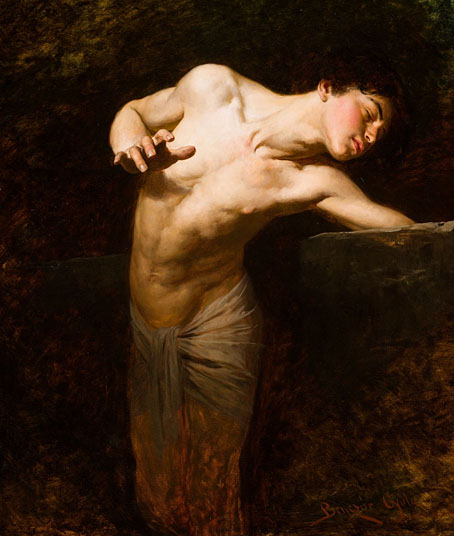
Narcissus (1881) by Gyula Benczúr.

• AnOther reposts an old interview with Dennis Bell of the Bob Mizer Foundation to coincide with an exhibition of homoerotic drawings from Physique Pictorial at JW Anderson Soho, London. The drawings by the pseudonymous (and still unidentified) “Spartacus” don’t bear comparison to those by Mizer’s celebrated discovery, Tom of Finland, but they’re part of a pioneering history. There’s more “Spartacus” at Wallpaper*.

• “Ever the deviant, Bidgood initiated a style that rebelled against the dominant sensibility of his physique-magazine peers, treating his subjects with the same love that a studio-era auteur may have bestowed upon his leading ladies.” Mayukh Sen on the tawdry, opulent world of James Bidgood’s underground classic Pink Narcissus.

• “Düsseldorf. Düsseldorf. Düsseldorf.” Samuel Cox on 50 years of La Düsseldorf by La Düsseldorf.

[Adrian] Sherwood argues that Perry’s antics often mask his genius. “What upset me in later years was people marvelling at him as some kind of joke,” says Sherwood. People saw a clown, when they should have seen someone who re-engineered music. From reimagining the studio as an instrument, pushing dub reggae to the sonic limits or inventing sampling, few producers have come anywhere close to matching Perry’s impact.

Lanre Bakari on the life and musical work of Lee “Scratch” Perry

• New music: Arles 75 Drei by Can; Voyager by PJ Harvey; Fantasy by Julia Holter.

• At the BFI: Adam Nayman chooses 10 great Canadian debut features.

• At Colossal: James Turrell’s 100th Skyscape opens in Aarhus.

• At The Daily Heller: Vector art by Catalina Estrada.

• A belated RIP for writer Sandy Robertson.

Sky – Rhythm (1972) by Dub Specialist | Skyliner (2006) by Boards Of Canada | The Sky Torn Apart (2018) by Paul Schütze

Weekend links 694

sutton.jpg

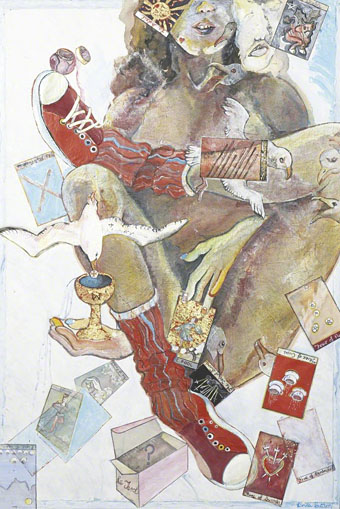
Reading the Tarot at Southend-on-Sea (c.1968) by Linda Sutton.

• “Starship Africa, released in 1980, was a densely textured audio collage emulating the sensation of intergalactic space travel, though it freaked out some in the scene. According to [Adrian] Sherwood, DJ David Rodigan told him: ‘What do you think you’re doing to reggae music?'” David Katz on the return of Creation Rebel.

• Coming soon from Strange Attractor: Subcontinental Synthesis, a history of India’s first electronic music studio, edited by Emptyset’s Paul Purgas. There’s also a related compilation album, The NID Tapes: Electronic Music from India 1969–1972.

• New music: The Lamentations Of Jeremiah by Vince Clarke, and Tidescape by Roger Eno.

But even when it’s a signal, even when it’s a microbe, we’ll likely never know if it’s aliens. Not just because of the vast distances involved or because of the wild possibilities presented by chemistry and biology, but because science seldom works that way. Discoveries almost never arrive as we think they will, as lightning bolt eurekas. They are slow, gradual, communal. Alien life may not be something we ever ‘find’, but instead inch towards, ever closer, like a curve approaching its asymptote. For all our desire to know who’s out there, that may have to be enough.

Jaime Green on the scientific method and the search for extraterrestrial life

• At Public Domain Review: Charles H. Bennett’s Shadows (ca. 1856).

• Steven Heller’s font of the month is JAF Herb.

Make a Spawn of Cthulhu mask.

Theon Cross’s favourite music.

Herb (1980) by Sly And The Revolutionaries With Jah Thomas | Pause In Herbs (1995) by Ken Ishii | Herb Is Burnin’ (2010) by Method Of Defiance

Talking time: Cabaret Voltaire interviews

cabs1.jpg

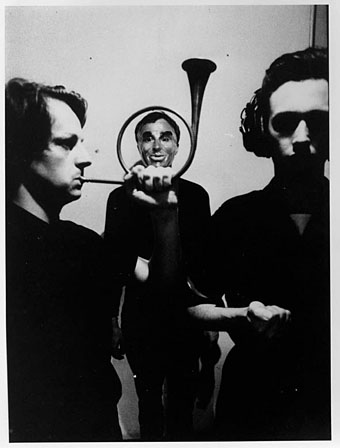
Cabaret Voltaire, circa 1981. Left to right: Richard H. Kirk, Chris Watson, Stephen Mallinder.

…A few brief facts. CV came about from a mutual interest in producing “sound” rather than “music”, a few years ago, making very rare live appearances from time to time. Now an interest has developed in the band, we are playing live more frequently instead of just recording. CV dislike the sick commercialism which pervades most “contemporary music”.

At the moment we are working on a basis which involves two types of performance. A “set” which consists of songs, and a set which is completely improvised, lasting from 20 minutes to “x” number of hours. CV also use films + slides as lighting in live performance. A CV concert is like a bad acid trip; CV want to create total sensory derangement. MIT UND OHNE POLITIK, UNVERNUNFTIGKEIT.

INFLUENCES — “anything which is unacceptable”.

The band’s line up is —
RICHARD – Guitar, Clarinet, Tapes, Vocals.
MAL – Bass, Electronic Percussion, Lead Vocals.
CHRIS – Electronics, Tape, Vocals.

Early band correspondence with a German fanzine

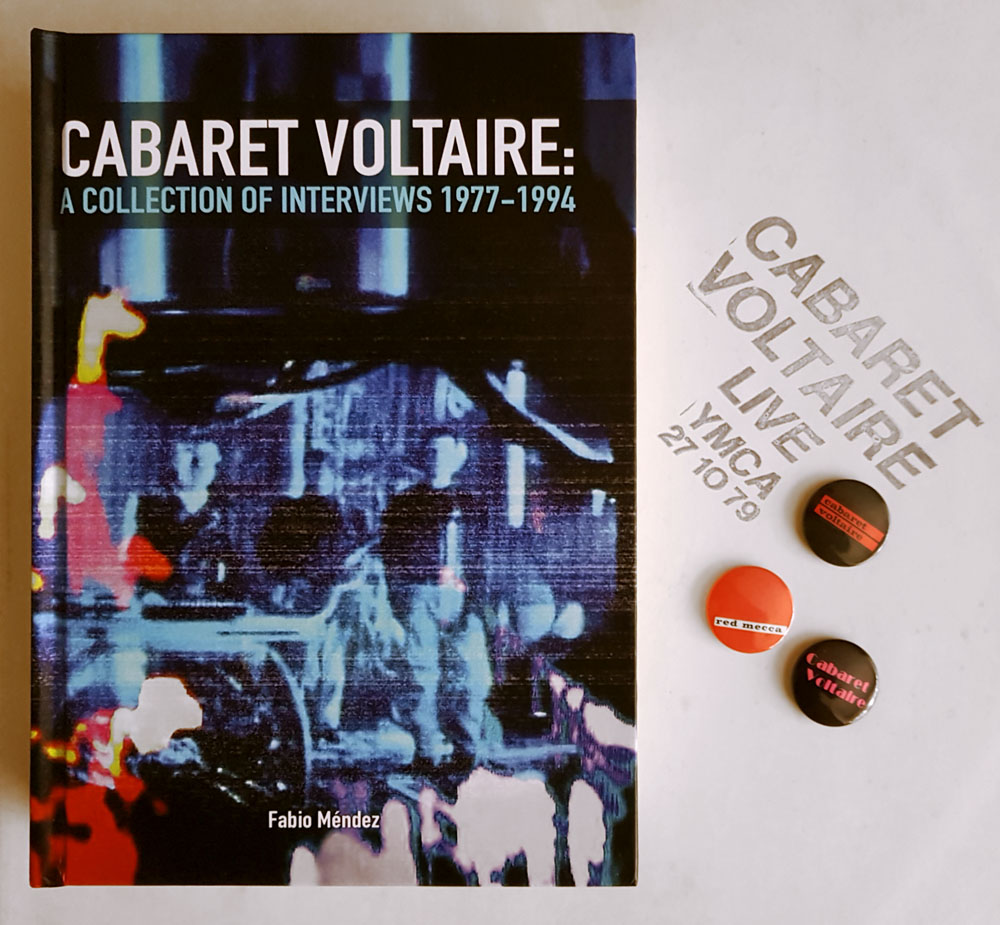
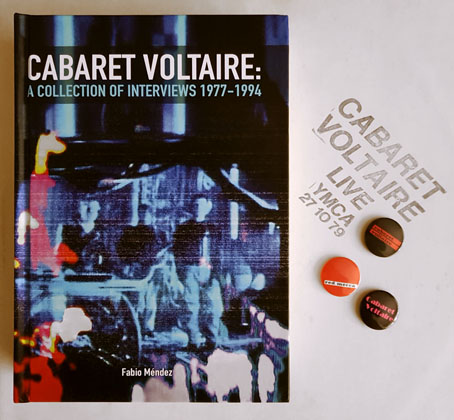
Another week, another book of music talk. Cabaret Voltaire: A Collection of Interviews 1977–1994 was published two years ago but I only just discovered it as a result of my recent cycling through the Cabs’ discography. I’ve never been a great reader of music books yet here I am with three of them devoted to this particular group. Fabio Méndez’s collection joins Cabaret Voltaire: The Art of the Sixth Sense, the first Cabs book from 1984, in which Mick Fish and D. Hallberry interrogate Kirk and Mallinder about their progress to date; and Industrial Evolution, a reprint of the Sixth Sense interviews plus newer ones appended to Fish’s memoir about life in the Cabs’ home town of Sheffield during the 1980s. The Méndez collection is the most substantial of the three, gathering articles from fanzines, magazines and newspapers, and translating into English many pieces from European publications.
cabs2.jpg

Badges not included.

As with Coil, I’ve always liked hearing what Kirk, Mallinder and Watson had to say. There was a fair amount of historical intersection between the two groups, Cabaret Voltaire having been a part of the first wave of Industrial music along with Throbbing Gristle, 23 Skidoo (whose records were produced by TG & CV), Clock DVA and the rest; later on the Cabs were part of the Some Bizzare stable along with Soft Cell, Coil, Einstürzende Neubauten and others. One of the interviews in Méndez’s book is from Stabmental, a short-lived fanzine edited in the early 1980s by a pre-Coil Geoff Rushton/John Balance. The zine ended its run with a cassette compilation, The Men With The Deadly Dreams, which included two exclusive recordings by Chris Watson and Richard Kirk. Watson’s piece, which applies cut-up theory to a radio news broadcast, is a good example of Cabaret Voltaire’s engagements with William Burroughs’ speculations about electronic media. Further examples of cut-up theory may be found in the group’s lyrics and in the video material they created, initially for use as projections while playing live, then later for their music videos which were in the vanguard of the form in the early 1980s.

A lot of the things we do tend to get glossed over. We’ll talk to anyone. We do loads of interviews with fanzines.

Unidentified group member, 1980

582 pages of interviews with a group that never had any kind of popular success is more information than most people would ever want or need. But as with Nick Soulsby’s Coil book, Méndez is doing future historians a service by resurrecting material from scarce and ephemeral sources. The post-punk period from 1978 to 1982 was a uniquely fertile musical moment, especially in Britain. For a few years absolutely anything seemed possible, with much of the wilder activity being logged and discussed in fanzines like Stabmental which usually had a limited circulation (often distributed by mail order) and a print run of a few hundred copies at most. The British music press also covered this scene, of course, but only up to a point, especially when the music was pushing the boundaries of the possible or the commercially acceptable. Méndez’s book emphasises the differences between the music-press approach—where the article is often as much about the writer as the group itself—and the fanzine interview which tends to be a list of questions with a small amount of contextual commentary. Fanzines were a circumscribed medium but they had advantages over the music papers; sincerity, for a start, allied with genuine enthusiasm and fewer of the tics that made reading the music press each week such a chore. The small publications weren’t always free of the bad habits of the weeklies but there was less of the journalistic posturing, the ignorant dismissal of whole areas of music, and the relentless snark and sarcasm which you’ll find thriving today on social media. The drawbacks of the fanzines were mostly about quality; fact-checking was often non-existent. Méndez’s book is littered with footnotes that log the errors present in the transcripts.

Which bands are influential on your music?
Chris: “Can, Neu!, Kraftwerk, Captain Beefheart…especially Can have influenced us.”

Spex magazine interview, 1980

Questions about influence are a common feature of any interview with creative people. Chris Watson’s reply is the first example I’ve seen of the Cabs mentioning so many German groups, as well as Captain Beefheart. A recurrent theme of these interviews concerns the group’s unusual trajectory, a career which evolved through a series of changes in direction that weren’t always predictable. The trio had started out in 1974 as resolute non-musicians and sound-collage provocateurs with Dadaist intentions; the music-making took time to develop. By the late 1970s the group that now called itself Cabaret Voltaire had become a more disturbed and disturbing counterpart to Sheffield’s other electronic music ensemble, The Human League. When Chris Watson departed in 1981 Kirk and Mallinder joined the Some Bizzare roster and followed the League to Virgin Records where a substantial advance helped the pair upgrade their equipment, launch their own independent music and video label, Doublevision, and record some of their best work.

Continue reading “Talking time: Cabaret Voltaire interviews”

Weekend links 622

balbi.jpg

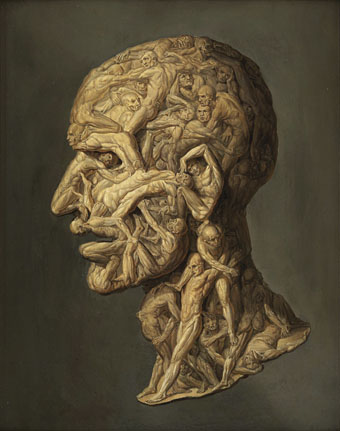
Testa Anatomica (1854) by Filippo Balbi.

The New School of the Anthropocene is “…an experiment. But it is also an act of repair. In partnership with October Gallery in London, we seek to reinstate the intellectual adventure and creative risk that formerly characterised arts education before the university system capitulated to market principles and managerial bureaucracy… (more)”

• “Every once in a while, you come across old music that generates a shock of new excitement.” Geeta Dayal on Oksana Linde whose electronic compositions are being released in a retrospective collection next month.

• More Walerian Borowczyk: Anatomy of the Devil, a collection of Borowczyk’s short stories, newly translated into English by Michael Levy, and with a cover design by the Quay Brothers.

• Washing machines, garden snails, and plastic surgery: A stroll through the Matmos catalogue. Related: “Why scientists are turning molecules into music.”

• Coming soon from Strange Attractor: Boogie Down Predictions, Hip Hop, Time and Afrofuturism, edited by Roy Christopher.

• At Spoon & Tamago: Exploring Japan’s historical landmarks and shrines in the middle of streets.

• New music: Adrian Sherwood Presents: Dub No Frontiers, music by female dub artists.

Winners of the 2022 Milky Way Photographer of the Year.

• A Vision In Many Voices: The art of Leo and Diane Dillon.

Molecular Delusion (1971) by Ramases | DNA Music (Molecular Meditation) (1985) by Riley McLaughlin | Pop Molecule (Molecular Pop 1) (2008) by Stereolab

Weekend links 350

eaton.jpg

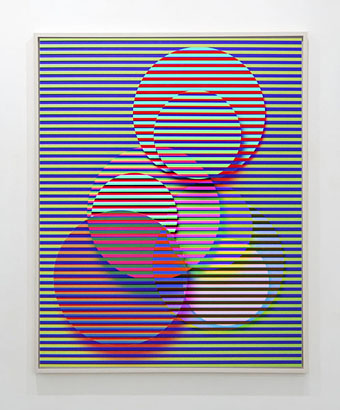
Transition H50 (2016) by Jessica Eaton.

• One of my weekend posts in 2012 contained details about Taking Tiger Mountain, a low-budget feature film put together in 1983 by Tom Huckabee using footage originally shot in Tangier and Wales in the 1970s. Huckabee’s film is a strange “experimental” work of science fiction, based in part on William Burroughs’ Blade Runner script (no relation to the Ridley Scott film apart from the title), and described here as “a psychotropic apocalyptic odyssey”. The most notable aspect of the film for many will be the presence of a young Bill Paxton in the lead role, something I was reminded of when Paxton’s death was announced earlier this week. Five years ago there was only a short clip of Taking Tiger Mountain available on YouTube but since then a full copy has appeared; watch it here while you can. (The widescreen frame is cropped, and the sound is all in one channel but it’s still watchable.) Tom Huckabee talked about the film’s production (and the Burroughs connections) to Beatdom. A curio that deserves wider attention.

• “With Biller, the references come thick and fast. In The Love Witch, she channels, among others, 50s Hitchcock, Douglas Sirk’s lurid lushness, Rainer Werner Fassbinder’s deadpan gaze, Nicholas Ray’s poetry, Sam Fuller’s tabloid style and Todd Haynes’s revisionist sexual politics. […] Then add the Technicolor, widescreen, haute-Hollywood “women’s pictures” of the 50s, a touch of Hammer Studios, The Wicker Man, Rosemary’s Baby and any number of studio melodramas and musicals.” John Patterson talks to director Anna Biller about her new film, The Love Witch.

• Mix of the week is the Anxious Heart Mix by Moon Wiring Club, another excellent blend of electronica, industria and dialogue samples from the outer limits of the televisual sphere. Also of note this week: VF Mix 83, an Adrian Sherwood selection by Pinch, XLR8R Podcast 479 by Chris SSG, and Secret Thirteen Mix 213 by -N.

• “Anthropologically, this was going on all around me: it was amazing and nobody was dealing with it like that, so I just went for it.” Hal Fischer on his photo-art series, Gay Semiotics, which is on display at Project Native Informant, London, until 1st April.

• Coming in May from Luaka Bop, World Spirituality Classics 1: The Ecstatic Music of Alice Coltrane Turiyasangitananda, the first-ever compilation of Alice Coltrane’s scarce releases on the Avatar Book Institute label.

Cinephilia looks back at Robert Wise and Nelson Gidding’s film of The Andromeda Strain (1971).

• Psychedelic Speed Freak: Remembering the blistering experimentalism of Hideo Ikeezumi.

• More witchery: S. Elizabeth talks to Pam Grossman about art, film and hex power.

• At The Quietus: Harry Sword on the strange world of Surgeon.

Leonor Fini playing cards

The Feathered Tiger (1969) by Kaleidoscope | Taking Tiger Mountain (1974) by Brian Eno | Plain Tiger (1985) by Cocteau Twins