Weekend links 845

belbury.jpg

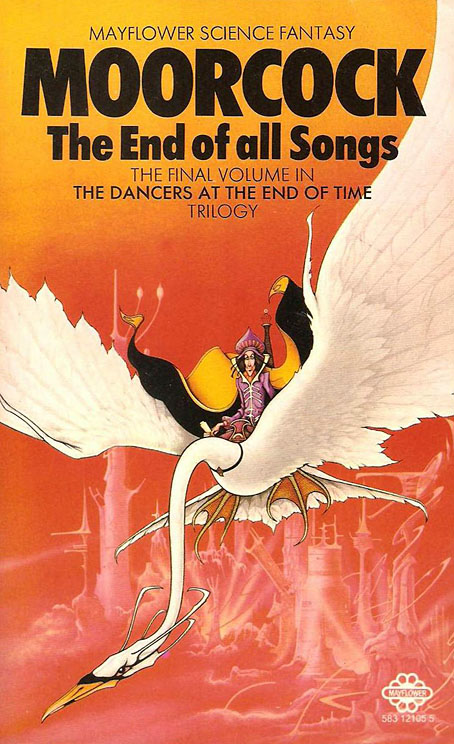
Cover design by Jim Jupp, art by Arik Roper.

• New music: Sorcery by Belbury Poly, or “The Belbury Poly” as the credit on the cover art has it. The description of the forthcoming release says “it grew from [Jim] Jupp’s love of early to mid-80s electronic music and a rediscovery of how that music had soundtracked his childhood love of all things sci-fi and fantasy. It’s moody and melodramatic electronica rendered in bright and evocative 80s sounds.” And concerning the cover art there’s this: “Some may notice the typographical nod to Mayflower Books’ Michael Moorcock novels.” Indeed.

matthews.jpg

Cover art by Rodney Matthews, 1977.

• Among the new titles at Standard Ebooks, the home of free, high-quality, public-domain texts: The Mummy! A Tale of the Twenty-Second Century (1827) by Jane C. Loudon, and The Place Called Dagon (1927) by Herbert S. Gorman.

• More new music: Materia by Julia Holter; Avaeken by Stephen O’Malley; Witchcraft & Black Magic In The United Kingdom by Various Artists.

• The Natural History Museum presents competition photos from Wildlife Photographer of the Year.

• This week I drew a new header design for the Endless Bookshelf website.

• At the BFI: Brogan Morris chooses 10 great films about screenwriters.

• At Dennis Cooper’s it’s Palimpsest Day.

• RIP Tim Curry and Yayoi Kusama.

Sorcery #1 (1974) by Jack DeJohnette | Sorcerer (1977) by Tangerine Dream | Return Of The Sorcerer (2011) by The Wounded Kings

Weekend links 836

narcissus.jpg

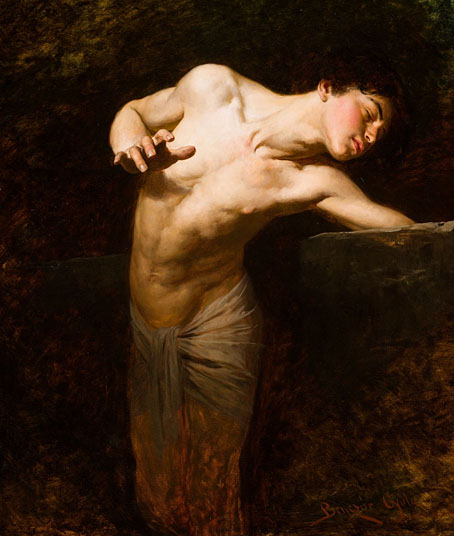
Narcissus (1881) by Gyula Benczúr.

• AnOther reposts an old interview with Dennis Bell of the Bob Mizer Foundation to coincide with an exhibition of homoerotic drawings from Physique Pictorial at JW Anderson Soho, London. The drawings by the pseudonymous (and still unidentified) “Spartacus” don’t bear comparison to those by Mizer’s celebrated discovery, Tom of Finland, but they’re part of a pioneering history. There’s more “Spartacus” at Wallpaper*.

• “Ever the deviant, Bidgood initiated a style that rebelled against the dominant sensibility of his physique-magazine peers, treating his subjects with the same love that a studio-era auteur may have bestowed upon his leading ladies.” Mayukh Sen on the tawdry, opulent world of James Bidgood’s underground classic Pink Narcissus.

• “Düsseldorf. Düsseldorf. Düsseldorf.” Samuel Cox on 50 years of La Düsseldorf by La Düsseldorf.

[Adrian] Sherwood argues that Perry’s antics often mask his genius. “What upset me in later years was people marvelling at him as some kind of joke,” says Sherwood. People saw a clown, when they should have seen someone who re-engineered music. From reimagining the studio as an instrument, pushing dub reggae to the sonic limits or inventing sampling, few producers have come anywhere close to matching Perry’s impact.

Lanre Bakari on the life and musical work of Lee “Scratch” Perry

• New music: Arles 75 Drei by Can; Voyager by PJ Harvey; Fantasy by Julia Holter.

• At the BFI: Adam Nayman chooses 10 great Canadian debut features.

• At Colossal: James Turrell’s 100th Skyscape opens in Aarhus.

• At The Daily Heller: Vector art by Catalina Estrada.

• A belated RIP for writer Sandy Robertson.

Sky – Rhythm (1972) by Dub Specialist | Skyliner (2006) by Boards Of Canada | The Sky Torn Apart (2018) by Paul Schütze

Weekend links 752

nemo.jpg

Captain Nemo by Alphonse de Neuville, from Twenty Thousand Leagues Under the Seas (1875) by Jules Verne.

• “…physical remoteness is a category of its own. It is an enhancer: It can make the glorious better and the terrible worse. The oceanic pole of inaccessibility distills physical remoteness on our planet into a pure and absolute form. […] Point Nemo is nearly impossible to get to and offers nothing when you arrive, not even a place to stand. It is the anti-Everest: It beckons because nothing is there.” Cullen Murphy explores the remotest place on Earth. A long and fascinating read, but no mention of Point Nemo’s dreaming tenant.

• More Bumper Book business: Smoky Man has posted the second part of his analysis of the book for (Quasi) (in Italian) which includes some comments from myself about the origin of the Moon and Serpent Magical Alphabet, and why the letter Q in the alphabet is assigned to Cthulhu. Elsewhere, Panini have announced an Italian edition of the Bumper Book for May next year, while at The Beat Steve Baxi reviewed the book from a philosophical perspective.

• At the BFI: David Parkinson on where to begin with Louis Feuillade. I’d suggest starting with Fantômas rather than Les Vampires but then I’m biased.

The combination of magic(k)al, ceremonial action, vivid colour and paradoxically serious camp in Jarman’s Super 8 films of the ’70s bears the influence of Kenneth Anger, but the differences between Jarman’s sensibility and Anger’s are more striking than the resemblances. Jarman’s vision is more materialist, austere and hermetic, and less sociological; where Anger identifies the glamour of American popular culture with the Will of the Crowleyan magician, Jarman situates the discovery of the cinematographic mechanism imaginatively within the history of alchemy. Anger cast rock stars as gods and adepts with the intention of harnessing the energy of their recognition; Jarman casts Fire Island, then in its heyday as a gay resort, as a desert defined by sculptural details and occupied by a single masked figure, in scenes that both recall his landscape paintings of the ’60s and ’70s and anticipate the design of his garden at Dungeness.

Luke Aspell on Derek Jarman’s hermetic film/painting, In the Shadow of the Sun

• At Smithsonian Magazine: “Visions of nuclear-powered cars captivated Cold War America, but the technology never really worked”.

• At The Spectator podcast: host Sam Leith talks to Michael Moorcock about 60 years of New Worlds magazine.

• At Public Domain Review: “Light from the Darkness” — Paul Nash’s Genesis (1924).

• At Bandcamp: “Disco godfather Cerrone’s enduring influence on dance music”.

• At Unquiet Things: The Art of Survival: Eyeball Fodder in Dark Times.

• Mix of the week: DreamScenes – November 2024 at Ambientblog.

• New music: The Laugh Is In The Eyes by Julia Holter.

• At The Daily Heller: The College of Collage.

• RIP jazz drummer Roy Haynes.

Thermonuclear Sweat (1980) by Defunkt | Nuclear Drive (1982) by Hawkwind | Nuclear Substation (2005) by The Advisory Circle


Weekend links 717

smith.jpg

Bookplate of Charles P. Searle (1904) by Sidney Lawton Smith.

• “If Minute 9 is the first time we hear the names Deckard and Blade Runner, it’s also the first time we meet the plainclothes cop who will play a key role in LAPD surveillance of Deckard—and in the changed emphasis of four subsequent versions of Blade Runner released over the next twenty-five years.” Des Barry in the latest Minute 9 installment at 3:AM Magazine, in which a writer analyses the ninth minute of a favourite film.

• “I’ve really started to respect the journalists who are documenting what artists are doing… There’s so much reliance on social media for artists to express themselves, but maybe some don’t want to express themselves on social media all the time. Maybe they’d rather talk to a professional journalist who could parse through it for them. It can be more interesting that way.” Julia Holter talking to Skye Butchard about music-making.

• “I didn’t use any instruments that had been manufactured after 1980, but vintage analogue gear to sound like the tracks that they’re trying to evoke.” Matt Berry discussing his enthusiasm for library music, and his new album of the same for the KPM label.

• Mixes of the week: Monument Waves 002 at A Strangely Isolated Place, and DreamScenes – March 2024 at Ambientblog.

• At Public Domain Review: The Art of Sutherland Macdonald, Victorian England’s “Michelangelo of Tattooing” (ca. 1905).

• At Colossal: Unearthly characters populate Spencer Hansen’s salvaged universe.

• At Bandcamp: A Guide to Can by George Grella.

• Galerie Dennis Cooper presents…Amir Zaki.

• New music: Shoures Soote by Cerfilic.

Queens Of The Circulating Library (2000) by Coil | Library Of Solomon Book 1 (2011) by Demdike Stare | The Equestrian Library (2013) by Broadcast

Weekend links 713

hishida.jpg

Black Cat (1910) by Shunso Hishida.

• “A duck goes quack quack in English but coin coin in French. In Spanish a dog goes guau-guau, not woof woof, while in Arabic it goes haw haw, and in Mandarin wang-wang. In Japanese cats go nyaa, and bees—having no access to the zz sound—go boon-boon.” Caspar Henderson asks “Could onomatopoeia be the origin of language?”

• Coming soon from MIT Press: Blotter: The Untold Story of an Acid Medium by Erik Davis; “the first comprehensive written account of the history, art, and design of LSD blotter paper, the iconic drug delivery device that will perhaps forever be linked to underground psychedelic culture and contemporary street art.”

• At Aquarium Drunkard: The late Damo Suzuki is remembered with a recording of Can playing at the Volkshalle Wagtzenborn-Steinberg, Giessen, October 22, 1971.

• At Unquiet Things: Another collection of Intermittent Eyeball Fodder. I was sorry to hear from that post that artist Dan Hillier had died recently. RIP.

• At Bandcamp Daily: Mouse On Mars discuss 30 years of dynamic electronic music.

• Old music: Rare Soundtracks & Lost Tapes (1973–1984) by Alain Goraguer.

• At Spoon & Tamago: The imaginary architectures of Minoru Nomata.

• Mix of the week: DreamScenes – February 2024 at Ambientblog.

• At Vinyl Factory: Julia Holter on some of her favourite records.

• At Public Domain Review: Wanda Gág’s Millions of Cats (1928).

• Steven Heller’s Font of the Month is Cuatro.

A brief history of London’s gas lamps.

• New music: Pithovirii by Aidan Baker.

Black Cat Bone (2000) by Laika | Black Cat (2005) by Broadcast | Black Cat (2008) by Ladytron