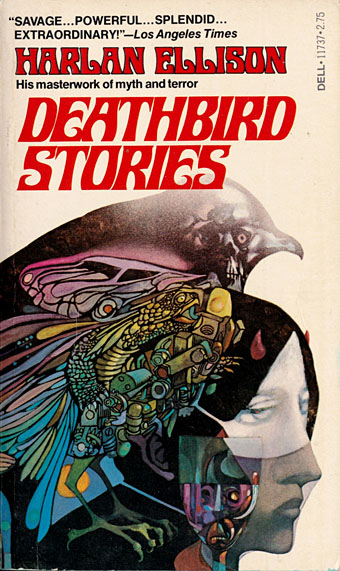
Icarus Descending

tmwfte02.jpg

UK, 2009.

Newton leaned forward, putting his elbows carefully on the table. “Nathan. Nathan. I was afraid of you then. I am afraid now. I have been afraid of all manner of things every moment I have spent on this planet, on this monstrous, beautiful, terrifying planet with all its strange creatures and its abundant water, and all of its human people. I am afraid now. I will be afraid to die here.”

Before my recent rewatch of The Man Who Fell to Earth I decided to read the novel in order to spice up yet another viewing by comparing the film with its source. And as is often the case when reading books of a certain vintage, curiosity had me wondering how the book has been cover-designed over the years.

The Man Who Fell to Earth was published in 1963. Prior to this Walter Tevis had only published one other book, The Hustler, his first novel about pool-player “Fast Eddie” Felson. Such a debut wouldn’t have marked Tevis as a putative writer of science fiction although he had written a handful of stories for SF magazines before attempting anything at novel length. The Man Who Fell to Earth is artistically satisfying science fiction, and a good novel in a literary sense, something you can’t always expect from those writers of Tevis’s generation who seemed to read nothing but technical reports and fiction by other SF writers.

The story opens in 1985, presenting a future which isn’t too different to the 1985 that many of us lived through. Speculation is minor and mostly relegated to the background, with occasional mentions of monorails, food shortages and warring African nations who threaten each other with nuclear weapons. Into this world there arrives the alien who calls himself Thomas Jerome Newton (we never learn his original name), a clandestine emissary from the dying planet his people know as Anthea. Newton has been sent to Earth with plans to build a financial empire using his advanced technical knowledge. This will, he hopes, enable him to build a craft in order to ferry the remaining Antheans to a world where they can survive. Once they’re secure, the Antheans also plan to rescue the inhabitants of Earth from imminent nuclear destruction.
tmwfte22.jpg

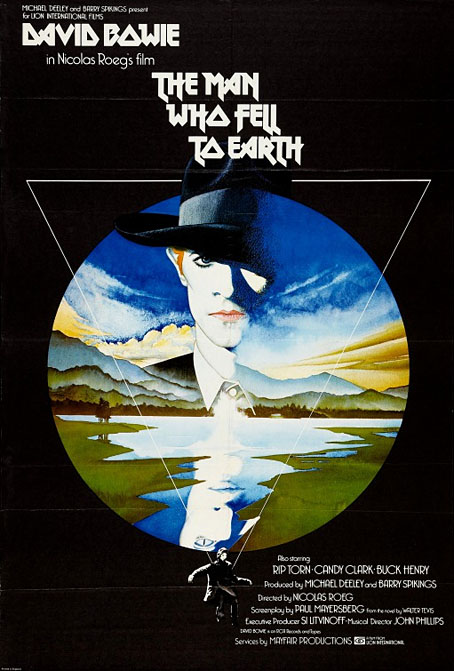
The US one-sheet of Vic Fair’s poster. After decades of illustrators and designers working with both the book and the film, Fair’s poster is still the most successful condensation of the story into a single, memorable image.

If you’ve seen the film then the broad strokes are all very familiar. Nicolas Roeg’s direction and Paul Mayersberg’s script treat the material elliptically but the film stays closer to the novel than you might expect, with Mayersberg even reusing some of Tevis’s dialogue. Both novel and film are very much concerned with portraying the Earth itself as an alien planet. For the first half of the novel, “1985: Icarus Descending”, we see our world through Newton’s eyes while he makes his way among the clever but dangerous primates. The second half, “1988: Rumpelstiltskin”, concentrates equally on Newton’s attempts to retain his sanity in a world that must never discover his real intentions or his true nature; and on the curiosity of Nathan Bryce, the chemist helping to construct Newton’s spacecraft, whose suspicions about his employer are eventually confirmed. Bryce believes that Anthea must be the planet Mars, but when asked about this directly Newton simply replies “Does it matter?”

Roeg and Mayersberg’s film received mixed reviews in 1976 but its cult status has grown thanks to its connection with David Bowie’s person and career. Bowie’s Newton has become a dominant motif for book covers even though Tevis’s Newton is a negative inversion of the screen alien, being six-and-a-half feet tall, with tanned skin and pure white hair. For art directors and illustrators the challenge since 1976 has been to present the novel in a manner which does more than merely repeat the imagery of the film. Not everyone succeeds in doing so.
tmwfte12.jpg

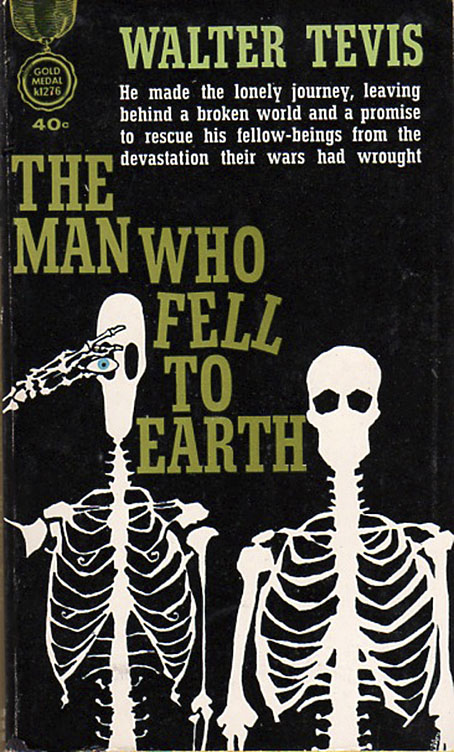
USA, 1963. Cover art by Leo and Diane Dillon.

The first printing was as a paperback original with untypical cover art by Leo & Diane Dillon. Without reading the novel it’s hard to tell what this is about at first glance, but the figure on the left is supposed to represent Newton’s unusual lightweight skeleton whose height and shape are contrasted with its human counterpart. The eye presumably refers to the contact lenses that Newton wears to disguise his cat-like pupils.
tmwfte07.jpg

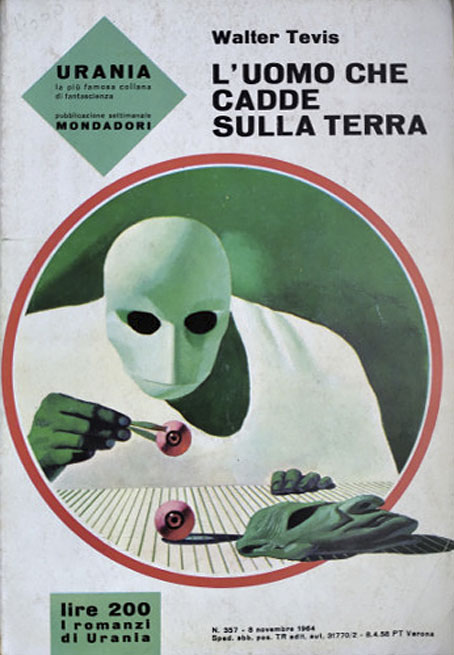
Italy, 1964. Cover art by Karel Thole.

The few covers that pre-date the film are what you might call the innocent ones, free of David Bowie’s face or Bowie-like figures. Here the prolific Karel Thole also favours Newton’s diguises over any other imagery.
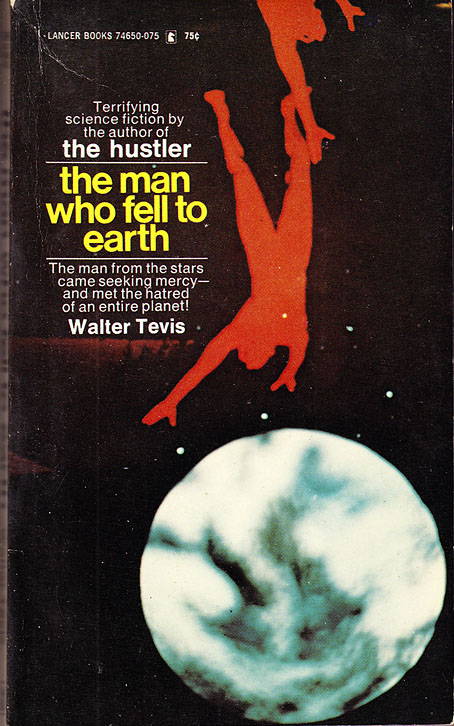
tmwfte03.jpg

USA, 1970. Cover art by Howard Winters.
Continue reading “Icarus Descending”

McCallum reads Lovecraft

mccallum1.jpg

Art by Leo and Diane Dillon.

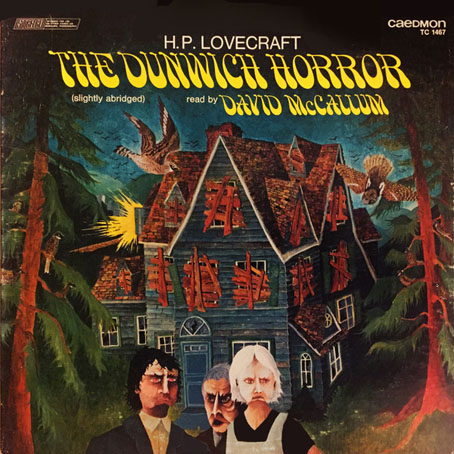
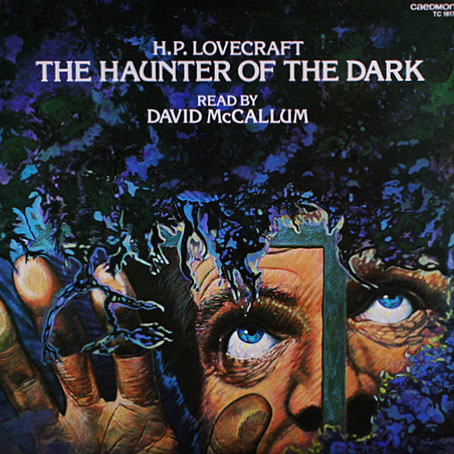
RIP David McCallum, who I prefer to remember for his role as one half of the weirdest-TV-duo-ever, Sapphire and Steel. McCallum was a minor sex symbol in the 1960s, thanks to The Man from U.N.C.L.E., a celebrity that led to his conducting a series of instrumental pop albums. I’ve never heard any of these but they have their champions. They were followed in the 1970s by a number of readings for the Caedmon label which included three albums of HP Lovecraft stories. The Dunwich Horror is one I’ve referred to in the past since I used to own a knackered copy. As a reading it’s pretty good, slightly edited but with the novelty of allowing you to hear McCallum recite the famous “As a foulness shall ye know them” passage from the Necronomicon. These commissions no doubt came about simply because McCallum was available but his Lovecraft recordings gain a deeper resonance in the light of his later exploits with Joanna Lumley in the haunted corridors of Time. Some of the malign forces that Sapphire and Steel face aren’t so distant from Lovecraft’s interdimensional “Old Ones”, unfathomable entities seeking ingress to the material universe.

mccallum2.jpg

Cover art uncredited.

All of the McCallum Lovecraft albums are now on YouTube so the curious may listen to the recordings without searching for rare (and expensive) vinyl:

The Rats in the Walls (1973)
The Dunwich Horror (1976)
The Haunter of the Dark (1979)

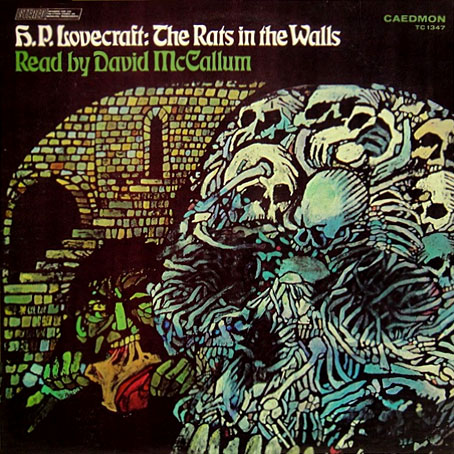
The reading of The Rats in the Walls doesn’t edit Lovecraft’s xenophobia so anyone unwilling to hear a racial epithet used as a name for a pet cat should avoid that particular recording. The first album, which included a sleeve note from August Derleth, is also the only one of the three that was reissued. I wonder whether The Dunwich Horror might have fared better if it didn’t have such appallingly amateurish cover art. A shame the Dillons weren’t able to illustrate that one as well.

mccallum3.jpg

Art by Les Katz.

Elsewhere on { feuilleton }
The Lovecraft archive

Previously on { feuilleton }
Haunted Corridors: The Temporal Enigmas of Sapphire and Steel

The Dillons at Caedmon

dillons18.jpg

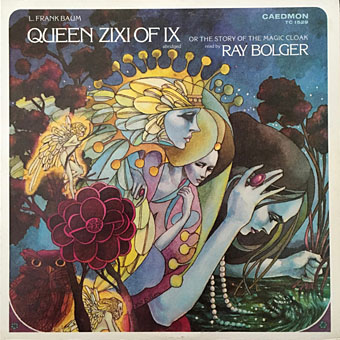
L. Frank Baum: Queen Zixi Of Ix (Or The Story Of The Magic Cloak) Read By Ray Bolger (1977).

There’s a lot you could write about illustrators Leo and Diane Dillon. They were very prolific for a start, creating many book covers and interior illustrations in a variety of styles and different media. They also maintained a long-running association with Harlan Ellison whose praise for the pair was never less than fulsome. Like Bob Pepper and other versatile illustrators, they created art for album covers as well as books, with regular commissions from Caedmon Records, a label that specialises in spoken-word recordings.

dillons12.jpg

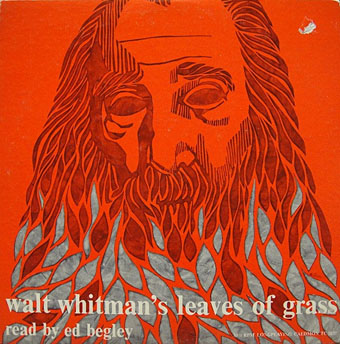
Walt Whitman’s Leaves Of Grass Read By Ed Begley (1959).

During the time the Dillons were working for Caedmon most of the label’s releases were on vinyl, a format that tended to restrict the readings to poetry, short stories or extracts from novels and plays. The format was limited for writers and listeners but beneficial for book illustrators, giving them a larger canvas to work on. These examples are a small selection of the Dillons’ output, more of which may be seen at Discogs. Not everything on Caedmon looked this good. I used to own the David McCallum reading of The Dunwich Horror, an album whose cover art was so amateurish it might have been drawn by Wilbur Whateley himself. The Dillons’ cover for The Rats in the Walls is much better, with a gnawing figure that resembles the woodcut-style illustrations the pair created for Harlan Ellison’s Dangerous Visions anthologies. I’ve never read anything about the Dillons’ techniques so can’t say whether their woodcut style was a product of actual wood engraving rather than linocut, a more convenient medium. I’d guess the latter since the end results look pretty much the same, but if anyone knows the answer then please leave a comment.

dillons01.jpg

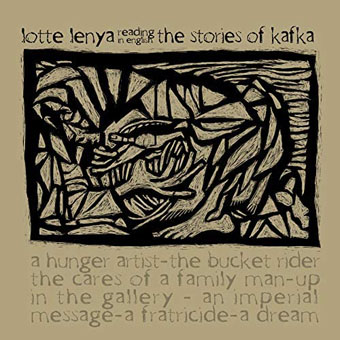
The Stories Of Kafka Read By Lotte Lenya (1962).

dillons07.jpg

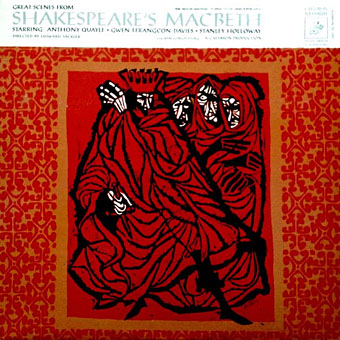
Great Scenes From Shakespeare’s Macbeth: Anthony Quayle, Gwen Ffrangcon-Davies, Stanley Holloway (1962).

dillons06.jpg

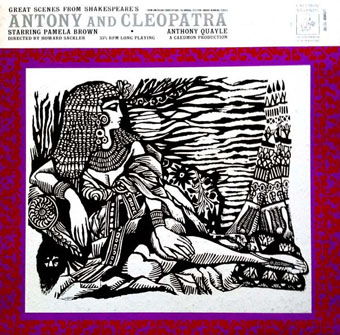
Great Scenes From Shakespeare’s Antony And Cleopatra: Pamela Brown And Anthony Quayle (1963).

Continue reading “The Dillons at Caedmon”

Weekend links 622

balbi.jpg

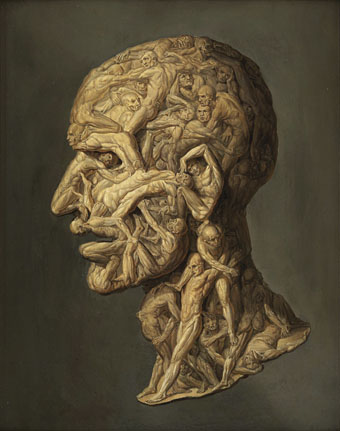
Testa Anatomica (1854) by Filippo Balbi.

The New School of the Anthropocene is “…an experiment. But it is also an act of repair. In partnership with October Gallery in London, we seek to reinstate the intellectual adventure and creative risk that formerly characterised arts education before the university system capitulated to market principles and managerial bureaucracy… (more)”

• “Every once in a while, you come across old music that generates a shock of new excitement.” Geeta Dayal on Oksana Linde whose electronic compositions are being released in a retrospective collection next month.

• More Walerian Borowczyk: Anatomy of the Devil, a collection of Borowczyk’s short stories, newly translated into English by Michael Levy, and with a cover design by the Quay Brothers.

• Washing machines, garden snails, and plastic surgery: A stroll through the Matmos catalogue. Related: “Why scientists are turning molecules into music.”

• Coming soon from Strange Attractor: Boogie Down Predictions, Hip Hop, Time and Afrofuturism, edited by Roy Christopher.

• At Spoon & Tamago: Exploring Japan’s historical landmarks and shrines in the middle of streets.

• New music: Adrian Sherwood Presents: Dub No Frontiers, music by female dub artists.

Winners of the 2022 Milky Way Photographer of the Year.

• A Vision In Many Voices: The art of Leo and Diane Dillon.

Molecular Delusion (1971) by Ramases | DNA Music (Molecular Meditation) (1985) by Riley McLaughlin | Pop Molecule (Molecular Pop 1) (2008) by Stereolab

Weekend links 419

ellison.jpg

Cover art by Leo & Diane Dillon, 1975.

Art is not supposed to be easier! There are a lot of things in life that are supposed to be easier. Ridding the world of heart attacks, making the roads smoother, making old people more comfortable in the winter, but not Art. Art should always be tough. Art should demand something of you. Art should involve foot-pounds of energy being expended. It’s not supposed to be easier, and those who want it easier should not be artists. They should be out selling public relations copy.

Typical of the late Harlan Ellison to describe his vocation in terms of difficulty and struggle even when his prolific output made writing seem effortless. When my colleagues at Savoy Books published a Savoy issue of New Worlds magazine in 1979 one of the features they ran was an introduction by Michael Moorcock to an Ellison story collection. (They also published two books of Ellison’s around this time.) A copy of the magazine was duly sent to the subject of the essay since Ellison always liked to keep track of his print appearances. The back page of that particular issue is blank but for a few words in bold type from singer PJ Proby: “I am an artist; and should be exempt from shit.” Ellison cut this slogan from the magazine then glued it to his typewriter, no doubt transferring it to later models since it was still visible in the 2008 Ellison documentary, Dreams With Sharp Teeth.

My first encounter with Ellison’s work was also my first encounter with what became labelled the new wave of science fiction, via a reprint of I Have No Mouth, and I Must Scream in a book in the school library. I was only about 12 or 13 at the time, and found Ellison’s story so shocking and disturbing that it overpowered everything else in the collection. The only other story that made an equivalent impression at the time was The Colour Out of Space by HP Lovecraft, so it’s perhaps fitting that Ellison gave my work a favourable mention in his introduction to the huge Centipede Press collection of Lovecraft artwork, A Lovecraft Retrospective: Artists Inspired by HP Lovecraft. I still haven’t got over that one. After the initial encounter, the Ellison-edited Dangerous Visions and Again, Dangerous Visions were just as important for me as the paperback reprints of stories from the Moorcock-edited New Worlds: a handful of books that showed science fiction to be a literary form of limitless possibilities, as opposed to the stereotype of space adventure and future technology. The Ellison and Moorcock anthologies led me to William Burroughs, James Joyce and all points beyond; they also soured for me the preoccupation with space adventure and future technology which persists today.

My final connection with Ellison replayed his compliment in a small way, when editor Jill Roberts and I took extra care with the typesetting of Jeffty is Five for The Very Best of Fantasy & Science Fiction, Volume 2. Ellison was the only author I’ve encountered in the digital age whose corrections were still handwritten comments on printed sheets; these had to be faxed to San Francisco then scanned and emailed to me (to this day I still don’t know why the oft-reprinted story required so many adjustments). It was awkward but amusingly so, a benign taste of a legendary bloody-mindedness and insistence on precision.

• “Laughing about an acid trip with members of Can and opening up about some of the ‘scars’ left from his association with Brian Eno and David Byrne’s My Life In the Bush of Ghosts, [Jon] Hassell is candid in a way that comes naturally to those who’ve lived life on their own terms.”

• Drone Metal Mysticism: Erik Davis talks with music scholar and ethnographer Owen Coggins about amplifier worship, sonic pilgrimage, “as if” listening, metal humour, and his new book Mysticism, Ritual and Religion in Drone Metal.

Psychedelic Prophets: The Letters of Aldous Huxley and Humphry Osmond; “Letters between the men who coined the term ‘psychedelic’ and opened doors to a different way of thinking about human consciousness.”

Artaud 1937 Apocalypse: Letters from Ireland by Antonin Artaud; translated and edited by Stephen Barber.

• “I thought female sexuality was an OK thing?” says writer and porn performer, Stoya.

• “How did a major label manage to lose a John Coltrane record?” asks Ted Gioia.

• Welcome to the dollhouse: Alex Denney on a century of cinematic cutaways.

• The trailer for Mandy, a new (and much-awaited) film by Panos Cosmatos.

• Rest in Anger, Harlan Ellison (1934–2018) by Nick Mamatas.

• Mix of the week: FACT Mix 659 by BD1982.

Emily Gosling on library music design.

Record Label Logos

The Deathbird Song (1997) by The Forbidden Dimension | Eidolons (2017) by Deathbird Stories | Deathbird (2017) by Tempos De Morte