Icarus Descending

tmwfte02.jpg

UK, 2009.

Newton leaned forward, putting his elbows carefully on the table. “Nathan. Nathan. I was afraid of you then. I am afraid now. I have been afraid of all manner of things every moment I have spent on this planet, on this monstrous, beautiful, terrifying planet with all its strange creatures and its abundant water, and all of its human people. I am afraid now. I will be afraid to die here.”

Before my recent rewatch of The Man Who Fell to Earth I decided to read the novel in order to spice up yet another viewing by comparing the film with its source. And as is often the case when reading books of a certain vintage, curiosity had me wondering how the book has been cover-designed over the years.

The Man Who Fell to Earth was published in 1963. Prior to this Walter Tevis had only published one other book, The Hustler, his first novel about pool-player “Fast Eddie” Felson. Such a debut wouldn’t have marked Tevis as a putative writer of science fiction although he had written a handful of stories for SF magazines before attempting anything at novel length. The Man Who Fell to Earth is artistically satisfying science fiction, and a good novel in a literary sense, something you can’t always expect from those writers of Tevis’s generation who seemed to read nothing but technical reports and fiction by other SF writers.

The story opens in 1985, presenting a future which isn’t too different to the 1985 that many of us lived through. Speculation is minor and mostly relegated to the background, with occasional mentions of monorails, food shortages and warring African nations who threaten each other with nuclear weapons. Into this world there arrives the alien who calls himself Thomas Jerome Newton (we never learn his original name), a clandestine emissary from the dying planet his people know as Anthea. Newton has been sent to Earth with plans to build a financial empire using his advanced technical knowledge. This will, he hopes, enable him to build a craft in order to ferry the remaining Antheans to a world where they can survive. Once they’re secure, the Antheans also plan to rescue the inhabitants of Earth from imminent nuclear destruction.
tmwfte22.jpg

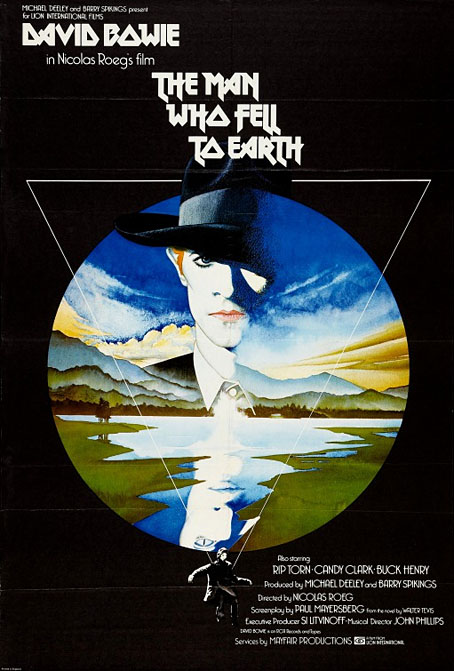
The US one-sheet of Vic Fair’s poster. After decades of illustrators and designers working with both the book and the film, Fair’s poster is still the most successful condensation of the story into a single, memorable image.

If you’ve seen the film then the broad strokes are all very familiar. Nicolas Roeg’s direction and Paul Mayersberg’s script treat the material elliptically but the film stays closer to the novel than you might expect, with Mayersberg even reusing some of Tevis’s dialogue. Both novel and film are very much concerned with portraying the Earth itself as an alien planet. For the first half of the novel, “1985: Icarus Descending”, we see our world through Newton’s eyes while he makes his way among the clever but dangerous primates. The second half, “1988: Rumpelstiltskin”, concentrates equally on Newton’s attempts to retain his sanity in a world that must never discover his real intentions or his true nature; and on the curiosity of Nathan Bryce, the chemist helping to construct Newton’s spacecraft, whose suspicions about his employer are eventually confirmed. Bryce believes that Anthea must be the planet Mars, but when asked about this directly Newton simply replies “Does it matter?”

Roeg and Mayersberg’s film received mixed reviews in 1976 but its cult status has grown thanks to its connection with David Bowie’s person and career. Bowie’s Newton has become a dominant motif for book covers even though Tevis’s Newton is a negative inversion of the screen alien, being six-and-a-half feet tall, with tanned skin and pure white hair. For art directors and illustrators the challenge since 1976 has been to present the novel in a manner which does more than merely repeat the imagery of the film. Not everyone succeeds in doing so.
tmwfte12.jpg

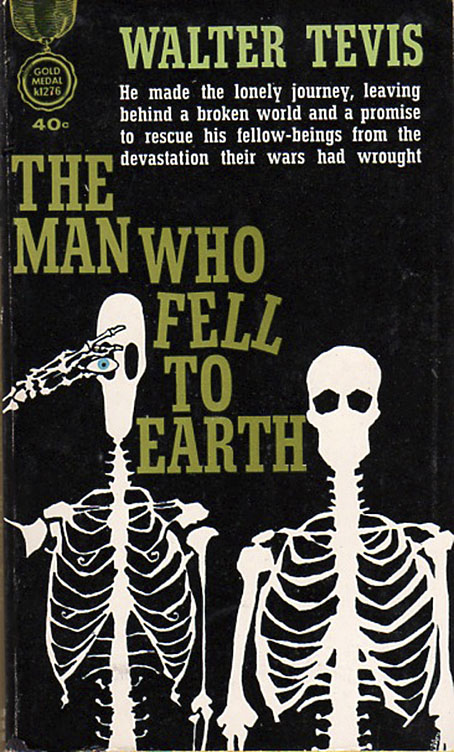
USA, 1963. Cover art by Leo and Diane Dillon.

The first printing was as a paperback original with untypical cover art by Leo & Diane Dillon. Without reading the novel it’s hard to tell what this is about at first glance, but the figure on the left is supposed to represent Newton’s unusual lightweight skeleton whose height and shape are contrasted with its human counterpart. The eye presumably refers to the contact lenses that Newton wears to disguise his cat-like pupils.
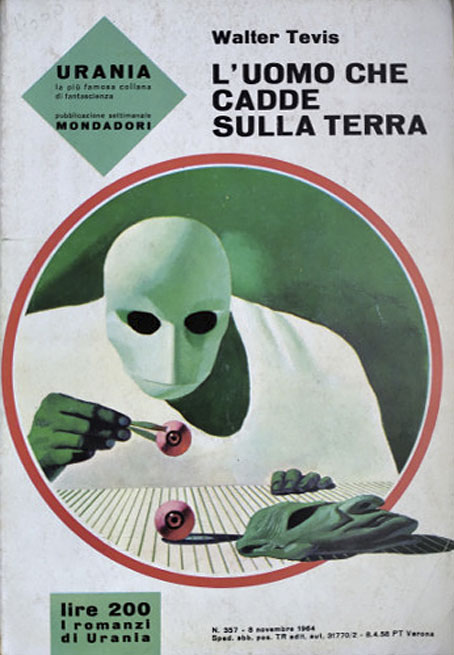
tmwfte07.jpg

Italy, 1964. Cover art by Karel Thole.

The few covers that pre-date the film are what you might call the innocent ones, free of David Bowie’s face or Bowie-like figures. Here the prolific Karel Thole also favours Newton’s diguises over any other imagery.
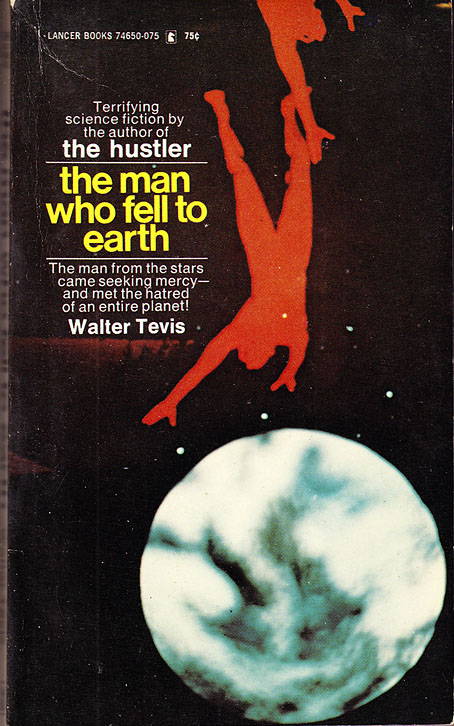
tmwfte03.jpg

USA, 1970. Cover art by Howard Winters.
Continue reading “Icarus Descending”

Biblio-hauntology

hauntology.jpg

An invented book cover from the latest post at blissblog. Since I like fakes of this nature, especially when they’re carefully done, I had to go in search of the creator. Rachel Laine is the person responsible, and there’s more along these lines at her Flickr pages, together with many similar items from the universe next door. (I know someone who’ll appreciate all those faded magazine covers combining soft-porn photos with headlines for stories about analogue synths.) Another of the book covers is a guide to “Witches and Witch Craft”, a title whose real-life counterparts included books such as the Hamlyn guide to witchcraft and black magic from 1971. As I’m often saying, the 1970s was the witchiest decade of the 20th century.

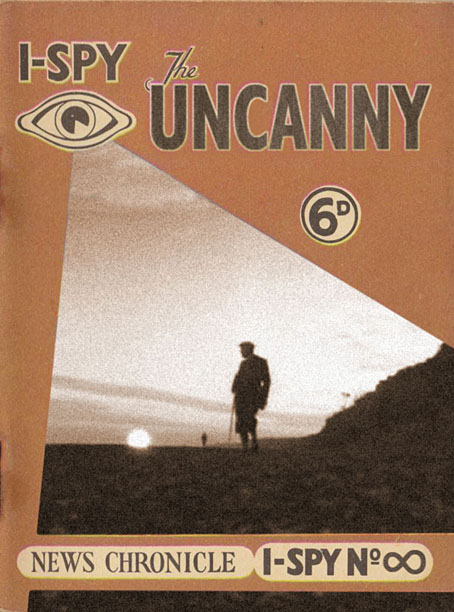
uncanny.jpg

All of which reminded me of a couple of recent inventions of my own. One of the advantages of writing here is that I can retrieve from obscurity some of the things I’d previously cast into the Malebolge formerly known as Twitter. This impromptu creation is something I threw together after Callum J posted the cover of an old I-Spy book dedicated to “The Unusual”. (If you don’t know what the I-Spy books were—and still are—Wikipedia has the history.) The screen-grab from Whistle and I’ll Come to You is a lazy choice but I wanted to surprise Callum by reworking his cover as quickly as possible.

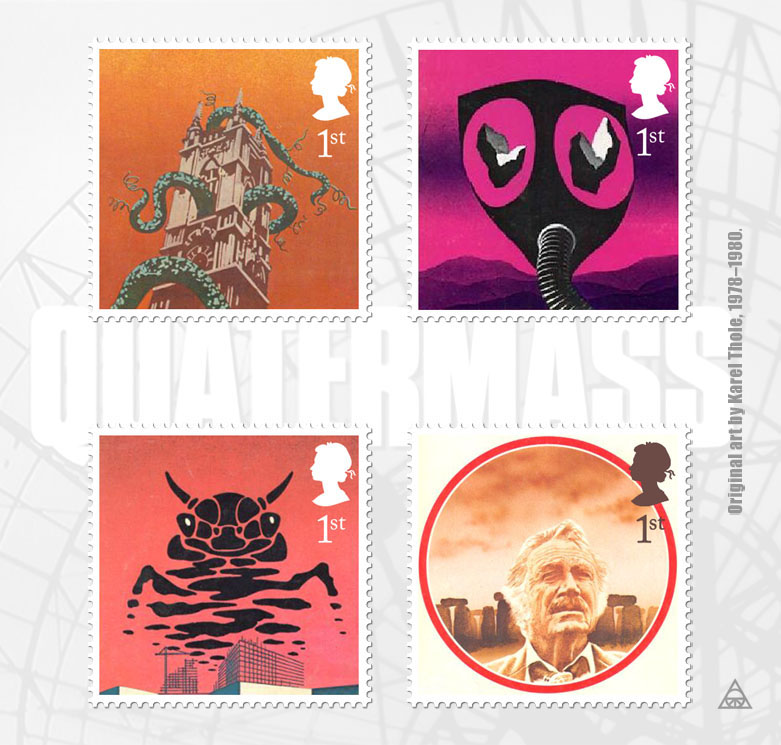
quatermass-stamps.jpg

A little more considered is this proposal for a set of British postage stamps dedicated to Nigel Kneale and his works. This one came about after a comment from Kim Newman that such a thing was overdue from the Royal Mail. Since I agreed I thought I could at least fake them into existence. They’re still a little incomplete—actual stamps would have a mention of Kneale on each one—but they look plausible. The artwork was swiped from a series of Quatermass book covers created by the prolific Karel Thole for Mondadori in the late 1970s. The images for the first Quatermass and Quatermass and the Pit work very well, I think, the fourth one less so. If I was doing these myself I’d try some combination of a radio telescope and a stone circle. Windows into another world; in the universe next door Quatermass is bigger than Star Wars. But we live here, not there.

Previously on { feuilleton }
Disciples of the Scorpion
Ghost Box and The Infinity Box
Llewellyn occult magazine and book catalogue, 1971
Typefaces of the occult revival
The Book of the Lost
Books Borges never wrote
Forbidden volumes

Picturing Vermilion Sands

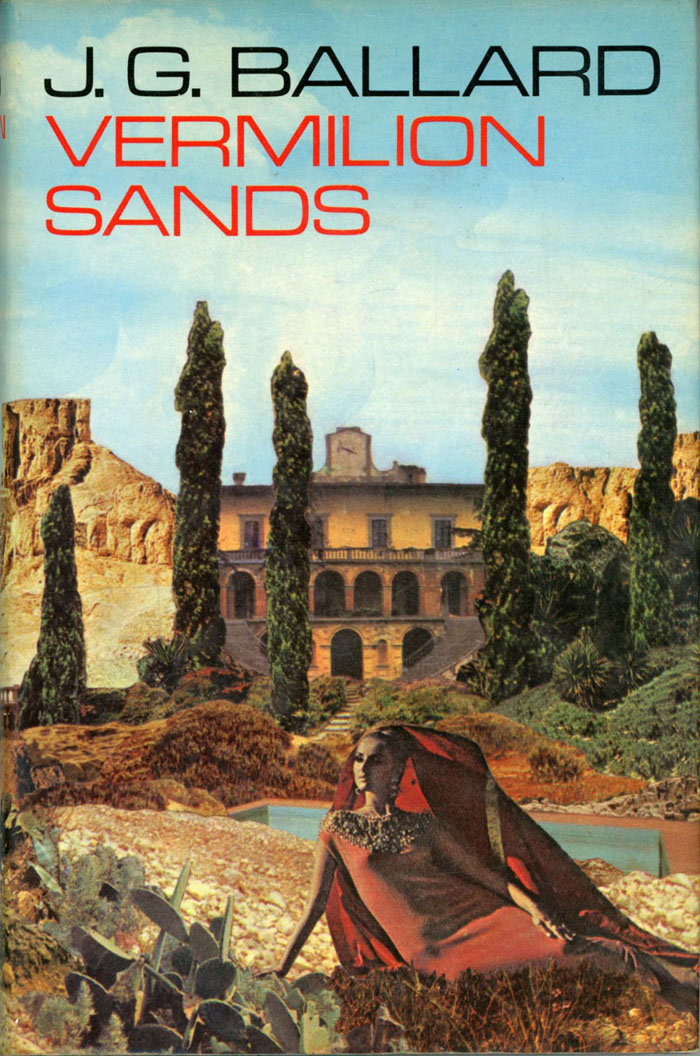
knight2.jpg

First UK edition, 1971. Art by Brian Knight.

Vermilion Sands (1971) is a story collection by JG Ballard which maintains a cult reputation despite being overshadowed by its author’s more popular novels. Most of the stories were written in the 1960s—a couple of them are among Ballard’s earliest works—but where many of his other short stories can read like the work of a writer with bills to pay, the tales of Vermilion Sands are much closer to Ballard’s core interests, filled with symbolic resonance and literary allusion.

Vermilion Sands, the place, is a near-future resort with a desert climate and an unspecified location; a region where the Côte d’Azur meets Southern California but the ocean is a sea of sand. While each story has a different artistic or cultural theme, all are populated by the idle midde-class types found in the rest of Ballard’s work. Ballard more receptive to visual art than many authors, especially the SF writers of his generation for whom art was less interesting than science and technology. There is science and technology in these stories—some of the latter is now inevitably dated—but it doesn’t dominate the proceedings. The stories derive less from scientific speculation than from Ballard’s desire to create a future he would have been happy to inhabit himself, an alternative to the grim dystopias which proliferate in science fiction. The background furnishings also reflect the author’s ideal, owing much to the Surrealist landscapes of Salvador Dalí and Max Ernst, a pair of artists whose works are often referenced in Ballard’s fiction. Given all of this you’d expect that cover artists might have risen to the challenge more than they have. What follows is a look at the most notable attempts to depict Vermilion Sands or its population, only a few of which are covers for the book itself.

Continue reading “Picturing Vermilion Sands”

The art of Karel Thole, 1914–2000

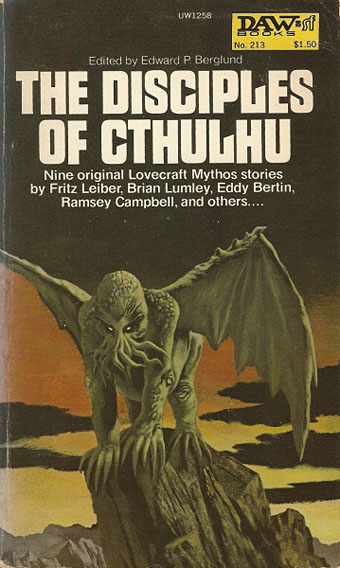
thole4.jpg

The Disciples of Cthulhu (1976).

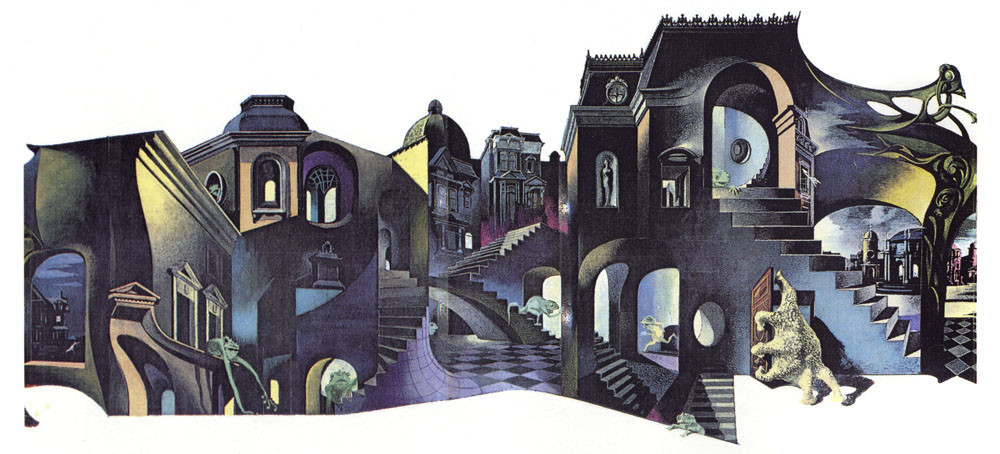
A disagreement I have with the burgeoning world of Lovecraft art is the relentless focus on monsters—and I say this in a week when I’ve been working on a new commission of exactly this: six pictures of Lovecraftian creatures. Lovecraft famously emphasised atmosphere as the paramount ingredient in a weird story, and atmosphere in his fiction is often generated by his descriptions of landscape and architecture; Angela Carter’s insightful essay in the George Hay Necronomicon (1978) was entitled Lovecraft and Landscape. Architecture often receives considerable attention in the stories: The Call of Cthulhu, The Dreams in the Witch House, The Haunter of the Dark, and At the Mountains of Madness all concern invented (or reimagined) architectural settings. Given this, you’d expect architecture to be more represented in Lovecraft art but this is seldom the case. When it comes to Cthulhu, a creature whose myriad representations must be reaching some kind of critical mass, artists will lavish great attention on tentacles, claws and flourished wings but the Cyclopean stones of R’lyeh are invariably reduced to a tentative backdrop.

thole1.jpg

I mostri all’angolo della strada (The Monsters on the Street Corner, 1966).

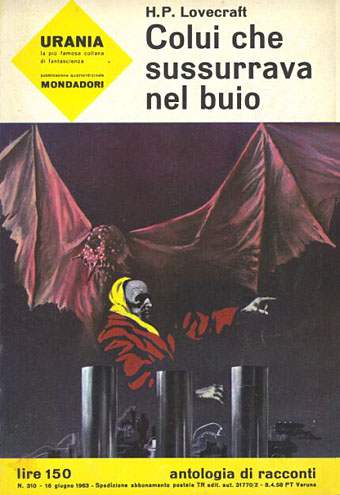
Hence the attraction of the wraparound cover by Karel Thole for I mostri all’angolo della strada, a Lovecraft story collection with one of the few cover designs I’ve seen that attempts to communicate anything of the writer’s preoccupations with angled space. Thole was a very prolific Dutch artist, producing many covers for Italian publisher Mondadori, and painting covers for Mondadori’s SF magazine, Urania, for over 20 years. The first paintings of Cthulhu I saw were those by Thole (above) and Bruce Pennington in Franz Rottensteiner’s The Fantasy Book (1978); Thole’s monster doesn’t have the required scale (and Pennington’s cover is a favourite) but for me it still carries a Proustian charge. The art for I mostri all’angolo della strada was featured in The Cosmical Horror of HP Lovecraft (1991), one of the first attempts to anthologise Lovecraft-related illustration past and present. The book contains many excellent reprints together with dubious material from European comics. Thole’s street scene—a curious combination of Escher, De Chirico and Art Nouveau—stood out among page after page of slavering abominations. I’d like to see more art that follows this direction; less of the monsters, more of the monstrous architecture.

thole2.jpg

Colui che sussurrava nel buio (The Whisperer in Darkness, 1963).

Continue reading “The art of Karel Thole, 1914–2000”