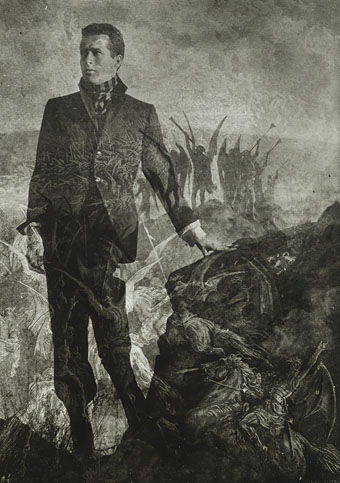
Writing about Steven Arnold last week I was wondering whether Arnold and Kenneth Anger had ever crossed paths. Anger moved to San Francisco in 1966 in order to channel the counter-cultural ferment into the film that would eventually become Lucifer Rising. I’m sure he must have been aware of Arnold’s midnight movie shows but if so there’s no mention of Arnold in the Bill Landis Anger biography.

When Anger died two years ago I posted links to some of the better online material related to the film-maker and his works. One of these was a German TV profile, Kenneth Anger–Magier des Untergrundfilms, a 53-minute documentary made in 1970 by Reinold E. Thiel for German TV channel WDR. The post included my complaint about the only copy of the film being blighted by an obtrusive graphic fixed to the footage by the person who uploaded it to YouTube a decade ago. The copy was further spoiled by burned-in subtitles but I felt sure that a better version would turn up eventually, and here we are with Kenneth Anger: Film als magisches Ritual, the same film under a different title, and free of obtrusive graphics. (There’s still that “WDR” in the corner but they paid for the damned thing so their proprietorial logo is at least justified.)

As a guide to Anger’s cinema, Thiel’s film only skates over the surface, with Anger being interviewed in piecemeal fashion, and explaining his work and magical philosophy to the camera. He doesn’t seem very happy in any of these sequences but WDR had paid to help with his own film so he was obliged to co-operate. We’re fortunate that they did. Thiel’s film is most valuable for having been made when Anger was shooting new scenes for Lucifer Rising in London. As far as I’m aware, this is the only documentary that shows Anger at work on any of the Magick Lantern films. The discussion of his career includes a mention of Rabbit’s Moon, the lost footage of which had been discovered in Paris but not yet pieced together into its finished form. The shots we see here are more rarities, being raw footage, untinted and unedited. The same goes for some of the shots from Lucifer Rising which include brief moments that didn’t make it to the final cut.

Anger had moved to London following his aborted attempts to make Lucifer Rising in San Francisco, a period which saw his first choice for the role of Lucifer remove himself from the production by means of suicide. His second choice, Bobby Beausoleil, fell out with Anger and stole most of the existing footage before being imprisoned for life as a result of his involvement with the Manson murders. The London phase of the film’s production was much more fruitful. In addition to the WDR funds and assistance from the Rolling Stones’ photographer, Michael Cooper, Anger was given a small grant by the BFI which helped pay for the sequences filmed in Germany and Egypt. Thiel’s footage shows Anger and assistants filming shots of the basement ritual with Aleister Crowley’s magic circle painted on the floor. Anger’s third Lucifer, Leslie Huggins, left the film before it was finished but we get to see him in several sequences, including shots of him wearing his “Lucifer” jacket. Thiel inadvertently clears up one minor mystery by revealing that the white-haired, ermine-robed Francis Cyril Rose is saying “Haven’t I seen you somewhere before?” to Huggins’ Lucifer during the ritual. In the finished Lucifer Rising we see Rose’s lips moving but the only words you ever hear in Anger’s films are the lyrics in the songs he uses.

Leslie Huggins doesn’t say a word either, even when Anger is directing his actions during the later sequences shot among the standing stones of Avebury, the same stones that would summon Derek Jarman to their circle a year later. Avebury’s megaliths have cultivated a great deal of mystery and legend but their aura is dispersed a little when you can hear an endless procession of motor traffic going by in the background. Anger shoots the stones from a low angle to make them seem more impressive, and also keep a flock of curious sheep out of the frame. Another minor mystery in Lucifer Rising was the shot of Huggins standing by the stones while making conjuring gestures towards a very stormy sky. Was the dark sky a special effect like some of the other shots in the film? Thiel reveals it to be a genuine Wiltshire thunderstorm which Anger hurries to photograph. The inhabitants of Avebury village were no doubt used to the sight of film crews gathered around the stones—a few years later the village became the location for an entire TV series—but even they must have been surprised by the sight of two film crews arriving simultaneously, with one of them filming the other. Thiel ends on a self-reflexive note, with a shot from Anger’s camera showing the camera filming him.
Previously on { feuilleton }
• Kenneth Anger, 1927–2023
• Anger Magick Lantern Cycle, 1966
• Don’t Smoke That Cigarette by Kenneth Anger
• Kenneth Anger’s Maldoror
• Donald Cammell and Kenneth Anger, 1972
• My Surfing Lucifer by Kenneth Anger
• Inauguration of the Pleasure Dome: The Eldorado Edition
• Brush of Baphomet by Kenneth Anger
• Anger Sees Red
• Kenneth Anger’s Hollywood Babylon
• Lucifer Rising posters
• Missoni by Kenneth Anger
• Anger in London
• Arabesque for Kenneth Anger by Marie Menken
• Edmund Teske
• Kenneth Anger on DVD again
• Mouse Heaven by Kenneth Anger
• The Man We Want to Hang by Kenneth Anger
• Relighting the Magick Lantern
• Kenneth Anger on DVD…finally