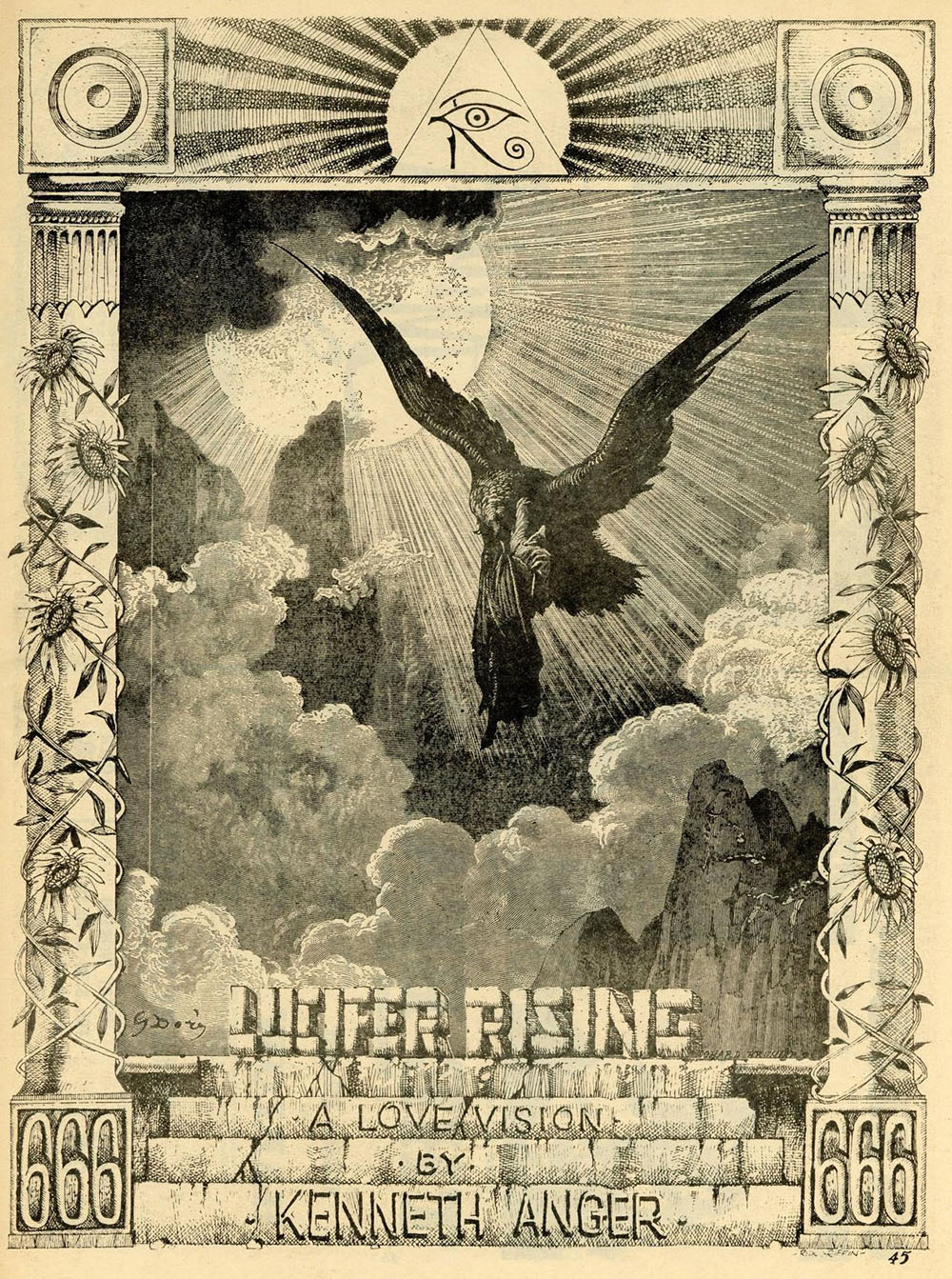
Art by Rick Griffin with Gustave Doré. San Francisco Oracle, Vol. 1 No. 7, February 1967.
In his later years Kenneth Anger often seemed to spend more time giving interviews than making films, even though he was keeping busy when out of the public eye. Most of the discussions cover familiar ground, recycling anecdotes about the creation of the Magick Lantern Cycle, and the people who contributed to the films. More interesting—and harder to find—are interviews from the time when Anger was still at work on his magnum opus, which is why this radio interview from 1967 is a very welcome discovery:
John Cott, host of the Coconut Grove show on KPFA, and co-hosts Tom Luddy and Juris Svendsen interview Kenneth Anger about his latest film, Lucifer Rising. At the time of the interview, Anger had not yet begun shooting Lucifer Rising; he discusses his vision for the film as a sequel to Scorpio Rising, talks about the film’s magick symbolism. The hosts play a tape of Anger performing an invocation for the film. He is joined in the studio by Gary (?), who is introduced as the star of the film, and Joy (no last name given), who plays music in the background throughout the interview and performs a song from the film. They are also briefly joined by author and critic Susan Sontag, who discusses her love of Anger’s films.
KPFA is a listener-funded radio station serving the San Francisco Bay area which is still active today. The interview, which is really more of a round-table discussion, took place in July 1967, when the “Summer of Love” was in full swing. Susan Sontag’s presence surprised me, I’ve never seen her mention Anger’s films anywhere yet here she is, declaring him to be the greatest living American director. She’s only there for a third of the discussion but during this time Juris Svendsen tries to isolate what it is that makes her regard Anger’s films so highly. Later on the conversation turns to the youthful demographic referred to as “the Love Generation”, a cohort who the participants all discuss as something separate from themselves. Kenneth Anger was 40 in 1967 yet he talks sympathetically about the youth of the day, seeing the hippies as catching up with many of the impulses that drove avant-gardists like himself in the 1950s: the growing interest in occultism, the disregard for the demands of “straight” society, and all forms of psychotropic exploration. When the discussion turns to Lucifer Rising, Anger emphasises the subtitle that appears on the film’s promotional poster by Rick Griffin: “A Love Vision”. It’s tempting to read this as opportunism, especially when the subtitle was missing from the film that was eventually released in 1980, but Anger regarded the original Lucifer Rising as an answer to the “Death Vision” of Scorpio Rising. Here, as elsewhere, he emphasises the positive aspects of Lucifer, the Bringer of Light, while love was an important component of the Thelemic philosophy which Anger followed: “Love is the law, love under will.”
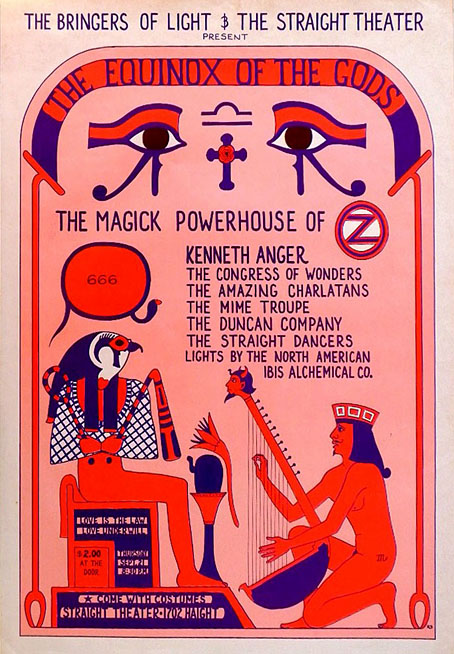
Art by Randy Salas.
Anger sounds relatively positive himself in the radio discussion but the rambling, unofficial biography by Bill Landis describes a not-so-love-filled atmosphere at the Russian Embassy in San Francisco where Bobby Beausoleil was supposed to be playing the part of Lucifer. I tend to be wary of the Landis account, he certainly did his research but isn’t always accurate, and some of the people he talked to (Anger wasn’t among them) would have been pushing their own agendas. A few months after the KPFA interview Anger and Beausoleil staged an occult ceremony/theatrical happening/musical concert at San Francisco’s Straight Theater. I used to think that the name of Beausoleil’s band, The Magickal Powerhouse of Oz, was a reference to Aleister Crowley’s Liber OZ (aka Liber LXXVII), a one-page distillation of the Law of Thelema which Anger happens to read out towards the end of the KPFA discussion. The band used the Crowlean spelling of Magick in their name but the Oz is merely a reference to the books by L. Frank Baum.
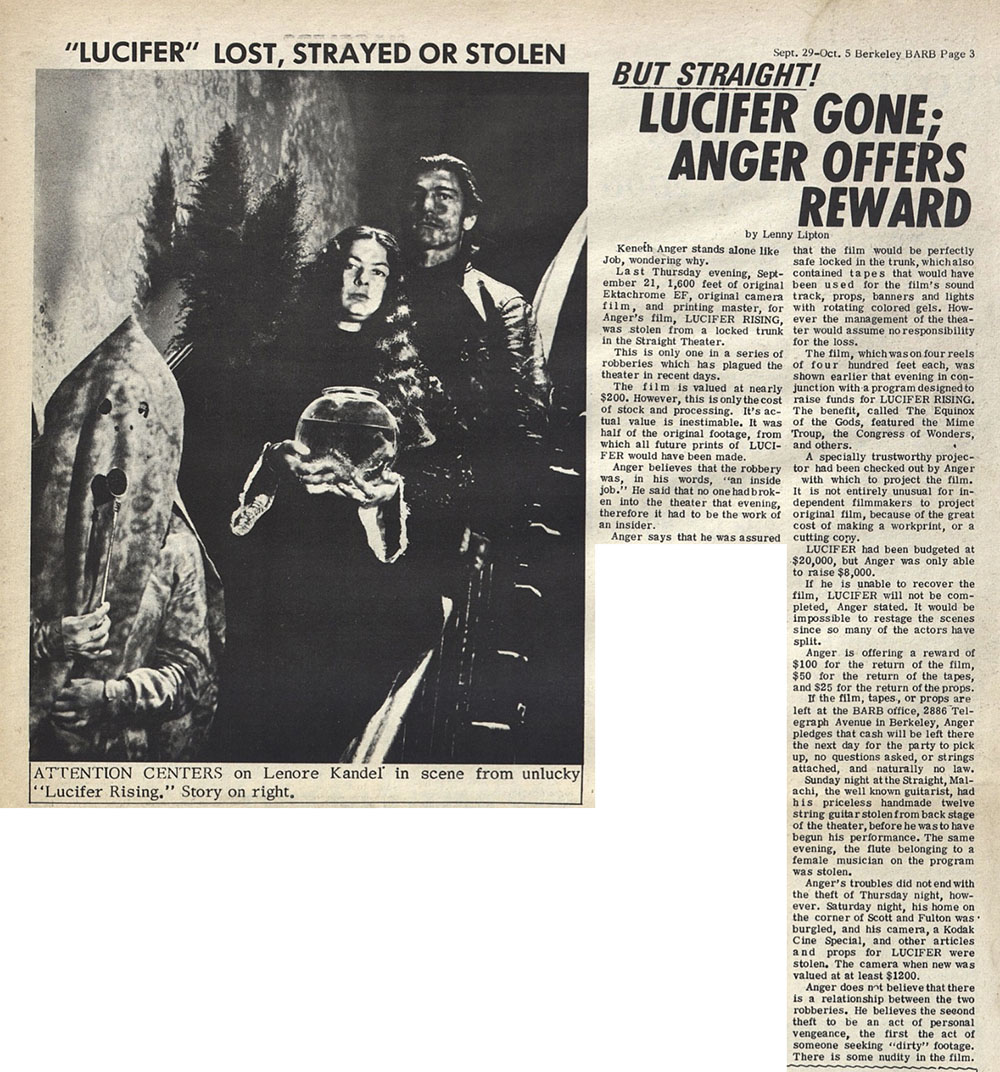
Berkeley Barb, Volume 5, Issue 12, Sept. 29–Oct. 5, 1967.
Fragments of the Equinox of the Gods performance may be the ones that appear in Invocation of My Demon Brother (Landis isn’t clear) but we do know that Anger’s 1969 film is made up of leftover footage from the original Lucifer Rising. The reporting here is confused by conflicting claims: Anger said that most of the original Lucifer footage was stolen from a car after the Straight Theater show; Beausoleil said that it was mainly equipment that was stolen since Anger hadn’t shot much film in the first place. Whatever the truth of the matter, the theft was reported as a news story in The Berkeley Barb at the end of September, something I was pleased to find while researching all of the above. I doubt that Anger would have gone to the press over a trivial loss but this is all rather academic now. Needless to say, whoever the thieves were they didn’t return Anger’s film which he why he spent the next decade remaking Lucifer Rising from scratch. Before he took off for London, however, he posted an ad in the Village Voice melodramatically announcing the end of his film-making career. I’ve always felt the thieves helped Anger rather than hindered him, even though he obviously wouldn’t have agreed at the time. The loss of the footage forced him to create a shorter film that wouldn’t otherwise have existed, one in which the “Death Vision” of Scorpio Rising is filtered through the hippy era to channel the growing negativity at the end of the decade: Vietnam, the Manson murders (in which Bobby Beausoleil was implicated), and Altamont (in which Mick Jagger was implicated), where the relatively harmless bikers of Scorpio Rising have been replaced by Hells Angels.
Previously on { feuilleton }
• Kenneth Anger: Film als magisches Ritual
• Kenneth Anger, 1927–2023
• Anger Magick Lantern Cycle, 1966
• Don’t Smoke That Cigarette by Kenneth Anger
• Kenneth Anger’s Maldoror
• Donald Cammell and Kenneth Anger, 1972
• My Surfing Lucifer by Kenneth Anger
• Inauguration of the Pleasure Dome: The Eldorado Edition
• Brush of Baphomet by Kenneth Anger
• Anger Sees Red
• Kenneth Anger’s Hollywood Babylon
• Lucifer Rising posters
• Missoni by Kenneth Anger
• Anger in London
• Arabesque for Kenneth Anger by Marie Menken
• Edmund Teske
• Kenneth Anger on DVD again
• Mouse Heaven by Kenneth Anger
• The Man We Want to Hang by Kenneth Anger
• Relighting the Magick Lantern
• Kenneth Anger on DVD…finally
John, I was a kid in the 70s and a huge Led Zeppelin fan. My musical tastes have changed somewhat over the years but I heard all the stories. So, since you brought up Lucifer Rising, let me ask, what’s the story about the semi-mythic lost Jimmy Page soundtrack?
Anger seems to have denied Page ever produced anything. Page claimed he delivered the work and Anger simply nutted up on him. Years later I heard music that was supposedly reworked and used on another Page soundtrack for a completely forgettable movie called Deathwish II. Truthfully it sounded like Page’s live bowed guitar and echoplex freakouts.
So, what’s the story? Have you heard it if it exits?
ps: I was always disappointed in Page’s post-Zep career. I guess I always expected him to chuck the impossible to follow-up blues band concept and come up with some weirdo off the deep end project given his well known proclivities. Seemed like Lucifer might have offered a template for such experiments.
The story with the Page soundtrack is that he recorded the music but there wasn’t even of it for Anger’s purposes. The film Anger was making in the 70s was intended to be about 40 minutes in length since he’d been filming in England, Germany and Egypt. Page only recorded about 20 minutes of music so it wouldn’t have been enough even for the final cut of the film which is about 30 minutes.
This is another thing I think worked out for the best. Page is still connected with the film since he appears in it very briefly, but the music by Bobby Beausoleil and his friends in prison is much better than Page’s soundtrack which has since been reissued officially and in bootleg form. Beausoleil had much more to prove than Page so he did a good job with the music, which also sounds more psychedelic (for want of a better term) than Page’s does.
As for Page’s solo career, I think he’s one of those musicians who needs good collaborators. He started out as a session player then got lucky with Led Zeppelin who had that magical syergy that some groups have. But that kind of thing is usually impossible to repeat. You see this all the time with musical groups. After they split the individual members spend a lot of time trying to find something new to do that works as well as before. The most successful ones (artistically) are usually those with strong individual characters to begin with. I’d guess that Page isn’t really that kind of person.
Page’s music for Lucifer Rising is on his “Sound Tracks” set:
https://shop.jimmypage.com/products/551728-sound-tracks-cd-box-set
I’m a Zep fan but I wasn’t particularly impressed by it.
Funny to read this now, as I came across that radio interview a few weeks ago, too, when I was trying to research *another* interview Anger gave to the KPFA station (in 1974), and which is online as a transcript here: https://julydogs.wordpress.com/2016/09/19/interviews-with-filmmakers-kenneth-anger-1974/ – a very interesting piece, as it starts with a passage in which Anger talks about Lovecraft and his Mythos, which, to my knowledge is quite unique… I had thought about contacting you, as your feuilleton blog certainly is a premier address at the intersection of all things Lovecraft and Anger, to find out if you knew further paths of research in that direction, and now this radio interview comes up here – quite a synchronicity! If you are interested in an exchange on that subject, I would be very happy to hear from you!
Hi Hagen. Many thanks for the interview link, that’s the first time I’ve seen Anger mention Lovecraft anywhere. Not too surprising that he’d know of him being an American–I was much more surprised to discover that Jean Cocteau was an enthusiast–but good to know all the same. Kenneth Grant had published The Magical Revival a couple of years before the interview in which he has a page comparing the names of Lovecraftian entities with references from Crowley’s texts. Since Grant and Anger were both connected to the OTO I’d expect Anger to have seen the book even if he didn’t read it.