
Arthur Machen isn’t usually considered to be a Decadent author even though it was in the Mauve Decade of the 1890s that he first established himself as a writer. Machen knew Oscar Wilde well enough to recount an anecdote in later life, and two of Machen’s earliest books were published with covers designed by Aubrey Beardsley. But Machen outlived Wilde and Beardsley and all the other writers and artists who expired prematurely around the turn of the century, while Machen’s 20th-century stories are now so enmeshed with the evolution of weird fiction that the world of the weird has claimed him as one of its own.
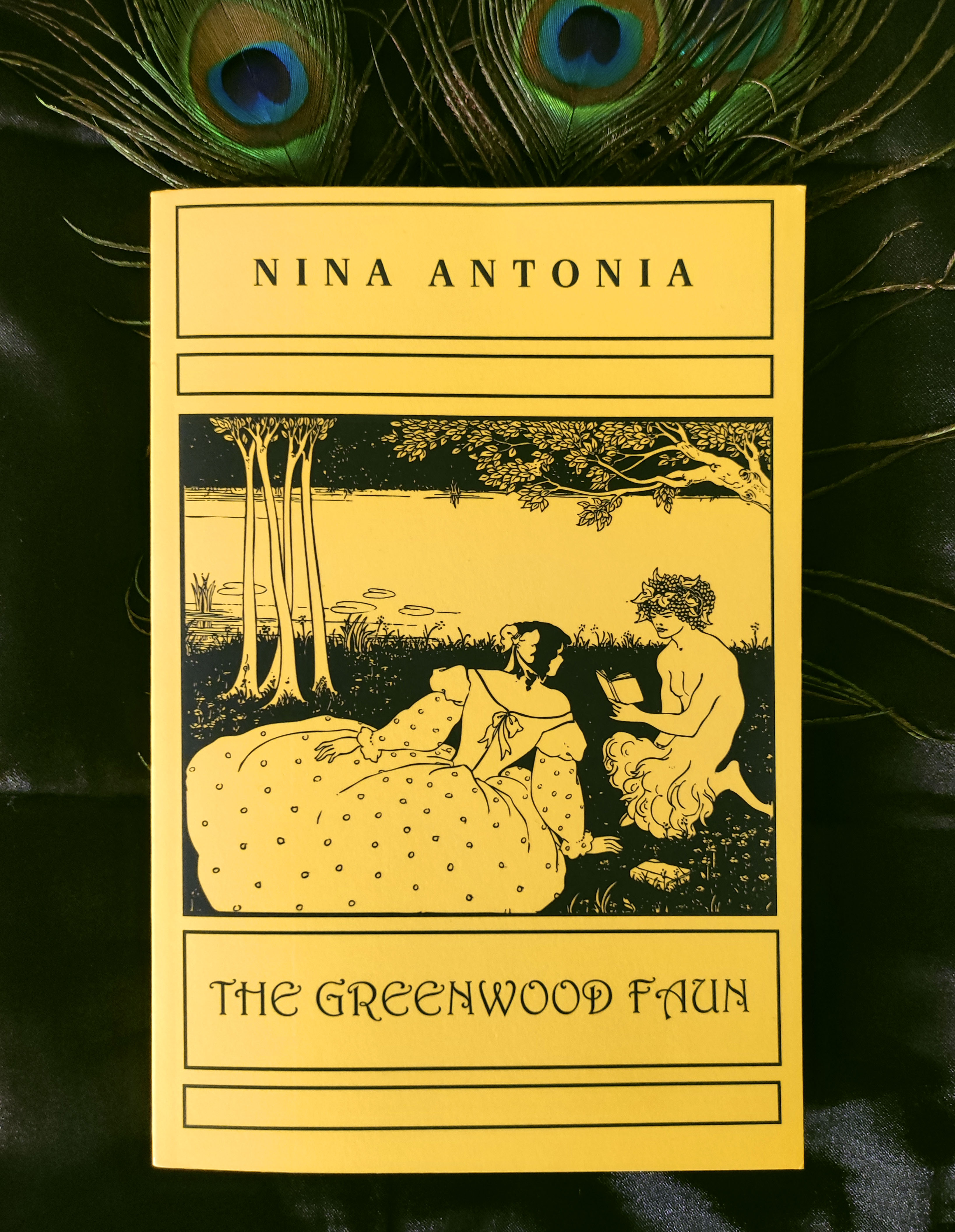
The Greenwood Faun is a novel by Nina Antonia which plays with both these phases of Arthur Machen’s career. This is a ghost story to some degree, in which the shade of Decadent poet Lionel Johnson wanders the streets of London in various stages of corporeality, as well as a tale of the dysfunctional Hartington Leacock-Jones family whose entanglements with a mysterious book—The Greenwood Faun by Lucian Taylor—comprise the main substance of the novel. Machen aficionados will recognise Lucian Taylor as being the central character of Machen’s semi-autobiographical The Hill of Dreams, a detail which makes Antonia’s story a novel about a novel from a novel.
It’s never entirely clear how the world of The Greenwood Faun manages to have Arthur Machen in it as the author of a novel called The Hill of Dreams while also containing the central character from that novel whose death has occurred before the story begins. The important element is Lucian Taylor’s unpublished book, discovered in manuscript form then printed in a limited edition (books like these are always limited editions) with faun-embossed boards and pages that exude a sylvan fragrance. Jorge Luis Borges would have enjoyed the intertextuality—he enjoyed inventing books, and also enjoyed Arthur Machen’s writing—which is paralleled to a small degree by Alan Moore’s The Great When in which we find another book from a Machen story—A London Walk by the Reverend Thomas Hampole—manifesting in the real world. (This isn’t to suggest any influence; Antonia’s book was first published in 2017.) The Greenwood Faun extends a fateful influence over the Hartington Leacock-Jones family, either chiming sympathetically with those receptive to its magical charm or repulsing those whose characters are blind to its visionary qualities. Roger, the oldest of the trio of siblings, is a worldly materialist who remains immune to the spell of the book, whereas Conrad, his dreamy younger brother, is a poète maudit in embryo, equally responsive to the lure of the novel and to the romantic seductions of the ghostly Lionel Johnson. The thorn in this world is Giles Gorse, a literary critic soon to be married to Violet, the brothers’ sister. Gorse has his own designs on The Greenwood Faun, seeing the novel as something he can republish as his own, if only the book would behave more like a book and less like an object endowed with magical life.
Nina Antonia’s novel is a treat for Decadent enthusiasts, littered with references and borrowings from the Mauve Decade, and to writers like Saki and Ronald Firbank who carried its spirit into the 20th century. Saki is a good match for Machen even though one of Saki’s most memorable characters, the waspish Clovis Sangrail, would be appalled to find himself repurposed here as one of the lower orders. The mysticism that surfaces now and then in Saki’s stories reaches a Machenesque peak in The Music on the Hill, another of those Edwardian tales in which Pan is encountered in the English countryside. The story is quoted in epigraph at the opening of The Greenwood Faun, and it’s to this vision of a pagan deity that the novel pays homage, not the annihilating terror of Machen’s Great God Pan.
The Greenwood Faun is published by Snuggly Books which also has a paperback edition of N by Arthur Machen, the story that concerns that other fateful volume, The London Walk.
Previously on { feuilleton }
• A Czech Machen
• Ibrahim Ineke’s The White People
• The White People
• The Bowmen by Arthur Machen
• Rex Ingram’s The Magician
• The Great God Pan