The Greenwood Faun

antonia.jpg

Arthur Machen isn’t usually considered to be a Decadent author even though it was in the Mauve Decade of the 1890s that he first established himself as a writer. Machen knew Oscar Wilde well enough to recount an anecdote in later life, and two of Machen’s earliest books were published with covers designed by Aubrey Beardsley. But Machen outlived Wilde and Beardsley and all the other writers and artists who expired prematurely around the turn of the century, while Machen’s 20th-century stories are now so enmeshed with the evolution of weird fiction that the world of the weird has claimed him as one of its own.

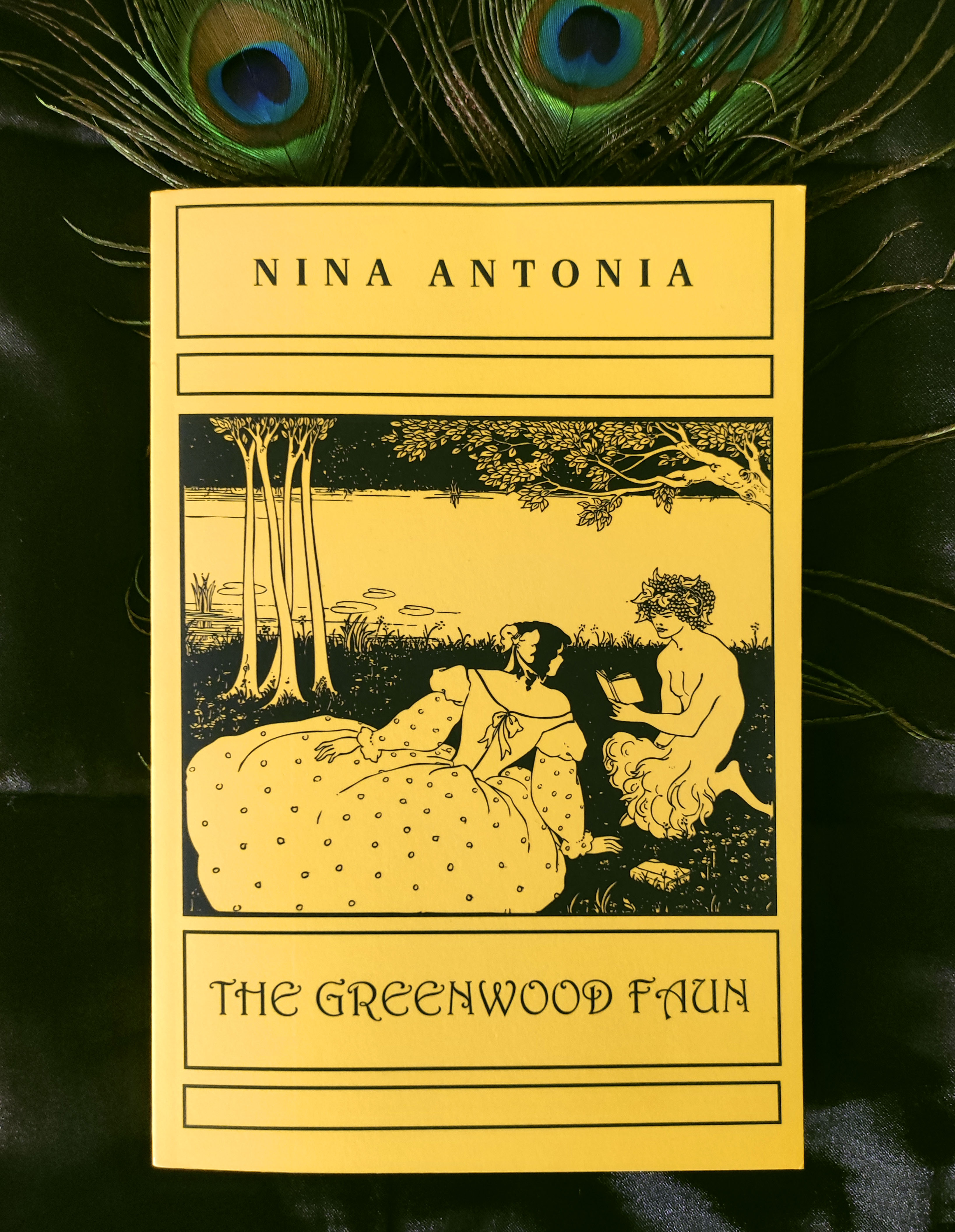
The Greenwood Faun is a novel by Nina Antonia which plays with both these phases of Arthur Machen’s career. This is a ghost story to some degree, in which the shade of Decadent poet Lionel Johnson wanders the streets of London in various stages of corporeality, as well as a tale of the dysfunctional Hartington Leacock-Jones family whose entanglements with a mysterious book—The Greenwood Faun by Lucian Taylor—comprise the main substance of the novel. Machen aficionados will recognise Lucian Taylor as being the central character of Machen’s semi-autobiographical The Hill of Dreams, a detail which makes Antonia’s story a novel about a novel from a novel.

It’s never entirely clear how the world of The Greenwood Faun manages to have Arthur Machen in it as the author of a novel called The Hill of Dreams while also containing the central character from that novel whose death has occurred before the story begins. The important element is Lucian Taylor’s unpublished book, discovered in manuscript form then printed in a limited edition (books like these are always limited editions) with faun-embossed boards and pages that exude a sylvan fragrance. Jorge Luis Borges would have enjoyed the intertextuality—he enjoyed inventing books, and also enjoyed Arthur Machen’s writing—which is paralleled to a small degree by Alan Moore’s The Great When in which we find another book from a Machen story—A London Walk by the Reverend Thomas Hampole—manifesting in the real world. (This isn’t to suggest any influence; Antonia’s book was first published in 2017.) The Greenwood Faun extends a fateful influence over the Hartington Leacock-Jones family, either chiming sympathetically with those receptive to its magical charm or repulsing those whose characters are blind to its visionary qualities. Roger, the oldest of the trio of siblings, is a worldly materialist who remains immune to the spell of the book, whereas Conrad, his dreamy younger brother, is a poète maudit in embryo, equally responsive to the lure of the novel and to the romantic seductions of the ghostly Lionel Johnson. The thorn in this world is Giles Gorse, a literary critic soon to be married to Violet, the brothers’ sister. Gorse has his own designs on The Greenwood Faun, seeing the novel as something he can republish as his own, if only the book would behave more like a book and less like an object endowed with magical life.

Nina Antonia’s novel is a treat for Decadent enthusiasts, littered with references and borrowings from the Mauve Decade, and to writers like Saki and Ronald Firbank who carried its spirit into the 20th century. Saki is a good match for Machen even though one of Saki’s most memorable characters, the waspish Clovis Sangrail, would be appalled to find himself repurposed here as one of the lower orders. The mysticism that surfaces now and then in Saki’s stories reaches a Machenesque peak in The Music on the Hill, another of those Edwardian tales in which Pan is encountered in the English countryside. The story is quoted in epigraph at the opening of The Greenwood Faun, and it’s to this vision of a pagan deity that the novel pays homage, not the annihilating terror of Machen’s Great God Pan.

The Greenwood Faun is published by Snuggly Books which also has a paperback edition of N by Arthur Machen, the story that concerns that other fateful volume, The London Walk.

Previously on { feuilleton }
A Czech Machen
Ibrahim Ineke’s The White People
The White People
The Bowmen by Arthur Machen
Rex Ingram’s The Magician
The Great God Pan

Weekend links 718

inagaki.jpg

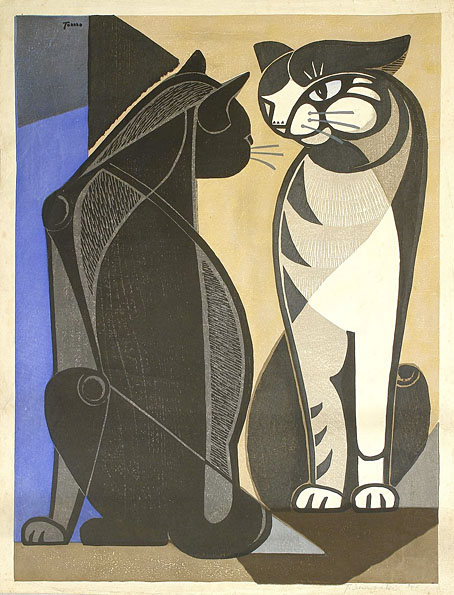
Chatting Cats (c.1960) by Tomoo Inagaki.

• New/old music: Follow The Light by Broadcast, a song which will appear on Spell Blanket—Collected Demos 2006–2009 in May. The album will be followed by another collection, Distant Call—Collected Demos 2000–2006, in September, with both releases being described as the last ever Broadcast albums. This was always going to happen eventually but I thought there might be a final collection of all the tracks the group recorded for compilations which have never been reissued.

• “Cats are all over Turkey. In Istanbul, which I visited before traveling to eastern Turkey, cats are welcome not just in cafes but in houses, restaurants, hotels, and bars.” Emily Sekine on the cats of Turkey.

• “El Shazly’s music is like a rush of new energy, a link between the past and present of Egyptian music that is fresh and vital.” Geeta Dayal on Egyptian singer and composer Nadah El Shazly.

• More werewolves: A trailer for Wulver’s Stane, a contemporary refashioning of werewolf lore. Director Joseph Cornelison is a reader of these pages. (Hi, Joseph!)

• Among the new titles at Standard Ebooks, the home of free, high-quality, public-domain texts: Ghost Stories by EF Benson.

• At Colossal: Sacred geometries and scientific diagrams merge in the metaphysical world of Daniel Martin Diaz.

• At The Quietus: What does dying sound like? Jak Hutchcraft on music and the near-death experience.

• At Unquiet Things: Languid Dreams and Unsettling Poetry: The Art of Jason Mowry.

• At Dennis Cooper’s: Spotlight on…Ronald Firbank Caprice (1917).

Ashkasha, a short animated film by Lara Maltz.

• New music: Chimet by Mining.

I’m The Wolf Man (1965) by Round Robin | The Werewolf (1972) by Barry Dransfield | Steppenwolf (1976) by Hawkwind

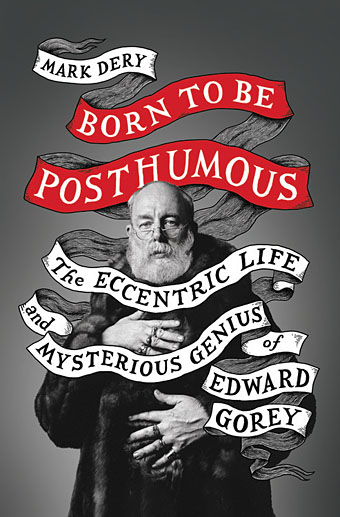
Born to be Posthumous: The Eccentric Life and Mysterious Genius of Edward Gorey

dery.jpg

Cover design by Jim Tierney; photo by Richard Corman.

When so many current biographies are recounting the lives of those about whom we’ve already heard a great deal (see the new biography of Oscar Wilde by Matthew Sturgis), a book exploring the career of a previously undocumented yet worthwhile figure is especially welcome. Such is the case with Born to Be Posthumous, Mark Dery’s life of the elusive Edward Gorey: artist, writer, illustrator, book designer, book creator, bibliophile, theatre designer, cat lover and balletomane.

gorey5.jpg

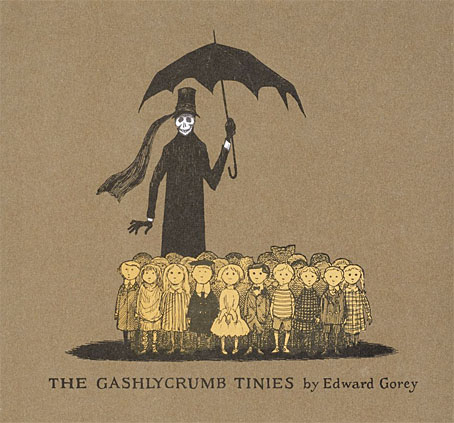
The Gashlycrumb Tinies (1963).

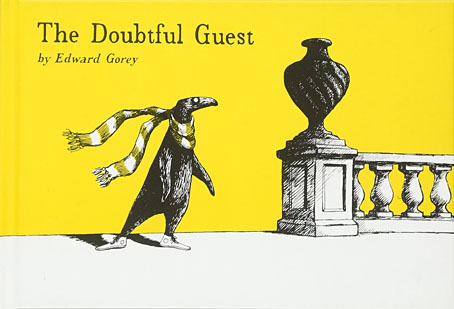
Gorey’s small books have long been one of the more curious fixtures of American culture: many of them look like children’s books but aren’t (unless the child is Wednesday Addams); others look like comic books but they aren’t comics either. The books are sometimes (but not always) Surrealist fables; or brief accounts of irreducible mystery; or sombre inexplicabilities; or camp ripostes to the pieties of Victorian morality; infrequently spiced with black humour and with lurches into outright horror. Gorey delivered his miniature tales in an idiosyncratic drawing style that combines a cartoon-like stylisation with the density of shading found in old wood engravings, a blend that would prove influential as his popularity grew. As Dery notes in his book’s introduction, without Edward Gorey’s work there would be no Lemony Snicket, while Tim Burton would be a skeletal shadow of his present self. (Given the latter’s current output, this might do him some good. But I digress.)

gorey4.jpg

The Doubtful Guest (1957).

In Britain, however, Gorey remains a cult rather than cultural figure, still overshadowed by better-known contemporaries such as Maurice Sendak and Charles Addams. Until the publication of the Amphigorey story collections Gorey’s books were produced in small editions with such a limited availability you were more likely to encounter his art on the cover of another author’s book than within the pages of his own. I became aware of Gorey’s work by gradual osmosis. The first substantial piece I read about him was his entry in Philip Core’s Camp: The Lie that Tells the Truth (1984), in which Core’s mention of an art style “recollecting Victorian engravings” marked Gorey as an artist to be investigated. Two years later he received a longer entry in The Penguin Encyclopedia of Horror and the Supernatural edited by Jack Sullivan. (Camp and horror: how many other artists sit so easily in both worlds?) But Gorey is absent from many books about 20th-century illustrators, and despite the sequential nature of his work you won’t find him in histories of comic art.

gorey6.jpg

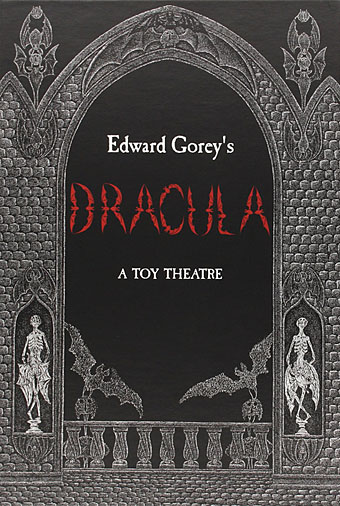
Edward Gorey’s Dracula: A Toy Theatre (1979).

In a way it’s fitting that the work of a man who was adamant in his determination to avoid being pinned down should be so difficult to find. But it’s also a shame that the work of an ardent Anglophile should be hard to find in the country that fuelled his imagination. Among Gorey’s literary favourites Dery lists Jane Austen and Agatha Christie together with Ronald Firbank, Saki, and EF Benson’s Mapp and Lucia novels. (The latter trio are all present in Core’s book on camp, which no doubt makes Gorey camp to the core. Whether he would have approved of being labelled as such is another matter.) I wasn’t surprised by the mention of Saki when so many of Saki’s story titles (The Secret Sin of Septimus Brope) sound like Gorey books, while many of the stories themselves are like Gorey scenarios in prose. Not all Gorey’s work is camp or comic, however; the 32 drawings that comprise the wordless masterpiece of The West Wing (1963) are closer to David Lynch or the “strange stories” of Robert Aickman, the latter an author that Gorey illustrated on several occasions. Dery emphasises how Gorey’s love of silent cinema contributed to The West Wing and other pieces, especially the serials of the Surrealists’ favourite filmmaker, Louis Feuillade.

Continue reading “Born to be Posthumous: The Eccentric Life and Mysterious Genius of Edward Gorey”

Weekend links 386

ward.jpg

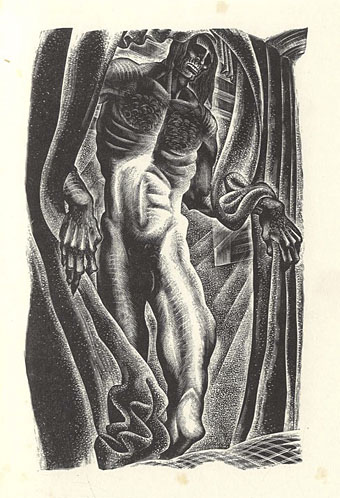
Lynd Ward again, and one of his illustrations for Frankenstein (1934).

• “Julio Mario Santo Domingo was a collector and visionary who filled his homes and warehouses with the world’s greatest private collection related to the subjects of drugs, sex, magic, and rock and roll: a library of more than 50,000 items…” Altered States: The Library of Julio Santo Domingo by Peter Watts catalogues some of the artefacts.

• “His vision of Gay Liberation was deeply, and uniquely, inflected by his study of, and belief, in anarchism.” More on the late Charles Shively: Michael Bronski remembers a pivotal figure in the gay liberation movement.

• William Friedkin’s Sorcerer was released on region-free blu-ray a couple of years ago but it’s being reissued again in the UK for its fortieth anniversary. Julian House has created a series of designs for the insert.

• Electronic musician and podcaster Marc Kate talks to Erik Davis about nihilism, horror movies, New Age music, and transmuting Nazi black metal into the ambient soundscapes of his latest album, Deface.

• “Beware the polished little man“: an extract from The Guesthouse at the Sign of the Teetering Globe by Franziska zu Reventlow which is available now from Rixdorf Editions.

• Another welcome blu-ray release, Sergei Parajanov’s The Colour of Pomegranates appears later this month in a special edition from Second Sight.

• Mixes of the week: FACT mix 626 by Sharp Veins, XLR8R Podcast 515 by Sammy Dee, and Secret Thirteen Mix 236 by Beta Evers.

The Witch Wave with Pam Grossman is a podcast for bewitching conversation about magic, creativity, and culture.

• Call me by the wrong name: Benjamin Lee on Hollywood’s perennial attempts to straight-wash gay films.

• At Dennis Cooper’s: Spotlight on…Ronald Firbank Concerning the Eccentricities of Cardinal Pirelli (1926).

• Zoë Lescaze reviews Frankenstein: The First Two Hundred Years by Christopher Frayling.

• Angry Optimism in a Drowned World: A Conversation with Kim Stanley Robinson.

• Stewart Smith on The Strange World of…Linda Sharrock.

Colors (1969) by Pharoah Sanders | Frankenstein (1972) by The Edgar Winter Group | Pomegranate (2001) by Transglobal Underground

Weekend links 149

bowie.jpg

It’s not cheap but it’s rather tasty: The Changing Faces of Bowie, a limited print at the V&A shop produced for the forthcoming David Bowie exhibition. One hundred artists and designers were asked to choose or create a Bowie-related type design, the collection being printed on holographic paper. Creative Review looked at some details. Related: Bowie’s new album, The Next Day, is now streaming in full at iTunes.

• Marisa Siegel reviews The Moon & Other Inventions: Poems After Joseph Cornell by Kristina Marie Darling, “a fully enchanting if somewhat mysterious collection of poems, written entirely as footnotes”. BlazeVOX has an extract here.

• “[Clement] Greenberg came round to our house in Camden Square. He started telling Bill what he should do to improve a work. Dad lost patience and kicked him out.” Alex Turbull of 23 Skidoo on sculptor father William Turnbull.

“You get the impression that a lot of these young directors have never gained much experience of life outside their film schools or their video-rental stores.”

Anne Billson met Roman Polanski in 1995 to discuss Death and the Maiden.

• Max Beerbohm’s The Happy Hypocrite, and Ronald Firbank’s Vainglory are available in new print-on-demand and ebook editions from Michael Walmer.

• “Bring Back the Illustrated Book!” says Sam Sacks. Some of us would reply that it never went away but merely remains subject to much unexamined prejudice.

The Forest and The Trees: A blog by Genevieve Kaplan about altered texts and book art by herself and other artists.

The Homosexual Atom Bomb: Sophie Pinkham on gay rights, Soviet Russia and the Cold War.

Who’s Afraid Of The Art Of Zang Tumb Tuum? A blog devoted to the ZTT record label.

• Nigel Kneale’s TV ghost drama, The Stone Tape, is reissued on DVD later this month.

• The drawings of Victor Hugo.

David Bowie at Pinterest.

•  The Man Who Sold The World (1994) by Nirvana | V-2 Schneider (1996) by Philip Glass | ‘Heroes’ (2000) by King Crimson