
Weekend links 112

venus.jpg

“Venus moves across the Sun in this image captured by Japan’s satellite Hinode, on June 6, 2012.” Via.

The imagery in Ah Pook covered a wide range of ideas. A train full of Mayan Gods for instance travelled through various time zones to end up alongside a carnival in a red brick town outside St Louis. Then they got out…out of the books Mr. Hart was reading on the train. Fact also alternated with fiction. We could be chugging along with Lizard boys in a Mayan City one moment then switch to a history of Immigration Laws in the US or the development of tape recorders and Speech Scramblers. Then switch to a bright red Shrew boy with a hard-on on a bicycle in Palm Beach at the end of the world. Time was what the book was about: defining it, controlling it and moving back and forth within it.

Malcolm McNeill

Malcolm McNeill talks to The White Review about working with William Burroughs on Ah Pook Is Here. Related: Jan Herman as Publisher of Nova Broadcast Press. Reality Studio has all the Nova Broadcast publications as downloadable PDFs.

• More Graphic Canon news: design historian Steven Heller reports on the project while at Nashville Scene editor Russ Kick talks to Joe Nolan about the books.

• There’s still a couple of days left to hear Martyn Wade’s Blue Veils and Golden Sands, a BBC radio drama about electronic composer Delia Derbyshire.
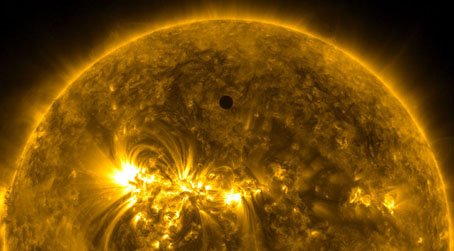
venus2.jpg

“Venus in silhouette, seen between the Earth and Sun, from NASA’s orbiting Solar Dynamics Observatory, on June 5, 2012.” Via.

• From 2010: Video of an hour-long lecture by Alberto Manguel at Yale University on “Borges and the Impossibility of Writing”.

• Bauhaus reflections: Frank Whitford on the design school and the exhibition currently running at the Barbican, London.

• “It’s easier to be gay in the US army than it is to be gay in hip-hop.” Zebra Katz, Mykki Blanco and the rise of queer rap.

• Back at the event site: Another extract from M. John Harrison’s forthcoming novel Empty Space.

• Rare 1959 audio: Flannery O’Connor reads A Good Man is Hard to Find.

Venus Transit 2012 – Ultra-high Definition View (NASA/ESA).

• The kitties just don’t care: Indifferent cats in amateur porn.

What happened to Dorothy Parker’s ashes?

Space Teriyaki 5 at 50 Watts.

Venus/Upper Egypt (1991) by Sonny Sharrock | Venus (1996) by Funki Porcini | Venus (2003) by Air
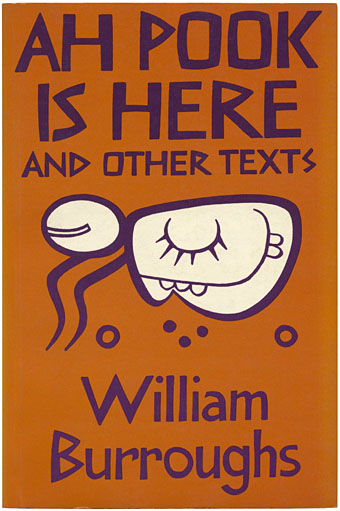
Ah Pook Is Here

pook1.jpg

John Calder edition (1979). Design by Brian Paine incorporating a glyph of Ah Pook from the Dresden Codex.

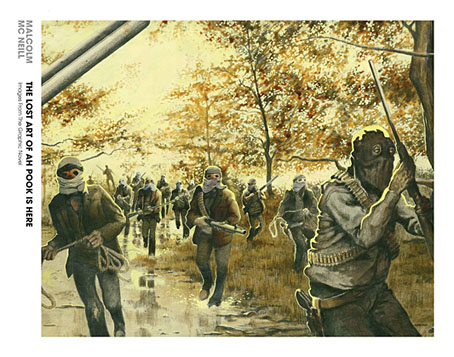
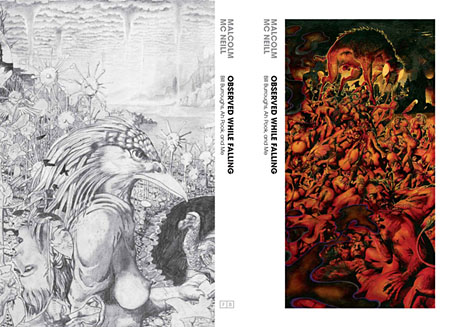
It would have been tempting to write “Ah Pook is finally here” but that’s not quite the case. Artist Malcolm McNeill sent Savoy Books the following preview images last week. What was originally going to be the long-awaited publication of McNeill’s collaboration with William Burroughs, Ah Pook Is Here, will now be two separate volumes published by Fantagraphics Books later this year: The Lost Art of Ah Pook Is Here which will comprise McNeill’s art without the accompanying text (apparently the Burroughs estate objected to its inclusion), and Observed While Falling—Burroughs, Ah Pook and Me, a memoir of the project’s creation. The loss of the text is an annoyance but not the end of the world, at least if you’re fortunate enough to own the scarce Calder book above which comprises a 40-page story that I imagine (and hope) may be read whilst viewing McNeill’s meticulous artwork. Amazon’s listing shows the two books scheduled for October 2012, and there’s now a website for the two books with further preview images.

pook2.jpg

pook3.jpg

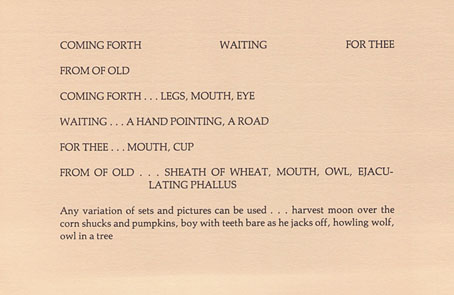
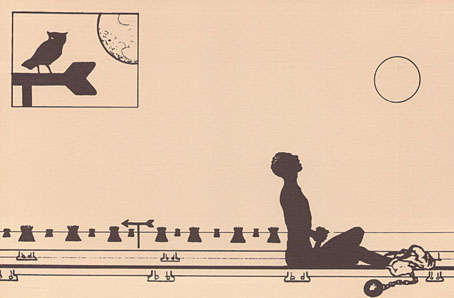
The 1979 Ah Pook Is Here is a fascinating collection, not least for the title piece which fits with the Wild Boys/Port of Saints narratives that Burroughs worked on during the 1970s. It’s also one of the better Burroughs anthologies so it’s always seemed odd that it’s remained resolutely out of print. Burroughs mentions McNeill’s artwork in a preface but doesn’t show any examples of his work. There is other artwork, however: in addition to some uncredited line drawings of figures like those in the Mayan codices there’s the whole of The Book of Breeething, a collaboration with artist Robert F. Gale from 1974. The latter concerns Burroughs’ interest in hieroglyphic communication, and attempts to show how one might convey short sentences through visual images alone, as in the pages below.

breeething1.jpg

The Book of Breeething (1974).

breeething2.jpg

The final piece in the book is The Electronic Revolution, an essay about using technology for guerilla purposes which was an inspiration for Cabaret Voltaire and others. All of this is choice and unusual material so it’s surprising that it’s been out of print for so long. In the case of Ah Pook Is Here it’s even more surprising to find it being prevented from republication despite Burroughs’ hope in his 1978 preface that the text would eventually be published along with the artwork. I’m sure the Burroughs estate have their own reasons for these manoeuvres but you can’t help but feel that this is another example of best intentions acting posthumously against the wishes of the artist they represent. A final irony can be found on the first page of Ah Pook Is Here where we see several mentions of a predatory agency that Burroughs warned against throughout his career, the thing he called CONTROL.

Elsewhere on { feuilleton }
The William Burroughs archive

Weekend links 103

fripp.jpg

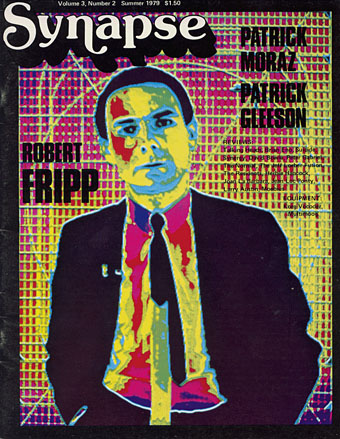
Robert Fripp photographed by Chris Stein. Video posterization by Michael Schiess.

Scans of Synapse, “The electronic music magazine”, are posted here. Issues range from 1976 to 1979, and include interviews with the more notable synthesists of the period, Kraftwerk included. Brian Eno was regularly interviewed by synth mags despite always being reluctant to talk about what equipment he might be using; sure enough he’s featured here. Far more interesting is a longer interview with Robert Fripp that catches the guitarist as he emerged from his self-imposed retirement in the mid-70s with the extraordinary Exposure album. (See a 1979 promo video for that here.) Related: TR-808 drum sequences in poster form by Rob Ricketts.

• More electronic music from the 1970s: “[Don Buchla] showed me that the idea of playing a black-and-white keyboard with one of these instruments was completely ridiculous. It was inappropriate and had nothing to do with the way you would use an electronic instrument.” Suzanne Ciani talks to John Doran about electronic music composition. A collection of her early recordings, Lixiviation, is released by Finders Keepers. Related: The Attack of the Radiophonic Women: How synthesizers cracked music’s glass ceiling.

• “Her writing—full of immigrants, circus animals, freaks, socialists, hipsters, servants, and suffragettes—revels in the atmosphere of the ‘Yellow Nineties,’ a period characterized by Wildean decadence and art for art’s sake.” Jenny Hendrix on Djuna Barnes.

brunovsky.jpg

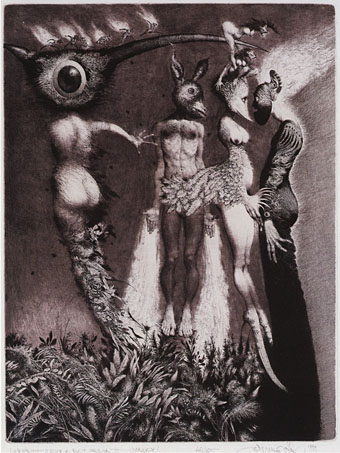
More etchings by Albin Brunovsky at But Does It Float.

• More scanned magazines: the Fuck You Press archive at Reality Studio. A trove of rare publications produced by Ed Sanders in the 1960s with contributions from world-class writers, William Burroughs included.

• “[My parents] were horrified by what I did, but they encouraged me to keep doing it because I was obsessed, and what else could I do?” John Waters writing in (of all places) the Wall Street Journal.

• A time-lapse assembly of Alfred Hitchcock’s Rear Window (1954) by Jeff Desom who explains how he did it here.

The Occult Experience: a 95-minute documentary on the international occult scene, filmed in 1984–85.

• Compost and Height re-post A Gold Thunder, a song by Julia Holter first sent to them in 2010.

• Drawings by Bette Burgoyne.

Schroeter’s Salomés

Cats are liquids

Fade Away And Radiate (1978) by Blondie (featuring Robert Fripp) | Exposure (1978) by Peter Gabriel (produced by and featuring Robert Fripp) | Exposure (1979) by Robert Fripp | Babs And Babs (1980) by Daryl Hall (produced by and featuring Robert Fripp) | Losing True (1982) by The Roches (produced by and featuring Robert Fripp).

Weekend links 101

cabat.jpg

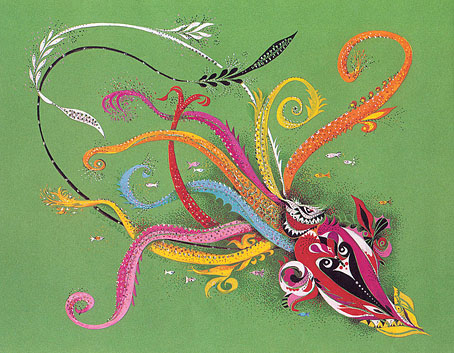
Kraken from Ernie Cabat’s Magical World Of Monsters (1992) at Monster Brains.

“I think for a lot of people who don’t read pulp growing up, there’s a real surprise that the particular kind of Pulp Modernism of a certain kind of lush purple prose isn’t necessarily a failure or a mistake, but is part of the fabric of the story and what makes it weird. There’s a big default notion that ‘spare,’ or ‘precise’ prose is somehow better. I keep insisting to them that while such prose is completely legitimate, it’s in no way intrinsically more accurate, more relevant, or better than lush prose.” China Miéville at Weird Fiction Review expressing an opinion that few in the literary world ever articulate, never mind agree with. Far more common is (to pick a recent example) Ursula K Le Guin dismissing Cormac McCarthy for “pretentious prose”.

• “Militant feminist scientists brainwash a research subject to assassinate the Welsh Minister of Prostitution. Meanwhile World War III is being fought and the USA has been invaded.” The IMDB précis for Taking Tiger Mountain (1983), a feature film directed by Tom Huckabee from a script by William Burroughs, and featuring a 19-year-old pre-Aliens/Near Dark Bill Paxton. The director discusses the film’s production at Screen Slate and attends a rare screening at Spectacle, Brooklyn, NYC, today (March 25th). YouTube has a three-minute clip. Surprising this has remained buried for so long. When can the rest of us get to see it?

• Prestel have published the catalogue for In Wonderland: The Surrealist Adventures of Women Artists in Mexico and the United States. AnOther previewed some of the contents. The exhibition runs at the LACMA, Los Angeles, until 6th May.

…gays only make up about 3% of the population so we spend our whole lives “translating” straight movies, books, ballets into gay terms and studying the heterosexuals around us—we know much more about them than they know about us, just as blacks know a lot about whites but whites know virtually nothing about blacks.

Edmund White (again) interviewed by Frank Pizzoli at Lambda Literary Review.

• New on Caroline True Records: Jon Savage’s “Fame”, Secret History of Post-Punk 1978–81. “Some of it doesn’t sound like anything that has happened since,” says Savage. Indeed. FACT has the track list which I was pleased to see includes Chrome among the usual suspects. Hear a 12-minute promo mix at Soundcloud.

guerin.jpg

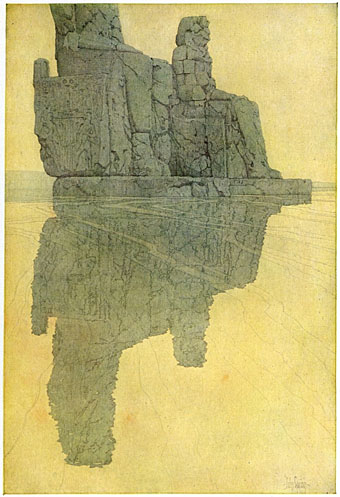
The Colossi of Memnon by Jules Guerin. From Egypt and its Monuments (1908) by Robert Hichens at Golden Age Comic Book Stories.

Gay Life Stories, “a colourful compendium of same-sex love through the ages” by Robert Aldrich. Reviewed here. Related: Alice Dreger asks “Are straight people born that way?”

• Clive Hicks-Jenkins created a series of designs for a Washington DC performance of Stravinsky’s The Soldier’s Tale. Follow their evolution in reverse order at his blog.

• Hocus Pocus: Margaret Eby on the brief epistolary relationship between Harry Houdini and Arthur Conan Doyle.

Rick Poynor on more cover designs for JG Ballard’s Crash.

London, city of dreams and rivers, caught on Polaroid.

• Photo prints by Thom Ayres for sale at Society6.

B*tches in Bookshops

• Meet You In The Subway (1979) by Chrome | New Age (Version III) (1980) by Chrome | Danger Zone (1981) by Chrome | Firebomb (1982) by Chrome.

Weekend links 100

bedini.jpg

How to become a mermaid and dissolve into sea foam in just seven surgical operations (2010) by Carla Bedini.

D.I.Y. Magic was a regular feature in the late Arthur Magazine that’s now become a book by Anthony Alvarado: “Think of it as jail-breaking the iPhone of your mind. Teaching it to do things that its basic programming was never set up for. Advanced self-psychology.” A first edition letterpress silver foil cover is limited to 1000 copies. | More magic: Jimmy Page’s unused soundtrack for Kenneth Anger’s Lucifer’s Rising finally gets an official release on March 20th.

Julia Holter‘s tremendous new album, Ekstasis, has been rocking my world this week. She’s interviewed at FACT where you can also hear the opening track, Marienbad, which receives extra points for being derived from that film. And there’s more: Ritual Music, a live performance at Sea & Space Gallery in Los Angeles, and Fur Felix, a film by Eric Fensler.

Brute Ornament, an exhibition of new work by Seher Shah and Kamrooz Aram opens at the Green Art Gallery, Dubai, on Monday. While the UAE is out of reach for most of us, the gallery site has samples of the work on display.

• This week’s mixtape arrives courtesy of BUTT magazine: Rock Bottom Mix by Cesar Padilla, a blend of acid, glam, grunge, punk, surf and stoner rock. Elsewhere, Richard Norris lists his 20 favourite UK psychedelic records.

the name is BURROUGHS ? Expanded Media at ZKM, the Center for Art and Media in Karlsruhe, is a comprehensive exhibition presenting for the first time in Germany the artistic output of William Burroughs.

Boneland by Alan Garner will be published in August, a new novel that concludes a narrative thread begun with The Weirdstone of Brisingamen in 1960.

• Coming soon (so to speak) on BFI DVD, The Erotic Films of Peter de Rome, more gay obscurities receiving quality attention.

The Northampton Chronicle reports on Alan Moore’s forthcoming novel about the town, Jerusalem.

Susan Cain is playing my tune (again): Why the world needs introverts.

• Techniques of terror: Carl Dreyer‘s Danish Gothic dissected.

• NASA has the latest map of Everything.

The male sex toy revolution.

Lucifer Rising Sessions (1972) by Bobby Beausoleil.