
Future Life magazine

future1.jpg

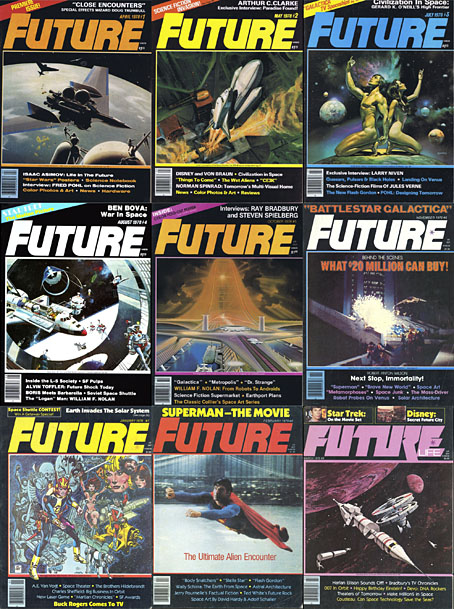
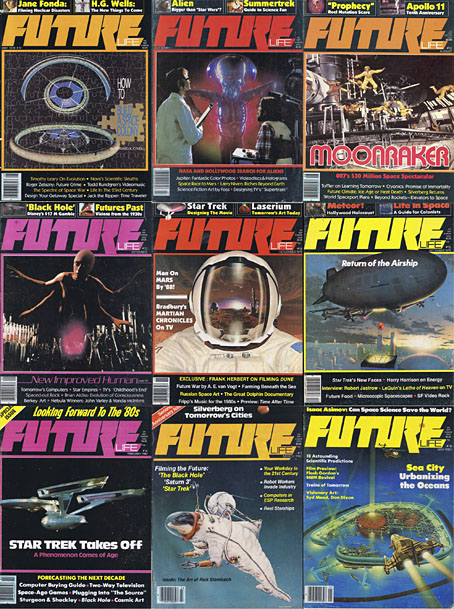
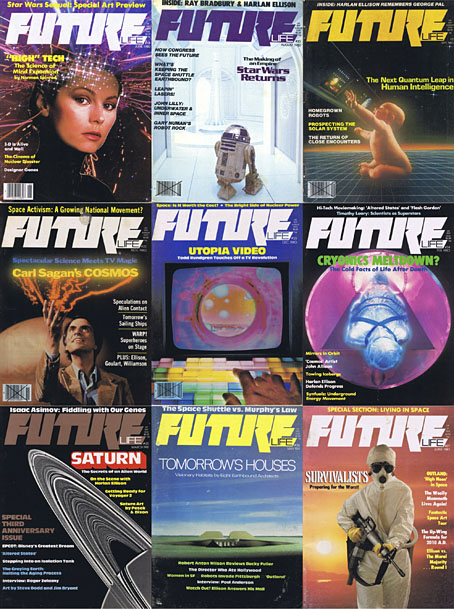
One thing I never expected about the future was that so many of my youthful enthusiasms would keep rising from the past, but here’s another, stumbling into the room reeking of cemetery earth and old newsprint. Future Life was a spinoff from Starlog magazine, and where the parent title concerned itself with science fiction and fantasy in film and television, the focus of Future Life was technology, popular science, scientific speculation, and written science fiction (all from an American perspective, of course); film and TV productions were there to attract general readers but never dominated the proceedings. Future Life ran for 31 issues from 1978 to 1981, and in many ways the magazine was a kind of OMNI-lite: not as lavish as its rival but not as expensive either. For a while this was a magazine I always looked out for (together with Heavy Metal, with whom it shared a music writer, Lou Stathis) but I missed the first nine issues, and many of the later ones before it vanished altogether, so it’s gratifying to find the complete run available as a job lot at the Internet Archive.
future2.jpg

It’s become commonplace today to regard Generation X as the first generation with no optimistic future to look forward to, but Future Life shows how much optimism there was at the beginning of the 1980s. The mood darkened just as the magazine expired, with genuine fears of a nuclear war persisting through much of the decade, and the Challenger disaster reminding everyone that leaving the planet was still a hazardous business. Future Life wasn’t blind to the problems posed by technology—there were features about the dangers posed by nuclear power and climate change—but it remained upbeat about the potentials, especially where space colonies were concerned. Most issues carried an art feature although these were generally about realistic space artists or spaceship painters, with none of the eye-popping weirdness favoured by OMNI. But this magazine was my first introduction to the work of Syd Mead, a few years before Blade Runner made him deservedly famous. On the writing side, many of the articles were by popular science fiction writers—Roger Zelazny on computer crime, Norman Spinrad on a pet theme, the future of drug-taking—which you can now read with the full benefit of hindsight. In later issues there was Harlan Ellison filing a succession of lengthy and inimitable film essays; several pieces by Robert Anton Wilson; and some good music articles with features on Larry Fast (issue 12) and Robert Fripp (issue 14), while Lou Stathis profiled and interviewed Bernie Krause (issue 18), The Residents (issue 19), Patrick Gleeson (issue 22), Jon Hassell (issue 24), Captain Beefheart (issue 25), and everyone’s favourite robots, Kraftwerk (issue 31).
future3.jpg

The Internet Archive currently has all the files stuck on a single page so most people will either have to download everything at once (I’d advise using the torrent file) or sample issues at random. Fortunately there’s a very thorough breakdown of the entire run of magazines here for those who prefer to pick through the detail. In the universe next door we’re reading these back issues while floating above the earth in our L5 space colonies.

Previously on { feuilleton }
• Science Fiction Monthly

Weekend links 356

toitoitoi.jpg

Im Hag by ToiToiToi will be Ghost Box 027, available from 12th May. Poster and album design, as always, by Julian House.

• The week in the electronic outer limits: The Haxan Cloak recorded a new piece of music using Moog’s Mother-32 modular synths; The Herzog Tapes is a new album by The Electric Pentacle; and Drew McDowall (ex-Coil, etc) has a new album, Unnatural Channel, out next month. (Vinyl-only, unfortunately, like his previous album.)

• More from Vinyl . Album . Cover . Art: The Complete Hipgnosis Catalogue by Aubrey Powell: How to design a record cover in 1977. The feature is a duplicate of Storm Thorgerson’s account in the first Hipgnosis book but since that volume has been out of print for decades it stands repeating.

• Talismanic Bookseller: Erik Davis talks to occult-book dealer and musician Richard Bishop talks about modern grimoires, scorpion gods, Orientalist imagery, and hunting down physical books in the age of the Internet.

• Arbery Books, “the UK’s leading online dealer in rare and secondhand books and ephemera of gay, lesbian and transgender interest”, is closing its website at the end of May so there’s a sale on.

• Amours Secrètes: Dans L’intimité Des Écrivains, an art book about the secret loves of five French writers: Marcel Proust, Pierre Loti, Renaud Icard, Roger Peyrefitte and Jean Genet.

• Ancient Methods and Futuristic Visions: Mark Pilkington & Michael J. York of Teleplasmiste answer 15 questions.

• Mix of the week: Homer Flynn, spokesperson of The Residents, compiles a playlist for The Wire.

• Adrian Searle on Queer British Art 1861–1967 at Tate Britain: “strange, sexy, heartwrenching”.

• Strange Flowers on August Endell (1871–1925) and the trees of spring.

• Urania (1995) by Panasonic | Pan Finale (2010) by Pan Sonic | 5′ 42” (2014) by Pan Sonic

Weekend links 302

bacchus.jpg

Nymphs of Bacchus by Lozzy Bones.

• “[Jonathan Meades] has a horror of explanation and an even greater one of manifestos, the artless moron’s medium of choice.” The writer turns artist with an “exhibition of Treyfs and Artknacks” at Londonewscastle.

• Robert Aickman: Author of Strange Tales is a 50-minute introduction to the writer and his works by RB Russell and Rosalie Parker.

• A second volume of  Cosmic Machine: A Voyage Through French Cosmic & Electronic Avantgarde will be landing in May.

• Amelia Mangan talks to Kattomic Energy about her horror fiction, and mentions these pages in passing. (Thanks!)

• The Interpretation of Screams: AS Hamrah on David Lynch: The Man from Another Place by Dennis Lim.

• “People thought we were on drugs – and we were!” Minimalist musician Tony Conrad interviewed.

• Two 1975 Buchla concerts by Suzanne Ciani are released for the first time by Finders Keepers.

• Inspiration from above and below: The strange world of… Sunn O))).

• At Dangerous Minds: HR Giger’s ads for the Pioneer Corporation.

• At Dennis Cooper’s: New Queer Cinema (1985–1998).

• Graphic Stamps, a history by Iain Follett and Blair Thomson.

• Ramsey Campbell’s “Thirteen Novels on the Edge of Horror”.

• The occult artwork of David Chaim Smith.

• Easter Woman (1980) by The Residents | Easter Parade (1984) by The Blue Nile | Easterfaust (2014) by The Cosmic Dead

Weekend links 297

floridxfauna.jpg

Crimson Metallic Emergent Skull Crystal Pendant by Kristen Phillips aka Floridxfauna.

• The Noise-Arch Backup at the Internet Archive is 30GB of mp3s from noise-arch.net, a collection of cassette-based releases and artwork: “material represented includes tape experimentation, industrial, avant-garde, indy, rock, diy, subvertainment and auto-hypnotic materials…” 30GB is an intimidatingly large amount of material so it’s better to browse The Noise-Arch Archive, a selection of 468 releases.

• The week in erotica: Claire Voon on Ancient Erotic Dreams and Explicit Scenes in the New York Public Library Collection; Melanie Porter on Great Grandporn: Hardcore Pornography of the Silent Era; Cathy Camper on The Comics of Dale Lazarov: Illustrated Explorations of Sexual Inventiveness.

• Void Beats/Invocation Trex by Cavern of Anti-Matter (Holger Zapf, Joe Dilworth & Tim Gane) was released this week. The opening number is Tardis Cymbals. Tom Furse condensed the 73-minute album into a 17-minute mini-mix.

Indeed, if you had to “place” ­Williams—put him alongside writers with whom he had something in common—it would be with the mystical autodidacts, the backstreet Rosicrucians more than with the pipe-smoking, tweedy Inklings. To that extent, the only unsatisfactory thing about Grevel Lindop’s book is its title. True, Williams went to Oxford when war broke out and became friends with the famous circle around C. S. Lewis. But he was not an Inkling in spirit. He was not at home in Oxford, and his arrival, far from consolidating the Inklings, actually broke them up by bewitching Lewis, and making Lewis neglect the central friendship of his life, that with ­Tolkien. Another scholar of Old English literature, C. L. Wrenn, said that meeting Williams made you realize why inquisitors thought they had the right to burn people. Tolkien agreed: “Williams is eminently combustible.”

Certainly, Williams’s books had an influence on the Inklings. Lindop is right to say that the central plotline of Many Dimensions suggests the story of The Lord of the Rings. In the Williams novel, it is a stone of great power, rather than a ring, but it has the same effect on those who bear it: They become its possession, not its possessor.

AN Wilson reviews Charles Williams: The Third Inkling by Grevel Lindop

• Russ Fischer recommends five films by Andrzej Żuławski (RIP). Possession (1981) is still the easiest to find, and a good place to start. I enthused about On The Silver Globe (1977–87) last year.

• England’s Hidden Reverse: A Secret History of the Esoteric Underground by David Keenan has been published in a revised and expanded edition by Strange Attractor.

• The Preservation Man (1962): Artist and collector Bruce Lacey (RIP) filmed by Ken Russell for the BBC’s Monitor.

• Barry Adamson: “I’ve been called the outsider’s outsider”.

• At Dangerous Minds: Six degrees of Marty Feldman.

• Mix of the week: FACT mix 536 by Not Waving.

• The Alan Clarke page at the BFI shop.

• Umberto Eco (RIP): Porta Ludovica

• Possessions (1980) by The Residents | Possessed (1992) by The Balanescu Quartet | Possessed (2001) by Sussan Deyhim & Shirin Neshat

Weekend links 296

invisiblecreature.jpg

Mars (variant design): one of three new posters for NASA by Invisible Creature.

• “If the point of Sade’s work was to marry sexual frustration and release to the practice of interpersonal violence, he could confidently gaze out on the landscape of our popular culture and declare it a fait accompli.” Hussein Ibish on The United Sades of America.

• Gravitational Waves Exist: The Inside Story of How Scientists Finally Found Them by Nicola Twilley. Sean Carroll explains the importance of the discovery.

• Another This Heat interview: Bruce Tantum interrogates Charles Bullen and Charles Hayward about being a group ahead of their time.

The English word comes ultimately from Greek magike (in which the original Persian word is spliced with tekhne, “art”), while the Persian magos “one of the members of the learned and priestly class” ultimately derives from magush, “to be able, to have power”, from which we may also derive the word “machine”. So my social hierarchy is your magic, and my magic might be your craft—or even your machinery. My religion is your magic. Your religion is my fairy lore. Or your religions might be a mass of fakery and trickery and foolery. Hence in making magic into an intellectual discipline, I theorize based on my observations, which might not be mine but those of others, heritable observations. But because what I do looks very like empiricism, as I examine materials for the tricks or fooleries, or for the real alterations, checking my results against descriptions of previous experiments, what I do feels like science, feels like the template for Baconian empiricism and its great instauration.

Diane Purkiss reviewing The Book of Magic: From Antiquity to the Enlightenment, edited by Brian Copenhaver

• The Strange World Of…The Residents: Sean Kitching talks to The Residents’ resident artist, Homer Flynn.

• At Strange Flowers: film of Natalie Barney in 1962 reminiscing about Oscar Wilde and Marcel Proust.

• From Battleship Potemkin to Baker Street: Ian Christie on Sergei Eisenstein’s trip to London.

• Mixes of the week: Krautrock Mix by Tarotplane, and Mix #15 (Transversales) by Jon Brooks.

• From Rock en Stock (France, 1973): Can and Agitation Free in live performance.

• Twenty classic British folk-horror stories: a selection by Kai Roberts.

• Immemory: a Flash version of Chris Marker’s CD-ROM.

• Cronenberg Valentines

• Static Gravity (1980) by Chrome | Zero Gravity (2001) by Monolake | Gravity (2013) by Roly Porter