Polaroids

polaroid1.jpg

I was given a Polaroid Instant Camera some years ago, not the cult SX-70, a later model. I still have it somewhere but never used it very much. The film cartridges were still available in shops, but at around £1 a shot Polaroids always seemed like a costly indulgence unless you had some specific use for them which I never did. The photo of Murnau’s Nosferatu was taken from a TV screen, and seems to be the only print I kept.

krims.jpg

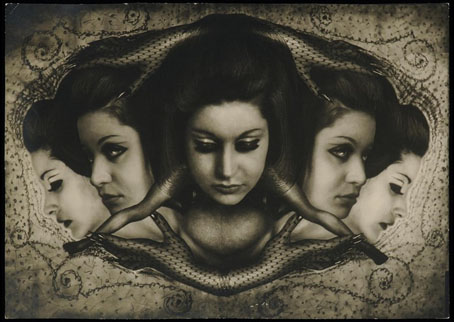
Radiation Victim Holding a Rabbit and Carrot (1974) by Les Krims.

This post was prompted by a search for the Polaroid manipulations made by Les Krims in the 1970s. Krims was one of the first people (the first?) to exploit the potential of the print’s slow processing to create surreal and grotesque images. Krims self-published a collection of these as Fictcryptokrimsographs in 1975. The Francis Bacon-like “radiation victim” is one of the more restrained examples, many of the others being male and female nudes in various stages of mutation.

gabriel1.jpg

Peter Gabriel (1980).

The mutation technique was more famously employed by the Hipgnosis design team and Peter Gabriel for the cover art of Gabriel’s third album. (Americans insist on calling this album “Melt” even though it was never titled as such.) The technique was also used for photos on the inner sleeve and on two of the single releases.

gabriel2.jpg

No Self Control (1980). Front and back sleeve of 7-inch single.

gabriel3.jpg

steadman.jpg

William Burroughs by Ralph Steadman.

Also in 1980, Ralph Steadman says discovered the same technique while on holiday in Turkey. I recall him discussing his own manipulations, which he calls “Paranoids”, on TV around this time. There’s no indication that Steadman was aware of Krims or the Gabriel album but he’s continued to use the technique ever since. The Burroughs portrait was one of a series created in 1995 when Steadman paid a visit to Lawrence, Kansas. There’s film of the meeting here although I’m more interested in the older TV film on the same page which shows Steadman creating a new composite portrait by drawing onto the emulsion.

Previously on { feuilleton }
Portrait

Out Of Limits

ool01.jpg

Out Of Limits (1963) by The Marketts.

Did you know that Marius Constant, composer of the theme for The Twilight Zone, had a career as a serious composer? I didn’t. I wonder what Constant thought about the reworking of his theme into a surf tune by Michael Z. Gordon and The Marketts in 1963. Gordon’s version was originally titled Outer Limits then changed to Out Of Limits to evade the copyright police. The Marketts’ version will be familiar to anyone who’s watched Pulp Fiction where (as I recall) it’s playing while John Travolta is driving around. But it’s even more familiar to surf obsessives as this small selection of covers shows. There’s more out there (so to speak), and we’ll probably be hearing even more interpretations versions in the future.

ool02.jpg

Outer Limits (1963) by Jerry Cole And His Spacemen.


ool05.jpg

Out Of Limits (1963) by The Ventures.


ool03.jpg

Out Of Limits (1964) by The Challengers.


ool04.jpg

Out Of Limits (1964) by Billy Vaughn.


ool08.jpg

Out Of Limits (1983) by Agent Orange.


ool11.jpg

Out Of Limits (1994) by Man Or Astro-Man?


ool12.jpg

Out Of Limits (2003) by Los Straitjackets.

Previously on { feuilleton }
In The Past
My Surfing Lucifer by Kenneth Anger
A Reverbstorm jukebox

James Ellroy’s Feast of Death

ellroy.jpg

In which the Demon Dog discusses his obsession with unsolved murders whilst meeting cop friends (and Nick Nolte) over a series of dinners. Vikram Jayanti’s 90-minute film was made for the BBC’s Arena strand in 2001, and was later released on DVD. It’s one of the best films I’ve seen about Ellroy whose take-no-prisoners attitude can be gauged from the anecdote at the very beginning. Films about writers are often better when they’re like this, talking about the things that interest them rather than discussing their work in a manner which can get blunted by having to answer to the same questions over and over again. Discussion touches inevitably on the murder of Ellroy’s mother, and the Black Dahlia case. “…with very strong language, and scenes you may find disturbing…” Watch it here.

The Nicolas Roeg Guardian Lecture, 1983

roeg.jpg

More Roegery. The recent BBC documentary about Nicolas Roeg has yet to appear on YouTube but this Guardian Lecture appeared there a few days ago. Roeg was in the news in 1983 following the release of Eureka, a film with a solid reputation today but one which the distributors weren’t happy with at the time. There’s no mention of these problems in this 37-minute interview with the late Philip Strick which ranges throughout Roeg’s career, and even includes some mention of his ill-fated plan to direct Flash Gordon for Dino De Laurentiis. It’s too short, of course, as these things always are, and Roeg has always been a somewhat rambling interviewee, but for Roeg-philes it’s worth a watch. The documentary I’d really like to see again is Nothing As It Seems: The Films of Nicolas Roeg, made the year before by Paul Joyce, and featuring contributions from two key collaborators: Donald Cammell and Paul Mayersberg.

Previously on { feuilleton }
Beyond the Fragile Geometry of Space
Canal view

Weekend links 265

rainbowhouse.jpg

The White House, Washington DC, on the evening of June 26, 2015.

I can remember that after the cops cleared us out of the bar we clustered in Christopher Street around the entrance to the Stonewall. The customers were not being arrested, but a paddy wagon had already hauled off several of the bartenders. Two or three policemen stayed behind, locked inside with the remaining members of staff, waiting for the return of the paddy wagon. During that interval someone in the defiant crowd outside called out “Gay Power”, which caused us all to laugh. The notion that gays might become militant after the manner of blacks seemed amusing for two reasons—first because we gay men were used to thinking of ourselves as too effeminate to protest anything, and second because most of us did not consider ourselves to be a legitimate minority.

At that time we perceived ourselves as separate individuals at odds with society because we were “sick” (the medical model), “sinful” (the religious model), “deviant” (the sociological model) or “criminal” (the legal model). Some of these words we might have said lightly, satirically, but no amount of wit could convince us that our grievances should be remedied or our status defended. We might ask for compassion but we could not demand justice. Many gays either were in therapy or felt they should be, and the words gay liberation would have seemed as preposterous to us as neurotic liberation (now, of course, Thomas S. Szasz in the United States, RD Laing in Britain and Felix Guattari on the Continent have, in their different ways, made even that phrase plausible enough).

What I want to stress is that before 1969 only a small (though courageous and articulate) number of gays had much pride in their homosexuality or a conviction that their predilections were legitimate. The rest of us defined our homosexuality in negative terms, and those terms isolated us from one another. We might claim Plato and Michelangelo as homosexuals and revere them for their supposed affinities with us, but we could just as readily dismiss, even despise, a living thinker or artist for being gay. Rich gays may have derived pleasure from their wealth, educated gays from their knowledge, talented gays from their gifts, but few felt anything but regret about their homosexuality as such. To be sure, particular sexual encounters, and especially particular love relationships, were gratifying then as now, but they were explained as happy accidents rather than as expected results.

Edmund White writing on The Political Vocabulary of Homosexuality (1980). Reprinted in The Burning Library: Writings on Art, Politics and Sexuality (1994).

• “…after seeing Don’t Look Now, The Wicker Man looked just so dull and flat. What Don’t Look Now has that The Wicker Man doesn’t is a complete mastery of cinema. Don’t Look Now is almost a silent movie, a brilliant, coherent, original and fantastic film that has an enormous emotional impact.” Bernard Rose emoting at length about Nicolas Roeg. Related: Wild Hearts Run Out Of Time, the Roy Orbison video that Rose mentions directing.

• “The male sex organ is depicted not so much as a body part, but more as a fetish object in its own right—a thing independent of the male body, worthy of intense, delirious veneration.” Jason Farago reviewing Tom of Finland: the Pleasure of Play. Related: Same-sex desire through the ages at the British Museum.

• “Sphinx is a typical love story only in the way that it’s the tale of two people who have fallen in love, and things don’t go smoothly. Beyond that…as reader, you have no idea of the gender of either half of this romantic equation.” Chris Clarke reviewing Sphinx, a novel by Anne Garréta.

• “To give space to the musical elements was really a thrill—how far can you get without using too much stuff?” Moritz von Oswald on “the sounds of emptiness”.

• “The problem is not always Helvetica but that Helvetica is all too often the default, the fall-back, the I-really-can’t-be-arsed choice,” says John Boardley.

• Mix of the week: Shaft’s Old Man: An Imaginary Soul Jazz Soundtrack by Aquarium Drunkard.

• “What is the Cut-Up Method?” Ken Hollings explains in a BBC magazine piece and radio feature.

• Nigel Kneale’s Quatermass, the final TV serial, will be released on Blu-ray next month.

• Relevant to the week’s reading: an archived Italo Calvino site.

Drÿad: a Tumblr.

Sphinx (1989) by Syd Straw | The Sodom And Gomorrah Show (2006) by Pet Shop Boys | Pattern 1 (2009) by Moritz Von Oswald Trio