Relativity

escher1.jpg

Relativity (1953) by MC Escher.

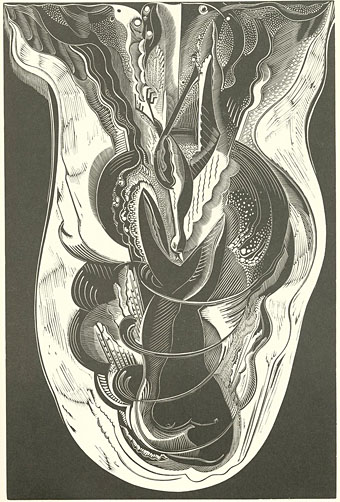
Escher’s famous lithograph has a less familiar companion piece in the woodcut below.

escher2.jpg

escher3.jpg

Delirius (1972) by Philippe Druillet.

Lone Sloane’s adventure on the pleasure planet of Delirius was written by Jacques Lob, and features this diversion in the Palais d’Escher. Possibly the first fictional use of one of Escher’s prints.

Continue reading “Relativity”

Ron Hays Music Image: Odyssey

hays1.jpg

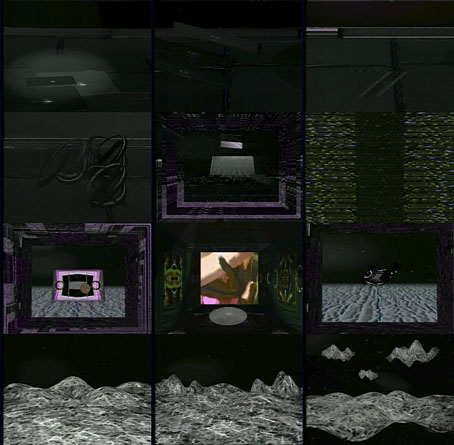
More of an oddity than an odyssey, discovered while browsing YouTube. Ron Hays Music Image: Odyssey is a 45-minute collection of video-synth graphics, animation and other effects made for Pioneer’s LaserDisc system in 1979. Among the visuals there’s slit-scan work from Con Pederson, creator of some of the effects for 2001: A Space Odyssey, animation by John Whitney, rudimentary computer graphics, and some very of-their-time dance sequences with glowing women working out in a cosmic void.

hays2.jpg

Each sequence is set to a different piece of music provided by Wagner, Pachelbel, Frank Serafine, and Larry Fast aka Synergy. It’s difficult to imagine anyone paying money to watch this unless it was the only disc on sale; more likely it would have been playing in television shops as a promotional tool, although you can also imagine it being piped into the rooms of inmates of the Arboria Institute in Beyond the Black Rainbow. I used to own Games, the Synergy album from which Delta 1 is taken. Hearing that piece again makes me regret getting rid of the album several years ago.

Elsewhere on { feuilleton }
The abstract cinema archive

Weekend links 273

pelcer.jpg

Byronic I by Boris Pelcer. Via Full Fathom Five.

• “Music determines everything in terms of our narrative. Music demands, music suggests. Whereas traditional Hollywood animation is all based on character development—you know, there’s Toy Story and it’s Tom Hanks’s voice pushing the thrust of the action. For us, décor is all part of it. It’s the objects, a sense of atmosphere, the stimmung (mood) of what’s happening in this landscape where the puppet is just, invariably, a tiny element.” The Brothers Quay talking to JW McCormack about their films, and about Quay, a short documentary by Christopher Nolan.

• Croissants with Cthulhu: Stephanie Gorton Murphy reports on the Cthulhu Prayer Breakfast at last week’s NecronomiCon. I didn’t attend this: abject silliness is the last thing I want at 8 o’clock in the morning.

• “…a light daze for the rest of the afternoon, detrimental to studying but advantageous for daydreaming.” Italo Calvino on his cinema-going youth.

Only in that brief moment of absolute uncertainty – when both options seem equally plausible and implausible, when neither thought can be accepted or rejected, when everything can be explained and nothing can be explained – only in that moment do we really have this horror of philosophy, this questioning of the principle of sufficient reason. It is for this reason that Todorov qualifies his definition by stating that the “fantastic occupies the duration of this uncertainty.”

Eugene Thacker in an extract from Tentacles Longer Than Night (Horror of Philosophy, vol. 3), Zero Books, 2015

• It’s always good to hear some new rumblings by Emptyset. The Guardian has a stream of side 1 of the latest release, Signal.

• David Rudkin’s Penda’s Fen receives a film screening at the Whitechapel Gallery, London, on Saturday, 5th September.

Sea Calls Me Home, another song from the forthcoming Julia Holter album.

• Digital visualizations of imagined future landscapes by Mike Winkelmann.

• Mix of the week: The Ivy-Strangled Path Vol. IX by David Colohan.

• Cherchez la femme: Women and Surrealism at Sotheby’s, NYC.

• At It’s Nice That: 50 years of A Humument by Tom Phillips.

April 16, 1963: Housewife on LSD

Tentaclii: a Lovecraft blog

Signal (1981) by Phew | Signals (1983) by Brian Eno with Daniel Lanois and Roger Eno | Signals (2010) by The Soundcarriers

A Cabinet of Curiosities

cabinet1.jpg

When I still had a television I used to enjoy Lucinda Lambton’s films for the BBC, and this one—a short history of the British Wunderkammer—was a particular favourite. Lambton’s films cover similar ground to those of Jonathan Meades but with a lighter touch, and free of Meades’ often relentless pontification. This episode of 40 Minutes, first broadcast in 1987, includes some unusual architecture—a Lambton speciality—but concentrates for the most part on seeking out a few surviving examples of the ad hoc museums hidden away in country houses. Among the more notable features there’s Walter Potter’s taxidermy diorama, The Death and Burial of Cock Robin, and the full 40-minute programme showed the incredible Bowes Swan automaton in action. The copy of the film at YouTube is missing the last 10 minutes so the swan is absent although it’s easily seen elsewhere.

cabinet2.jpg

Previously on { feuilleton }
The Thackery T. Lambshead Cabinet of Curiosities
The specimens of Alex CF
Walmor Corrêa’s Memento Mori
The art of Ron Pippin
Custom creatures
Jan Švankmajer: The Complete Short Films
Cryptozoology
The Bowes Swan
The Museum of Fantastic Specimens

The Living Grave by David Rudkin

rudkin.jpg

Having recently discovered two episodes from the BBC’s long-running Leap in the Dark series (In the Mind’s Eye, and Alan Garner’s To Kill a King), I was hoping the episode written by David Rudkin might turn up eventually. And here it is, posted to YouTube last month. Leap in the Dark, which ran from 1973 to 1980, was unusual for series dealing with the paranormal in the way it combined documentary episodes with fictional ones. The Living Grave (1980) is a skillful blend of both fact and fiction; Rudkin’s website describes it thus:

Based on documentary transcripts: the hypnotist Joe Keaton “regresses” Pauline, a Merseyside nurse, back beyond her birth to an earlier life – she starts to speak as Kitty, a maidservant on 18th century Dartmoor, who is made pregnant and hangs herself. To this day, on Kitty’s unconsecrated grave at a lonely forkroads, flowers are still left by an unknown hand.

I intercut the hypnosis scenes with glimpses of the life and death of Kitty herself as “her” voice was describing them – but with the camera as Kitty’s point of view, and so never seeing her, and using the locations as they are now. This was to avoid the inertia of mere illustration, creating instead a simultaneity of the two time-frames, and a sense of Kitty’s experience still present in the landscape today.

In May this year I wrote a lengthy essay about Rudkin’s dramas (more about that later) so The Living Grave has additional relevance beyond its cult interest. For a half-hour film it’s a more impressive piece than White Lady, a longer original drama that Rudkin wrote and also directed in 1987. Where White Lady is surprisingly inert, The Living Grave features familiar Rudkin touches, especially the voice of the unseen “haunted man” whose words are the closest thing to the speech in the stage plays. After spending some time tracing Rudkin’s recurrent use of sacred monuments, whether churches or stone circles, the shots of Dartmoor megaliths were especially notable. In the essay I sketched a comparison between Rudkin and Alan Garner, two writers who share concerns with the way the deep past of the British Isles impresses itself on the present, especially in a rural context. As noted above, Garner wrote an episode of Leap in the Dark, and there’s a further connection here in Lesley Dunlop who plays the hypnotised nurse, Pauline; two years before, Dunlop was Jan in Garner’s excellent TV adaptation of his novel, Red Shift. The hypnotist in The Living Grave is played by Ian Hogg, a friend of Rudkin’s who played Arne in Penda’s Fen, and has appeared in a number of the writer’s other dramas for stage and radio.

Previously on { feuilleton }
In the Mind’s Eye
To Kill a King by Alan Garner
Afore Night Come by David Rudkin
White Lady by David Rudkin
Red Shift by Alan Garner
Penda’s Fen by David Rudkin
David Rudkin on Carl Dreyer’s Vampyr