
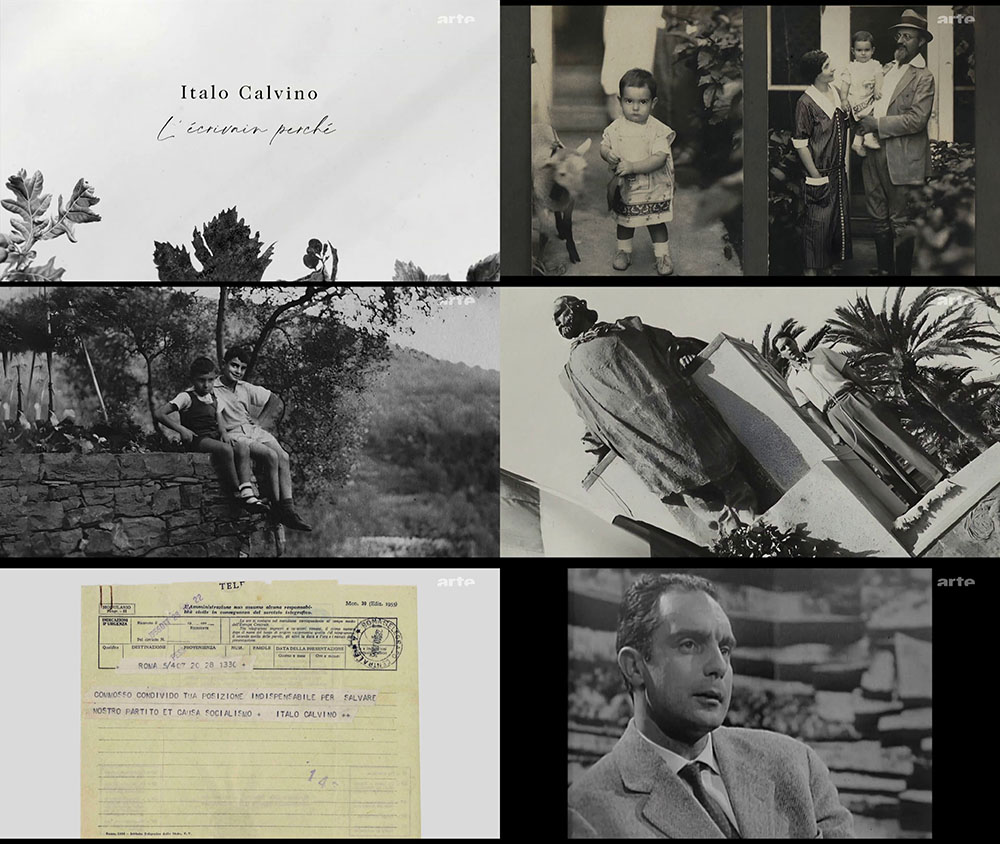
The first minute of this Franco-German documentary doesn’t present a title in English but the French title, L’écrivain perché, refers to Le Baron perché, one of Italo Calvino’s earliest novels which English readers know as Baron in the Trees. The novel isn’t the first of Calvino’s flights of fancy—The Cloven Viscount preceded it—but in borrowing its title the documentary suggests that the tree-dwelling Baron’s new way of living and viewing the world was personally significant for its author, something supported by the opening interview clip.
A promising start, then, so it’s a shame that the documentary as a whole isn’t very satisfying. As with last week’s science-fiction documentary, the best parts are the extracts from interviews with Calvino himself, and I’d have preferred to see more of these than hear from random individuals (the inevitable academics, an American writer, a musician) whose comments aren’t without value but who use up time that might have been better spent describing for those unfamiliar with Calvino’s work the origin and structure of his fictions. I can tell you, for example, that the stories in Cosmicomics (1965) are the closest that Calvino came to outright science fiction; that The Castle of Crossed Destinies (1969) is a novel based around a series of Tarot readings, with the layout of those readings appearing beside the text in the book; that Invisible Cities (1972) is a book-length conversation between Marco Polo and Kublai Khan in which the Venetian explorer presents capsule descriptions of the places he’s encountered on his travels; that If On a Winter’s Night a Traveller (1979) is a masterpiece of self-reflexive writing… And so on. The documentary, unfortunately, tells you none of these things, and hardly mentions these books at all, leaving the unfamiliar viewer with no clue as to why Calvino became one of Italy’s most popular writers during his lifetime, and why he continues to be popular today. One of the worst examples of this is when his French translator talks about Calvino’s relocation to Paris in 1967, an event which brought him into the orbit of the Oulipo writers. There’s a brief explanation of the Oulipo group using formal constraints to reinvent their fiction but no mention of what this meant to Calvino or whether the formal restraints in the novels and stories he produced after 1967 were influenced by Oulipo or not.
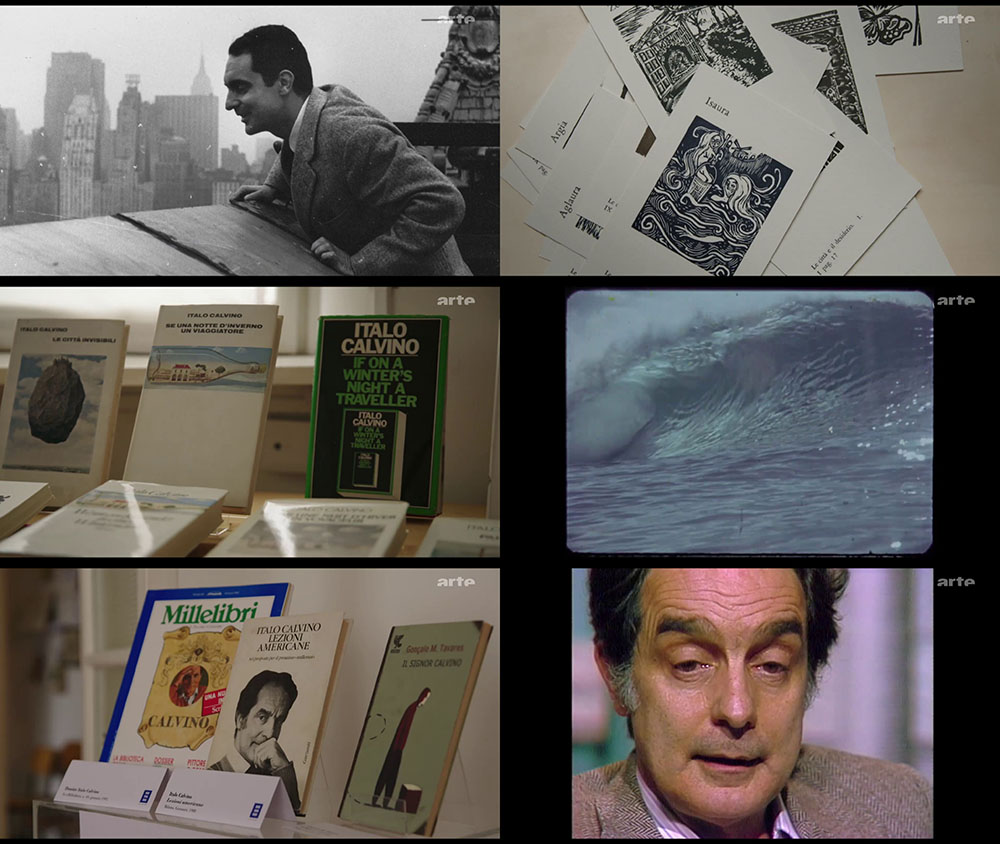
I wouldn’t usually spend so much time writing about something which was dissatisfying but, as with the SF documentary, this felt like a missed opportunity. Arte is a public service channel that produces many similar arts documentaries. The Calvino one is well-made, subtitled in English throughout, and contains a large quantity of photographs and scarce film footage which must have taken time to assemble. Despite his continued popularity Italo Calvino has been very poorly served by Anglophone documentaries. The BBC interviewed him in 1985, the last year of his life, but the introduction to the man and his work was crammed into half an episode of Bookmark when he should have been profiled at greater length in an episode of Arena as Jorge Luis Borges was in 1982. Calvino said in the BBC film that he disliked being interviewed—he says something similar in one of the clips here—but he still spent enough time sitting in front of cameras to help support a better documentary.
Previously on { feuilleton }
• More Invisible Cities (and an invisible author)
• Invisible Cities: Miscellanea
• Seeing Calvino: Invisible Cities
• Gérard Trignac’s Invisible Cities
• Colleen Corradi Brannigan’s Invisible Cities
• Le Città In/visibili
• Mikhail Viesel’s Invisible Cities
• Bookmark: Italo Calvino
• Crossed destinies revisted
• Crossed destinies: when the Quays met Calvino
• Tressants: the Calvino Hotel