The Chronicle of the Cursed Sleeve

blacksword7.jpg

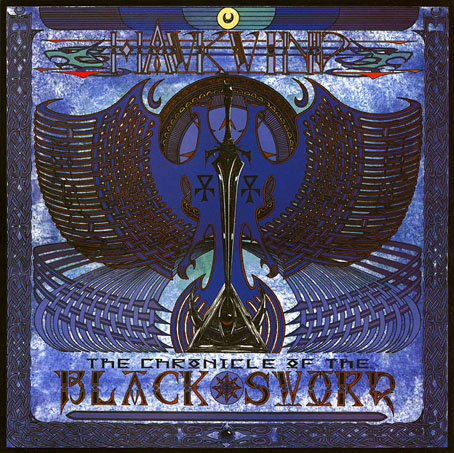
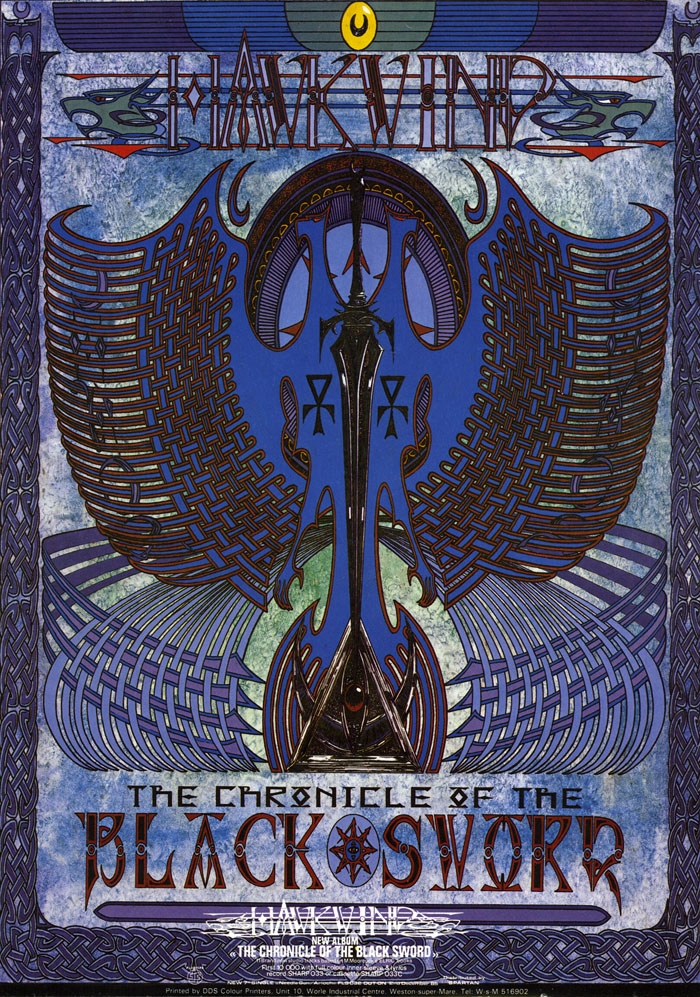
A copy of the cover art that I attempted to colour-correct some years ago to compensate for the poor print reproduction.

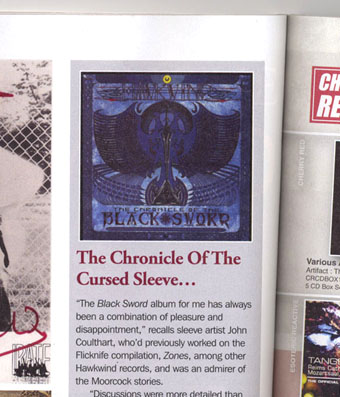
This month I’m in Record Collector magazine talking in a sidebar feature about my work on the Hawkwind album The Chronicle of the Black Sword. The issue is Hawkwind-heavy, with a Nik Turner interview, a history of Flicknife Records (the label that released COTBS), and a retrospective feature on the Black Sword album which was released in December 1985. My words were slightly cut to fit the allotted space but I can run the full text here in which I describe my ambivalent feelings towards this particular cover.

blacksword8.jpg

The Black Sword album for me has always been a combination of pleasure and disappointment. I was very pleased initially to hear that Hawkwind were writing a concept based on the Elric books, a series I’d enjoyed for many years. Cover discussions were a little more detailed than usual since this design was sketched out beforehand then approved by the Dave Brock and co. Prior to this I’d been creating something vague after equally vague requests; communication back then was all done via post and call box as I didn’t own a phone.

This was the first album where I was able to create an integrated front and back cover design. A friend had recently found me a copy of George Bain’s Celtic Art: Its Methods of Construction (1951), a study of the creation of Celtic knotwork, and I was keen to use this somehow. Rather than do a cover that looked like a fantasy paperback the idea was to use the knotwork style to create something that was suitably Hawkish whilst also fitting the Elric theme. The front cover has some nods back to earlier Hawkart in the winged sphere—which goes back to Barney Bubbles and his obsession with Ancient Egypt—and the eye-in-a-triangle, a symbol which first appeared on the cover of the Hawklog booklet in the In Search of Space album, and which I scattered throughout many of my Hawkwind designs.

All the lettering on the album was hand-drawn (not very well in places) using letterforms based on Bain’s examples from the books of Kells and Lindisfarne. I drew the track listing onto the artwork for the back cover, a decision that later proved to be a bad one when the band decided to change the running order of the songs, hence the large purple square that spoils the design. My lack of any direct contact with the record company made problems like this inevitable; I was trying to do graphic design at a distance without having any communication at all with the printers responsible for the sleeve. Before digital design, the creation of an album cover could be a complicated business involving photo-mechanical transfers, knockout areas, overlays, typesetters and more; if you weren’t in direct contact with the printer (or somebody who was) then you simply had to hope for the best.

This process of design-at-a-distance led to the disaster with the cover printing, the front of which has an unwarranted blue cast that dulled the impact of the sleeve and, for me, ruined the whole thing. You can see how the cover should have looked by comparing the background colours of front and back; the front was also printed in its true colours on the back page of the 1985 tour programme. It was this, and the messy appearance of the lettering on the back, that pushed me further towards ending my involvement with Hawkwind and doing something of my own over which I’d have complete control.

blacksword1.jpg

The retrospective feature in the magazine includes a picture of the back cover of the tour programme (above) so those familiar with the album can see the difference in reproduction. The difference isn’t so noticeable on the copies posted here after I tried altering the tones of the cover. Over the years I’ve grown used to the blueness but the back cover remains blighted by its purple boxes.

Continue reading “The Chronicle of the Cursed Sleeve”

Weekend links 269

cluster.jpg

Grosses Wasser (1979) by Cluster. Cover art by Dieter Moebius.

• RIP Dieter Moebius: one half of Cluster (with Hans-Joachim Roedelius), one third of Harmonia (with Roedelius and Michael Rother), and collaborator with many other musicians, including Brian Eno and Conny Plank. Geeta Dayal, who interviewed Moebius for Frieze in 2012, chose five favourite recordings. From 2008: Cosmic Outriders: the music of Cluster and Harmonia by Mark Pilkington. At the Free Music Archive: Harmonia playing at ATP, New York in 2008. Live recordings of Cluster in the 1970s have always been scarce but in 1977 they played a droning set at the Metz Science-Fiction Festival, a performance that was broadcast on FM radio (the Eno credit there seems to be an error).

• “I’ve since had the feeling that, if the attacks against The Satanic Verses had taken place today, these people would not have defended me, and would have used the same arguments against me, accusing me of insulting an ethnic and cultural minority.” Salman Rushdie on the fallout from the Charlie Hebdo killings.

• “The effect of these memories is to make you think you know the film better than you do, and wonder what it’s like actually to sit down and watch it.” Michael Wood on rewatching Orson Welles’ Touch of Evil (1958). Related: Tipping My Fedora on the film’s source novel, Badge of Evil (1956).

“To me, it’s simple,” he says. “Fantasy became as bland as everything else in entertainment. To be a bestseller, you’ve got to rub the corners off. The more you can predict the emotional arc of a book, the more successful it will become.

“I do understand that Game of Thrones is different. It has its political dimensions; I’m very fond of the dwarf and I’m very pleased that George [R R Martin], who’s a good friend, has had such a huge success. But ultimately it’s a soap opera. In order to have success on that scale, you have to obey certain rules. I’ve had conversations with fantasy writers who are ambitious for bestseller status and I’ve had to ask them, ‘Yes, but do you want to have to write those sorts of books in order to get there?’”

Michael Moorcock talking to Andrew Harrison about fantasy, science fiction, the past and the present.

• “Architects love Blade Runner, they just go bonkers. When I was working on the film, it was all about, let’s jam together Byzantine and Mayan and Post-Modern and even a little bit of Memphis, just mash it all together.” Designer and visual futurist Syd Mead talking to Patrick Sisson.

• “Lucian of Samosata’s True History reads like a doomed acid trip,” says Cecilia D’Anastasio, who wonders whether or not the book can be regarded as the earliest work of science fiction.

• Mixes of the week: A Tribute to Dieter Moebius by Vegan Logic, and another by Totallyradio.

• The Phantasmagoria of the First Hand-Painted Films by Joshua Yumibe.

Islamic Geometric: calligraphic tessellations by Shakil Akram Khan.

Michael Prodger on The Dangerous Mind of Richard Dadd.

A chronological list of synth scores and soundtracks.

Touch Of Evil (Main Theme) (1958) by Henry Mancini | Badge Of Evil (1982) by Cabaret Voltaire | Touch Of Evil (2009) by Jaga Jazzist

Weekend links 260

burgher.jpg

Bachelor with “demons” (Sleezy) [sic] (2015) by Elijah Burgher. One of a new series of artworks by Burgher showing at Zieher Smith & Horton, NYC.

• The week in HR Giger: Belinda Sallin on her documentary, Dark Star: HR Giger’s World; Ron Kretsch on the unseen cinema of HR Giger; Matthew Cheney thinks the Gigeresque has become too familiar. I can see his point but originality is always in short supply; asking for something new means setting yourself up for a long wait.

Pwdre ser, or Star jelly, is “a pale, foul-smelling jelly traditionally associated with meteorite falls”. The Rot of the Stars at the ICA, London, is an audio-visual art collaboration between Jo Fisher and Mark Pilkington dealing with the mysterious substance.

• Mixes of the week: A Tri Angle Records birthday DJ set by Björk; OreCast 196 mix by Ilius; Secret Thirteen Mix 153 by M!R!M.

To assume that a given group of people would be similar because of birthdate, Ryder thought, was to risk committing a fallacy. “The burden of proof is on those who insist that the cohort acquires the organised characteristics of some kind of temporal community,” he wrote. “This may be a fruitful hypothesis in the study of small groups of coevals in artistic or political movements but it scarcely applies to more than a small minority of the cohort in a mass society.”

Generational thinking is a bogus way to understand the world says Rebecca Onion

The plan for an airport above the streets of Manhattan. Related: Charles Glover‘s similar plan for London.

Errol Morris on how typography shapes our perception of truth.

Michael Moorcock enjoyed The Vorrh, a novel by Brian Catling.

Clive Barker on almost dying, hustling, and killing Pinhead.

• A new Penguin Books website for Angela Carter.

• Callum James on artist Philip Core.

A Beginner’s Guide to King Tubby

King Tubby Meets Rockers Uptown (1976) by Augustus Pablo | Star Cannibal (1982) by Hawkwind | Sleazy (1983) by Jah Wobble, The Edge, Holger Czukay

More trip texts

parry1.jpg

More psychedelia of a sort. Anthologist Michel Parry, who died last year, was a familiar name to British readers of fantasy, horror and science fiction for his themed collections: Beware of the Cat (1972; horror stories about cats), The Devil’s Children (1974; horror stories about children), The Hounds of Hell (1974; horror stories about dogs), Jack the Knife (1975; Jack the Ripper stories), The Supernatural Solution (1976; occult investigators), Sex in the 21st Century (1979), and so on.

Parry also compiled multi-volume anthologies throughout the 1970s, two of which have always stood out for me: the Mayflower Books of Black Magic Stories ran to six volumes presenting a wide range of occult fiction that included a number of obscure tales from Victorian and Edwardian writers; for Panther Books he compiled three collections of drug-related fantasy and SF stories that are just as varied, and may even be unique for the way they place authors as such as Lord Dunsany and Norman Spinrad together in the same volume. Both series are very much of their time—occult psychedelia!—and are worth seeking out, if you can find them. I emphasise the last point because it’s taken me a while to find a copy of Strange Ecstasies that wasn’t being offered for bizarrely inflated prices; my paperback habit has its limits… None of these anthologies have been reprinted so they’ll become increasingly scarce. For more invented drugs, there’s a good list at Wikipedia.

parry2.jpg

Cover art by Bob Haberfield.

Strange Ecstasies (1973)
The Plutonian Drug (1934) by Clark Ashton Smith
The Dream Pills (1920) by FH Davis
The White Powder (1895) by Arthur Machen
The New Accelerator (1901) by HG Wells
The Big Fix (1956) by Richard Wilson
The Secret Songs (1962) by Fritz Leiber
The Hounds of Tindalos (1929) by Frank Belknap Long
Subjectivity (1964) by Norman Spinrad
What to Do Until the Analyst Comes (1956) by Frederik Pohl
Pipe Dream (1972) by Chris Miller

parry3.jpg

Cover art by Bob Haberfield.

Dream Trips (1974)
The Hashish Man (1910) by Lord Dunsany
As Dreams Are Made On (1973) by Joseph F. Pumilia
The Adventure of the Pipe (1898) by Richard Marsh
Dream-Dust from Mars (1938) by Manly Wade Wellman
The Life Serum (1926) by Paul S. Powers
Morning After (1957) by Robert Sheckley
Under the Knife (1896) by HG Wells
The Good Trip (1970) by Ursula K. Le Guin
No Direction Home (1971) by Norman Spinrad
The Phantom Drug (1926) by AW Kapfer

parry4.jpg

Cover art by Brian Froud.

Spaced Out (1977)
The Deep Fix (1964) by Michael Moorcock
All the Weed in the World (1961) by Fritz Leiber
The Roger Bacon Formula (1929) by Fletcher Pratt
Smoke of the Snake (1934) by Carl Jacobi
Melodramine (1965) by Henry Slesar
My Head’s in a Different Place, Now (1972) by Grania Davis
Sky (1971) by RA Lafferty
All of Them Were Empty— (1972) by David Gerrold

Previously on { feuilleton }
Trip texts
Acid albums
Acid covers
Lyrical Substance Deliberated
The Art of Tripping, a documentary by Storm Thorgerson
Enter the Void
In the Land of Retinal Delights
Haschisch Hallucinations by HE Gowers
The art of LSD
Hep cats

Weekend links 240

wiley.jpg

The Death of Chatterton (2014) by Kehinde Wiley.

• Mixes of the week (and the week before that): The Conjurer’s Hexmas: Second Rite by SeraphicManta; Secret Thirteen Mix 140 by Deaf Center; Best of 2014: A Highly Opinionated Mix by Robin The Fog.

• Never mind Music for Airports, how about Music for Neurosurgery? The Tegos Tapes Edits are extracts from “12 hours of unheard Vangelis music soundtracking films of various surgical operations”.

• “It was one of the first magazines that, with science-fiction and comics together, proposed comics for adults.” Aug Stone on 40 years of publisher Les Humanoïdes Associés and Métal Hurlant.

• Zinesters Do It on the Photocopier: Stephanie Schroeder on the Queer Zine Archive Project. Related: Holy Titclamps by Larry-bob Roberts.

A Year In The Country reached the end of its 365 posts. The archive is well worth a browse.

• “These people love to collect radioactive glass. Are they nuts?” asks Ben Marks.

• Think before you share: 86 viral images from 2014 that were totally fake.

• The Anti-Tolkien: Peter Bebergal on Michael Moorcock.

• Extracts from Alan Bennett‘s diary for 2014.

John Cage 4’33” Autotune

Alpha (1976) by Vangelis | Reve (1979) by Vangelis | L’Enfant (1979) by Vangelis