Moorcock: Faith, Hope and Anxiety

moorcock.jpg

Photo of the author by Linda Moorcock.

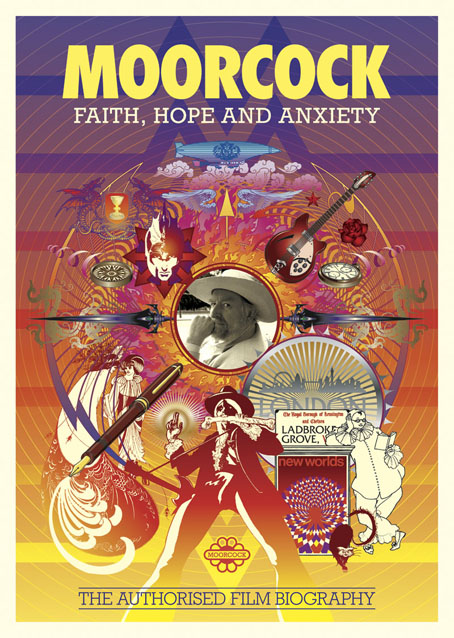
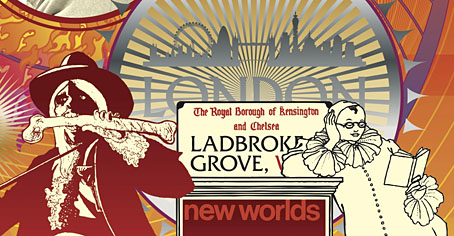
I mentioned a few days ago that I had another new piece of work to reveal, and this is it, a poster/promotional piece for Russell Wall’s forthcoming documentary about Michael Moorcock. The main challenge with one was to create something that would give a sense of Moorcock’s extensive career and the genre-spanning content of his many books.

mm1.jpg

I took the 1970s as the starting point, since this was the period when his reputation as a writer was established worldwide. The decade began with Britain’s bookshelves being colonised by Moorcock’s SF and fantasy novels published by Mayflower with vivid covers; it saw a cult feature film—The Final Programme—made from his first Jerry Cornelius novel, and it ended with the fourth Jerry Cornelius novel, The Condition of Muzak, winning a serious literary award, the Guardian Fiction Prize.

mm2.jpg

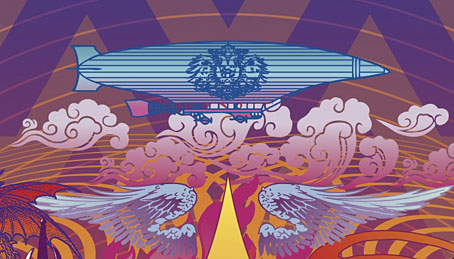
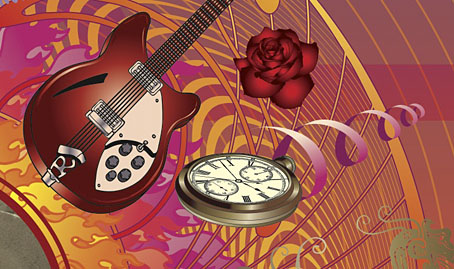
So the general appearance of the design, the headline typography, and the colour scheme are a nod to the Mayflower covers and especially to Bob Haberfield’s artwork which often used a similar style of Tibetan flames and clouds. The rest of the type is set in Rockwell, a preferred typeface of the Hipgnosis design team for much of the 1970s. Early on I had the idea of filling the design with stylised graphics like those used by some of the Hipgnosis illustrators, chiefly George Hardie, but that idea receded once the composition began to arrange itself. The fountain pen is the main hangover from this, a hard-edged graphic tilted at an angle like many of Hardie’s illustrations. The pen is a little inappropriate given that Moorcock is famous for knocking out novels at speed on a typewriter but it made a good visual rhyme with the guitar, a Rickenbacker like the one the author played in his Deep Fix band.

mm3.jpg

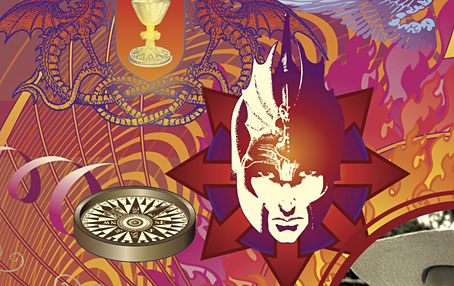
Elsewhere there are many specific references competing for attention: the Elric head is Jim Cawthorn’s illustration from the first edition of Stormbringer (1965); the Jerry Cornelius figure (straddling a repurposed Mayflower logo) is one of Mal Dean’s best, as seen on the cover of issue 191 of New Worlds magazine; the sorcerous blades are my own designs from 1985 as seen on the sleeve of Hawkwind’s Chronicle of the Black Sword album; the Beardsley figures from Salomé were a vague gesture to the 1890s but the Pierrot figure happens to be one Moorcock used for a while as a bookplate, something I didn’t know until I’d placed it in the design; the cat at Pierrot’s feet is another Beardsley from one of the Bon-Mots books; the London skyline is a contemporary one, London past and present having been a continual feature of Moorcock’s writing throughout his career. Lastly, all these details are contained by a graphic based on Abram Games’ BBC TV ident from the 1950s. When Russell and I began talking about this project the words “television biography” were being used so this would have connected to that idea, and to the decade when Moorcock’s career began.

mm4.jpg

I don’t know when the documentary will be released but any news will be posted here in due course. There’s also talk of making copies of the poster available for purchase but nothing concrete has been decided yet.

Previously on { feuilleton }
Eduardo Paolozzi at New Worlds
Elric 1: Le trône de rubis
Into the Media Web by Michael Moorcock
The Best of Michael Moorcock
Revenant volumes: Bob Haberfield, New Worlds and others

Weekend links 225

mori.jpg

Still from The Shaman-Girl’s Prayer (1997), a video piece by Mariko Mori. This page has pictures of Mori’s futuristic/cosmic performances, films & environments.

Time Out of Mind (1979) was a BBC TV series about science fiction writers, five short films concentrating on Arthur C. Clarke, John Brunner, Michael Moorcock, Anne McCaffrey and an sf convention. I was only interested in the Moorcock film at the time, not least because it featured a short clip of Hawkwind playing Silver Machine, and inserted scenes from the film of The Final Programme (1973) between the interviews. The Moorcock episode is less about his books than about New Worlds magazine and the so-called New Wave of sf in general, so you also see rare footage of M. John Harrison in a Barney Bubbles “Blockhead” T-shirt talking then ascending a limestone cliff, and bits of interviews with Brian Aldiss and Thomas Disch. Ballard isn’t interviewed but is present via a scene from the Harley Cokeliss film Crash! (1971) in which Gabrielle Drake slides in and out of a car while someone reads Elements of an Orgasm from The Atrocity Exhibition.

• “…there happened to be a book on Ritual Magick that talked about John Dee and summonings and Dr. Faust and all that kind of stuff. So then obviously at that age, too, I read HP Lovecraft and then Michael Moorcock and what they call fantasy literature. Through HP Lovecraft I discovered Arthur Machen, and I think that sort of percolated down inside…” Dylan Carlson of Earth talking to Steel for Brains. The Wire has the vinyl-only track from the new Earth album, Primitive And Deadly, and a track from Carlson’s solo album, Gold. Related: Artwork by Samantha Muljat, designer/photographer for the new Earth album.

Phantasmaphile has details of the next two issues of deluxe occult magazine Abraxas. Issue 6 includes a major feature on Leonora Carrington while Luminous Screen is a special issue devoted to occult cinema.

• More Broadcast: Video of a performance at Teatro Comunale di Carpi, March 2010 (part 2 here), and “constellators and artifacts” at A Year In The Country.

• “Petition demands return of ‘Penis Satan’ statue to Vancouver.” There’s an uncensored photo of the contentious statue here.

• Literary Alchemy and Graphic Design: Adrian Shaughnessy on James Joyce’s writings among graphic designers.

• Frank Pizzoli talks to John Rechy about “the gay sensibility”, melding truth and fiction, and his literary legacy.

• Mixes of the week: Secret Thirteen Mix 127 by Roberto Crippa, and FACT Mix 459 by Craig Leon.

Alan Moore has finished the first draft of his million-word novel, Jerusalem.

• Crazy pavings: Alex Bellos on Craig Kaplan’s parquet deformations.

Noise Not Music: “Live recordings, obscure cassettes and more…”

Pylon of the Month

Zoot Kook (1980) by Sandii | Rose Garden (1981) by Akiko Yano | Telstar (1997) by Takako Minekawa

The Use and Abuse of Books

savoy.jpg

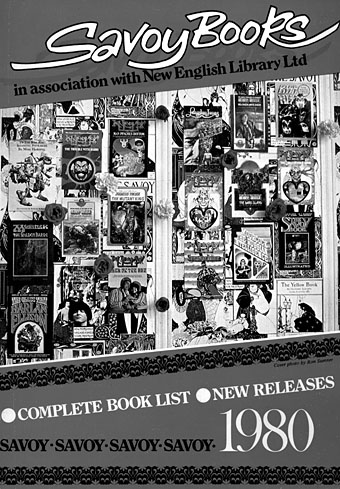
Savoy • Savoy • Savoy: The first wave of book covers pinned to the Beardsley wallpaper of the Deansgate office.

I often feel I’m in a minority in never having been desperate to see my work in a gallery. We are, after all, living in the Age of Mechanical Reproduction (thanks, Walter), and the idea of having to visit a physical location in order to see a work of art can seem like a rather antiquated affair. (Plenty of arguments counter this, of course, but I don’t create anything that needs to be experienced in situ, and I’m also not enmeshed in the art market.) So it’s been surprising this month to realise that examples of my work are currently on display in Monterey, California (the Tentacles exhibition), London (Comics Unmasked: Art and Anarchy in the UK at the British Library which ends today) and in Manchester (The Exhibition Centre for the Use and Abuse of Books at the International Anthony Burgess Foundation). If all goes according to plan, some of my steampunk book covers will also be exhibited in Beijing next month; more about that later.

dbmb.jpg

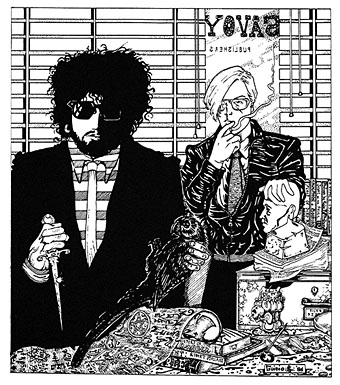
Britton & Butterworth by Kris Guidio (1986).

The Use and Abuse of Books is a necessarily brief overview of the 40-year history of Savoy Books, a notable moment in the life of the company since this is the first time any Manchester institution has acknowledged the existence of a local publisher with such a long, varied and often controversial history. In part this is a result of the cultural histories of Manchester concentrating almost exclusively on the music scene. Many of the books and features written about Manchester arts have been produced by DJs or ex-musicians who appear tone-deaf to literary culture despite the existence of Carcanet Press (established 1969), Savoy Books, and other more recent publishers who are happy to operate outside London. (The venerable Jon Savage gets a pass here.) Carping aside, The Use and Abuse of Books describes itself thus:

Featuring text, images and rare promotional content from Savoy’s infamous 1989 publication Lord Horror, the exhibition tackles the question of whether the depiction and description of horrific acts is justified in satire. In 1992 Lord Horror was declared by Judge Gerrard Humphries as ‘a glorification of racism and violence’ whereas writer Michael Moorcock believed the book to belong to ‘a tradition of lampoon, of exaggeration. Its purpose is to show up social evils, and the evils within ourselves.’ Displaying artwork from Sinister Legends and Meng and Ecker alongside other panels from rare comics and graphic novels (including Reverbstorm), The Use and Abuse of Books also examines the relationship between text and imagery within Savoy’s publications, revealing how artwork from John Coulthart, Kris Guidio and James Cawthorn supplements and enhances the storytelling through visual references to architecture, cultural figures or specific works of art. The exhibition will be open 10am–4pm weekdays and in the evenings during events from Friday 15th August until Friday 5th September. (more)

Some of my pages from Lord Horror: Reverbstorm have been printed large-size for the walls, and there’s also a life-size cardboard figure of my Beardsley-style Lord Horror. Savoy publications past and present are on display, including some of my book designs. It’s fitting that this should be taking place under the aegis of the Anthony Burgess Foundation; Burgess was a great Joycean and a champion of two Savoy favourites: William Burroughs and JG Ballard. I can’t imagine him getting too enthusiastic about many of Savoy’s publications but I’d hope he might have appreciated the spirit of Mancunian bloody-mindedness in which they were produced.

Lovecraft: Démons et Merveilles

hpl-pd01.jpg

UK publisher Titan Books announced earlier this year that they’d be reprinting the first volume of Glénat’s excellent comic-strip adaptation of Michael Moorcock’s Elric novels in an English edition, a book that should be out in September. This was a surprise to me when I’ve complained for years that Titan seldom showed any interest at all in Continental comics, despite France and Belgium being over-burdened by world-class creators. I’ve been surprised again this week by the news that Titan will also be reprinting the English edition of Philippe Druillet’s The Six Journeys of Lone Sloane in March next year. Druillet’s books have been unavailable in English editions for decades so this is good news indeed, even if the attention is scandalously late.

As I noted in the post about Glénat’s Elric, Druillet illustrated Moorcock’s albino anti-hero in 1973. The artist is better known for his Lovecraftian depictions, however, even when—as in the adventures of Lone Sloane—the story could easily sustain itself without all those sinister temples, fish people, Cyclopean architecture and the menace of nameless gods. The Lovecraft influence, which can be found in some of his earliest illustrations, comes to the fore in Lovecraft: Démons et Merveilles, an HP Lovecraft story collection published in an expensive limited edition by Éditions Opta/André Sauret in 1976. Druillet provided ten colour illustrations plus a design for the boards. Some of these illustrations have since been used on paperback editions of Lovecraft in France, although many of them crop the artwork. Tentacles have become a perennial cliché in Lovecraftian art (I should know, I’ve drawn enough of them) so it’s worth noting how few there are in Druillet’s drawings.

hpl-pd02.jpg

hpl-pd03.jpg

hpl-pd04.jpg

Continue reading “Lovecraft: Démons et Merveilles”

Weekend links 201

kettelwell.jpg

An illustration by John Kettelwell for The Story of Aladdin and the Wonderful Lamp (1928).

• “The strain in everything I write, of not being taken with the bounteousness of humankind, was also the attitude of both my parents.” Jonathan Meades talking to James Kidd about his forthcoming memoirs.

• 7 Trumps From the Tarot Cards and Pinions (1969), and album of electronic music by Ruth White, is being given a limited vinyl reissue. Related: Ruth White—An American Composer.

• 82 minutes of Michael Moorcock talking in 1972 to Jean-Pierre Turmel, co-founder of the Sordide Sentimental record label.

If Verne’s protagonists often seem to stop short of revelation, it’s because the revelation is not meant to be known. Revelation has a way of putting man back at the front of the evolution chart, moving neatly toward a happily progressing future, out of the darkness and into the light. The characters who embark upon the Voyages Extraordinares move backward and forward and all about, spun around like blindfolded children trying to pin the tail on the donkey. The point of the adventure, after all, is not to have a conclusion; it is to get knocked off your feet.

Stefany Anne Golberg on Journey to the Center of the Earth at 150.

• Photographs of pre-Haussmann Paris by Charles Marville, and photographs by Amy Heiden of industrial ruins.

• Mixes of the week: FACT Mix 427 by Wild Beasts, and Secret Thirteen Mix 108 by Kangding Ray.

• Hear Italo Calvino read selections from Invisible Cities, Mr Palomar and others.

William S. Burroughs in Dub conducted by Dub Spencer & Trance Hill.

• Cycles, Returns & Rebirth: Alexander Tucker on Derek Jarman.

Harold Budd: the composer with no urge to make music.

The Museum of Imaginary Musical Instruments.

• 80 minutes of Monolake playing live in 1999.

• At 50 Watts: Dyl’s Dance.

Owls And Flowers (2006) by Belbury Poly | Learning Owl Reappears (2011) by The Advisory Circle | The Owls (2013) by Félicia Atkinson