Weekend links 350

eaton.jpg

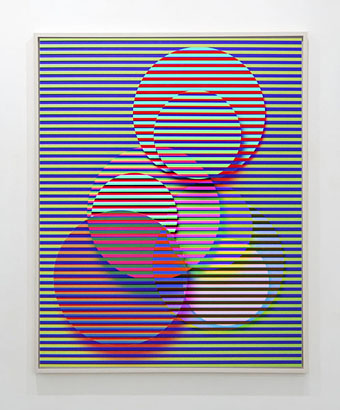
Transition H50 (2016) by Jessica Eaton.

• One of my weekend posts in 2012 contained details about Taking Tiger Mountain, a low-budget feature film put together in 1983 by Tom Huckabee using footage originally shot in Tangier and Wales in the 1970s. Huckabee’s film is a strange “experimental” work of science fiction, based in part on William Burroughs’ Blade Runner script (no relation to the Ridley Scott film apart from the title), and described here as “a psychotropic apocalyptic odyssey”. The most notable aspect of the film for many will be the presence of a young Bill Paxton in the lead role, something I was reminded of when Paxton’s death was announced earlier this week. Five years ago there was only a short clip of Taking Tiger Mountain available on YouTube but since then a full copy has appeared; watch it here while you can. (The widescreen frame is cropped, and the sound is all in one channel but it’s still watchable.) Tom Huckabee talked about the film’s production (and the Burroughs connections) to Beatdom. A curio that deserves wider attention.

• “With Biller, the references come thick and fast. In The Love Witch, she channels, among others, 50s Hitchcock, Douglas Sirk’s lurid lushness, Rainer Werner Fassbinder’s deadpan gaze, Nicholas Ray’s poetry, Sam Fuller’s tabloid style and Todd Haynes’s revisionist sexual politics. […] Then add the Technicolor, widescreen, haute-Hollywood “women’s pictures” of the 50s, a touch of Hammer Studios, The Wicker Man, Rosemary’s Baby and any number of studio melodramas and musicals.” John Patterson talks to director Anna Biller about her new film, The Love Witch.

• Mix of the week is the Anxious Heart Mix by Moon Wiring Club, another excellent blend of electronica, industria and dialogue samples from the outer limits of the televisual sphere. Also of note this week: VF Mix 83, an Adrian Sherwood selection by Pinch, XLR8R Podcast 479 by Chris SSG, and Secret Thirteen Mix 213 by -N.

• “Anthropologically, this was going on all around me: it was amazing and nobody was dealing with it like that, so I just went for it.” Hal Fischer on his photo-art series, Gay Semiotics, which is on display at Project Native Informant, London, until 1st April.

• Coming in May from Luaka Bop, World Spirituality Classics 1: The Ecstatic Music of Alice Coltrane Turiyasangitananda, the first-ever compilation of Alice Coltrane’s scarce releases on the Avatar Book Institute label.

Cinephilia looks back at Robert Wise and Nelson Gidding’s film of The Andromeda Strain (1971).

• Psychedelic Speed Freak: Remembering the blistering experimentalism of Hideo Ikeezumi.

• More witchery: S. Elizabeth talks to Pam Grossman about art, film and hex power.

• At The Quietus: Harry Sword on the strange world of Surgeon.

Leonor Fini playing cards

The Feathered Tiger (1969) by Kaleidoscope | Taking Tiger Mountain (1974) by Brian Eno | Plain Tiger (1985) by Cocteau Twins

Weekend links 345

lazo.jpg

Wasted Alice (2017) by Sonia Lazo.

Brian Eno: “We’ve been in decline for 40 years—Trump is a chance to rethink.” An equivocal headline, and the usual misinterpretation from the hard-of-thinking, prompted Eno to issue a clarification. More Trumpery: Jonathan Meades wonders what kind of wall “The Lout” might want to build. Related: almost all of Meades’ smart and witty television essays may be viewed at MeadesShrine (click through to Vimeo for download links).

• “Once you’ve turned entire buildings into instruments as on Medium, and then you’ve made the ionosphere itself an instrument as on Signal, where do you go next?” Emptyset discuss their forthcoming album, Borders, and a change in their working methods.

Christopher Burke & David Davis at Weird Fiction Review talk to Valancourt Books about reprinting neglected works of horror and gay fiction.

• At the BFI this week: All about Jim Jarmusch’s leading men, from Tom Waits to Bill Murray, and John Hurt (RIP): 10 essential films.

• “Claude Arnaud’s biography of Jean Cocteau shows how the artist lived a life nourished by infinity,” says Ricky D’Ambrose

Sukhdev Sandhu on John Berger: “a pathfinder who was alive to the present”.

Theodore Carter on Doll Part Art: Visual Feasts Made of Plastic Bodies.

• Count Backwards from Ten: Peter Bebergal‘s Top 10 Occult in Media.

• Books from Strange Attractor will now be distributed by MIT Press.

Eero Saarinen, the architect who saw the future.

• Mix of the week: FACT Mix 585 by Niagara.

• RIP Maggie Roche.

Hammond Song (1979) by The Roches | Losing True (1982) by The Roches | Keep On Doing What You Do / Jerks On The Loose (live, 1990) by The Roches

Jaki Liebezeit times ten

jaki11.jpg

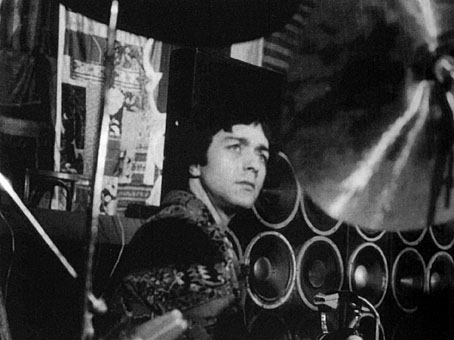
Jaki Liebezeit.

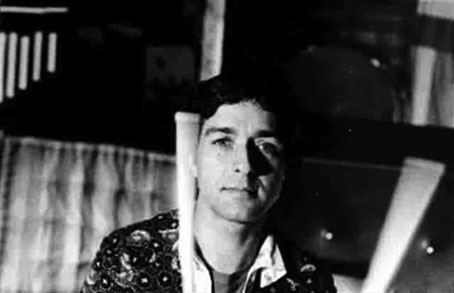
One thing to note about the late Jaki Liebezeit is that everyone liked Can in the 1970s, which means that everyone liked Jaki Liebezeit’s drumming. When the music wars were raging in 1976, Can were one of the few groups from the hippy side of the barricade given a pass by the punks. Prog-heads liked Can because of the rock grooves and complex improvisations; punks enjoyed the muscular insistence of songs like Father Cannot Yell and Halleluwah. David Bowie liked Can; Brian Eno liked Can enough to let Jaki Liebezeit guest on Before And After Science (Eno also made this tribute video for the Can DVD); John Lydon when he was still Johnny Rotten played Halleluwah on his Capital Radio show in 1977 together with other favourite records; a year later, Pete Shelley wrote a sleeve note for a Can compilation (and the first Can album I bought), Cannibalism; Mark E. Smith liked Can (of course); Siouxsie called Jaki Liebezeit “the best drummer in the world,” while Jah Wobble would go on to work with Liebezeit on numerous recordings under his own name and as a guest on other albums. Some of the Wobble recordings appear below. If there’s a minimum of Can music in the following list that’s mainly because Mute/Spoon keep the back catalogue away from British users of YouTube. I don’t mind that; the absence of the prime stuff means I can draw attention to some examples of Jaki Liebezeit’s post-Can work which might otherwise be overlooked.

jaki01.jpg

Mother Sky/Deadlock (1970) by Can.

Two numbers from the fantastic live set the group played on German TV for an audience of ecstatic/bored/stoned hippies.

jaki02.jpg

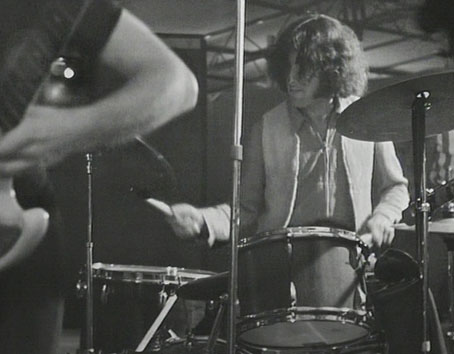
Jaki Liebezeit drum solo (1970).

In the Can Book Liebezeit says he never played drum solos but he was forgetting about this example from the group’s early days.

jaki03.jpg

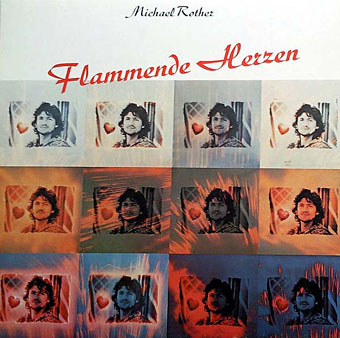
Flammende Herzen (1977) by Michael Rother.

Michael Rother’s first solo album was also his best after leaving Neu! The album is essentially a duet between Rother and Liebezeit, with Rother playing all instruments apart from the drums.

jaki04.jpg

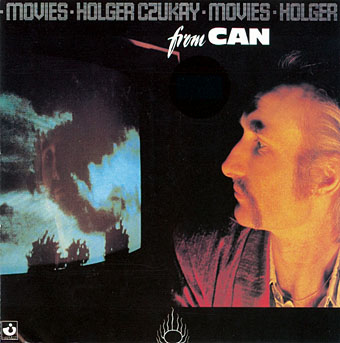
Oh Lord Give Us More Money (1979) by Holger Czukay.

In which Holger Czukay takes the Can song Hunters And Collectors, removes the vocals then extends and remixes the whole thing into a 13-minute collage blending the music with BBC sound effects and vocal samples taken from radio and TV. Samplers didn’t exist in 1979, this was all done with tape, and it’s incredible. I forget whether it was Jaki Liebezeit or Michael Karoli who said they didn’t recognise their playing afterwards (probably the latter) but Leibezeit’s drums sustain the entire piece. He also plays on the rest of the album. Movies is Czukay’s masterpiece, and more true to the questing, inventive spirit of Can than the albums the group made after Landed. Another track, Persian Love, samples Middle Eastern vocalists two years before My Life In The Bush Of Ghosts. Eno was paying attention.

Continue reading “Jaki Liebezeit times ten”

Weekend links 343

carrington.jpg

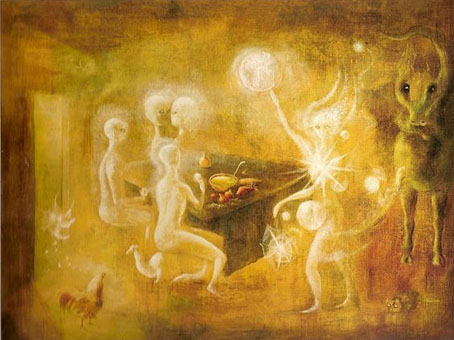
Sidhe, the white people of the Tuatha Dé Danann (1954) by Leonora Carrington.

• January brings a wealth of recommended-reading lists for the new year, together with the feeling that many of those lists are merely clones of each other. Not so the recommendations at Strange Flowers which also includes links to forthcoming events such as this exhibition of Symbolist art at the Guggenheim, New York.

Some Ceremonies are Better than Others, an exhibition of sound objects and drawings by Matthias König & Ibrahim R. Ineke inspired by Arthur Machen’s The White People, at The Bries Space, Borgerhout, Belgium, from 21st January. Previously: Ineke’s comic-strip adaptation of the Machen story.

• “These must-reads explore Dada, Futurism, Surrealism, and the art of opposition,” says Carol Cooper. One of the titles under discussion is the Bruce Sterling book I designed and illustrated last year, Pirate Utopia. Sterling talked to Wired about the book and its relation to the present moment.

RIP Mark Fisher, a cultural theorist whose death was announced just as extracts from his latest book, The Weird and the Eerie, were beginning to appear. One of those extracts is at The Quietus. Related: Fisher’s k-punk blog and its earlier incarnation.

James Cargill (ex of Broadcast) announces a debut release by his new group, Children of Alice. Related: Jonathan Miller’s 1966 TV film of Alice in Wonderland rescored with Broadcast songs.

We are the Martians: the Legacy of Nigel Kneale, a collection of Kneale-related essays and appreciations edited by Neil Snowdon, is finally appearing in print from PS Publishing.

• Pursuing paths hauntological, The Electric Pentacle offers “an unholy stew of library music, Kosmische, arcane ritual electronica, modular synthesisers and shortwave radio”.

• Mixes of the week: The Ivy-Strangled Path Vol. XVI by David Colohan, and Low Visibility Across Sunken Village by The Geography Trip.

• “With Reflection, [Brian Eno] offers generative music for a turbulent time,” says Geeta Dayal.

Anna Biller, director of The Love Witch, talks to New Jack Witch about her film.

• The story behind Gay Bob, the world’s first out-and-proud doll.

Alice (1969) by Jon Plum | Alice (1982) by The Sisters of Mercy | Alice (2009) by Sunn O)))

Weekend links 307

chew.jpg

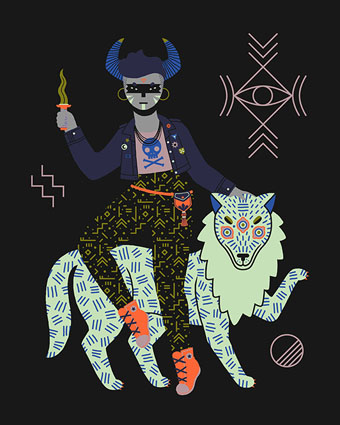
Demon (2014) from the Witch Series by Camille Chew.

• Released next month, Machines Of Desire is the first album of new music by Peter Baumann since Strangers In The Night in 1983. Baumann’s first two solo albums, Romance 76 (1976) and Trans Harmonic Nights (1979), are exceptional works of analogue electronica that frequently outmatch his former colleagues in Tangerine Dream. Both albums have been unavailable for over 20 years so it’s good to know that Cherry Red are reissuing them at the end of May (see here and here).

• RIP Jenny Diski whose death from cancer wasn’t a surprise when she’d been writing about her condition for many months. Linked here in 2013 was this pre-diagnosis meditation on death that takes in Nabokov, Beckett and Francis Bacon (philosopher, not artist). “Jenny offered a living example of how, sometimes, compassion can be born of misanthropy,” says Justin EH Smith. The LRB’s archive of Diski writings is currently free to all.

Murder by Remote Control, a graphic novel by artist Paul Kirchner and writer Janwillem van de Wetering that “resembles a Raymond Chandler-esque noir ‘whodunnit,’ viewed through the psychotropic lens of filmmaker Alejandro Jodorowsky”.

Inspired by Gore Vidal’s 1968 satirical novel, Myra Breckinridge which was denounced as obscene by conservatives, [Boyd] McDonald embarked on a radically, offensive publication, one that avoided the sexless influence of middle class gay mores that sought to whitewash the homosexual experience in order to present a more palatable image of assimilated gays to the general society. This political strategy was successful in achieving gay marriage and more tolerance, but, in the opinion of McDonald, came at a cost. Straight to Hell was in fact the first queer zine. Utilizing erotic photos, interviews and news, McDonald saw it as a “newsletter for us,” the small group of deviates who were its earliest subscribers.

Walter Holland reviewing True Homosexual Experiences: Boyd McDonald and Straight to Hell by William E. Jones

• “HP Lovecraft’s…fascination with all things tentacular and aquatic is unmistakably imprinted on Evolution“, a new film by Lucile Hadžihalilović. Watch the trailer.

• At Dangerous Minds: Broken, the notorious Nine Inch Nails video collection with “snuff movie” interludes by Peter Christopherson, is available online (again).

BEAK> (Geoff Barrow & Billy Fuller) make “claustrophobic, hypnotic music, drawing…on krautrock, post-punk and Interstellar-Overdrive psychedelia”.

• Mixes of the week: Bacchus Beltane 3 : The Age of Abrasax by The Ephemeral Man, and Secret Thirteen Mix 183 by December.

Tease by Jan Rattia, photographs of male strippers on display at ClampArt, NYC.

Wu Zei (2010), a sea-monster sculpture by Huang Yong Ping.

• “I was born weird,” says Robert Crumb.

Sacred Revelation by Susanna

Broken Head (1978) by Eno, Moebius & Roedelius | Broken Horse (1984) by Rain Parade | Broken Harbours (Part 1) (2001) by Stars Of The Lid