Kafkaesque

kafkaesque1.jpg

Another book design of mine (interiors only) which I completed last September for Tachyon and about which I had this to say at the time:

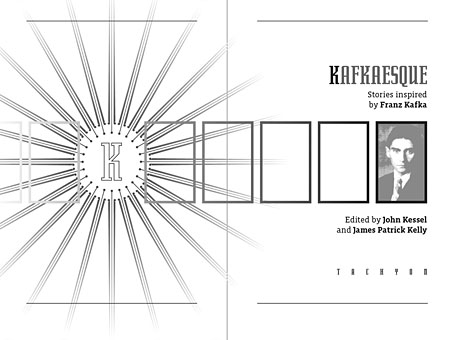
Kafkaesque [is] edited by John Kessel and James Patrick Kelly. It’s a collection of short stories either inspired by Franz Kafka, or with a Kafka-like atmosphere, and features a high calibre of contributions from writers including JG Ballard, Jorge Luis Borges, Carol Emshwiller, Jeffrey Ford, Jonathan Lethem and Philip Roth, and also the comic strip adaptation of The Hunger Artist by Robert Crumb.

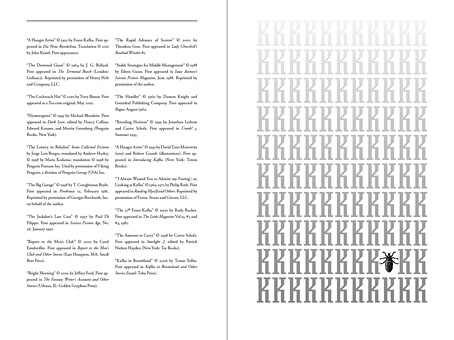
The book gained a positive review at SF Site recently, reminding me that I hadn’t written anything about the design. As with some of my other Tachyon work the interiors take their cue from a pre-determined cover by another designer, in this case Josh Beatman. I followed Josh’s type choices (Senator for the titles and headings) and also extended his use of an insect as a recurrent motif. Before I saw the contents I was fairly determined to avoid any further insect imagery but it became apparent that Kafka’s Metamorphosis is a repeated reference in many of the stories.
kafkaesque2.jpg

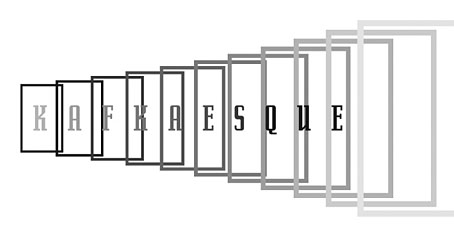
As for the recurrent “K”, that seemed inevitable given Kafka’s own use of the letter as well as its presence not only in Kafka’s own name but in the names of the editors. The frames were an idea borrowed from (and referring to) Steven Berkoff’s stage adaptation of The Trial in which portable frames serve on the stage as doorways, windows, corridors, picture frames and so on. I was hoping to do more with this idea but (as is often the case) ran out of time to develop it further.
kafkaesque3.jpg

And while we’re on the subject of Tachyon designs, I don’t seem to have mentioned my interiors for a Joe R Lansdale collection, Crucified Dreams, which also appeared last year. This is a hard-boiled anthology of Lansdale’s favourite stories for which I supplied suitably rough-and-tough graphics comprising scanned scalpel blades and lettering assembled from torn newspaper pages. I’m due to start on some new work for Tachyon this week. More about that at a later date.

Continue reading “Kafkaesque”

Weekend links 90

varo.jpg

Portrait of Dr. Ignacio Chavez (1957) by Remedios Varo (1908–1963) some of whose Surrealist paintings can be seen at Frey Norris, San Francisco, from 19th January. There’s also In Wonderland: The Surrealist Adventures of Women Artists in Mexico and the United States at the Los Angeles County Museum of Art from 29th January.

The current crop of Republicans jostling for the Presidential nomination have reminded me of the Downunder people in Harlan Ellison’s post-apocalypse novella A Boy and His Dog (1969): a retrograde, fear-ridden community who send troublesome individuals to be exterminated at “the farm”. Rick Santorum (unforgettably pictured here with family in 2006 after losing an election) almost received the majority of Iowa’s votes for his nomination last week, prompting renewed scrutiny of his negative views about gay people, sexually active people, foreign people (especially Arabs and Mexicans), and anyone generally who isn’t a white, Catholic, Downunder person. Santorum is against gay marriage, of course—it’s hard to find a Republican who isn’t—but he also wants to ban abortion even in cases of rape and incest, and given the opportunity would allow US states to prevent any use of contraception. Add to this his pro-torture stance (which offends current Catholic church policy), and his willingness to wage war with Iran, and it’s easy to see why his name prompts reactions such as this:

I have a history with Rick Santorum. In 2003, when Santorum, in an interview with the Associated Press, first compared gay relationships to child rape and dog fucking (have I mentioned that Santorum has compared gay relationships to child rape and dog fucking?), I held a contest to redefine Santorum‘s last name. The winning definition: “the frothy mix of lube and fecal matter that is sometimes the byproduct of anal sex.” (“Sometimes” is the most important word in the new definition of santorum; if you’re doing anal sex correctly, there won’t be any santorum – lower- or upper-case.) And since 2003, the new definition has been the No. 1 Google return when you search “santorum“.

Rick Santorum’s homophobic frothing by Dan Savage

Related: Santorum was named one of the three “most corrupt” Senators in 2006 | “Homohater fosser fram” which is how Dagbladet, Norway’s second largest tabloid newspaper, introduces Santorum to its readers | “Rick Santorum channels Saint Augustine” an article at Slate exploring the Handmaid’s Tale extent of Santorum‘s attitudes towards sex and morality | Rick Santorum quotes as New Yorker cartoons.

marlin.jpg

The Rod (1973) by Brigid Marlin.

• Ballardian posts a long-overdue interview with Brigid Marlin, famous now for having brought two lost Paul Delvaux paintings back to life for JG Ballard, but also a woman with an extensive career as a fantastic artist using Ernst Fuchs‘s laborious mische painting technique.

• Quentin Blake on Ronald Searle, in which Blake notes that his hero was given a full-scale exhibition of his work at the Bibliothèque Nationale, France, in 1973 whilst being ignored throughout his life by the major institutions in Britain.

• Alfred Jarry: A Pataphysical Life by Alastair Brotchie is reviewed by Michael Moorcock who tells me the Guardian cut out his references to Boris Vian, Maurice Richardson and David Britton.

• Ian McKellen stirs things up by suggesting (not for the first time) that Shakespeare was bisexual.

• Ten posters by Only More Never Less inspired by Pink Floyd’s Dark Side of the Moon.

• An end to bad heir days: The posthumous power of the literary estate.

• Peace Eye! Fug! A Long Talk With Ed Sanders.

• Sand sculptures by Carl Jara.

• Letterheady

• Skylab: These Are The Blues (1995) | Beyond The Breeze (1995) | Red Light, Blue Light (1995) | Indigo (Sabres of Paradise remix, 1995) | Seashell (Nobukazu Takemura mix, 1995).

Weekend links 86

alastair.jpg

Salammbô by Alastair (Hans Henning Voigt) from Harry Crosby‘s Red Skeletons (1927). Dover published a new collection of Alastair’s drawings in September.

“A Taste of Honey showed working-class women from a working-class woman’s point of view, had a gay man as a central and sympathetic figure, and a black character who was neither idealised nor a racial stereotype.” RIP Shelagh Delaney. Related: Shelagh Delaney’s Salford (1960), directed by Ken Russell, and all 47 minutes (!) of The White Bus (1967), Lindsay Anderson’s strange, pre-If…. short, written by Shelagh Delaney, filmed in and around Manchester.

Since birth I’ve craved all things psychedelic, the energy and beauty of it. The pleasure… […] But in the US the exploration of consciousness and its powers—or really any curiosity about anything at all—is actively discouraged, because the system is so corrupt that it depends on people being virtually unconscious all the time. Burroughs cracked that code long ago. Spirituality here equals money; no one seems to be able to think, never mind explore their own consciousness.

Laurie Weeks: Making Magic Out of the Real

• Ian Albinson shows us The Title Design of Saul Bass while Ace Jet 170 has a copy of the new Bass monograph.

• Kris Kool (1970) at 50 Watts, Philip Caza’s lurid, erotic, psychedelic comic strip.

lilien.jpg

Götz Krafft by EM Lilien from a collection at Flickr.

• Serious Listeners: The Strange and Frightening World of Coil.

• The Octopus Chronicles, a new blog at Scientific American.

• We now live in a world where there are Ghost Box badges.

• Kilian Eng interviewed at Sci-Fi-O-Rama.

• Dalí Planet

• Bedabbled!

• A Taste of Honey (1962) by Acker Bilk | A Taste of Honey (1965) by Herb Alpert’s Tijuana Brass | A Taste of Honey (Moog version) (1969) by Martin Denny.

Koloman Moser posters

moser2

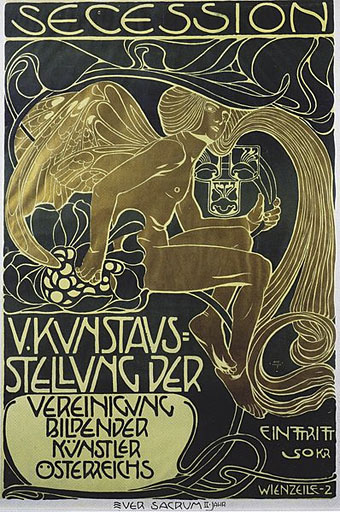
Secession poster (1899).

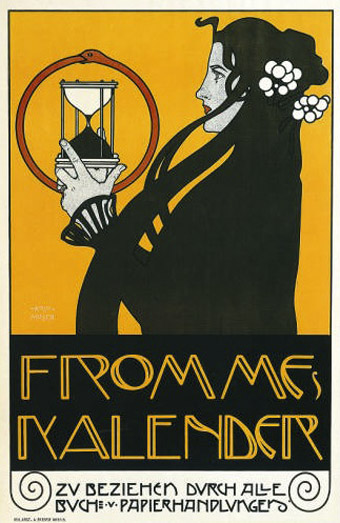
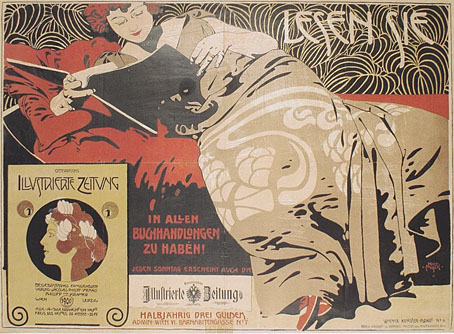
Since I’ve been delving over the past year into the fin de siècle culture of Germany and Austria, the name of Koloman Moser (1868–1918) has kept recurring. This is partly because of Moser’s associations with the Viennese Secession and the Wiener Werkstätte, of course, but I’ve made a point of drawing attention to his work since it’s struck me as some of the most remarkable being produced anywhere in Europe during the period 1895–1910. Moser’s poster designs are a good example of his authority as an artist and graphic designer who quickly evolved from Mucha-derived Art Nouveau flourishes to a degree of stylisation that was incredibly advanced for the early 1900s. The graphics of Moser and fellow artist/design Alfred Roller point the way to Art Deco twenty years later, and also to the psychedelic era whose poster artists eagerly borrowed motifs, figures and lettering designs from Moser, Roller, Mucha and others.

moser3

Frommes Kalender poster (1899).

Wikimedia Commons has a generous sampling of Moser’s work that shows his incredible versatility in a variety of media. The Secession designers, and Moser in particular, and memorialised in Paul Shaw’s typeface design, Kolo.

moser8

Illustrierte Zeitung poster (1900).

Continue reading “Koloman Moser posters”

Weekend links 82

morris.jpg

At the Mountains of Madness (1979) from Halloween in Arkham by Harry O. Morris.

• Golden Age Comic Book Stories always pulls out the stops in the run up to Halloween. In addition to a wonderful collection of Harry O. Morris collages, Mr Door Tree has also been posting Virgil Finlay’s illustrations for Edgar Allan Poe, Lynd Ward’s tremendous illustrations for a collection of weird tales entitled The Haunted Omnibus, Barry Moser’s woodcuts for an edition of Frankenstein, and Virgil Finlay’s illustrations for stories and poems by HP Lovecraft.

• “Eugene Thacker suggests that we look to the genre of horror as offering a way of thinking about the unthinkable world. To confront this idea is to confront the limit of our ability to understand the world in which we live – a central motif of the horror genre. In the Dust of This Planet explores these relationships between philosophy and horror.”

• “…the reader […] becomes a conscious participant in the process of imposing a linear sequence, while at the same time remaining aware that all narrative is an act of memory, and that memory is necessarily random.” Jonathan Coe reviews Marc Saporta’s book-in-a-box, Composition No.1, recently republished by Visual Editions.

• Nearly fifty years after its first performance, Peter Weiss’s Marat/Sade is still disturbing playgoers. And nearly ninety years after its release, Alla Nazimova’s silent film production of Oscar Wilde’s Salomé is touring the UK with live musical accompaniment.

• Tom of Sinland at Homotography, in which illustrator Bendix Bauer portrays some of the fashion world’s notable male designers as Tom of Finland-style characters for Horst magazine.

• Neil Gaiman Presents is a new audiobook imprint which launches with works by Jonathan Carroll, Alina Simone, Keith Roberts, M. John Harrison and Steven Sherrill.

• The Weird Wild West: Paul Kirchner has put all his Dope Rider comic strips online.

• Leonora Carrington prints at Viktor Wynd Fine Art, London, from November 5th.

• The Fall to Earth: David Bowie, Cocaine and the Occult.

• Photos of New York City, 1978–1985.

• Kathy Acker recordings at Ubuweb.

• The Occupied Times of London.

• The Golden Age of Dirty Talk.

• Pushkin silhouettes.

• This week I’ve been lost in the Velvet Goldmine (again): John, I’m Only Dancing (1972) by David Bowie | The Jean Genie (1972) by David Bowie | Drive-In Saturday (1973) by David Bowie.