Weekend links 411

crowley.jpg

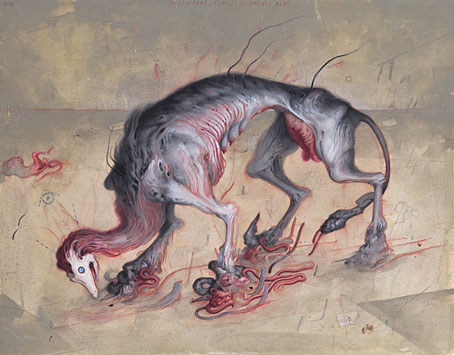
The Temple of Love (1911–24) by Herbert E. Crowley.

• My film viewing in the 1980s involved a considerable amount of backtracking: watching any film noir that turned up on the TV while chasing the early works of David Cronenberg, and various “New Hollywood” classics on television or at repertory cinemas (when such things were still plentiful). Contemporary fare by comparison was often a lot less attractive, although I’d be waiting for new work from David Lynch and Nicolas Roeg while pursuing obscurities (usually the banned or censored) on videotape. Popular films seldom generated actual loathing but throughout the decade I nurtured a persistent hatred for the works of John Hughes, an animus that can still return today when I read yet another nostalgic article about his oeuvre.

The monoculture of the 1980s was writ large on American cinema of the decade. From Arnold Schwarzenegger’s muscle-rippling actioners to John Hughes’s adolescent confections, bombastic, generally upbeat films characterised the decade of the yuppie.

Christina Newland offers a welcome riposte to the pastel-hued retrospectives in a piece entitled “Reagan’s bastard children: the lost teens of 1980s American indie films”. While not exclusively teen pictures, I’d have mentioned three low-budget films written by Eric Red: The Hitcher (1986), Near Dark (1987) and Cohen and Tate (1989).

The Temple of Silence: Forgotten Works & Worlds of Herbert Crowley is a lavish (and costly) study of the strange comic strips and incredibly detailed drawings of Herbert E. Crowley (1873–1937). Mark Newgarden interviewed Justin Duerr about rescuing Crowley’s art from undeserved neglect. I missed an earlier interview by Steven Heller with Temple of Silence publisher Josh O’Neill. There’s more: The Wiggle Much a Tumblr devoted to Crowley’s comic strips and other artwork. (Ta to Jay for the tip!)

Pandemic is an interactive film by John Bradburn for The Science Museum. “A pandemic is causing heart failure–how far will you go to create a pig/human hybrid to provide donor organs?” The multiple choice begins at YouTube; there’s also a behind the scenes feature at the Museum blog, and a trailer. Anyone who remembers a certain scene in Lindsay Anderson’s O Lucky Man! may hesitate before playing.

Given the plain palette of so much 1969–70 rock—jammed-out bluesy boogie in the Canned Heat and Allman Brothers mode, nasal pseudo-country harmony singing à la CSN&Y and their afterbirth—it is tempting to imagine an entirely alternative history for rock. It’s a parallel world where Fifty Foot Hose’s Cauldron, United States of America’s self-titled album and synthedelic oddities from Syrinx, Silver Apples, Beaver & Krause and Tonto’s Expanding Head Band were just the run-up to a giant leap into the electronic future.

Simon Reynolds in an excellent piece on one of my favourite musical sub-genres, electronic psychedelia

• The week in animated film: Emerald Rush, a video for an extract from Jon Hopkins’ new album, Singularity; Awaken Akira, a short homage to Katsuhiro Otomo’s graphic novel/film by Ash Thorp and Zaoeyo; Extra (1996), a video by one of the Akira animators, Koji Morimoto, for music by Ken Ishii.

Tenebrous Kate on The Powers of Darkness & The Powers of the Mind: The Legacy of Jacques Tourneur’s Night of the Demon. Related: a look at the film’s shooting script and pressbook.

• At Dangerous Minds: John Gray, the pre-Bosie lover of Oscar Wilde, and the man whose surname is memorialised in Wilde’s most famous creation, Dorian Gray.

• Skewing the Picture: China Miéville posts the full text of an essay from 2016 about the rural weird.

• Share a pastrami sandwich with TED Klein in Episode 65 of Eating the Fantastic.

• More Hodgsoniana: The Land of Lonesomeness, a short story by Sam Gafford.

• At The Quietus: Barry Miles on William Burroughs’ years in London.

• At Dennis Cooper’s: Curtis Harrington Day.

Night Of The Assassins (1977?) by Les Rallizes Dénudés | Night Of The Earth (1980) by Chrome | Night Of The Swallow (1982) by Kate Bush
Weekend links 409

steppenwolf.jpg

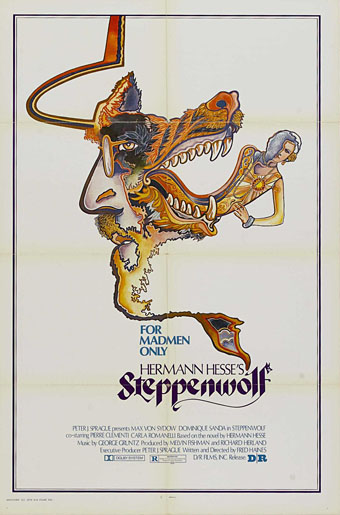
Poster for Steppenwolf (1974), a film directed by Fred Haines (his only one) based on the novel by Herman Hesse, and starring Max von Sydow and Dominique Sanda. No artist or designer credited.

• “…in her 20s, she heard two elderly folk singers and was struck by their ‘gentle dignity’. It cemented her own philosophy: ‘No dramatising a song, no selling it to an audience, no overdecorating in a way that was alien to English songs, and most of all, singing to people, not at them.'” Laura Snapes on Shirley Collins and her memoir, All in the Downs.

• Many of the BBC’s sound effects were available for years in necessarily small collections on vinyl, tape and CD. Now you can download over 16,000 of them for free here. The interface is still primitive so try typing some words into the search box to see what shows up.

Carl Swanson on Natalie Frank’s paintings based on Pauline Réage’s Story of O, and the problems these caused when she tried to exhibit them.

• Pictures of the Jazz Age: Regina Marler reviews three books about photographer Berenice Abbott.

• “The late Juraj Herz was a one-man wave of Czechoslovak horror,” says Kat Ellinger.

Mark Dery on William S. Burroughs and the dead-end horror of the Centipede God.

• Mixes of the week: FACT mix 648 by Laraaji, and XLR8R Podcast 538 by Fluxion.

Kashmir by Forming The Void, and Kazakhstan by Brian Eno.

• At Dennis Cooper’s: Dominique Sanda Day.

PixaTool by Kronbits.

Born To Be Wild (1968) by Steppenwolf | Steppenwolf (1976) by Hawkwind | Der Steppenwolf (2015) by Selofan

Weekend links 405

expo70.jpg

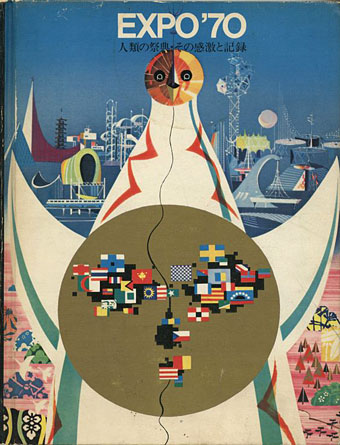
Taro Okamoto’s Tower of the Sun on the cover of an Expo ’70 guide.

• Last week I was watching the restored print of Howard Brookner’s excellent William Burroughs documentary, Burroughs. Among the later scenes are shots of the writer visiting Britain in the autumn of 1982 for the Final Academy events, a visit also recorded on Super-8 by Derek Jarman, and by the video cameras of the Haçienda nightclub at a reading I was fortunate to attend. Included in the Brookner film are brief snatches of an interview with Burroughs for BBC Radio 1 by John Peel’s producer, John Walters, something I missed when it was first broadcast.

• Taro Okamoto’s Tower of the Sun was built in Osaka for Expo ’70, and unlike many one-off expo buildings has managed to survive years of neglect and threats of demolition. Visitors to the Tower may now explore the restored “Tree of Life” interior, although places are limited so it’s necessary to book in advance. Related: Expo ’70 at ExpoMuseum, and Tower Of The Sun (1997) by Shonen Knife.

• Also at Dangerous Minds this week: a 1969 TV recording of Krzysztof Penderecki’s notorious The Devils of Loudon, an opera based on the same Aldous Huxley book as Ken Russell’s The Devils, and which includes (among other things) a singing nun enduring a forced enema.

• The new Cavern Of Anti-Matter album, Hormone Lemonade, is released this week. XLR8R has a preview. Related: an old/undated mix by Tim Gane for The Brain radio show here.

Milton Glaser on some of his favourite posters. Milton Glaser Posters, a book collecting 427 poster designs, is published this week by Abrams.

• The Ghosts of Empty Moments: Christopher Burke reviews M. John Harrison’s You Should Come with Me Now.

• Mixes of the week: FACT mix 644 by Susanna, and XLR8R Podcast 534 by Pär Grindvik.

Emily Temple found 25 of the most expensive books you can buy on the internet.

Towers Of Dub (1992) The Orb | Tower Of Our Tuning (2001) by Broadcast | Television Tower (2001) by Monolake

Weekend links 363

sommers.jpg

The Constant Drumbeat of Terrible News (no date) by Allison Sommers.

• Nadia Khomami on Gay UK: Love, Law and Liberty, an exhibition at the British Library. Related: Simon McCallum‘s potted history of LGB characters on British screens. Elsewhere: writer and philanthropist Chuck Forester on gay sex in the 1970s.

The Panic Fables: Mystic Teachings and Initiatory Tales by Alejandro Jodorowsky. Finally available in English, a collection of all the comic strips written and illustrated by Jodorowsky when he was living in Mexico in the 1960s.

• A trailer for the restored print of The Fabulous Baron Munchausen (1961) by Karel Zeman. Related: collage designs by Graphic Manipulator for a Japanese collection of Zeman’s films.

• “Whether divining ancient wisdoms or elevating the art of cold reading, Tarot is a form of therapy, much like psychoanalysis,” says James McConnachie.

James Reith on “the Icelandic publisher that only prints books during a full moon – then burns them”.

• Mixes of the week: Wire 400 Mix #6 by Emptyset, and Secret Thirteen Mix 223 by Constantine.

• Mud And Flame: Penda’s Fen re-examined by Matthew Harle and James Machin.

Tilda Swinton in a Leonora Carrington-inspired fashion shoot for i-D magazine.

• At Dennis Cooper’s: Spotlight on William Burroughs’ The Wild Boys.

Applied Ballardianism: A Theory of Nothing by Simon Sellars.

• At Dangerous Minds: The Dark Rift by Jim Jarmusch’s Sqürl.

French Underground Rock: 1967–1980; a Discogs list.

Suzanne Ciani‘s favourite albums.

Infinite artwork: Untitled, 2017

Rip, Rig And Panic (1965) by The Roland Kirk Quartet | Panic (1984) by Coil | Flash Of Panic (1994) by Axiom Ambient

Weekend links 350

eaton.jpg

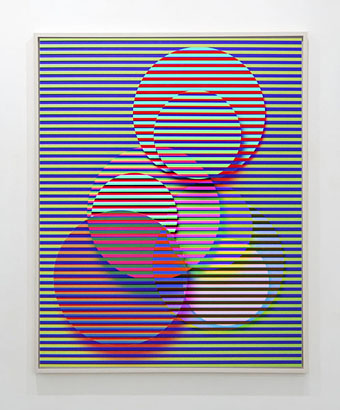
Transition H50 (2016) by Jessica Eaton.

• One of my weekend posts in 2012 contained details about Taking Tiger Mountain, a low-budget feature film put together in 1983 by Tom Huckabee using footage originally shot in Tangier and Wales in the 1970s. Huckabee’s film is a strange “experimental” work of science fiction, based in part on William Burroughs’ Blade Runner script (no relation to the Ridley Scott film apart from the title), and described here as “a psychotropic apocalyptic odyssey”. The most notable aspect of the film for many will be the presence of a young Bill Paxton in the lead role, something I was reminded of when Paxton’s death was announced earlier this week. Five years ago there was only a short clip of Taking Tiger Mountain available on YouTube but since then a full copy has appeared; watch it here while you can. (The widescreen frame is cropped, and the sound is all in one channel but it’s still watchable.) Tom Huckabee talked about the film’s production (and the Burroughs connections) to Beatdom. A curio that deserves wider attention.

• “With Biller, the references come thick and fast. In The Love Witch, she channels, among others, 50s Hitchcock, Douglas Sirk’s lurid lushness, Rainer Werner Fassbinder’s deadpan gaze, Nicholas Ray’s poetry, Sam Fuller’s tabloid style and Todd Haynes’s revisionist sexual politics. […] Then add the Technicolor, widescreen, haute-Hollywood “women’s pictures” of the 50s, a touch of Hammer Studios, The Wicker Man, Rosemary’s Baby and any number of studio melodramas and musicals.” John Patterson talks to director Anna Biller about her new film, The Love Witch.

• Mix of the week is the Anxious Heart Mix by Moon Wiring Club, another excellent blend of electronica, industria and dialogue samples from the outer limits of the televisual sphere. Also of note this week: VF Mix 83, an Adrian Sherwood selection by Pinch, XLR8R Podcast 479 by Chris SSG, and Secret Thirteen Mix 213 by -N.

• “Anthropologically, this was going on all around me: it was amazing and nobody was dealing with it like that, so I just went for it.” Hal Fischer on his photo-art series, Gay Semiotics, which is on display at Project Native Informant, London, until 1st April.

• Coming in May from Luaka Bop, World Spirituality Classics 1: The Ecstatic Music of Alice Coltrane Turiyasangitananda, the first-ever compilation of Alice Coltrane’s scarce releases on the Avatar Book Institute label.

Cinephilia looks back at Robert Wise and Nelson Gidding’s film of The Andromeda Strain (1971).

• Psychedelic Speed Freak: Remembering the blistering experimentalism of Hideo Ikeezumi.

• More witchery: S. Elizabeth talks to Pam Grossman about art, film and hex power.

• At The Quietus: Harry Sword on the strange world of Surgeon.

Leonor Fini playing cards

The Feathered Tiger (1969) by Kaleidoscope | Taking Tiger Mountain (1974) by Brian Eno | Plain Tiger (1985) by Cocteau Twins