Weekend links 837

grimshaw.jpg

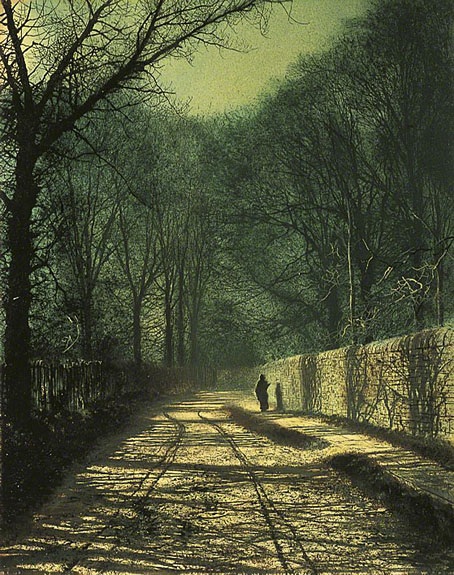
Tree Shadows on the Park Wall, Roundhay, Leeds (1872) by John Atkinson Grimshaw.

• “In many cases, the rules of physics that apply in a real scene appear to be optional in a painting; they can be obeyed or ignored at the discretion of the artist to enhance the painting’s intended effect.” An extract from The Visual World of Shadows by Roberto Casati and Patrick Cavanagh, in which the authors examine some of the rule-breaking that takes place when artists are dealing with shadows in paintings. I mentioned this aspect of artistic licence in a recent interview, making the point that meticulously accurate light and shade is a tell-tale sign of AI art.

• Orson Welles’ unfinished film of Don Quixote is back in the news again. Welles spent twenty years shooting scenes when he had the time and the money, and I seem to have spent an equivalent time reading about attempts to release the film. Any assembled footage will lack Welles’ bravura editing but I’d still like to see it.

• Read an extract from Still In A Dream: Shoegaze, Slackers And The Reinvention Of Rock, 1984–994 by Simon Reynolds.

• Mixes of the week: King Tubby – The Heaviest Dubs – A DJ Mix by Mista Savona, and Bleep Mix #319 by Yu Su.

• “What makes music psychedelic?” James McKeown on the music of Terry Riley.

• At the BFI: Gayle Sequeira selects 10 great films about dinner parties.

• Steven Heller’s font of the month is Loopy.

• The Strange World of…King Tubby.

Shadows (1967) by The Leather Boy | The Never-Deserting Shadow (1991) by Jarboe | Moon Shadows (2001) by Laraaji
Weekend links 723

manrique.jpg

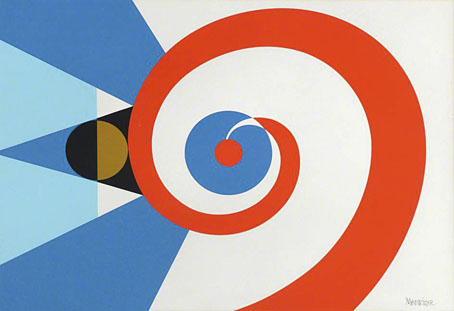
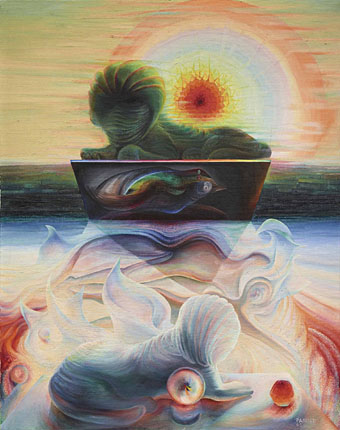
Flags of the Undiscovered Planets: 3 (1985) by César Manrique.

• “That mysterious font is Festive, not Stymie.” Ray Newman goes looking for a typeface that immediately says “Britain in the 1950s”. I used to refer to one of its relatives as “the launderette font”, although it was also a common sight on shopfronts, public buildings and other mid-century signage. Today I know it as the slab serif named Profil (aka Decorated 035), although as Newman demonstrates, this is only one of several slab-serif variants popular in the 1950s and 60s.

The Man Who Killed Google Search is a deep dive by Ed Zitron into why Google’s search has turned to shit. I recently changed the search option for all the browsers on my machines to DuckDuckGo. It’s not perfect but it’ll do for now.

• New music: Daddy’s Gonna Tell You No Lie, music by Sun Ra performed by Laraaji and the Kronos Quartet; Chroma by Loscil / Lawrence English; Homage To Hennix (The Electric Harpsichord Reinterpreted) by Dave Seidel.

• At Colossal: Tune into your own brain waves with Steve Parker’s suspended constellations of salvaged brass.

• At Bajo el Signo de Libra: Caspar David Friedrich (1774–1840): Icono del Romanticismo Alemán.

• At Public Domain Review: Maria Catharina Prestel’s Printed Cabinet of Drawings (ca. 1780s).

• At Unquiet Things: The teeming, tumbling, tangled cosmos of Madeline Von Foerster.

• Mix of the week: A mix for The Wire by FUJI||||||||||TA.

• At Dennis Cooper’s: 77 planetariums.

Planet D (Portishead Remix) (1994) by The Sabres Of Paradise | Planet Munich (1998) by Add N To (X) | Planet Vega (2000) by Air

Weekend links 521

parent.jpg

Au Lion d’or (1965) by Mimi Parent.

• After the recent announcement of Jon Hassell’s health issues it’s good to see he has a new album on the way at the end of July. Seeing Through Sound (Pentimento Volume Two) follows the form of the first volume, Seeing Through Pictures (2018), in reworking elements of earlier recordings into new forms. Not remixes, more reimaginings, and a process that Hassell has been applying to his own work for many years, most notably on his collaboration with Peter Freeman, The Vertical Collection (1997). The latter is an album which is impossible to find today and really ought to be reissued, together with more scarcities from the Hassell catalogue.

• Death of a typeface: John Boardley on Robert Granjon’s Civilité, a type design intended to be the national typeface of France but which fell out of favour. It wasn’t completely forgotten however; I was re-reading Huysmans’ À Rebours a couple of weeks ago, and Civilité is mentioned there as being a type that Des Esseintes chooses for some of his privately-printed books.

• At Plutonium Shores: Kurosawa versus Leone in A Fistful of Yojimbo. Christopher Frayling makes a similar analysis in his landmark study, Spaghetti Westerns (1981), but I didn’t realise that Leone had based so many of his shots on Kurosawa’s film.

• More lockdown art: Seen from Here: Writing in the Lockdown is a collection of new writing edited by Tim Etchells and Vlatka Horvat. A PDF book whose sales will go to support the Trussell Trust, a UK food bank charity.

• The week’s culture guides: Ben Cardew on where to start with the back catalogue of Miles Davis, and Hayley Scanlon on where to begin with the films of Yasujiro Ozu.

• “We can no longer ignore the potential of psychedelic drugs to treat depression,” says Robin Carhart-Harris.

• At Dangerous Minds: Laraaji returns with a new album, Sun Piano, and a preview of the same, This Too Shall Pass.

• Mixes of the week: The Ivy-Strangled Path Vol. XXI by David Colohan, and XLR8R Podcast 647 by The Orb.

Penelope Rosemont on the humorous Surrealism of Mimi Parent.

• At Dennis Cooper’s: Jeff Jackson presents Free Jazz Day.

The Golden Lion (1967) by Lomax Alliance | Dread Lion (1976) by The Upsetters | Gehenna Lion (1982) by Chrome

Weekend links 503

kausch.jpg

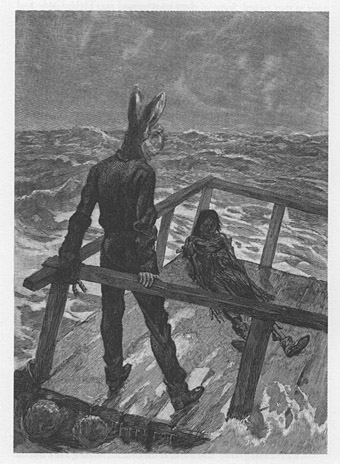
Rabbit Man with Skull Lady (1998) by Allan Kausch.

• “They were the first generation that said, ‘Fuck it, we’re not going to be intimidated.’ They weren’t going to make specifically pro-gay statements, but they were the first generation to really live that out. If you look at the Alternative Miss World, it’s a kind of gender-fuck, it’s almost like the English version of the Cockettes.” Jon Savage speaking in a piece by Alex Petridis about “Them” (Kevin Whitney, Luciana Martinez de la Rosa, Duggie Fields, Derek Jarman, Zandra Rhodes, Andrew Logan et al). Related: Andrew Logan in Andrew’s Adventures in Loganland.

• Sex, Satanism, Manson, Murder, and LSD: Kenneth Anger tells his tale. “Anger rarely if ever veers from the script as he is a man who has carefully controlled his myth and reputation for decades,” says Paul Gallagher.

• “Don’t even think about operating heavy machinery while listening to this mix.” The latest Dave Maier collection of recent ambient drift, drone-works and beatless atmospherics.

It is by no means easy to track or trace relationships between women, past or present. Women’s relationships with other women are often disguised: by well-documented marriages to men, by a cultural refusal to see what is in full view or even to believe such relationships exist. In a world built by and for men and their pursuits, a woman who loves women does not register—and is not registered, i.e., written down. Reasons for this layer one upon the other: A lesbian purposely hides her identity and remains closeted. A lesbian refuses to call herself a lesbian, disidentifying from the term and its associations for reasons personal or political. A woman does not know she is a lesbian—because she does not ever have a relationship with another woman, or because she is not aware that the relationships she engages in could be called lesbian. I didn’t call myself one for several years. Or, as in Carson’s case, her own self-understanding and identification are difficult to determine because of the efforts of those who outlived her and pushed her into the closet.

Jenn Shapland on the closeting of Carson McCullers

• At The Paris Review: The Collages of Max Ernst. Related: Kolaj: A directory of collage books.

Adam Scovell on the deathly hinterlands of Georges Franju’s Eyes without a Face.

• When Dorothy Parker got fired from Vanity Fair, by Jonathan Goldman.

• At Dennis Cooper’s: The Proto-Psychedelic Art of CG Jung’s Red Book.

• The abstract, single-stroke paintings of Daigoro Yonekura.

Adam Gopnik on the seriousness of George Steiner.

Caligula MMXX

The Ballad Of Dorothy Parker (1987) by Prince | Lotus Collage (1979) by Laraaji | Death Collage (1992) by Snakefinger & The Residents

Weekend links 409

steppenwolf.jpg

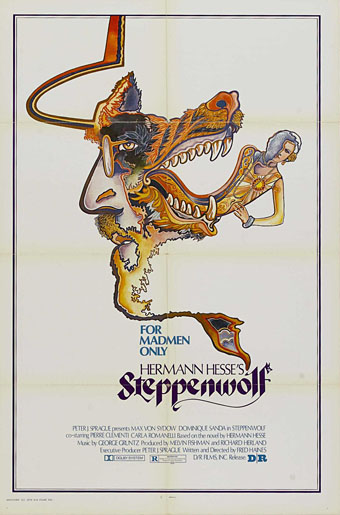
Poster for Steppenwolf (1974), a film directed by Fred Haines (his only one) based on the novel by Herman Hesse, and starring Max von Sydow and Dominique Sanda. No artist or designer credited.

• “…in her 20s, she heard two elderly folk singers and was struck by their ‘gentle dignity’. It cemented her own philosophy: ‘No dramatising a song, no selling it to an audience, no overdecorating in a way that was alien to English songs, and most of all, singing to people, not at them.'” Laura Snapes on Shirley Collins and her memoir, All in the Downs.

• Many of the BBC’s sound effects were available for years in necessarily small collections on vinyl, tape and CD. Now you can download over 16,000 of them for free here. The interface is still primitive so try typing some words into the search box to see what shows up.

Carl Swanson on Natalie Frank’s paintings based on Pauline Réage’s Story of O, and the problems these caused when she tried to exhibit them.

• Pictures of the Jazz Age: Regina Marler reviews three books about photographer Berenice Abbott.

• “The late Juraj Herz was a one-man wave of Czechoslovak horror,” says Kat Ellinger.

Mark Dery on William S. Burroughs and the dead-end horror of the Centipede God.

• Mixes of the week: FACT mix 648 by Laraaji, and XLR8R Podcast 538 by Fluxion.

Kashmir by Forming The Void, and Kazakhstan by Brian Eno.

• At Dennis Cooper’s: Dominique Sanda Day.

PixaTool by Kronbits.

Born To Be Wild (1968) by Steppenwolf | Steppenwolf (1976) by Hawkwind | Der Steppenwolf (2015) by Selofan