Weekend links 324

waliszewska.jpg

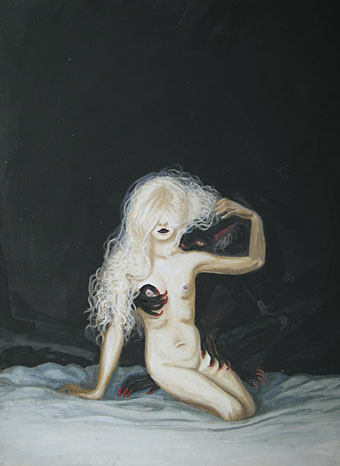
Untitled painting by Aleksandra Waliszewska. The artist is profiled by S. Elizabeth at Dirge Magazine.

• “…from my point of view, the only thing to do with any genre, any medium, is pretty much to break it, to transcend it, to find out what its limits are, and then go beyond them, and see what happens.” Alan Moore (again) talking to Heidi MacDonald about his novel, Jerusalem, which is out next month.

• A Monument to Outlast Humanity: Dana Goodyear gets the reclusive Michael Heizer to talk about his decade-spanning sculptural project, City, work on which is almost finished.

William Burroughs’ appearances in adult men’s magazines: a catalogue which includes some downloads of uncollected Burroughs essays and other writings.

• Mixes of the week: Homegirls & Handgrenades Mix by Moor Mother, Secret Thirteen Mix 194 by Kareem, and hieroglyphics #014 by Temples.

Remoteness of Light is a new album by The Stargazer’s Assistant inspired by the depths of the oceans and the vastness of space.

• RIP Gilli Smyth. “The silliness ran deep in Gong, but they could groove like mothers, too,” says Joe Muggs.

Guide to Computing: historic computers presented by James Ball as though they were new machines.

• “Oscar Wilde’s De Profundis is one of the greatest love letters ever written,” says Colm Tóibín.

• “Will You Dance With Me?” Derek Jarman films dancers in a gay club in 1984.

• Snapshots from an editor: Donald Weise on working with Edmund White.

Stupid by Wrangler (Stephen Mallinder, Phil Winter and Benge).

The Rutt-Etra-Izer

Dynamite/I Am Your Animal (1971) by Gong | Witch’s Song/I Am Your Pussy (1973) by Gong | Prostitute Poem (1973) by Gong

Weekend links 323

taylor.jpg

Mescaline Woods (1969) by Gage Taylor.

• The soundtrack to The Man Who Fell to Earth will be released for the first time next month in a double-disc set (CD & vinyl). This isn’t, as some people have hoped, David Bowie’s unheard music for the film, but a collection of the pre-existing songs and other pieces, plus the original compositions by John Phillips. Consequence of Sound has a track list.

• At Scream Addicts: Joe R. Lansdale talks about the only film adaptation of Shirley Jackson’s The Haunting of Hill House that you need to see: the 1963 version directed by Robert Wise.

• The new wave of new age: How music’s most maligned genre finally became cool by Adam Bychawski.

• Transmissions From The Abyss: Dark ambient music for the perfect headspace by S. Elizabeth.

Jason Farrago reviews Art Aids America, an exhibition at the Bronx Museum, New York.

Curse Go Back: a limited reissue of tape experiments by William Burroughs.

Samuel Wigley on Notorious at 70: toasting Hitchcock’s dark masterpiece.

Toyah Willcox remembers working with Derek Jarman on The Tempest.

• “Why are musicians so obsessed with David Lynch?” asks Selim Bulut.

• Read the original 32-page programme for Fritz Lang’s Metropolis.

David Parkinson chooses 10 essential films starring Oliver Reed.

• Mixes of the week: The Sounds of the Dawn NTS radio shows.

Keith Haring envisions Manhattan as a kingdom of penises.

Frank Guan on Massive Attack’s Blue Lines, 25 years on.

Honky Tonk Pts 1 & 2 (1956) by Bill Doggett | I’ve Told Every Little Star (1961) by Linda Scott | I’m Deranged (1995) by David Bowie

Weekend links 319

hibert.jpg

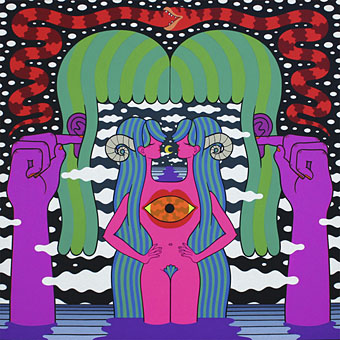
The Sapphic Sleep Web by Oliver Hibert.

• “Google isn’t willing to say whether or not it’s censorship. That they don’t have to even address this is what’s so shocking, It seems like cowardice.” Dennis Cooper talking to Andrew Durbin at Frieze about Google’s unexplained deletion of his long-running blog. Cooper’s case has been covered by arts sites and some newspapers but I’ve yet to see any mention at all on the main US gay news sites despite Cooper being a notable gay author. I’ve cast aspersions at those sites in the past for their obsession with terrible pop acts and off-topic trivia (one site still reports every last fart of Britain’s Royal Family as “news”); this recent issue only reinforces their irrelevance.

• Creating Jerusalem: Alan Moore on the most important book he has written. Related: Alan Moore uses nine-year-old’s fan letter on new book’s cover.

• “Whatever side of the aisle you’re on, HL Mencken is as relevant as ever,” says Paula Marantz Cohen.

To say that Goodbar is an obsessive and symbolically overdetermined film would be an understatement: the film compulsively reiterates themes, visual motifs and parallel narratives, a relentless and repetitive reiteration of ideas that lends that film the aspect of a Freudian dream landscape, a baroque, Boschian sequence of fantasies, projections and illusions.

Bruce LaBruce on Richard Brooks’ film of Looking for Mr. Goodbar

Mare Teno by Michel Redolfi, performed by Thomas Bloch, Susan Belling & Michel Redolfi.

• From 2015: Suicide’s Alan Vega Talks Fiery Record With Big Star’s Alex Chilton.

• Mix of the week: The Takeover with Front & Follow & The Geography Trip.

• Psychic Spaces & Neon Nirvana: The Art of Oliver Hibert by S. Elizabeth.

• How William Burroughs‘s drug experiments helped neurology research.

Yello, absurdist Swiss pop pioneers, return with a new video, Limbo.

• Morphologies Masterclass: Ramsey Campbell on HP Lovecraft.

Cliff Martinez on horror, homage and The Neon Demon.

• A City of Dust: photos of London by Lewis Bush.

Dust To Dust (1986) by Ginger Baker | Neon Sisters (1992) by Thomas Dolby | Limbo (1992) by Sandoz

Weekend links 317

mucha.jpg

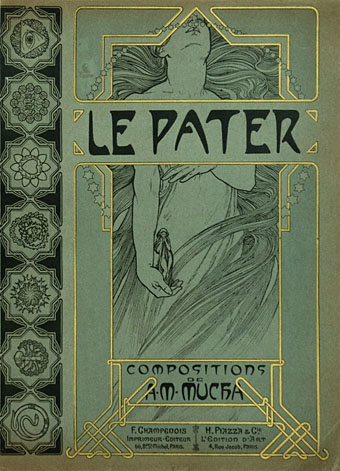
Alphonse Mucha’s Le Pater, a book of mystical Symbolism written, designed and illustrated by the artist, was published in a limited edition in 1899. The book has been out of print ever since but Thomas Negovan at Century Guild will be reprinting it later this year.

• “Five axioms to define Europe: the coffee house; the landscape on a traversable and human scale; these streets and squares named after the statesmen, scientists, artists, writers of the past; our twofold descent from Athens and Jerusalem; and, lastly, that apprehension of a closing chapter, of that famous Hegelian sunset, which shadowed the idea and substance of Europe even in their noon hours.” George Steiner explores his idea of Europe.

Journey To The Edge Of The Universe by Upper Astral, 43 minutes of cosmic ambience, is a cassette-only release from 1983. The album has never been reissued so secondhand copies command excessive prices but it may be downloaded here.

• Mixes of the week: Three hours of ambience by Gregg Hermetech, XLR8R Podcast 446 by [Adrian] Sherwood x Nisennenmondai, and Secret Thirteen Mix 190 by Shxcxchcxsh.

Today [Angela] Carter is well known, widely taught in schools and universities, and much of what she presaged—in terms of recycling and updating (“old wine in new bottles”, she called it), or gender role play and reversal—has become commonplace in the culture. Despite this, many critics find it difficult to situate her work properly. This is partly because Carter is so sui generis (she has literary offspring but few antecedents), and partly because many struggle with the relationship of politics and aesthetics in her writing.

Kate Webb reviews two new books about Angela Carter

• Words that will forever pursue us: Tim Page on the late Michael Herr, “rock’n’roll voice of the Vietnam War”.

• From 2015: Luigi Serafini on how and why he created an encyclopedia of an imaginary world.

James Campbell on Ginsberg, Kerouac and Burroughs: celebrating the Beats in Paris.

Fragile Beasts, an exhibition of grotesque print ornaments at Cooper Hewitt, NYC.

• Not before time, Guy Gavriel Kay wants to see an end to the plague of writing tips.

• David Bowie and Buster Keaton by Steve Schapiro.

Tom Charity on the films of Michael Cimino.

Alison Goldfrapp: photographer.

Golem Mecanique

European Man (1981) by Landscape | Europe After The Rain (1981) by John Foxx | Trans Europe Express (1994) by The One You Love

Weekend links 308

trochut.jpg

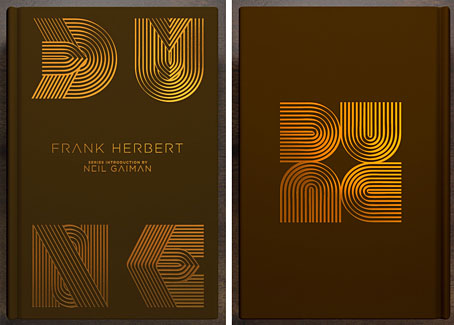
Frank Herbert’s Dune receives a new cover design by Alex Trochut together with other notable works of science fiction and fantasy for a new series from Penguin.

• “…poet, scholar and biographer Sandeep Parmar…has raised the possibility that a long poem by Hope Mirrlees, titled Paris and published by the Hogarth Press in 1919, was a strong influence on The Waste Land.” Alfred Corn on new TS Eliot scholarship.

• “[Evolution‘s] strain of body horror brings to mind an ethereal HP Lovecraft mixed with David Cronenberg.” Rachel Bowles talks to the film’s director, Lucile Hadžihalilović.

• Library music “is a sonic world of ‘weird beats, odd instrumentations, albums full of dark jazzy interludes or bizarre garage rock.'” Adrian Shaughnessy on innovation in banality.

Italy, which EM Forster called “the beautiful country where they say ‘yes’”, became another resort, especially the island of Capri, where a French poet staged a ceremonial flogging of his teenage Italian lover before the boy departed to do his military service and became the subject of a novel by his compatriot Roger Peyrefitte. In the Egyptian city of Alexandria, Forster observed the Greek poet Constantine Cavafy “standing absolutely motionless at a slight angle to the universe”, and the Australian novelist Patrick White met a local man who became his lifelong companion. For decades, the novelists Paul and Jane Bowles presided in Tangier, which Jack Kerouac was to call a “sinister international hive of queens”. William Burroughs arrived in 1954 with a teenage Spaniard named Kiki who, Woods writes, “was, famously, the boy who would blow smoke into his pubic hair and say ‘Abracadabra’ as his hardening cock emerged from the cloud”. Tangier was to figure in Burroughs’s novel Naked Lunch as a phantasmagoric, rubbery walled sex market called the Interzone.

Caleb Crain reviewing Homintern by Gregory Woods

• Beardsley biographer Matthew Sturgis reviews Aubrey Beardsley: A Catalogue Raisonné, a two-volume collection edited by Linda Gertner Zatlin.

• “He was the Bresson of Birkenhead.” Andrew Collins reviews the forthcoming collection of BBC dramas directed by Alan Clarke.

• “The postwar Hollywood western was more content to let strangeness be strange,” says Michael Newton.

• “Bosch’s work has always caused trouble for interpreters and critics,” says Morgan Meis.

Misplaced New York: a project by Anton Repponen and Jon Earle.

Wyrd Daze, Lvl2 Issue 6, is out, and as before is a free download.

Lessons we can learn from Robert Altman’s 3 Women.

• Mix of the week: FACT Mix 548 by Peder Mannerfelt.

Paris 1971 (1971) by Suzanne Ciani | Paris II (1987) by Jon Hassell | Dreaming Of Paris (2013) by Van Dyke Parks