Weekend links 216

heathen.jpg

Why Do The Heathen Rage? (2014) by The Soft Pink Truth. Cover art by Mavado Charon.

Drew Daniel’s latest release as The Soft Pink Truth is Why Do The Heathen Rage?, a witty electronic riposte to the often reactionary attitudes of black metal music and the people who create it. (The album is dedicated to Magne Andreassen, a gay man stabbed to death by the drummer from Emperor.) Dorian Lynskey talked to Daniel about queering the metal world, as did Angus Finlayson at FACT. Daniel’s project has been receiving press everywhere but you wouldn’t know it to read US/UK gay news sites where the music coverage is relentlessly narrow and insular. To date, only BUTT magazine has mentioned Why Do The Heathen Rage? but then BUTT have always stood apart from their parochial contemporaries. Never mind, here’s another fucking article about “petite pop princess” Kylie Minogue.

• “By the letter of the law, Ulysses was obscene. Obviously, gratuitously, relentlessly obscene.” Josh Cook on censorship and dangerous books. One of my own dangerous publications, the fifth issue of the Lord Horror comics series, Hard Core Horror (declared obscene in a UK court in 1995), received a very belated review at The Comics Journal. More censorship: Judy Bloom on the perennial panics in US school libraries. Lest we feel superior to American prudery, Leena McCall’s painting of a semi-naked woman caused some consternation in a London gallery last week.

• “Over and over, we’re told that nobody buys [compact discs] anymore.” Steven Hyden on the latest obituaries being written for a music format. Ten years ago the death of vinyl was being confidently predicted: “The physical presence of the popular song is gone,” Paul Morley declared. Related: The death of mp3s.

There is nothing quite like Maryanne Amacher’s third ear music. It is alarming. Some of her fellow artists never quite believed that their ears were not being damaged. Third ear music invades you, wraps inside your body, your head, your eyes — just like she says. You can’t be sure, after a while, if the sounds you hear are those created by your ears or Maryanne Amacher.

Stefany Anne Golberg on the music of Maryanne Amacher

• At Dangerous Minds: Nothing Lasts Forever (1984), Bill Murray in a “lost sci-fi comedy set in a totalitarian New York City”.

• More Joyce (there’s always more Joyce): Humument Images to Accompany James Joyce’s Ulysses by Tom Phillips.

• Another celebration of Penda’s Fen by David Rudkin, and another reminder that it’s still not available on DVD.

• Stairway to Heaven: Atlas Obscura on the Gustave Moreau Museum, an essential stop if you visit Paris.

• Mix of the week: Secret Thirteen Mix 121 by Higher Intelligence Agency.

• MetaFilter has a wealth of links to pulp magazine archives.

Yan Nascimbene’s illustrations for Italo Calvino’s stories.

• Rebecca Litchfield’s Orphans of Time and Soviet Ghosts.

• RIP Charlie Haden

Going Home (1972) by Alice Coltrane (Charlie Haden, bass) | Earth (1974) by Joe Henderson Featuring Alice Coltrane (Charlie Haden, bass) | Malkauns (1975) by Don Cherry (Charlie Haden, bass)
Weekend links 204

somnium.jpg

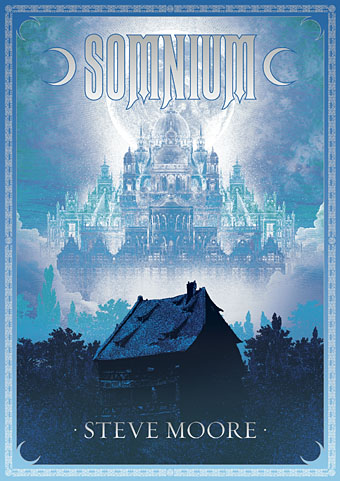
RIP Steve Moore. We never met, unfortunately, but I was very pleased he asked me to create a cover for his unique occult novel, Somnium, in 2011. Prior to this we’d been connected by shared acquaintances, colleagues, and membership in the informal cabal that was (and maybe still is) The Moon & Serpent Grand Egyptian Theatre of Marvels. Steve’s long friendship with Alan Moore (no relation) is well-documented, not least by Alan himself who made Steve the subject of his Unearthing project. One surprising connection for me was that Steve also had a link to Savoy Books. In the late 1960s he was working for comics publisher Odhams where he was able to copy for David Britton some Ken Reid comic art which Odhams had refused to print. Dave published the forbidden pages in his first magazine, Weird Fantasy, in 1969. In 2011 Steve talked to Pádraig Ó Méalóid about Somnium, and also to Aug Stone at The Quietus. Aug Stone penned a few memorial words here.

• “People love using the word ‘porn’ as long as there’s a partner for it. Pair ‘porn’ with something else and it’s usually a good thing. A celebration of style and culture. But that word on its own? Well.” Porn star Conner Habib asks why people have such a problem with porn actors.

Dave Maier‘s Russian cinema recommendations. Several favourites there including the magical and remarkable Shadows of Our Forgotten Ancestors (1964) which, as Maier notes, isn’t really Russian but should be seen in any case.

Shakespeare uses verbal magic, cantrips and ditties, nonsense songs and verses throughout the plays, but in Othello he gives a glimpse of how powerful a spell becomes when it’s no longer oral, but fixed in material form. The fatal handkerchief is no ordinary hanky; it’s a love spell, and it was made with gruesome and potent ingredients (mummified “maiden’s hearts”) by a two-hundred-year-old sibyl in Egypt—Egypt being the birthplace and pinnacle of magic knowledge.

Marina Warner on magic.

• Mixes of the week: an hour of electro-acoustics and contemporary classical recordings sequenced by Laurel Halo, and (from 2010) 36-minutes of “umbral electronic hypnagogia” by The Wyrding Module.

• “This is the book that, 10 years later, inspired Richard Hollis’s landmark design for John Berger’s Ways of Seeing.” Rick Poynor on Chris Marker’s Commentaires.

• Is the Linweave Tarot the grooviest deck ever made? Dangerous Minds thinks so.

• Bobby Barry talks to Holger Czukay about his 1969 audio collage, Canaxis 5.

• “What Happened to Experimental Writing?” asks Susan Steinberg.

Aldous Huxley‘s lectures on visionary experience at MIT, 1962.

Laura Palmer will see Agent Cooper again in just a few hours.

Callum found a copy of The Gay Coloring Book (1964).

Metal Cats

Moonshake (1973) by Can | Lunar Musick Suite (1976) by Steve Hillage | Dark Moon (1993) by Holger Czukay | Boy In The Moon (2012) by Julia Holter

The Trials of Oz

oztrial.jpg

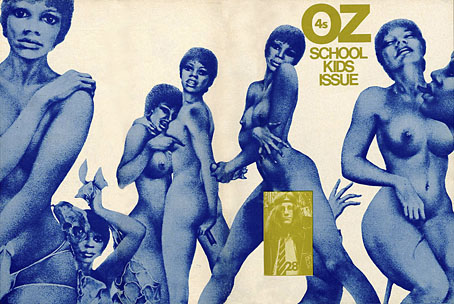
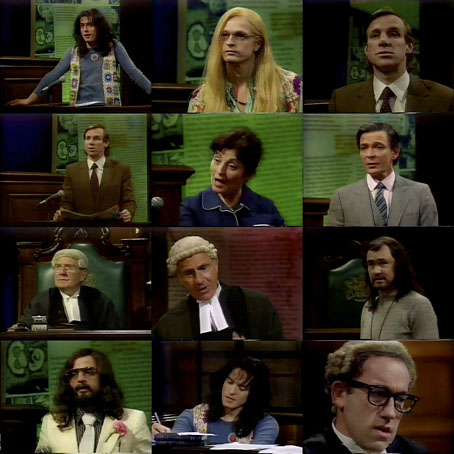
If it’s a surprise to see Cockney geezer Phil Daniels masquerading as the erudite (and non-Cockney) Thomas De Quincey in The Art of Tripping, it’s even more of a surprise to see Hugh Grant in wig and hippy gear as Richard Neville in this 1991 dramatisation of the obscenity trial against Neville’s Oz magazine. Grant wasn’t exactly unknown when this was made but it was prior to Four Weddings and a Funeral so the casting didn’t seem very notable at the time.

The play was written by Geoffrey Robertson QC from the trial transcripts to coincide with the 20th anniversary of a long and very public trial. Robertson in 1971 was an assistant to John Mortimer, the magazine’s lawyer, so the reconstruction may be taken to be an accurate one. In addition to Grant as Neville, Simon Callow plays Mortimer, Nigel Hawthorne is prosecutor Brian Leary, and Leslie Phillips is Judge Michael Argyle. Among the witnesses there’s Alfred Molina as George Melly (yet again; see yesterday’s post), and Nigel Planer as DJ John Peel, both of whom were called to testify that the notorious “School Kids” issue of Oz wasn’t an obscene publication. The trial, like the earlier drug busts against the Rolling Stones, was as much about the State trying to clobber a bunch of anarchist upstarts as anything that involved the pros and cons of antiquated laws. The three defendants—Neville, Felix Dennis and Jim Anderson—were also accused of “conspiring to corrupt public morals”; the obscenity issue was merely a pretext for getting the longhairs into the dock.

oz28.jpg

Oz 28 (1970). Art by Raymond Bertrand.

This isn’t a lavish production—it’s stylised to the extent that the public gallery is made up of cardboard figures—but it’s good to know that there’s a (rough) copy out there after my tape of the original broadcast developed a fault. (Update: It’s now on YouTube.) Not available, unfortunately, is the live studio discussion that followed in which Jonathan Dimbleby spoke to Geoffrey Robertson, Germaine Greer and others about the trial. The discussion featured a delicious moment when Dimbleby referred to Greer’s feminist issue (no. 29) as “C-Power Oz“. “Come on, Jonathan,” said Greer, “it was Cunt Power Oz!” Dimbleby then spluttered “Anyone can say ‘Cunt Power Oz‘…” and hastily moved on the discussion. (Update: The studio discussion is also on YouTube!)

A year after his TV appearance Geoffrey Robertson was in Manchester Crown Court appealing an earlier ruling of obscenity against David Britton’s Lord Horror (1990) novel. I was in the public gallery on that occasion, and it was an education seeing how little had changed since the Oz trial, with a similarly Philistine and deeply ignorant judge presiding. Robertson overturned the ruling against the novel but a ruling against one of Savoy’s Meng & Ecker comics was upheld. In 1995 we were back in court attempting to argue for a jury trial against further rulings of obscenity, this time against one of my own comics, Hard Core Horror 5. (That issue is now the opening section of the Reverbstorm book.) We failed that time thanks to a magistrate who was even less inclined to listen to any argument.

The Oz trial may seem quaint and farcical today but the issues remain pertinent: some forms of art will always be in conflict with laws that are out-of-date, badly written or maliciously applied. And once you’re standing in a courtroom your opinion about the situation is of no consequence; you’re at the mercy of the people who make the rules.

Previously on { feuilleton }
Martin Sharp, 1942–2013
Raymond Bertrand paintings
Raymond Bertrand’s science fiction covers
The art of Bertrand
Oz magazine, 1967–73

The Last Angel of History: Afrofuturism, science fiction and electronic music

lastangel1.jpg

There’s been a resurgence of interest recently in Afrofuturism (see this recent newspaper article, and this site), not before time when the term has been around since 1993. The concept itself goes back a long way, at least as far as the remarkable body of work produced by Sun Ra (1914–1993) whose vast discography dates from 1956, and has to be considered the first concerted attempt to craft an expansive cosmic/futuristic mythos in music.

lastangel2.jpg

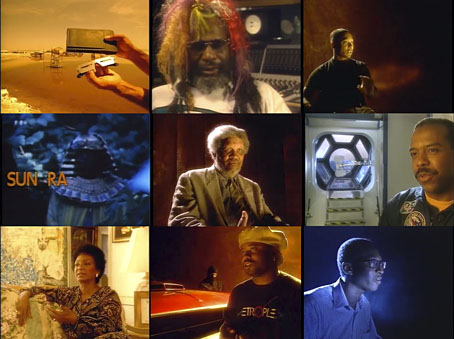
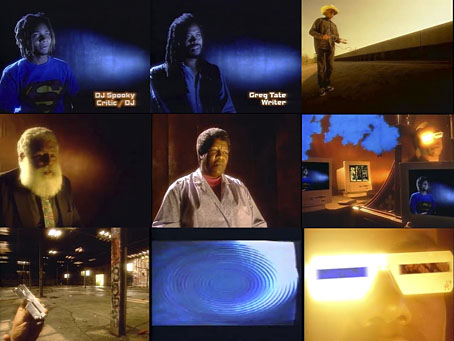
Sun Ra and his Arkestra make fleeting appearances in The Last Angel of History (1997), a 45-minute documentary by John Akomfrah which looks at Afrofuturism via its manifestations in fiction, contemporary music, and in space travel. The connecting tissue is a somewhat dated bit of cyperpunk fluff but it’s worth sticking around for the cast of interviewees. On the musical side there’s George Clinton, Derrick May, Juan Atkins, Carl Craig, DJ Spooky, Goldie, and A Guy Called Gerald; on the writing side there’s Ishmael Reed (whose early novels would have been published by my colleagues at Savoy Books if the company hadn’t gone bust in the early 80s), Samuel R. Delany (Savoy did publish one of his novels), Octavia Butler, Kodwo Eshun and Greg Tate; Nichelle Nichols has a chance to talk about something other than Star Trek for once, since she helped with NASA’s recruitment programme. There’s also Bernard A. Harris Jr, one of the first African-Americans in space. The techno-fetishism seems overheated now that we’ve all calmed down about computers and the internet, but that doesn’t negate the important points: SF as a reflection of the present moment and a means to imagine a different situation or way of life. With 2014 being Sun Ra’s centenary year I’m anticipating a lot more of this.

The Last Angel of History: part 1 | part 2 | part 3

Previously on { feuilleton }
Rammellzee RIP

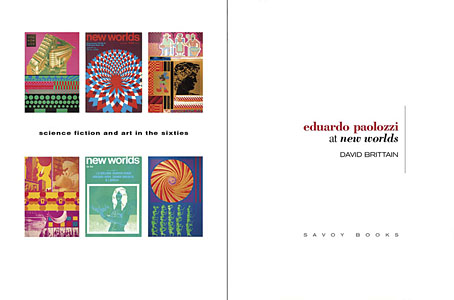
Eduardo Paolozzi at New Worlds

paolozzi00.jpg

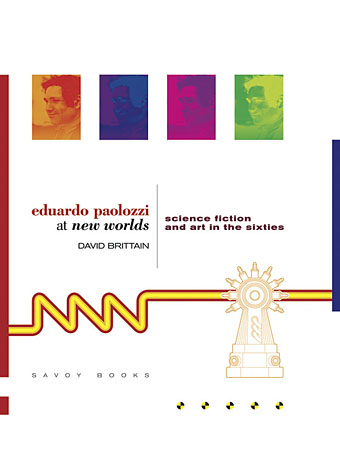
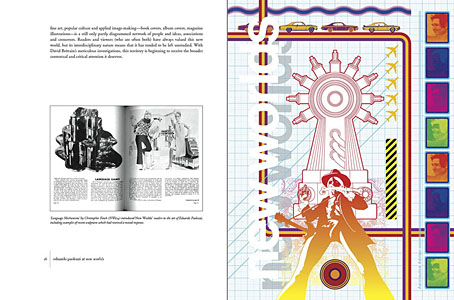
I was working on this book throughout the autumn, and it could hardly be more different to some of the visual extravagance that came before and after. Eduardo Paolozzi at New Worlds is published by Savoy Books this month. Predominantly an examination by David Brittain (no relation to David Britton) of the connections between artists such as Paolozzi and Richard Hamilton with New Worlds magazine in the 1960s, the book is also a rare study of the science fiction magazine when it was making its greatest impact in the late 60s and early 70s.

Brittain highlights many examples of Paolozzi’s sf-influenced art of the period, and examines the development of the magazine under Michael Moorcock’s editorship during which time New Worlds evolved from being a slightly moribund sf title in the early 60s to what JG Ballard later called “one of the most exciting magazines of any kind in this country”. An appendix features interviews with some of the key creators and contributors: editor Moorcock, designer Charles Platt, art editor Christopher Finch, contributor Michael Butterworth, and critic John Clute. Writer and illustrator Pamela Zoline created some original artwork for the endpapers. The introduction is by Rick Poynor.

paolozzi01.jpg

Despite being pressured for time I was very pleased to be designing this book. I’d liked Paolozzi’s work since I first encountered it in the Tate Gallery in the 1970s; a couple of years later I was buying up anthologies featuring New Worlds stories (I was too young for the 60s magazine), so discovering that Moorcock had made Paolozzi the magazine’s “Aeronautics Advisor” made perfect sense. In the past I’ve said that New Worlds ruined my taste for hard sf but that’s not really true since I never really liked the stuff beyond a few Arthur C. Clarke books. Too much bad writing, too many cardboard characters shuffling around between chunks of explanation about made-up technology. The discovery of New Worlds merely demonstrated that there were other ways of approaching sf, and you didn’t have to put up with the rubbish.

I also enjoyed the magazine’s bolshy attitude, a quality shared by Harlan Ellison in his Dangerous Visions anthologies. Moorcock says in Brittain’s interview that NW sympathised with the Underground of the late 60s but also tried to be more disciplined in its approach, especially where the design was concerned. You couldn’t have treated fiction to the semi-legible printing that Oz and Frendz often deployed. But the radical attitudes of the Underground can be discerned in the stance NW adopted. Some of the reviews and polemical articles by Moorcock (often under his “James Colvin” pseudonym), M. John Harrison and John Clute are bracingly vitriolic to a degree which if delivered today would probably see them ostracised for life.

paolozzi02.jpg

With the design the main intention was to present the information clearly and let the visuals speak for themselves. The book is heavily illustrated throughout, with many examples of Paolozzi’s marvellous prints. The layout nods obliquely to the period; before getting started I spent some time looking at the work of Erik Nitsche. I like the way Nitsche laid out the books he designed in the 1960s, and there’s also a connection in his work as a designer for the General Dynamics corporation: one of Paolozzi’s print series of the period is entitled General Dynamics F.U.N.

Being full-colour throughout, the print run for this book is smaller than usual so anyone interested is advised to move swiftly. Official publication is December 16th but it’s on sale now at Savoy and at Amazon.

paolozzi03.jpg

Continue reading “Eduardo Paolozzi at New Worlds”