Gockinga’s Bacchanal and an unknown portrait of Fritz Klein

bacchanal.jpg

Bacchanal by René Gockinga.

A guest post today by Sander Bink who generously translated his latest piece of research into the Dutch artists of the early 20th century who took the Beardsley style as a foundation for their own black-and-white delineations. As with this earlier post on the subject, many of these drawings are very good but the artists are less well-known than the Beardsley followers in other countries who were their contemporaries. Here’s Sander.

* * *

Ladies and gentlemen, welcome to another episode of ‘Droomkunst’. This time we’ll discuss our cult hero Joseph René Gockinga who has a drawing exhibited at the Singer Museum Droomkunst exhibition. An obvious choice, because how often do you see his work—which I wrote about more in detail here—in a museum? Almost never. In 1976, two works by Gockinga were shown in the Kunstenaren der Idee exhibition but unfortunately I was only just born that year. The current locations of these works by the way is still unknown to me.

salome.jpg

Salomé by René Gockinga.

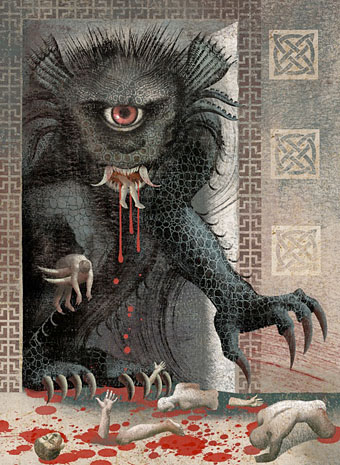
One of them, however, Gockinga’s version of Salomé, resurfaced in 1995 but I don’t know the current location either. And the acclaimed Louis Couperus Museum last year showed an unknown Couperus illustration of Gockinga from a private collection (no, not mine). In Droomkunst now hangs a small but fine work in a similar style: the Bacchanal already mentioned here. The Droomkunst catalogue dates the work about 1915. I would dare to date is somewhat earlier, I think 1913.

In his opening speech Singer director de Lorm compared Gockinga’s Bacchanal with the work of Erwin Olaf because of the hedonistic, decadent parallels between the two works. If I remember correctly, de Lorm also talked about certain places preferred by these artists, in addition to the perverse, decadent, decayed Amsterdam also Indonesia and especially Java, which was known as a kind of international gay colony.

Now, our Gockinga has also dwelled there; I do not know exactly where and when, but—and this is information that surfaced after my earlier mentioned article was published—he lived in the late thirties in Bali for a while in the home of the renowned painter W.G. Hofker. And in a recent study Imagining Gay Paradise: Bali, Bangkok, Singapore and cyber-Singapore we read that Gockinga was one of the victims of a scandal; he was arrested because of his homosexuality in December 1938 in Denpasar. Here, the comparison with the 2000 generation of artists limp, which, after all, in Amsterdam and elsewhere were partying without having fears of being arrested for lewd behaviour.

klein.jpg

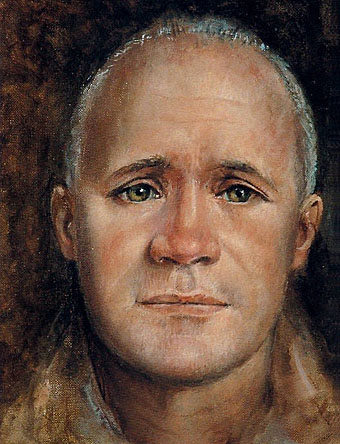
Fritz Klein by René Gockinga.

Where several generations of artists do come together is in the following, in our humble opinion a very nice item that was sent us last year. The majority of Gockinga’s Beardsley and the Nérée-like drawings from around 1917 are still unfortunately lost. Probably the “immoral” nature of his work is the main reason. So the item presented here is, as far as we know for the first time, is a new discovery.

It is a Beardsley-like portrait from 1917 or thereafter and it portrays none other than the painter Fred (Fritz) Klein (1898–1990), father of the famous and important Yves Klein.

Huh? What? How can that be? Well, that is of course very well possible. They were more or less contemporaries (Klein was born in 1898, Gockinga in 1893), were both born in the Dutch East Indies and were back in The Netherlands in 1913. They shared a great interest in art. In 1920, Klein moved to France, where he would make his sunny canvases that he became known for. Before that, he was apparently also in The Hague, where he visited his friend Gockinga. That friend has now made a special and somewhat decadent portrait of Klein: a kind of mythological half-man, surrounded by masks and, as I said, in a nice Beardsley-style. You could interpret the masks and the mix of male/female characteristics in a certain way but I leave that to the viewer. In any case, a special drawing can be added to the mysterious oeuvre of the Dutch Symbolist. Big thanks to the Klein relatives that allowed me to write about and portray it, of course.

Sander Bink

Previously on { feuilleton }
Antony Little’s echoes of Aubrey
Aubrey in LIFE
Beardsley reviewed
Aubrey Beardsley in The Studio
Ads for The Yellow Book
Beardsley and His Work
Further echoes of Aubrey
A Wilde Night
Echoes of Aubrey
After Beardsley by Chris James
Illustrating Poe #1: Aubrey Beardsley
Beardsley’s Rape of the Lock
The Savoy magazine
Beardsley at the V&A
Merely fanciful or grotesque
Aubrey Beardsley’s musical afterlife
Aubrey by John Selwyn Gilbert
“Weirdsley Daubery”: Beardsley and Punch
Alla Nazimova’s Salomé

Weekend links 218

white.jpg

The End of a Thousand Years (2014) by Hilary White. Via Phantasmaphile.

• It’s taken a while to shamble into the world but A Mountain Walked, an anthology of Cthulhu Mythos stories edited by leading Lovecraft scholar ST Joshi, will be published by Centipede Press next month. The publisher’s page for the book shows that my contribution will be facing Joshi’s introduction which is something I wasn’t aware of until this week. It also says the 692-page limited edition is sold out, although book dealers often buy collectible volumes such as this to sell on after adding their own markup. Be warned that it was listed on Amazon at $160 so if there are copies available anywhere they won’t be cheap.

• It’s not such a surprise to hear that magic mushrooms were an inspiration for Frank Herbert’s Dune. David Lynch’s film of Dune receives passing mention in this profile by Jeremy Kay of Lynch and the Twin Peaks film/TV series.

• “Whitechapel station is one of Giambattista Piranesi’s imaginary prisons, colonised by frantic electrical engineers and watched over by CCTV.” Will Wiles on the chaos and tangled energy of modern cities.

The word perfume comes from the French root “fume”—smoke—and where there’s smoke, there’s fire! I think most people are turned on sexually by scents and smells. Certain body odours can be very sexually stimulating. We purposefully chose certain ingredients for my Obscenity perfume that are associated with occult or religious rituals, including vetiver, labdanum, and oud, and others that are considered aphrodisiacal, including patchouli and sandalwood. The point of Obscenity is that there is no conflict between the religious and the sexual, and in fact they should be completely complimentary. The fragrance is meant to stimulate you sexually, but it also literally contains water from Lourdes, so it also has religious notes and perhaps even healing properties!

Bruce LaBruce talks to Kathy Grayson about his new fragrance, Obscenity

The Baffler, “a journal of iconoclastic wit and cultural analysis” relaunches with full access to its archives from 1988 to the present.

Pineal, the new album by Othon, is dark and “properly, brilliantly queer,” says David Peschek.

• At Core77: How to improve the audio quality of vinyl records with wood glue.

• P. Adams Sitney interviews Kenneth Anger on WNYC’s Arts Forum (1972).

• At BibliOdyssey: Le Bestiaire Fabuleux by Jean Lurçat.

• Mix of the week: Secret Thirteen mix 123 by Evol.

Meawbin the Creepy Cat

Perfumed Metal (1981) by Chrome | Fragrance (Ode To Perfume) (1982) by Holger Czukay | The Perfume (2006) by Johnny Klimek, Reinhold Heil, Tom Tykwer

Tuxedomoon: some queer connections

roques18.jpg

UK poster insert by Patrick Roques for Desire (1981).

Yes, more Tuxedomoon: there’s a lot to explore. It’s always a pleasure when something that you enjoy one medium connects to things that interest you elsewhere. From the outset Tuxedomoon have had more than their share of connections to gay culture—to writers especially—but it’s more of an ongoing conversation than any kind of proselytising concern. This post teases out those connections some of which I hadn’t spotted myself until I started delving deeper.

The Angels of Light: Not the Michael Gira group but an earlier band of musicians and performers in San Francisco in the early 1970s. The Angels of Light formed out of performance troupe The Cockettes following a split between those who wanted to charge admission for their shows, and those who wanted to keep things free to all. Among the troupe there was Steven Brown, soon to be a founding member of Tuxedomoon:

The group began as an offshoot of The Angels of Light, ‘a “family” of dedicated artists who sang, danced, painted and sewed for the Free Theater’, says Steve Brown. ‘I was lucky to be part of the Angels—I fell for a bearded transvestite in the show and moved in with him at the Angels’ commune. Gay or bi men and women who were themselves works of art, extravagant in dress and behaviour, disciples of Artaud and Wilde and Julian Beck [of the Living Theater] … we lived together in a big Victorian house … pooled all our disability cheques each month, ate communally … and used the rest of the funds to produce lavish theatrical productions—never charging a dime to the public. This is what theatre was meant to be: a Dionysian rite of lights and music and chaos and Eros.’

Rip it Up and Start Again: Postpunk 1978-1984 by Simon Reynolds

(Special Treatment For The) Family Man (1979): A sombre commentary from the Scream With A View EP on the trial of Dan White, the assassin of Harvey Milk and George Moscone. White’s “special treatment” in court led to a conviction for manslaughter which in turn resulted in San Francisco’s White Night riots in May, 1979.

James Whale (1980): An instrumental on the first Tuxedomoon album, Half-Mute, all sinister electronics and tolling bells as befits a piece named after a director of horror films. Whale’s Bride of Frankenstein (1935) is not only the best of the Universal horror series, it’s also commonly regarded as a subversive examination of marriage and the creation of life from a gay perspective. (Whale’s friends and partner disagreed, however.)

joeboysf.jpg

Cover art by Winston Tong.

Joeboy San Francisco (1981): The Joeboy name was lifted from a piece of San Francisco graffiti to become a name for Tuxedomoon’s DIY philosophy. It’s also a record label name, the name of an early single, and a side project of the group which in 1981 produced Joeboy In Rotterdam / Joeboy San Francisco. The SF side features a collage piece by Winston Tong based on The Wild Boys by William Burroughs, a key inspiration for the band which first surfaces here.

In one piece, the band cites its influences as: “burroughs, bowie, camus, cage, eno, moroder”. Can you say what you admired or drew on vis-à-vis these artists?

William S. Burroughs — ideas concerning use of media — tapes, projections, his radical anti-control politic in general as well as his outspoken gayness. Early on we duplicated on stage one of his early experiments projecting films of faces onto faces.

Simon Reynolds interview with Steven Brown

Continue reading “Tuxedomoon: some queer connections”

Fast Friends

lazarov1.jpg

My thanks to writer Dale Lazarov for letting me see an advance copy of his new comic, Fast Friends. Despite writing about gay art often enough I don’t see many gay comics but this one had the immediate attraction of being a 62-page wordless story, wordless comics being a minor tradition that I’ve always enjoyed. When description and dialogue are removed, the artist needs to take greater care over the storytelling, even in an uncomplicated story such as this chance meeting between two spurned lovers. That’s not to say wordless comics aren’t still written at the outset: someone has to imagine the characters, create the story, describe the action, and so on. Michael Broderick is responsible for the artwork, and he proves himself adept at dealing with the technical challenges; he’s equally adept at making the erotic encounter into a stimulating, sexy read. Fast Friends is a touching story, and, in the recurring comic books that act as a commentary on the action, not unaware of the romance comic tradition.

lazarov2.jpg

Elsewhere on { feuilleton }
The gay artists archive

Weekend links 216

heathen.jpg

Why Do The Heathen Rage? (2014) by The Soft Pink Truth. Cover art by Mavado Charon.

Drew Daniel’s latest release as The Soft Pink Truth is Why Do The Heathen Rage?, a witty electronic riposte to the often reactionary attitudes of black metal music and the people who create it. (The album is dedicated to Magne Andreassen, a gay man stabbed to death by the drummer from Emperor.) Dorian Lynskey talked to Daniel about queering the metal world, as did Angus Finlayson at FACT. Daniel’s project has been receiving press everywhere but you wouldn’t know it to read US/UK gay news sites where the music coverage is relentlessly narrow and insular. To date, only BUTT magazine has mentioned Why Do The Heathen Rage? but then BUTT have always stood apart from their parochial contemporaries. Never mind, here’s another fucking article about “petite pop princess” Kylie Minogue.

• “By the letter of the law, Ulysses was obscene. Obviously, gratuitously, relentlessly obscene.” Josh Cook on censorship and dangerous books. One of my own dangerous publications, the fifth issue of the Lord Horror comics series, Hard Core Horror (declared obscene in a UK court in 1995), received a very belated review at The Comics Journal. More censorship: Judy Bloom on the perennial panics in US school libraries. Lest we feel superior to American prudery, Leena McCall’s painting of a semi-naked woman caused some consternation in a London gallery last week.

• “Over and over, we’re told that nobody buys [compact discs] anymore.” Steven Hyden on the latest obituaries being written for a music format. Ten years ago the death of vinyl was being confidently predicted: “The physical presence of the popular song is gone,” Paul Morley declared. Related: The death of mp3s.

There is nothing quite like Maryanne Amacher’s third ear music. It is alarming. Some of her fellow artists never quite believed that their ears were not being damaged. Third ear music invades you, wraps inside your body, your head, your eyes — just like she says. You can’t be sure, after a while, if the sounds you hear are those created by your ears or Maryanne Amacher.

Stefany Anne Golberg on the music of Maryanne Amacher

• At Dangerous Minds: Nothing Lasts Forever (1984), Bill Murray in a “lost sci-fi comedy set in a totalitarian New York City”.

• More Joyce (there’s always more Joyce): Humument Images to Accompany James Joyce’s Ulysses by Tom Phillips.

• Another celebration of Penda’s Fen by David Rudkin, and another reminder that it’s still not available on DVD.

• Stairway to Heaven: Atlas Obscura on the Gustave Moreau Museum, an essential stop if you visit Paris.

• Mix of the week: Secret Thirteen Mix 121 by Higher Intelligence Agency.

• MetaFilter has a wealth of links to pulp magazine archives.

Yan Nascimbene’s illustrations for Italo Calvino’s stories.

• Rebecca Litchfield’s Orphans of Time and Soviet Ghosts.

• RIP Charlie Haden

Going Home (1972) by Alice Coltrane (Charlie Haden, bass) | Earth (1974) by Joe Henderson Featuring Alice Coltrane (Charlie Haden, bass) | Malkauns (1975) by Don Cherry (Charlie Haden, bass)