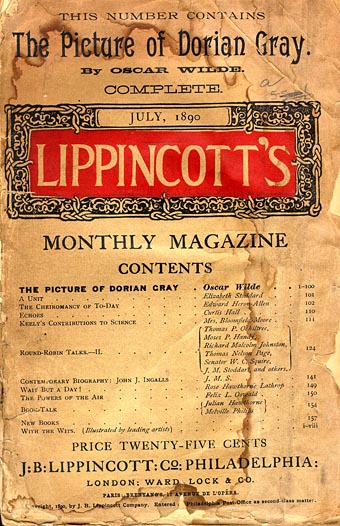
The original magazine publication, 1890.
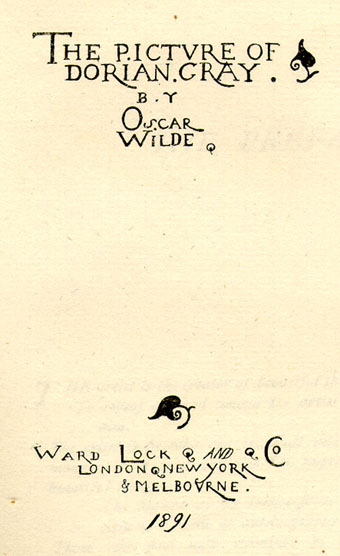
Title page of the first edition, 1891.
Elsewhere on { feuilleton }
• The Oscar Wilde archive
A journal by artist and designer John Coulthart.

Gay
The original magazine publication, 1890.
Title page of the first edition, 1891.
Elsewhere on { feuilleton }
• The Oscar Wilde archive
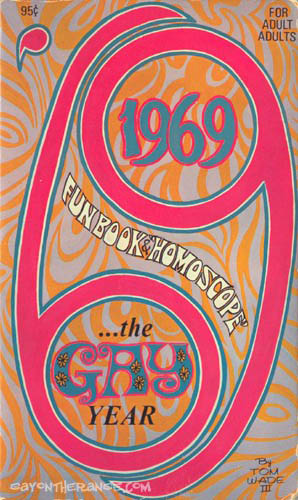
Gay on the Range (very apt name in the year of Brokeback Mountain) has a great selection of gay paperback covers from the 1950s and 60s. The one above is one of the more psychedelic examples (I was 7 years old in 1969; no one told me it was “the gay year”.) Lots of hysterical art and titles, some of them genre parodies, others delicious examples of steamy prurience that teasingly imply “exposure” of the terrible world of “the gay”. For balance, the Strange Sisters site has a similar collection of lesbian book jackets from the same period.
Elsewhere on { feuilleton }
• The gay artists archive
• The book covers archive
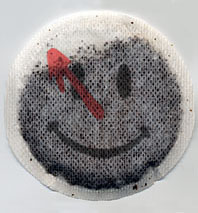
Originally published in Strange Things Are Happening, vol. 1, no. 2, May/June 1988. Note: “Vincent Eno” was Richard Norris, later one half of dance/ambient outfit The Grid with Dave Ball. See also the Watchmen round table discussion on this site.
Vincent Eno and El Csawza meet
comics megastar ALAN MOORE
Amidst smouldering heaps of superlatives flung in the direction of the comic genre of late, one name stands head and shoulders above the crowd: ALAN MOORE. But don’t just trust the gushing blurbs on the back of Moore’s works (‘Alan Moore has reinvented the comic book genre’ and so on), take it from your pals at Strange Things – Alan Moore is beezer!
With Watchmen the comic book format legitimately became what the media manipulators were attempting to tell us all about – the graphic novel. Watchmen is a work to be read and re-read, loved and cherished. Poetry, Cinema, narrative, music… they’re all here. The advent of such a work is as exciting in literary terms as the publication of the earliest novels, and you’d better believe it. Because within the next two years, the work of Alan Moore and his contemporaries is going to eclipse Watchmen and zoom into overdrive. As Alan says, ‘the next two years are going to be good for comics.’ Some understatement.
Turning into the first true comic megastar wasn’t an easy ride for Alan.
‘After school I did a variety of awful horrifying jobs,’ he recalls. ‘They look great on the dust jacket of your first novel, but were shit to actually live through! I started off by working at the skin division of the local Co-operative society. We’d go to work at seven thirty in the morning, drag these blood-sodden sheepskins out of vats of cold water and urine, chop off extraneous testicles or hooves and throw them at each other in this concentration camp gaiety we’d established to cope with the grimness of our surroundings. People there were splattered with this chemical for removing wool from hide, these blue marks all over them.
‘Then I climbed up the social ladder and became a toilet cleaner for a hotel. After that I went through a number of grindingly tedious office jobs; finally I had to make the jump into writing because we’d got a kid on the way and if I’d waited until after the baby was born I’d never have had the nerve. I decided that life being as short as it is, and as far as I know us getting only one crack at it, it just seemed important that I shouldn’t spend any of it doing something I didn’t want to do.’
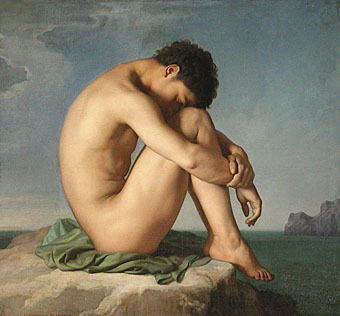
Jean Hippolyte Flandrin (1809-1864) was a Neo-Classical painter whose work tends to lack the sensuality of his master, Ingres, yet who managed to produce one picture at least which has been an inspiration to subsequent artists and photographers.
Jeune Homme Assis au Bord de la Mer (Young Man Sitting by the Seashore) was painted in 1836. The simplicity and directness of the rendering is probably intended to be reminiscent of Classical sculpture and the figures seen on Greek pottery and bas-reliefs. There’s nothing in Flandrin’s history to suggest a homoerotic intent but the picture has that effect nonetheless, and it’s to gay artists (and viewers) that the work has mostly appealed since, as can be seen below.
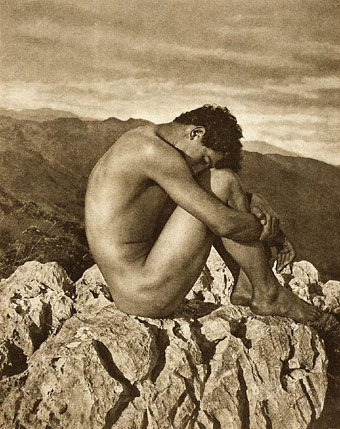
The first (?) copy, usually dated as being from 1900 although it may be earlier, and a very careful imitation of the original pose. Photographer Wilhelm von Gloeden specialised in Classical-themed gay erotica and gave his figure a Biblical allusion by titling the picture Cain. Gloeden’s follower, Gaetano d’Agata, produced his own version.
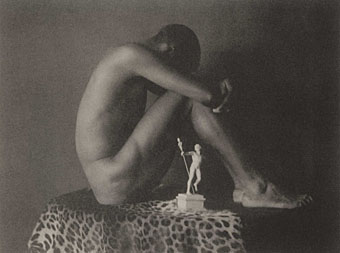
Ebony and Ivory (1897) by Fred Holland Day.
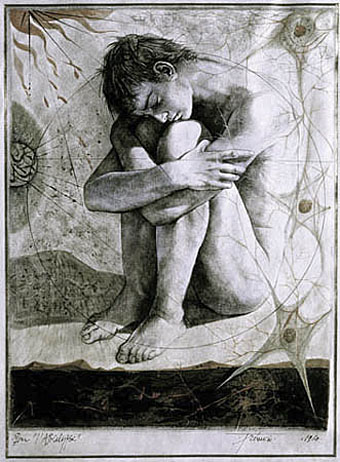
L’Apocalypse by Pierre Yves Trémois (1961).
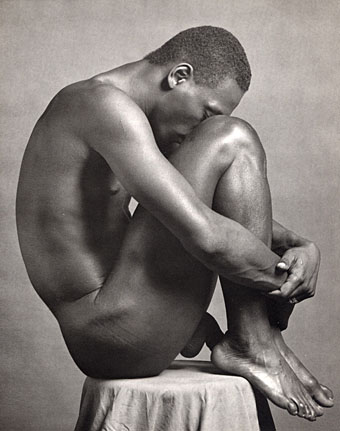
Ajitto by Robert Mapplethorpe (1981).
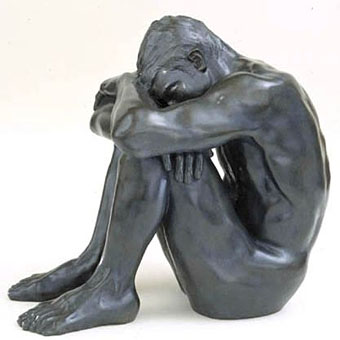
A rare sculpture version, L’Homme de l’Apocalypse by Pierre Yves Trémois (1998).
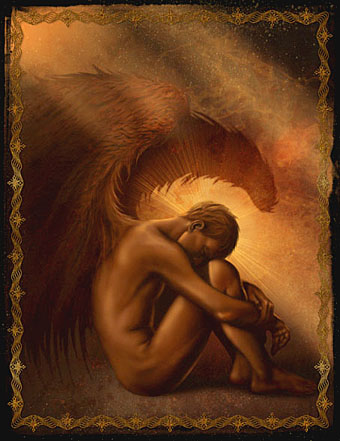
Finally, here’s my own Fallen Angel picture from 2004 which added wings to the figure.
Elsewhere on { feuilleton }
• The recurrent pose archive
• The gay artists archive