Weekend links 205

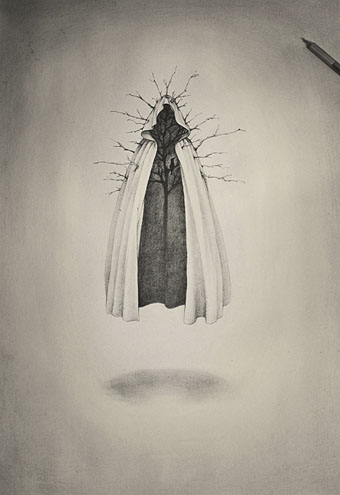
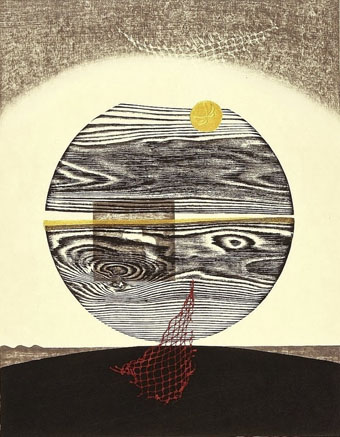
lin.jpg

King’s Cloak (2012) by Alice Lin.

• The week in Finnegans Wake: illustrations by John Vernon Lord for a new Folio Society edition; The Guardian‘s review from 1939; Christina Scholz explores Joyce’s use of the Ant and the Grasshopper fable; Sheng Yun wonders when Dai Congrong will compete the first Chinese translation of the book; Stephanie Boland on riverrun, the latest theatrical adaptation.

• It’s Robert Aickman‘s centenary year so Faber are reissuing several volumes of his peerless “strange stories”. And it’s good to see the great Clark Ashton Smith finally receive the blessing of Penguin Classics.

• The Teenage Boyfriend of the Beat Generation: Marcus Ewart slept with Allen Ginsberg (who showed him how to give a proper blowjob), and had an eight-year relationship with William Burroughs.

Yet another advocate of shorter work time was JS Mill. He dismissed the ‘gospel of work’ proposed by Thomas Carlyle in part because it drew a veil over the real costs of work, including slave work that Carlyle sought to defend. Instead, Mill advocated a ‘gospel of leisure’, arguing that technology should be used to curtail work time as far as possible. This stress on technology as a means to shorten work time was later to feature in Bert­rand Russell’s 1932 essay, ‘In Praise of Idleness’.

David Spencer on The Case for Working Less

• More Steve Moore memorials: Mitch Jenkins put the pages from Unearthing online, while Pádraig Ó Méalóid posted a personal appreciation at The Beat.

Linda Marsa on how psychedelics are helping cancer patients deal with their illness.

• The Weird Album: art by Enrique Alcatena (including some Lovecraftian pieces).

• Didgeridoom: Director Ted Kotcheff talks to Robert Barry about Wake in Fright.

The Jealous God (1985), a comic strip by Alejandro Jodorowsky & Silvio Cadelo.

• The Dune in Your Head: Ethan Gilsdorf on the greatest SF film never made.

50 minutes of Kraftwerk on Rockpalast in 1970. Astonishing.

• At 50 Watts: Sheet-music covers from Sweden in the 1920s.

Harvard discovers old library books bound in human skin.

Same-sex marriage is now legal in England and Wales.

Wyrd Daze has reached issue 5.

Kaleidoscopes at Pinterest.

Flight From Ashiya (live on TV! 1967?) by Kaleidoscope (UK) | Lie To Me (1969) by Kaleidoscope (US) | Kaleidoscope (1984) by The Rain Parade
Weekend links 193

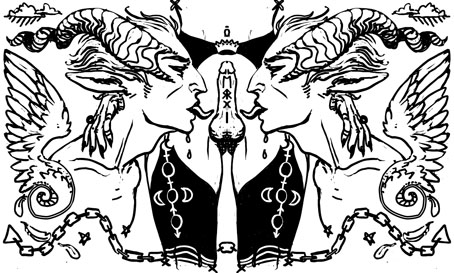
gauger.jpg

A Problem Glyph by Eliza Gauger. Problem Glyphs are “symbolic illustrations … drawn in response to problems sent in by tumblr users”.

Kosmische Night takes place at the Museum of Bath at Work, Bath, Somerset, on January 25th (Rescheduled to February 22nd).  “…a celebration of all things Teutonic for anyone who enjoys Neu!, Can, Tangerine Dream, Stockhausen and Kraftwerk,” say the organisers. Also on the bill, The Electric Pentacle, a Carnacki-esque collaboration between Narco Lounge Combo and The Levels.

• Shock Headed Peters’ Fear Engine II: Almost As If It Had Never Happened. Joe Banks on Karl Blake, “…one of the most fascinating and colourful characters to emerge from the fertile loam of the post-punk scene”.

• “The great question in the film and the tale is not the existence of the ghosts but the way the governess understands their no-longer-lived lives and desires.” Michael Wood on The Innocents.

Nobody, however, is a greater authority on the intersection of porn and alternative spirituality than Annie Sprinkle. Beginning as a prostitute in the 1960s and 70s, she entered porn in the pre-AIDS era and made over two hundred films. She then jumped into a career as a sex-positive author and educator, which brought her into close conflict not only with feminists like Andrea Dworkin and Catharine MacKinnon, but also right-wing patriarch Jesse Helms, who denounced one of her sex magick performance pieces on the floor of the Senate. For Sprinkle, both sexuality and performance are explicitly spiritual and magical, part of her role as a cultural shaman.

In the Valley of the Porn Witches by Jason Louv.

Stars of the Lid and Wordless Music Orchestra playing for two hours last month at the Basilica of Our Lady of Perpetual Help in Sunset Park, Brooklyn.

Rick Poynor on the late Martin Sharp’s contributions to People, Politics and Pop: Australians in the Sixties (1968) by Craig McGregor.

Maggie Greene on The Woman in Green: A Chinese Ghost Tale from Mao to Ming, 1981–1381.

• “TED actually stands for: middlebrow megachurch infotainment,” says Benjamin H Bratton.

Geoff Manaugh on how corpses helped shape the London Underground.

Tony White on Eduardo Paolozzi at New Worlds by David Brittain.

• Mix of the week: Secret Thirteen Mix 102 by Frank Bretschneider.

• At Dangerous Minds: film of Syd Barrett‘s first psychedelic trip.

NYPL Wire: a New York Public Library Tumblr.

Microbial art by Eshel Ben-Jacob and others.

Interstellar Rock: Kosmische Musik (1974) by The Cosmic Jokers | I, Bloodbrother Be (1984) by Shock Headed Peters | Obscene and Pornographic Art (1991) by Bongwater

Weekend links 182

iwami.jpg

Mirror of Water (1981) by Reika Iwami.

• The week in comics: Paul Gravett interviews Enki Bilal. | Paul Kirchner’s wordless and inventively surreal strip, The Bus, was republished in France last year but it’s been out-of-print for years everywhere else. Read it online here. | Bill Watterson has made the entire run of Calvin and Hobbes available for free.

• “…seek and learn to recognize who and what, in the midst of the inferno, are not inferno, then make them endure, give them space.” Leland de la Durantaye reviews Italo Calvino: Letters 1941–1985.

• Artist Charles Ross says “My interest in science is related to how mysterious it is.” Ross Andersen visited Ross’s Star Axis, “a masterpiece forty years in the making”.

There is a satirical intent at work here, as well as mordant humour, a potent mix that reminds one more of the absurdist fictions of the French jazz musician Boris Vian than of anything in the SF canon. Science fiction is not central in Harrison’s work – not even as a target of his sharp wit – and it is a mistake to regard him as being chiefly interested in demolishing a genre that is only one of several he has mastered.

John Gray on M. John Harrison’s Kefahuchi Tract trilogy. This week Harrison posted a new piece of fiction on his blog.

• Mixes of the week: Secret Thirteen Mix 091 by Sugai Ken, and Bride of the Abominable Marshman, an early Halloween mix by Hackneymarshman.

• Clive Hicks-Jenkins on Schandmasken (masks of shame), and the clay visage of Paul Wegener’s Golem.

• A version of Kraftwerk’s Trans Europe Express by Chicago band Disappears.

Postcards to the Curious: MR James-themed artwork by Alisdair Wood.

Clive Barker: Why I Once Gave Up Horror Movies Entirely.

• Artist Melinda Gebbie at Phantasmaphile.

Fragment, a new video from Emptyset.

38 photos of airships through the ages.

• This Much I Know: Kenneth Anger.

• Trans Europe Express (2000) by Señor Coconut Y Su Conjunto | Trans Europe Express (2007) by Receptors | Trans Europe Express (2012) by Daniel Mantey

Weekend links 175

maeda.jpg

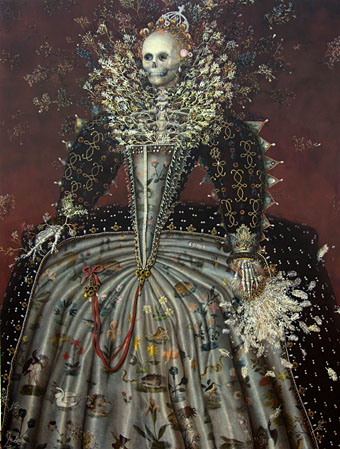
Heartbeat of the Death – Queen Elizabeth the First (2013) by Haruko Maeda.

• “The casual mixing of people from across the world at The Garden broke down many barriers. Its rich, beautiful, smart, and successful people were confident enough to exercise the kind of sexual freedom that would land you in jail elsewhere in the country.” Kate Webb on Alla Nazimova’s Hollywood estate, The Garden of Alla.

• “…from 1956 to 1970 Borges taught English literature at the University of Buenos Aires, and now, over half a century later, one of his courses is finally available in English in a slim, delightful volume.” Will Glovinsky on Professor Borges. Related: Jacob Mikanowski says “To Tlön: Let’s Invade Reality”.

• Mixes of the week: Secret Thirteen Mix 084 by Koen Holtkamp—Alice Coltrane, Alan Watts, John Cage, Popol Vuh, Faust and others—and Sequenze E Frequenze, “the rarefied outer limits of ‘stare at the sun, outsider peaked’ Italian music”.

Consider the fate of the concept of ‘futuristic’ music. The ‘futuristic’ in music has long since ceased to refer to any future that we expect to be different; it has become an established style, much like a particular typographical font. Invited to think of the futuristic, we will still come up with something like the music of Kraftwerk, even though this is now as antique as Glenn Miller’s big band jazz was when the German group began experimenting with synthesizers in the early 1970s.

Where is the 21st-century equivalent of Kraftwerk? If Kraftwerk’s music came out of a casual intolerance of the already-established, then the present moment is marked by its extraordinary accommodation towards the past. More than that, the very distinction between past and present is breaking down. In 1981, the 1960s seemed much further away than they do today. Since then, cultural time has folded back on itself, and the impression of linear development has given way to a strange simultaneity.

Mark Fisher on the present cultural moment, and the weirdness of Sapphire and Steel.

• At Front Free Endpaper: A Gay Library Thing and French Line Gay Pulp Cover Designs. Callum is also giving away books by Frederick Rolfe/Baron Corvo to anyone who asks. The proviso is you write a short review for his blog.

• Film director Ben Wheatley on Don’t Look Now: “I felt a great panic come over me”. Elsewhere it was announced this week that Wheatley is planning a film of JG Ballard’s High Rise.

• Brits may remember the wonderful Laurie Pike from the Manhattan Cable TV show in the early 1990s. These days she’s writing an online guide to the city of Paris.

Ben Frost has made three previously unreleased recordings available at Bandcamp.

The Media History Digital Library: 800,000 pages of film and radio periodicals.

• The results of three derives in London by Christina Scholz here, here and here.

• The late Seamus Heaney reads his own translation of Beowulf here and here.

High Rise (1979) by Hawkwind | Pop Sicle (1994) by High Rise | High Rise (2005) by Ladytron

Ralf and Florian

randf.jpg

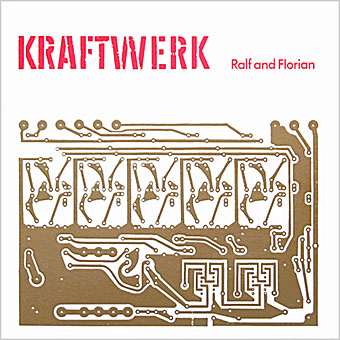
Ralf and Florian, 1973. Back cover photo by Barbara Niemöller.

Kraftwerk’s third album, Ralf and Florian, is forty years old this year. It was recorded and mixed from May to July, 1973, and released three months later. As with the first two Kraftwerk albums, it still hasn’t been given an official CD reissue. When so many albums by the big names of the 1970s have been reissued multiple times Kraftwerk are pretty much unique in suppressing part of their catalogue.

raf.jpg

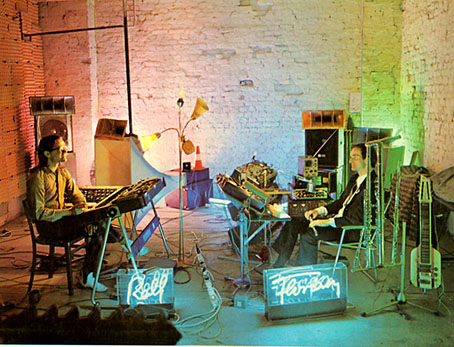
Photo by Robert Franck.

The reason usually given for this is that the fourth album, Autobahn (1974), was the first to adopt the conceptual style that became a hallmark of the group’s output. Well, yes and no. The celebrated sleeve design for Autobahn went through several variations, and the motoring theme only applies to the first side of the album. The second side doesn’t match the theme at all, and with its melodies and instrumentation (Florian was still using his flute) is much closer to the previous albums, especially the third one, than those that came after. What Kraftwerk prefer to see as a clean break is really more of a gradual evolution.

randf.jpg

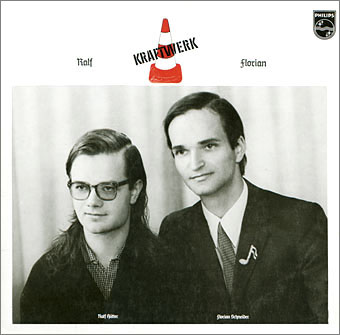
The sleeve for the first UK release. No designer credited.

I’ve always liked the Ralf and Florian album, and don’t mind so much that it’s not been given a proper reissue. Bootleg copies circulate, and even the original vinyl isn’t so scarce. A couple of things related to the album are more difficult to find, however. The first German copies came with a large poster-insert illustrated by the group’s artist/designer Emil Schult. This item more than anything shows a charming, human side to Ralf and Florian which was later overshadowed by the machine-obsessed conceptualism. Large scans of the insert were recently posted at Mostly Retro.

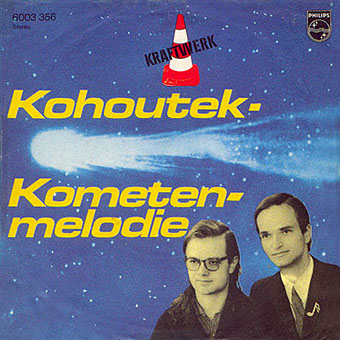
kohoutek.jpg

Then there’s Kohoutek – Kometenmelodie, a 7-inch single released in December 1973 which forms a bridge between the third and fourth albums. Kometenmelodie subsequently appeared in two versions on Autobahn but the single sleeve is very much in the R&F zone with the faces from the album cover, while the back of the sleeve sports Emil Schult’s Kling Klang Verlag logo from the album insert. Kohoutek was a comet visible in the night skies in 1973. This was Kraftwerk’s debut single, presenting two unique versions of Kometenmelodie. It’s never been reissued but both tracks can be heard here. Elsewhere on YouTube there’s a performance of the R&F track Tanzmusik on a German TV programme, a clip which features new group member, Wolfgang Flür, playing his electronic drum pads.

Previously on { feuilleton }
Reworking Kraftwerk
Autobahn animated
Sleeve craft
Who designed Vertigo #6360 620?
Old music and old technology
Aerodynamik by Kraftwerk