Tonto’s expanding frog men

tonto.jpg

I wasn’t going to write about album cover art three times in a row but things keep catching my attention this week. Anyone interested in the history of electronic music knows the name Tonto’s Expanding Head Band, the duo formed by Malcolm Cecil and Robert Margouleff to create music with Cecil’s huge, custom-built TONTO (The Original New Timbral Orchestra) synthesizer. Cecil and Margouleff recorded two albums together: Zero Time (1971) and It’s About Time (1974), the latter credited to Tonto only. Zero Time was incredibly advanced for 1971, not classical adaptations like those being produced by Wendy Carlos and her many imitators, but all-original pieces created polyphonically, a feat that only the TONTO synth could easily achieve.

Given how successful the album is musically I’ve always thought it a shame that the sleeve art, inside and out, was the kind of amateurish “psychedelic” doodling that you find on many albums of this period. The design above was for a 1975 reissue, something I’d not seen before. The artist was illustrator Jeffrey Schrier who has a small, and no doubt incomplete, listing at Discogs with nothing similar to this in evidence. At a guess I’d say the evolving frog men are derived from the lyrics of Riversong, a meandering piece with singing processed via early vocoder-style technology, something that Wendy Carlos was also experimenting with. It’s not all hippy ambience: Jetsex sounds like an outtake from Kraftwerk’s Autobahn (albeit three years early) while Timewhys wouldn’t have been out-of-place on The Human League’s Travelogue album almost a decade later. Easy to see why Stevie Wonder and others were eager to work with Malcolm Cecil throughout the 1970s.

Elsewhere on { feuilleton }
The album covers archive

Previously on { feuilleton }
A Clockwork Orange: The Complete Original Score
Weekend links 164

panikanova.jpg

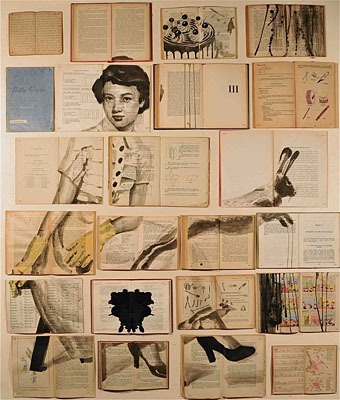
Ekaterina Panikanova paints on books.

Back in 2009 I bought a book of Art Nouveau illustration and design which contained an intriguing drawing by an Austrian artist, Franz Wacik (1883–1938). At the time there was little of Wacik’s other work online so I was delighted by the latest post at 50 Watts which showcases a selection of his illustrations. Wacik was a contemporary of British illustrator Sidney Sime, and both artists share a predilection for the comic and the grotesque.

• “The outlawing of drugs such as cannabis, MDMA and LSD amounts to the ‘the worst case of scientific censorship since the Catholic Church banned the works of Copernicus and Galileo’, the former Government drugs advisor Professor David Nutt has claimed.” Related: “At last, the edifice of drugs prohibition is starting to crumble,” says Amanda Feilding.

Alan Johnston on “A gay island community created by Italy’s Fascists”, and at Another Nickel In The Machine a report on The Gateways Club, one of the few meeting places for London’s lesbians in the 1960s. Alex Park wonders “Why Is Gay Porn So Popular In Pakistan?”

• If it’s June 16th then it must be Bloomsday: The Irish Times has a page of Joyce-related links to mark the anniversary. This year there’s a global reading of Ulysses taking place.

• “Now we can concentrate on album number nine,” says Kraftwerk’s Ralf Hutter. The rest of us will impatiently count the passing seconds.

• After a week in which George Orwell’s Nineteen Eighty-Four has seen an increase in sales, a look at its cover designs old and new.

Aleister Crowley: Wandering the Waste is a 144-page graphic biography of the Great Beast by Martin Hayes and RH Stewart.

Barnbrook Design‘s presentation of Taxidermy, a book by Alexis Turner, is rather splendid.

• FACT Mix 386 is a great collection of dubby grooves compiled by Young Echo.

• From 2001: Michael Wood in the LRB reviewing Apocalypse Now Redux.

• The first recording of Allen Ginsberg reading Howl.

Rejoyce (1967) by Jefferson Airplane | The Sensual World (1989) by Kate Bush | Molly Bloom (2013) by Alan Munde

Weekend links 146

snake.jpg

A Chinese postage stamp celebrating the Year of the Snake.

Cyclopean is a collaboration from Burnt Friedman, Jono Podmore and Can founding members Jaki Liebezeit, and Irmin Schmidt. The Quietus has a preview of all the tracks from their forthcoming EP. Great stuff.

Ten Things You (Possibly) Don’t Know About Kraftwerk. Related: a Speak & Spell emulator, and Atomium, a new single by Karl Bartos.

• In 1975 Barney Bubbles designed an inner sleeve for Hawkwind’s Warrior on the Edge of Time album, and this scarce recipe booklet.

• “We should all use language carefully. That is an obligation on the literate. But carefully doesn’t mean fearfully,” says Jenny Diski.

• Faber’s car-crash of a cover design for the 50th anniversary edition of The Bell Jar by Sylvia Plath caused an outbreak of parodies.

• At Strange Flowers: Ancient dreams and antique corruptions, Salomé via Gustave Moreau and Huysmans.

• FACT Mix 368 is a very varied collection of recent music and older pieces curated by Holly Herndon.

• At Ubuweb: eleven out-of-print recordings of Harry Bertoia’s sound sculptures.

Laurie Anderson and Brian Eno in conversation at Interview magazine.

Michael Chabon on Wes Anderson’s Worlds.

Snake Rag (1923) by King Oliver’s Creole Jazz Band | Rattlesnake Shake (1969) by Fleetwood Mac | Snakes Crawl (1980) by Bush Tetras | Ananta Snake Dance (1980) by Suns of Arqa | Snakeblood (2000) by Leftfield

Weekend links 141

nguyen.jpg

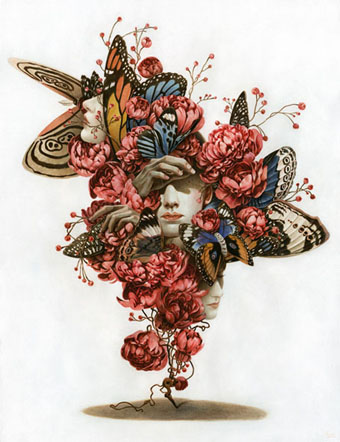
From the Beautiful Faces series (2012) by Tran Nguyen.

• “What possessed a generation of young European artists, and a few Americans, to suddenly suppress recognizable imagery in pictures and sculptures? Unthinkable at one moment, the strategy became practically compulsory in the next.” Peter Schjeldahl on the birth of abstraction.

• “A profanely mystical work of hyperpurple theory-porn, ObliviOnanisM is an auto-erotic intellectual fiction envisioning the phantastical unending odyssey of a young woman, Gemma, whom you will never know.”

Psychedelia—An Ancient Culture, A Modern Way of Life, a 520-page history of psychedelic culture by Patrick Lundborg. Related: Ken Kesey talks about the meaning of the Acid Tests.

[Hodges] made a convincing case that Turing’s teenage crush on a fellow schoolboy, Christopher Morcom, was an important catalyst for his lifelong preoccupation with the relationship between brain and mind. Morcom’s unexpected death at the age of eighteen was a shattering blow to Turing, who began to reflect on whether his friend’s consciousness might survive after death or whether it was simply a result of complex material processes and expired when life did. Hodges also linked the famous “Turing Test”, in which a computer attempts to pass as an intelligent human being, to Turing’s own dilemma as a gay man in a homophobic world. (Turing called his test the “imitation game”, and Hodges observed, “like any homosexual man, he was living an imitation game, not in the sense of conscious play acting, but by being accepted as a person that he was not”.)

Michael Saler reviews three books about computing pioneer Alan Turing

• Paul Gallagher at Dangerous Minds looks at Flowers, Lindsay Kemp’s theatrical staging of Genet’s Our Lady of the Flowers.

David Pearson designed a new edition of George Orwell’s Nineteen Eighty-Four for Penguin.

• Quadtone – Lumisonic Rotera: Mariska de Groot plays a light-to-sound instrument.

“Cash Mobs” Go Global—Battle Spreads Against Chain Store Dominance.

Cities and the Soul: a feast of Italo Calvino links at MetaFilter.

25 dessins d’un dormeur, Jean Cocteau, 1929.

Haunted Decor: a Flickr group.

Computer In Love (1966) by Perrey & Kingsley | Computer Love (1981) by Kraftwerk | Computer Love (1992) by The Balanescu Quartet

Weekend links 134

ulian.jpg

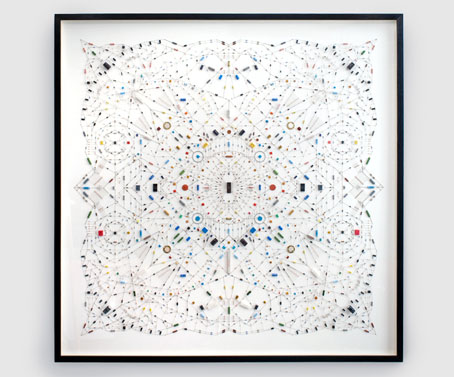
Technological mandala 02 (The beginning) (2012) by Leonardo Ulian.

• The Yellow Magic Orchestra really were the Japanese equivalent of Kraftwerk in 1978. I’d not seen this video for Firecracker before. Same goes for the Technopolis and Rydeen videos. Related: YMO’s synth programmer, Hideki Matsutake, showing off his modular Moog on a Japanese TV show.

Sra is the final book in the Aedena Cycle by Moebius. It’s never been translated into English but Quenched Consciousness has just finished posting the entire book in an unofficial translation.

• “It’s better to have a small amount of good comics, than a big amount of mediocre comics.” Dutch comic artist Joost Swarte interviewed.

• From 2007: The Strange Lovecraftian Statuary of Puerto Vallarta (Thanks, Ian.) Related: More art by Alejandro Colunga.

steam.jpg

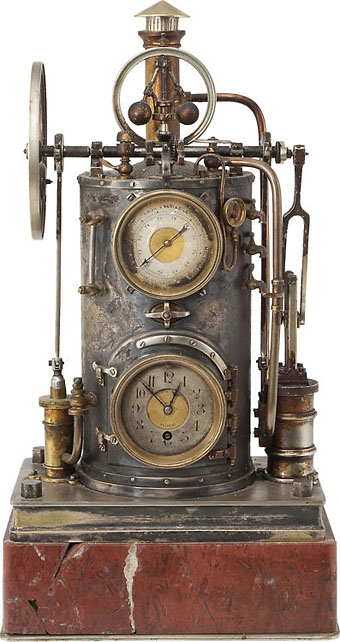
A novelty mechanical clock barometer in the form of a steam engine (c. 1885).

The MR-808: a room-size TR-808 drum machine by Moritz Simon Geist with real instruments played by robot hands.

• “Shoot us and dig the grave; otherwise we’re staying.” The women living in Chernobyl’s toxic wasteland.

Hotel Room Portraits 1999–2012 by Richard Renaldi, a new photo exhibition at Wessel + O’Connor.

Lane’s Telescopic View of the Opening of the Great Exhibition, 1851.

• “I’m the target market, and I don’t like it!” A Creative Catharsis.

Brian Eno’s new ambient album, Lux, is released on Monday.

Collages by Sergei Parajanov.

Techno City (1984) by Cybotron | Techno Primitiv (1985) by Chris & Cosey | Techno Dread (2008) by 2562.