My White Bicycle

tomorrow1.jpg

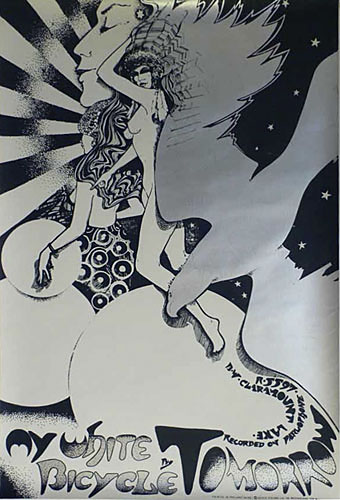
My White Bicycle (1967), poster by Hapshash and the Coloured Coat. Too risqué for EMI.

In what passes here for spare time I’ve been working on a private project that concerns events in London during a single week in 1967. I won’t elaborate for now but the research has been fun, and has led down byways where it’s easy to get lost in a profusion of historic detail. The International Times archive is a great time-sink if you want to see London’s psychedelic culture evolving from one week to the next. Oz magazine covered much of the same ground but in broader strokes; IT being a weekly paper was the closest thing the underground of the time had to a journal of record which means you’ll find things there which weren’t reported anywhere else.
tomorrow3.jpg

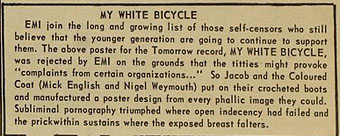
International Times, Volume 1, issue 13, 19/05/1967.

A brief item about a poster for the debut single by Tomorrow caught my eye, the artwork being an early piece by Hapshash and the Coloured Coat (Michael English and Nigel Waymouth) who we here discover were briefly known by another name:

MY WHITE BICYCLE

EMI join the long and growing list of those self-censors who still believe that the younger generation are going to continue to support them. The above poster for the Tomorrow record, MY WHITE BICYCLE, was rejected by EMI on the grounds that the titties might provoke “complaints from certain organizations…” So Jacob and the Coloured Coat (Mick English and Nigel Weymouth [sic]) put on their crocheted boots and manufactured a poster design from every phallic image they could. Subliminal pornography triumphed where open indecency had failed and the prick within sustains where the exposed breast falters.

Tomorrow were one of the first British psychedelic bands. My White Bicycle is their most memorable song but the rest of their self-titled debut album still holds up today. Ace guitarist Steve Howe became a lot more famous in Yes a few years later, while drummer Twink was in a host of bands in the late 60s and early 70s, Hawkwind included. My White Bicycle sounds superficially like a typical piece of psych whimsy à la Pink Floyd’s Bike (both songs were recorded at Abbey Road) but according to Twink there’s an anarchist subtext:

“My White Bicycle” was written out of what was actually going on in Amsterdam. One of the owners of Granny Takes a Trip, Nigel Weymouth [sic], had gone there and come back with a Provos badge which he gave to me. They were kind of like a student anarchist group that believed everything should be free. In fact, they had white bicycles in Amsterdam and they used to leave them around the town. And if you were going somewhere and you needed to use a bike, you’d just take the bike and you’d go somewhere and just leave it. Whoever needed the bikes would take them and leave them when they were done.

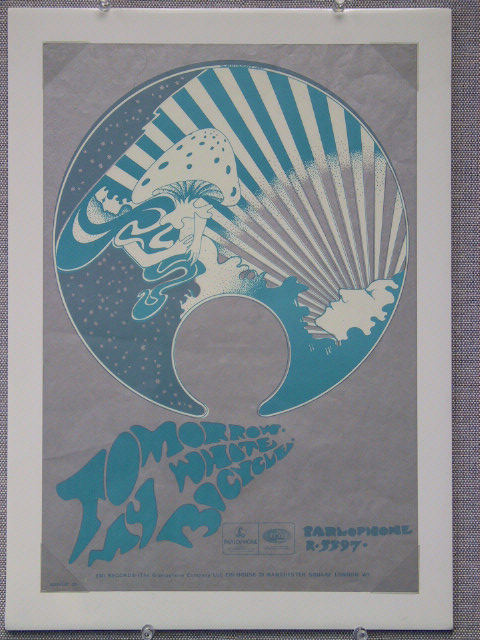
What would have been dismissed as pure utopianism now looks like prescience when bike-sharing schemes have become a reality. As to the redrawn poster, there’s a copy here which is described as very rare, hence its absence from other Hapshash galleries. Not really as phallic as the IT report implies; Aubrey Beardsley got away with a lot more priapic subterfuge in the 1890s when the strictures were also more severe.
tomorrow2.jpg

My White Bicycle (1967), the replacement poster by Hapshash and the Coloured Coat.

On the same page of IT there’s a brief announcement that The Beatles will have a new album out in June, something entitled Sgt. Pepper’s Lonely Hearts Club Band. That album also gave EMI a headache with both Lucy In The Sky With Diamonds and A Day In The Life being accused by “certain organisations” of promoting drugs. If the record company could have seen the greater headache that was coming less than ten years later from Malcolm McLaren and his King’s Road scallywags they might not have been so uptight.

Previously on { feuilleton }
Hapshash Takes a Trip
Michael English, 1941–2009
The Look presents Nigel Waymouth
The New Love Poetry

Weekend links 154

poizat.jpg

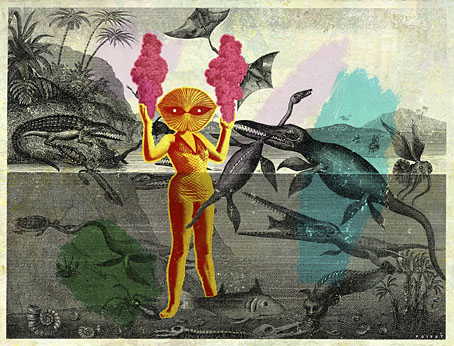
Collage by Chloé Poizat.

Xenis Emputae Travelling Band plays the Music of John Dee, and free at Bandcamp: Victorian Machine Music by Plinth, the “creaking, winding, piping, chiming and wood-knocking of Victorian parlour music machines”.

Jeremy Willard on Mikhail Kuzmin, “the Oscar Wilde of Russia”. Related: Conner Habib on the Disinfo podcast discussing pornography, sexuality, and whether sex be a revolutionary act.

Ed Vulliamy paid a visit to Hawkwind’s Hawkeaster festival. The Hawks’ Warrior On The Edge Of Time album is released in a remastered edition next month.

• Blasts from the past: Mahavishnu Orchestra, live in France, August 23rd, 1972, and Ashra (Manuel Göttsching & Lutz Ulbrich) in Barcelona, 1981.

martini.jpg

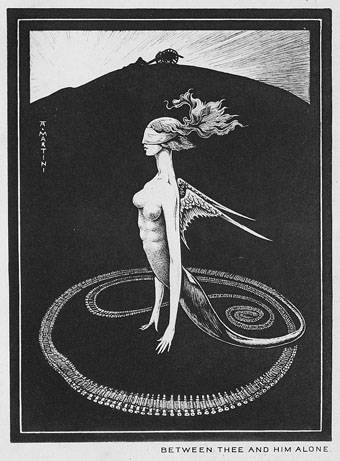
An illustration by Alberto Martini for Raw Edges (1908) by Perceval Landon.

NASA’s cover designs for Space Program manuals, guidebooks, press kits, reports and brochures.

PingMag—”Art, Design, Life – from Japan”—makes a welcome return as an active blog.

Suzanne Treister‘s Hexen 2.0 Tarot designs.

Listening to records that no longer exist

The architectural origins of the chess set

The Bohemian Realm of Absinthiana

Les sources d’une île: a Tumblr

Hammer Without A Master (1998) by Broadcast | Test Area (1999) by Broadcast | Make My Sleep His Song (2009) by Broadcast & The Focus Group

On the pyramid

pyramid01.jpg

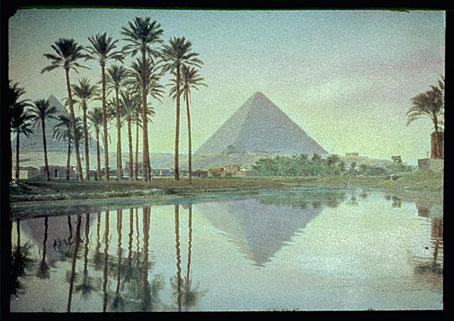
Lots of attention given this week to a series of photos taken from the summit of the Great Pyramid of Cheops by a Russian group of urban explorers. The Egyptian authorities who maintain the World Heritage site bar visitors from the place at night so the photographers hid in a tomb for a few hours before beginning their ascent. The original LiveJournal post with the full complement of photos is here, and is worth running through Google Translate if you’re interested in the details. One of the other photographers has a page devoted to his spectacular views here.

pyramid02.jpg

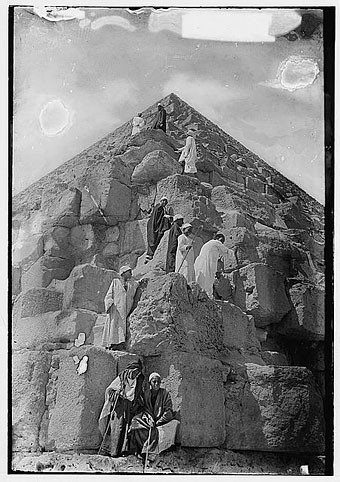
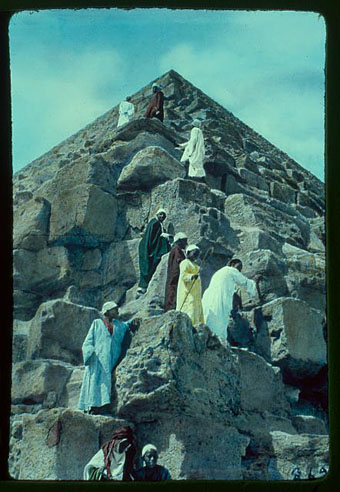
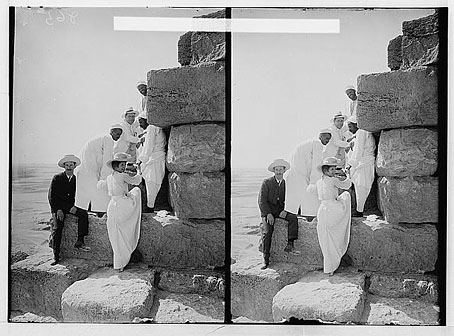
Ascent of the Cheops pyramid may be discouraged now but used to be a common pursuit for those visitors capable of making the climb. The Russian post mentions that among the graffiti carved into the stones on the summit they found the name of Tsar Nicholas II. The Library of Congress has many photos of Egyptian monuments in its archives, including a number showing pyramid ascents. Ex-Hawkwind man Nik Turner made the ascent himself after leaving the band in 1976. Whilst there he recorded three hours of solo flute in the sarcophagus of the King’s Chamber which later formed the basis for his Xitintoday album.

pyramid03.jpg

pyramid04.jpg

Continue reading “On the pyramid”

Weekend links 150

feanne.jpg

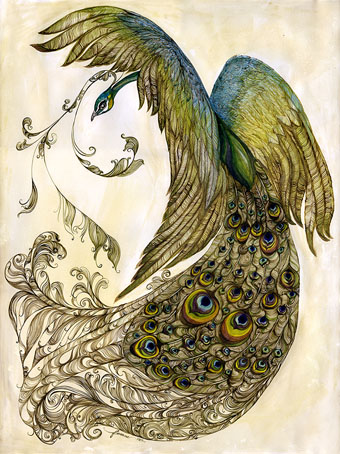
One of A Pair of Peacocks (2012) by Feanne.

Jonathan Barnbrook reveals his package design for the new David Bowie CD. The Barnbrook studio has also designed the catalogue for the forthcoming V&A Bowie exhibition. And there’s more (don’t worry, it’ll be over soon): Jon Savage on When Bowie met Burroughs.

• “Witches have a fashion moment,” says the NYT. Nice clothes but the writing trots out too many of the usual lazy clichés. Related: A Tale of Witches, Woodland and Half-remembered Melodies…, a new mix by Melmoth the Wanderer.

Calidostópia! is a free album (FLAC & mp3) from Marcus Popp aka Oval: “an enticing 16-track collaboration…with seven wonderful singers/musicians from all over South America”.

Before meeting Moorcock in person, [Hari] Kunzru went on to say, ‘I didn’t realise the role he’d played in connecting so many different scenes and undergrounds together – the psychedelic music scene, the science fiction scene, the hip experimental literature scene around people like William Burroughs, pop art’.

Brave New Worlds: A Michael Moorcock Retrospective by Carol Huston. Moorcock’s Elric novels will be published by Glénat in new bande dessinée adaptations later this year.

• More art by Michael W. Kaluta at The Golden Age. And more fantastic comics/illustration by Philippe Caza at 50 Watts. There’s more Caza here.

• Mine and David Britton’s new book, Lord Horror: Reverbstorm, was reviewed at The Spectator.

Google Street Scene: “Moments of cinema captured by Google Street View cameras”.

Cosmic Sentinels and Spiral Jetties: JG Ballard, Robert Smithson & Tacita Dean

• Strange Flowers showcases the heads of Pavel Tchelitchew, 1949–1952.

Setting in the East: Diamanda Galás on Women and Real Horror

Little Joe: “A magazine about queers and cinema, mostly.”

Nanoparticles loaded with bee venom kill HIV.

Treatises on Dust: Antic Found Texts

The Wizard Blew His Horn (1975) by Hawkwind (with Michael Moorcock) | Brothel In Rosenstrasse (1982) by Michael Moorcock’s Deep Fix | Running Through The Back Brain (1983) by Hawkwind (with Michael Moorcock)

Weekend links 146

snake.jpg

A Chinese postage stamp celebrating the Year of the Snake.

Cyclopean is a collaboration from Burnt Friedman, Jono Podmore and Can founding members Jaki Liebezeit, and Irmin Schmidt. The Quietus has a preview of all the tracks from their forthcoming EP. Great stuff.

Ten Things You (Possibly) Don’t Know About Kraftwerk. Related: a Speak & Spell emulator, and Atomium, a new single by Karl Bartos.

• In 1975 Barney Bubbles designed an inner sleeve for Hawkwind’s Warrior on the Edge of Time album, and this scarce recipe booklet.

• “We should all use language carefully. That is an obligation on the literate. But carefully doesn’t mean fearfully,” says Jenny Diski.

• Faber’s car-crash of a cover design for the 50th anniversary edition of The Bell Jar by Sylvia Plath caused an outbreak of parodies.

• At Strange Flowers: Ancient dreams and antique corruptions, Salomé via Gustave Moreau and Huysmans.

• FACT Mix 368 is a very varied collection of recent music and older pieces curated by Holly Herndon.

• At Ubuweb: eleven out-of-print recordings of Harry Bertoia’s sound sculptures.

Laurie Anderson and Brian Eno in conversation at Interview magazine.

Michael Chabon on Wes Anderson’s Worlds.

Snake Rag (1923) by King Oliver’s Creole Jazz Band | Rattlesnake Shake (1969) by Fleetwood Mac | Snakes Crawl (1980) by Bush Tetras | Ananta Snake Dance (1980) by Suns of Arqa | Snakeblood (2000) by Leftfield