Albin Grau’s Nosferatu

nosferatu01.jpg

For many directors a film like Nosferatu: A Symphony of Horror (1922) would have been a career peak, but Friedrich Murnau went on to make The Last Laugh (1924), Faust (1926) and Sunrise (1927). All those films improve cinematically on Nosferatu but the vampire film continues to cast the longest shadow: quoted, remade, and with even its production fictionalised in Shadow of the Vampire (2000). The lasting success of Nosferatu wasn’t all Murnau’s doing, however.
nosferatu05.jpg

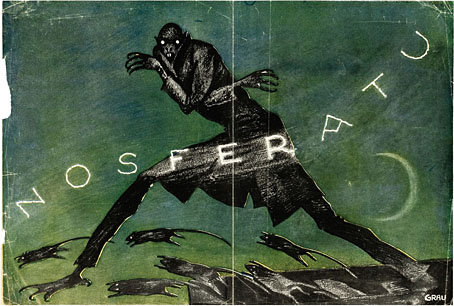
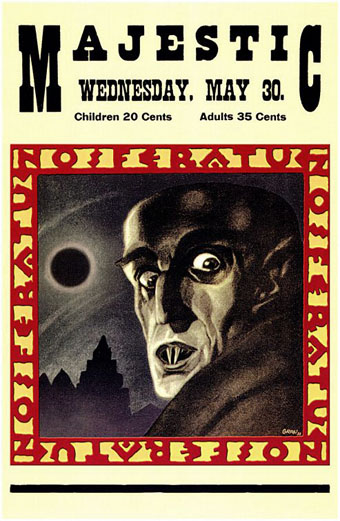
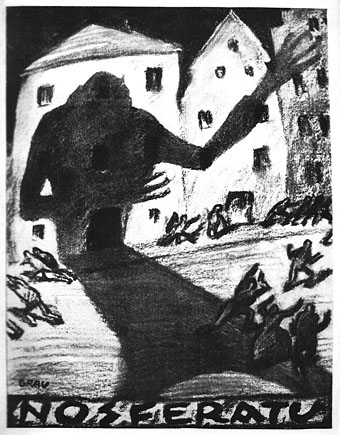
It’s arguable that without the preliminary work of production designer Albin Grau (1884–1971) the film might have been little more than a curious precursor of the Universal Dracula (1931). Grau was responsible for the set design and the extraordinary appearance of Max Schreck’s Count Orlok; Grau also created the film’s memorable poster and advertising imagery in which the vampire’s appearance hints at something even more terrible than the figure that stalks before the camera.
nosferatu03.jpg

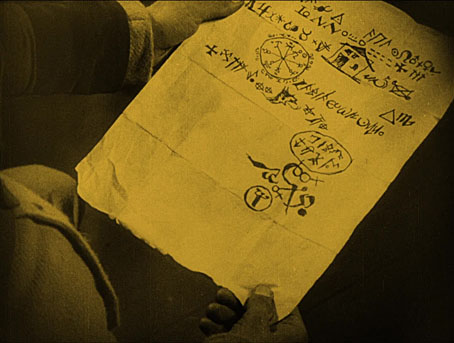
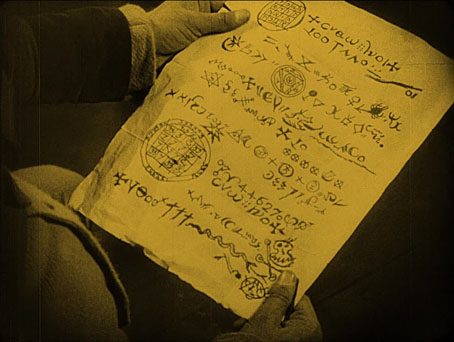
A great deal of German silent cinema is labelled “Expressionist” even if the films themselves show little in the way of overt Expressionism. Nosferatu isn’t very Expressionist at all but Albin Grau’s sketches and posters certainly tend in that direction, so much so that they make me wonder how different the film might have been if it had been as stylised as The Cabinet of Dr. Caligari (1919). In addition to his artistic pursuits, Grau was an occultist which explains the attention to detail in the bizarre contract drawn up between Knock and Count Orlok, a document that looks more like a page from a grimoire than anything used by an estate agent. There’s a quote from Grau in his occult capacity in John Symonds’ Aleister Crowley biography, The Great Beast, complaining in 1925 about Crowley’s ascension to the heights of the Ordo Templi Orientis.
nosferatu11.jpg

Nosferatu: The Knock-Orlok contract.

nosferatu12.jpg

Nosferatu comes out of the occult preoccupations, having been Grau’s project from the beginning when he formed a film company, Prana-Film, with Enrico Dieckmann. The pair announced plans for three films: Dreams of Hell, The Devil of the Swamp, and a drama about a vampire. Only Nosferatu materialised then sank the company almost as soon as it was finished: Prana-Film had spent more on publicity than on the film itself, and went deep into debt. The success of the film might have helped their finances but the death blow was struck by Florence Stoker and the British Society of Authors who won a court case against the company for filming Dracula without permission. The efforts of the Stoker estate to destroy Nosferatu are recounted in detail in David J. Skal’s fascinating Hollywood Gothic (1990). Many of Murnau’s minor films were lost through various misfortunes, and it’s a fluke that a handful of prints of Nosferatu survived. Happily for us, it’s not only vampires that manage to remain undead.
Continue reading “Albin Grau’s Nosferatu”

The occult Knapp

knapp01.jpg

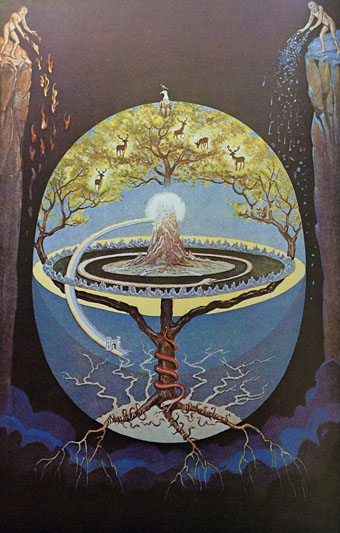
Yggdrasil, the World Tree of Norse mythology.

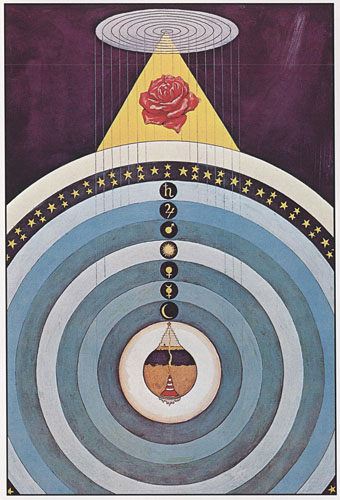
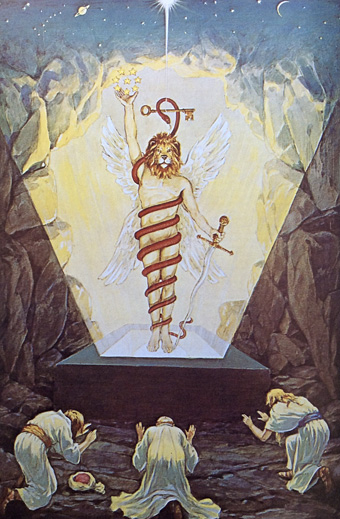
Following up the work of Etidorhpa‘s illustrator, J. Augustus Knapp (1853–1938), I realised that I’d already encountered some of his later paintings. After illustrating books by John Uri Lloyd, Knapp moved to California where he met occult historian, mystic and book collector Manly Palmer Hall. Knapp exchanged Lloyd’s fungi researches and weird fiction for Hall’s mysticism, illustrating The Initiates of the Flame (1922), and Hall’s magnum opus, The Secret Teachings of All Ages (1928). Knapp’s 54 paintings for the latter volume have since proved convenient for the occult encyclopedias that followed, many of which plundered Hall’s study for its illustrations. Knapp’s depictions aren’t always very successful—Odin’s wolves look silly rather than fierce—but they served Hall’s purpose of fixing mythological characters and metaphysical schemes in a colourful manner for a contemporary audience.

knapp06.jpg

Mithra in the form of Boundless Time.

Hall and Knapp also produced their own Tarot deck (see here and here) which can still be bought today from the University of Philosophical Research in Los Angeles. The UPR was founded by Manly Hall, and has a collection of Knapp’s paintings. They also sell Hall’s books, of course, and you can browse a copy of The Secret Teachings of All Ages if you visit the library, as I discovered in 2005 when Jay Babcock and I paid the place a visit.

knapp10.jpg

The Key to Dante’s Divine Comedy.

Continue reading “The occult Knapp”

Heaven and Hell calendar

heavenhell00.jpg

Painting from the poster art for The Highbury Working (2000) by Alan Moore & Tim Perkins.

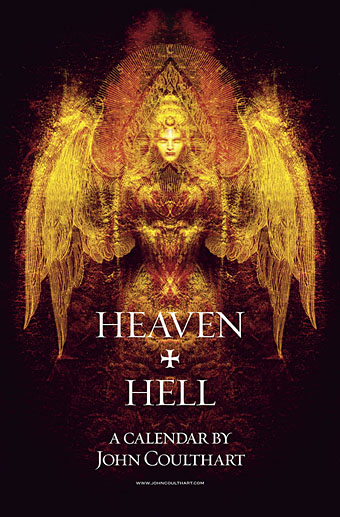
Unlike last year, this year’s CafePress calendar arrives on time, its creation being eased by the fact that it’s a reworking on an earlier version. The idea with the previous Heaven & Hell calendar had been to alternate various pieces of infernal Cradle of Filth artwork with contrasting imagery; as things turned out I had more offerings for Hell than for Heaven—no surprise there—so the reality wasn’t very satisfying.

This year I’ve managed to fill out the Heaven sequence with more recent works, all of which have been slightly adjusted to fit the square page ratio required by CafePress. So even though these are old pieces many of them are unique to this printing. Larger copies of the pages may be seen here while the CafePress purchase page is here. As always, my thanks to everyone who buys these things.

And as before, the calendars for previous years are now available all year round; see the full range here. Note that this means you need to select January as the starting month if you want the months to run for a single year only.

heavenhell01.jpg

JANUARY: Variation of the poster art for Angel Passage (2001) by Alan Moore & Tim Perkins.

Angel Passage was Alan and Tim’s album about the life and work of William Blake. I designed the CD, a poster, and also produced a video for the multi-media performance of the piece at the Purcell Room, London, in February 2001.

heavenhell02.jpg

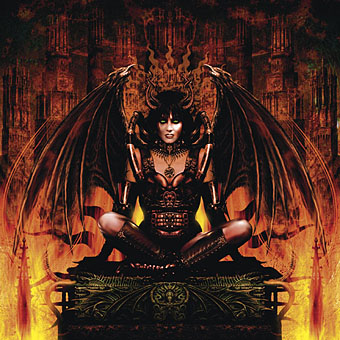
FEBRUARY: Cover for Bitter Suites To Succubi by Cradle of Filth (2001).

My first piece of Cradle of Filth art. I was a little surprised when working on this that they really did want the wings and horns; Dani loved that kind of imagery. I was even more surprised when this cover was subsequently showcased in an entire window in Tower Records’ main London shop in Piccadilly.

Continue reading “Heaven and Hell calendar”

Weekend links 230

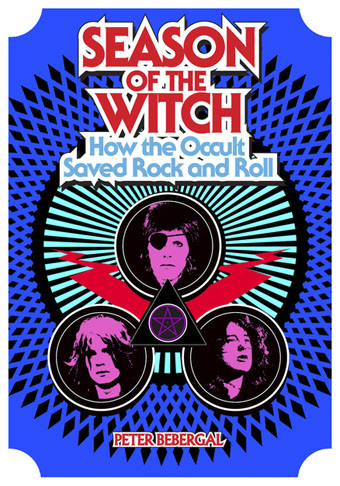
bebergal.jpg

Cover art by Arik Roper.

Peter Bebergal’s Season of the Witch: How the Occult Saved Rock and Roll was published this week. Articles about rock music’s occult preoccupations have been a recurrent feature of music magazines, especially around Halloween, but Bebergal’s book is the first attempt at a wide-ranging, full-length study. Despite the subtitle, the scope goes beyond the familiar—David Bowie’s Golden Dawn references, Jimmy Page’s Aleister Crowley obsession—to take in the pagan nature of the blues, pre-Beatles rock’n’roll, and the byways of electronic music. My old employers, Hawkwind, provide a title (Space Ritual) for one section, and I was pleased to see the Krautrock scene receiving some attention: years ago you couldn’t have counted on this from an American music study. As Bebergal notes, Can’s Aumgn on Tago Mago (1971) isn’t the hippy Aum/Om but originates in a mantra defined in Crowley’s Magick in Theory and Practice.

• “We don’t just have skeletons in our cupboard, we have an ossuary.” Another week, another Alan Moore interview, but Tim Martin‘s piece is as much a portrait of the man as a conversation about the usual subjects: art, science, magic, etc.

• “Europe’s history of penis worship was cast aside when the Catholic Church realized Jesus’s foreskin was too potent to control.” Stassa Edwards on venerated members.

Gays and horror actually have  somewhat of a lost history. FW Murnau, the director of Nosferatu, was openly gay. Frankenstein’s real creator, James Whale, was also out. Given the talent involved, and the illicit nature of the genre, amateur and professional critics have been divining queer themes from horror films for decades.

Patrick Rosenquist on Gory, Gay & Loving It: Why Homosexuals Heart Horror

• “I thought that fine art was fairly dishonest as an industry. It pretends to be about culture but it’s really about money.” Andy Butler interviews designer Neville Brody.

• Snapping, Humming, Buzzing, Banging: Richard B. Woodward on the creative partnership between David Lynch and sound-design genius Alan Splet.

• Also published this week: Discovering Scarfolk, Richard Littler’s guide to the occult-obsessed, rabies-infested English town.

• More rock music: When Art Rocked: San Francisco Music Posters, 1966–1971 by Ben Marks.

• The trailer for 808, a documentary about Roland’s celebrated drum machine.

• At The Millions: Devin Kelly on the collaborative art of words and images.

• More Crowley: Strange Flowers goes looking for Aleister Crowley’s Berlin.

• Mix of the week: Secret Thirteen Mix 130 by Gábor Lázár.

• Yello’s Boris Blank on his 10 favourite electronic records.

Richard Hirst‘s Top 5 Robert Aickman Stories.

I Put A Spell On You (1968) by Arthur Brown | I Put A Spell On You (1992) by Diamanda Galás | I Put A Spell On You (2004) by Queen Latifah

Weekend links 227

grim.jpg

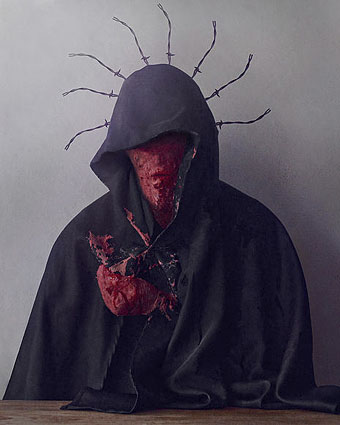
A Follower by Jason Grim.

Haunted Futures, a multi-genre anthology from Ghostwoods Books, will feature stories by Warren Ellis, John Reppion, Liesel Schwarz, Chuck Wendig, Richard Kadrey, Stephen Blackmoore and others. It will also feature some of my illustrations but only if this this Kickstarter fund is successful.

• “…at issue here is restriction versus potential: protect a specific set of choices versus open the field to the exploration of everything.” Sam Potts offers a refutation of Robert Bringhurst’s design textbook The Elements of Typographic Style.

• “I discovered that if one looks a little closer at this beautiful world, there are always red ants underneath.” Morgan Meis quoting David Lynch in a review of David Lynch: The Unified Field, a new exhibition of Lynch’s paintings.

But among these novels only Moravagine, first discovered for English-speaking readers by Henry Miller and a direct ancestor of Céline’s Voyage au bout de la nuit, has survived as an underground classic. A monstrous admixture of Lautréamont’s Maldoror, Feuillade’s Fantômas, Nietzsche’s Superman, Jack the Ripper and (according to the Cendrars scholar Jay Bochner) the deranged Jung and Freud disciple Otto Gross, Moravagine remains Cendrars’s most nihilistic and darkly comic other.

Richard Sieburth on Blaise Cendrars and his “Dada update of Dostoevsky”, coincidentally the subject of a post here earlier in the week.

• “…the duchess became enthralled with the idea of creating a garden of plants that could kill instead of heal.” Natasha Geiling on Jane Percy’s Poison Garden.

• Mix of the week: Kosmik Elektronik [part 3] by The Kosmische Club. More Kosmische musik: Agitation Free on French television in 1973.

• At Dangerous Minds: Secret Weapons (1972), 22 minutes of made-for-TV dystopian science fiction directed by David Cronenberg.

Project Praeterlimina, “a journal of daemonology, magic, and the human condition”.

The NOS Project: download Shed’s score for Murnau’s Nosferatu.

• At Lambda Literary: Toy, a poem by Evan J. Peterson.

Drew Daniel doesn’t want to play the listicle game.

Surrealism and Magic

Stuff in old books

Haunted Island (1973) by Agitation Free | Haunted Heights (1977) by Peter Baumann | Haunted Dancehall (1994) by The Sabres of Paradise