Odilon Redon’s musical afterlife

redon5.jpg

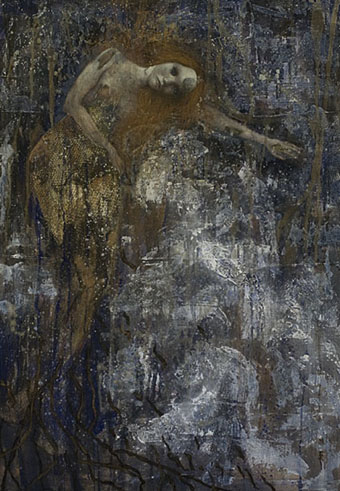
Pilgrim Of The Sublunary World (2002) by Heid.

It would have been surprising if Magazine were the only group to have used Odilon Redon’s art for album covers. What is surprising is that these releases are all relatively recent and aren’t the cluster of Goth doodlings I would have expected: descriptions at Discogs list Heid as an industrial outfit, Revelation and While Heaven Wept are doom metal while Spider Trio play jazz. Odilon Redon is unusual in being able to provide artwork strange enough for Magazine or, in the case of his many pastel drawings, pretty enough for classical recordings. I omitted a couple of other CD covers which inset his pictures in dreadful layouts. The Heid album uses more Redon art on the insert pages.

redon4.jpg

Live @ Rendezvous/Jewelbox Theater 8.12.06 (2007) by Spider Trio.

redon1.jpg

Never Comes Silence (2007) by Revelation.

redon3.jpg

L’Amour De Loin (2009) by Kaija Saariaho.

redon2.jpg

Sorrow Of The Angels (2010) by While Heaven Wept.

Elsewhere on { feuilleton }
The album covers archive

Previously on { feuilleton }
Odilon Redon and Magazine
Odilon Redon lithographs
The eyes of Odilon Redon
Aubrey Beardsley’s musical afterlife

Odilon Redon and Magazine

magazine1.jpg

Shot By Both Sides (1978). Design by Malcolm Garrett. Art: La Chimere regarda avec effroi toutes choses (1886) by Odilon Redon.

The first two albums by British post-punk band Magazine have been soundtracking the inner landscape here for the past couple of weeks. Looking at some of their cover art on Discogs reminded me that two of their early singles came dressed with drawings by Symbolist artist Odilon Redon (1840–1916) so these covers may well have been the first place I saw any of Redon’s work at all. This was an unusual choice at the time which makes it typical of a group that stood slightly apart from much of the music around them, often being regarded as too proficient and too clever. (Pop music and politics are the only places where incompetence and stupidity are virtues.)

magazine2.jpg

Give Me Everything (1978). Design by Malcolm Garrett? Art:The Cactus Man (1881) by Odilon Redon.

Magazine’s golden era runs from 1978 to 1980 and for me their music and that of fellow Mancunians Joy Division remains inextricably connected to memories of Manchester in the late 1970s, a place I visited sporadically before moving here in 1982. The city then was a lot more grimy and run-down, filled with the disused mills and warehouses of the collapsed cotton industry, blighted by the failed architecture of the 1960s and polluted by endless convoys of orange buses. This photo from 1978 fixes the mephitic ambience, as does some of M. John Harrison‘s fiction from the period, notably his short story Egnaro. Unlike Joy Divison, Magazine haven’t been burdened with an increasingly inflated reputation which makes revisiting their works all the more enjoyable. They pull you back to those gloomy times then take you off elsewhere, into the cajoling and neurotic imagination of that Nosferatu-in-a-leather-jacket, Howard Devoto.

magazine3.jpg

No Thyself (2009). Designer unknown. Art: Le polype difforme flottait sur les rivages, sorte de cyclope souriant et hideux, Les Origines (1883) by Odilon Redon.

The band reformed in 2009 although I’m not convinced the current incarnation is for me, I’m generally sceptical of such moves and the absence of ace guitarist John McGeogh (who died in 2004) and bassist Barry Adamson means it won’t be the same. No Thyself did refer back to their origins, however, literally so in the title of the Odilon Redon picture on the cover, while the Chimera from the first single turned up on a recent tour poster. Howard Devoto talked late last year to The Quietus about the recent album.

Elsewhere on { feuilleton }
The album covers archive

Previously on { feuilleton }
Odilon Redon lithographs
The eyes of Odilon Redon

Weekend links 98

postcard.jpg

The Arcimboldo Effect again. An undated postcard from the image section of A Virtual Wunderkammer: Early Twentieth Century Erotica in Spain.

“I took George Clinton and Bootsy Collins to the Battle Station for the first time, and they left feeling like they’d just had a close encounter,” said the bassist and music producer Bill Laswell, who met Rammellzee in the early 1980s and remained one of the few people who saw him regularly.

Rammellzee’s Work and Reputation Re-emerge

• Also in the NYT: China Miéville on Apocalyptic London: “Everyone knows there’s a catastrophe unfolding, that few can afford to live in their own city. It was not always so.” Reverse the perspective and find Iain Sinclair writing in 2002 about Abel Ferrara’s The King of New York: “A memento mori of the century’s ultimate city in meltdown.”

• The Inverted Gaze: Queering the French Literary Classics in America by François Cusset. Related: Glitterwolf Magazine is asking for submissions from LGBT writers/artists/photographers.

• The vinyl releases of Cristal music by Structures Sonores Lasry-Baschet continue to be scarce and unreissued. Mark Morb has a high-quality rip of the group’s No. 4 EP here.

Henri’s Walk to Paris, the children’s book designed by Saul Bass in 1962, is being republished. Steven Heller takes a look.

As the critic Jon Savage points out, even rock’n’roll’s very roots, the blues, contained a weird gay subculture. The genre was home to songs such as George Hannah’s Freakish Man Blues, Luis Russell’s The New Call of the Freaks, and Kokomo Arnold’s Sissy Man Blues. “I woke up this morning with my pork grindin’ business in my hand,” offers Arnold, adding, “Lord, if you can’t send me no woman, please send me some sissy man.”

Straight and narrow: how pop lost its gay edge by Alexis Petridis

David Pelham: The Art of Inner Space. James Pardey interviews the designer for Ballardian.

BBCX365: Johnny Selman designs an entire year of news stories.

• Sarah Funke Butler on Nabokov’s notes for Eugene Onegin.

• Leslie S. Klinger on The cult of Sherlock Holmes.

How piracy built the US publishing industry.

SynthCats

The Light Pours Out Of Me (1978) by Magazine | Touch And Go (1978) by Magazine | Motorcade (1978) by Magazine | Feed The Enemy (1979) by Magazine | Cut-Out Shapes (1979) by Magazine.

Weekend links 97

conformist.jpg

Illustration by Ermanno Iaia. Hard to believe that Bernardo Bertolucci’s The Conformist (1970) is only now appearing on DVD in the UK. Arrow Films release a dual-format edition at the end of this month.

• The week in perfume: Perfumes: The Guide by Luca Turin & Tania Sanchez is reviewed by Emily Gould (“this is a golden age of perfume criticism”) and prompts a meditation on the art and process of scent from Rishidev Chaudhuri.

Electrical Banana by Norman Hathaway & Dan Nadel is “the first definitive examination of the international language of psychedelia, focusing on the most important practitioners in their respective fields”.

Sacred Monsters is a forthcoming collection of essays and criticism by Edmund White. Related: Colm Tóibín from 1999 reviewing A History of Gay Literature: The Male Tradition by Gregory Woods.

Medium, a video by Clayton Welham and Sam Williams for Emptyset whose imminent release (also entitled Medium) I’ve designed. Related: Dave Maier on music versus noise.

• Couldn’t happen to a nicer guy: the face of US presidential contender Rick Santorum rendered as a collage of (mostly) gay porn. More provocation: All Dead Mormons Are Now Gay.

• Coilhouse discovered a rough copy of Bells of Atlantis (1952), an experimental film which features Anaïs Nin, input from Len Lye and an electronic score by Louis & Bebe Barron.

• “The idea that we should have but two options when it comes to our gender presentation, male or female, has always felt ludicrous to me,” says LaJohn Joseph.

Bely paints “a universe of strange manifestations” which drifts across Apollonovich’s consciousness every night before he falls asleep. We are even shown congeries of images that are shards of events which took place that day for the senator: “all the earlier inarticulacies, rustlings, crystallographic figures, the golden, chrysanthemum-like stars racing through the darkness on rays that resembled myriapods”

Malcom Forbes on Andrei Bely’s masterwork, Petersburg (1916).

RIP Barney Rosset, publisher of Grove Press books and the Evergreen Review.

The Brothers Quay will be at work in Leeds city centre this May. Lucky Leeds.

Warm Leatherette, a short film by Analogue Solutions.

Cormac McCarthy, Quantum Copy Editor.

The importance of being axonometric.

Always Crashing In The Same Car (1977) by David Bowie | Crash (1980) by Tuxedomoon | Crash Dance (1983) by Yello.

Reworking Kraftwerk

randf.jpg

Ralf and Florian, 1973.

It’s a common problem when you like a musical artist so much that you own their entire catalogue: where to go next? In the case of Kraftwerk the problem has been exacerbated by the group’s famously sluggish rate of production: the last studio album was in 2003, the one before that was 1991. Cover versions are one solution, of course, and Kraftwerk have the advantage of providing simple yet memorable melodies that can stand no end of sonic mangling. I linked to a favourite Kraftwerk cover at the weekend, the Balanescu Quartet’s version of The Model. What follows is a list of favourite Kraftwerk cover albums (as opposed to one-off tracks). Given the vagaries of the music business some of these may now be deleted.

Possessed (1992) by The Balanescu Quartet

Robots
Model
Autobahn
Computer Love
Pocket Calculator

Kraftwerk are among the gods in the firmament of Mute Records so it’s not so surprising to find an erstwhile electronic label releasing an album of arrangements by Alexander Balanescu‘s string quartet. The Kronos Quartet were in the vanguard of working quartet variations on rock or pop music (their self-titled album from 1986 included a version of Purple Haze) but Balanescu’s arrangements still stand out for attempting to render electronic music with string instruments. Model is particularly good.

Trans Slovenia Express (1994) by Various Artists

Zrcalo Sveta (Das Spiegelglas Der Welt) by Laibach
The Robots by Coptic Rain
Trans Europe Express by The One You Love
Radioactivity by April Nine
Airwaves by Beitthron
Transistor by Data Processed Corrupted
Ohm Sweet Ohm by Borghesia
Neonlicht by Mitja V.S.
Antenna by Z-Entropa
Man Machine by Strelnikoff
Home Computer by Random Logic
The Model by Demolition Group
Kometenmelodie Part 1 by 300,000 V.K.
Spacelab by Videosex
Lie-Werk by Kraftbach

Also on the Mute label and less of a surprise since the contents are mostly from electronic groups. Laibach, who open and close the collection, were already Mute artists. Of the other Slovenians present, Borghesia and Coptic Rain were familiar names but the rest remain a mystery. This is nonetheless a great compilation with an equal mix of eccentric and sympathetic covers. Neonlicht features a banjo and the Enzo Fabiani Quartet, Coptic Rain give The Robots the Nine Inch Nails treatment while April Nine turn Radioactivity into a sublime mystery. Trans Slovenia Express Volume 2 appeared in 2005.

Die Roboter Rubato (1997) by Terre Thaemlitz

Die Roboter
Ätherwellen
Tour De France
Computer Welt
Techno Pop
Ruckzuck
Radioland
Mensch Machine
Schaufensterpuppen
Morgen Spaziergang

In which the musician/artist/theorist plays rubato piano variations on the well-known songs. The presence of Ruckzuck from the first Kraftwerk album is a surprise—hardly anyone does covers of tracks from the first two Kraftwerk albums. All Thaemlitz’s releases come with pages of accompanying text culled from Marxist theory, gender studies, queer politics and the like. Die Roboter Rubato is no exception:

Kraftwerk’s most vibrant celebration of this Homoeroticization is in the composition Tour de France. The sonic manifestation of the group’s well known adoration for cycling bears an undeniable resemblance to the sound of two men fucking one another – the rhythmic breaths of the top intermingling with the panting moans of the bottom.

Immediate questions come to mind: for all of the obviousness of homoerotic thematics in the world of the Mensch Machines, how do such thematics remain undiscussed by popular media? Is the dominant silence around homoerotic themes an act of social suppression or social obliviousness? (etc)

Subsequent Thaemlitz releases have given similar rubato treatment to Gary Numan and Devo.

El Baile Alemán (2000) by Señor Coconut Y Su Conjunto

Introdución
Showroom Dummies
Trans Europe Express
The Robots
Neon Lights
Autobahn
Home Computer
Tour De France
The Man-Machine
Music Non Stop

German electronic musician Uwe Schmidt uses his Señor Coconut guise to present songs by synth artists as though they’d been covered by a cheap Latin American ensemble. Swiss group Yello introduced Perez Prado-style shouts and brass stabs into the world of Fairlight samplers in the 1980s so this may be regarded as the logical conclusion. Funny arrangements, especially Autobahn where the car refuses to start and the radio is tuned to South American stations. Señor Coconut’s 2006 album Yellow Fever! reworks the Yellow Magic Orchestra to similar effect.

8-Bit Operators: The Music of Kraftwerk (2007) by Various Artists

The Robots (Die Roboter) by Bacalao
Pocket Calculator by Glomag
Computer Love by Covox
Showroom Dummies by Role Model
The Model by Nullsleep
Radioactivity by David E. Sugar
Kristallo by Oliver Wittchow
Spacelab by 8 Bit Weapon
Computer World (Computerwelt) by firestARTer
Electric Café by Neotericz
Trans-Europe Express by Receptors
Tanzmusik by Herbert Weixelbaum
It’s More Fun to Compute by Bubblyfish
Antenna by Bit Shifter
The Man-Machine (Die Mensch-Maschine) by gwEm and Counter Reset

The masters of minimal aesthetics here receive some minimal cover treatments. Advertised as being “performed on vintage 8-bit video game systems” I was disappointed when some tracks failed to adhere to this stricture and added other instruments.The voices can also be a letdown when they’re left unprocessed. Complaints aside, the fat and bouncy rhythms are a good match for tunes which in other electronic hands were being lured into techno remix tedium. And it’s also good to see Tanzmusik from the Ralf & Florian album given an airing.

As I noted at the weekend, Kraftwerk give a series of retrospective concerts at the Museum of Modern Art, NYC, in April.

Previously on { feuilleton }
Martin Rushent, 1948–2011
Autobahn animated
Sleeve craft
Who designed Vertigo #6360 620?
Old music and old technology
Aerodynamik by Kraftwerk